
Top 5 AdCreative.ai alternatives for consumer brands in 2026
Research
Claron Kinny
|
Growth & Content
Reviewed By Satej Sirur
AdCreative.ai it generates social ad variants fast, without a designer. For a team running only Meta and Google campaigns at moderate volume, that's a real capability worth paying for.
But once you're producing assets for Amazon, Walmart, and Target or any other retailer simultaneously, each with its own image specs and compliance rules, "fast template generation" stops being enough.
You need retailer compliance and brand consistency enforced automatically, not dependent on whoever's using the tool.
This post compares seven AdCreative.ai alternatives through the lens of what large-scale consumer brands actually need in 2026.
Key takeaways
|
|---|
AdCreative.ai it generates social ad variants fast, without a designer. For a team running only Meta and Google campaigns at moderate volume, that's a real capability worth paying for.
But once you're producing assets for Amazon, Walmart, and Target or any other retailer simultaneously, each with its own image specs and compliance rules, "fast template generation" stops being enough.
You need retailer compliance and brand consistency enforced automatically, not dependent on whoever's using the tool.
This post compares seven AdCreative.ai alternatives through the lens of what large-scale consumer brands actually need in 2026.
Key takeaways
|
|---|
TL;DR comparison: AdCreative.ai alternatives
Tool | Best for | Human QA | Pricing |
|---|---|---|---|
Rocketium AI Studio | Consumer brands producing high volumes of assets across multiple channels | Yes | Custom |
Pencil | Marketing teams generating ad variants and predicting winners before spend | No | From $14/mo |
Smartly.io | Paid social teams spending $50K+/mo who want creative and media in one place | No | Custom |
Celtra | Global brands keeping 10+ regional teams on-brand without manual policing | No | Custom |
The Brief (formerly Creatopy) | Small in-house teams designing display ads without agency support | No | From $29/mo |
Canva | Quick social and display assets when no designer is available | No | Free / $13/mo |
Predis.ai | Solo marketers scheduling AI-generated organic social posts | No | From $19/mo |
What your ad creative software must handle
Before comparing tools, get clear on which capabilities actually matter for your situation.
Retailer compliance: Does the tool understand platform-specific specs for Amazon A+ content, Walmart display, Target Roundel, and so on? Generic ad tools don't encode these rules. This is where production quality breaks down at scale.
Brand guardrails: Can the system enforce your fonts, color values, and logo placements automatically, or does a human have to check every output? For enterprise brands, this needs to be systematic, not a checklist someone runs manually on Friday afternoon.
Asset volume: How many assets do you genuinely need per month? A team running three campaigns has different requirements than a team doing a 500-SKU catalog refresh. Size the tool to your actual volume, not your aspirational one.
Human review: AI makes mistakes. For retail-grade assets where a compliance error means a rejected listing or a brand violation, a quality review step is not optional. Some tools offer this; most don't.
Video support: If your roadmap includes video production for Reels, TikTok, or Amazon video ads, check whether video is native, an add-on, or locked behind the most expensive plan tier before you commit.
Pricing transparency: Can you predict your monthly bill? Credit-based models vary significantly in how they handle iterations, revisions, and outputs that don't make it to final export. Ask specifically what consumes a credit before signing anything.
TL;DR comparison: AdCreative.ai alternatives
Tool | Best for | Human QA | Pricing |
|---|---|---|---|
Rocketium AI Studio | Consumer brands producing high volumes of assets across multiple channels | Yes | Custom |
Pencil | Marketing teams generating ad variants and predicting winners before spend | No | From $14/mo |
Smartly.io | Paid social teams spending $50K+/mo who want creative and media in one place | No | Custom |
Celtra | Global brands keeping 10+ regional teams on-brand without manual policing | No | Custom |
The Brief (formerly Creatopy) | Small in-house teams designing display ads without agency support | No | From $29/mo |
Canva | Quick social and display assets when no designer is available | No | Free / $13/mo |
Predis.ai | Solo marketers scheduling AI-generated organic social posts | No | From $19/mo |
What your ad creative software must handle
Before comparing tools, get clear on which capabilities actually matter for your situation.
Retailer compliance: Does the tool understand platform-specific specs for Amazon A+ content, Walmart display, Target Roundel, and so on? Generic ad tools don't encode these rules. This is where production quality breaks down at scale.
Brand guardrails: Can the system enforce your fonts, color values, and logo placements automatically, or does a human have to check every output? For enterprise brands, this needs to be systematic, not a checklist someone runs manually on Friday afternoon.
Asset volume: How many assets do you genuinely need per month? A team running three campaigns has different requirements than a team doing a 500-SKU catalog refresh. Size the tool to your actual volume, not your aspirational one.
Human review: AI makes mistakes. For retail-grade assets where a compliance error means a rejected listing or a brand violation, a quality review step is not optional. Some tools offer this; most don't.
Video support: If your roadmap includes video production for Reels, TikTok, or Amazon video ads, check whether video is native, an add-on, or locked behind the most expensive plan tier before you commit.
Pricing transparency: Can you predict your monthly bill? Credit-based models vary significantly in how they handle iterations, revisions, and outputs that don't make it to final export. Ask specifically what consumes a credit before signing anything.
Top 6 AdCreative.ai alternatives
1. Rocketium AI Studio
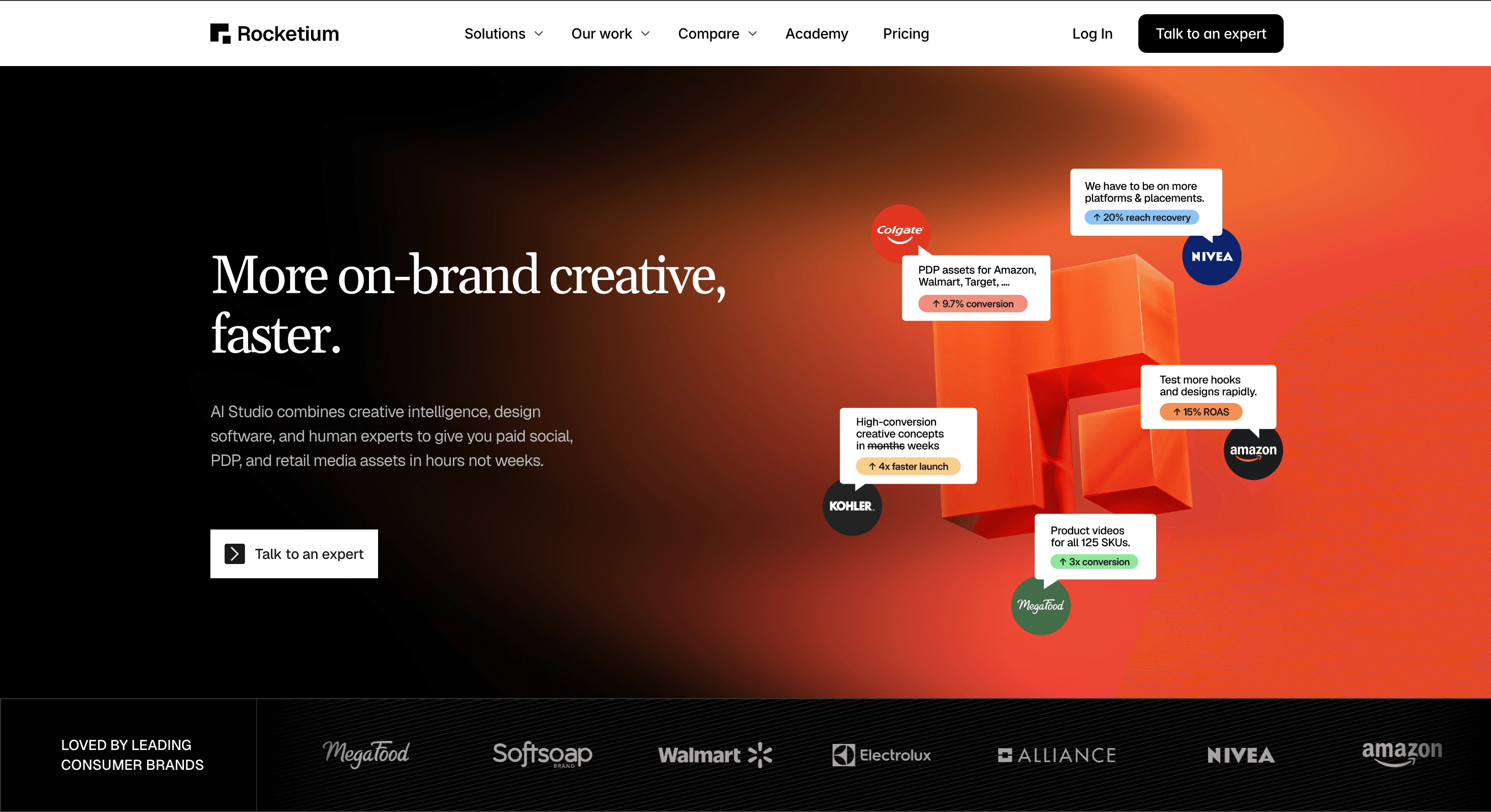
Rocketium AI Studio is a managed creative production service built for enterprise and consumer retail brands that need on-brand assets at scale. It combines a Creative OS covering adaptation, production, and concepting, a team of experts including AI engineers, creative strategists, designers, and QA, and Intelligence built from brand guidelines, retailer platform rules, and LLM integrations.
The model is different from every other tool on this list. You don't use AI Studio as a self-serve platform. Your team submits a brief and reviews assets. The complexity happens between AI agents and Rocketium's expert team.
Key features
Adaptation takes a master design and versions it across 30+ formats, with retailer-specific specs enforced automatically. One static asset costs one credit; a video over 15 seconds costs two credits. No seat fees, no per-user charges.
Production creates net-new assets from a brief: copy, translation, AI-generated lifestyle imagery, motion graphics video, and live-action video. Customers provide pack shots, product photos, brand guidelines, and the asset type needed. AI Studio delivers finished assets ready for Adaptation.
Concepting delivers 2-3 master design directions as fully realized layouts, shown across 2-3 key formats so teams can evaluate how a concept works before committing to production. Without Rocketium, a creative agency charges $5,000-$30,000 per campaign concept with 3-6 weeks of back-and-forth. Through AI Studio's credit model, concepting runs at 15-30 credits per direction, typically $225-$450, delivered in 3-5 business days.
Who benefits most
Mid-size to enterprise retail brands with 5+ SKUs selling on 5+ retailers, $100M+ e-commerce revenue, and a need to produce hundreds to thousands of on-brand assets across multiple platforms. Brands with a lean team that currently outsources production to agencies or freelancers. Of the six tools in this post, AI Studio is the only one that pairs human experts (creative strategists, designers, and QA) with AI production at every stage. Every other option on this list is self-serve: the output quality is entirely determined by how well your team uses the tool.
Pros
Human expert review at every stage, so output quality is production-ready, not draft-ready
Retailer compliance baked into the workflow, not a manual checklist
One credit per static asset makes cost predictable at volume
30-70% savings over agencies on a per-asset basis
Pilot turnaround in 24-48 hours, with about 40 minutes of customer time
Cons
Not a self-serve tool; requires brief submission and a review cycle
No public pricing page; requires a conversation with sales
Pricing
Annual platform fee from $50K, with $15-25 per credit at standard rates (lower at volume). At scale, 500 adaptations/month works out to roughly $7,500-$12,500/year vs. $25,000-$100,000/year with an agency. See [Rocketium's pricing page] for current details.
Why choose Rocketium AI Studio over AdCreative.ai:
Rocketium AI Studio | AdCreative.ai | |
|---|---|---|
Human quality review | Yes, at every stage | No |
Retailer compliance | Built in (Amazon, Walmart, Target, etc.) | Not native |
Brand enforcement | Systematic, guided by brand guidelines | Template-based, manual |
Video production | Yes, end-to-end | Locked behind $249/month plan |
Concepting | Yes, with AI + expert strategists | No |
Asset volume sweet spot | 500+ assets/month | 10-1,000 downloads/month |
Pricing transparency | Per-credit, no per-seat fees | Per-credit, tiered plans |
Support model | Dedicated account team | Self-serve |
2. Pencil
Pencil started as a predictive ad creative tool and has since repositioned significantly. Owned by Brandtech Group since 2023, it now describes itself as an enterprise agentic marketing OS: a single platform designed to cover the full marketing workflow from brief to results, with AI agents handling work at every step. Insights, briefing, planning, creation, adaptation, approval, deployment, activation, analysis, and reporting all live in one place rather than across separate tools.
What sets the platform apart technically is its Open Garden approach to AI models. Rather than locking teams into one vendor's output quality, Pencil integrates OpenAI, Google Gemini, Adobe Firefly, Bria, and Runway into a single orchestration layer. When a new model launches and produces better output for a given task, teams automatically benefit without switching platforms. Brand guardrails are enforced across every generation regardless of which model produced it.
Performance prediction remains a core capability. Pencil draws on data from over $1 billion in ad spend across 4,000+ brands to score creatives before they go live, giving teams a data-backed reason to prioritize one variant over another before committing media budget. The platform integrates directly with Meta, TikTok, YouTube, Google Display, and LinkedIn, so teams move from creation to launch without context-switching.
It's trusted by 1,000+ enterprise brands including Diageo, Unilever, L'Oréal, and Indeed, with 88,000+ users and over 10 million generations completed to date. Enterprise security is included as standard: SOC2 compliance, IP indemnity, and data ringfencing are part of every enterprise plan, not add-ons.
Pros
Full workflow coverage from brief to results in one platform, not just creative generation
Multi-model approach means teams always get the best available AI output without vendor lock-in
Named a Gartner Cool Vendor 2025 and Most Innovative Company 2024 by Fast Company
SOC2 compliance and IP indemnity included as standard on enterprise plans
Strong G2 rating: 4.8/5 from 14 reviews, with 10/10 for quality of support
Cons
Core plan ($14/month) caps at 50 generations per month. High-volume teams burn through this quickly.
Growth plan ($55/month) raises the limit to 250 generations, but Pro requires contacting sales for custom volume
No competitor ad tracking or competitive intelligence features, unlike some alternatives
Enterprise-first direction since the Brandtech acquisition makes the self-serve experience less predictable for smaller teams
Pricing
Core plan at $14/month for 50 generations. Growth plan at $55/month for 250 generations (as of March 2026). Pro plans with custom generation limits require contacting sales.
Pencil is the right fit if your primary challenge is running a complete campaign workflow from brief through to performance analysis, with AI handling production at every step. Teams primarily producing retailer-spec catalog assets, or those who need competitive intelligence built into their creative process, will find it less suited to their needs.
3. Smartly.io
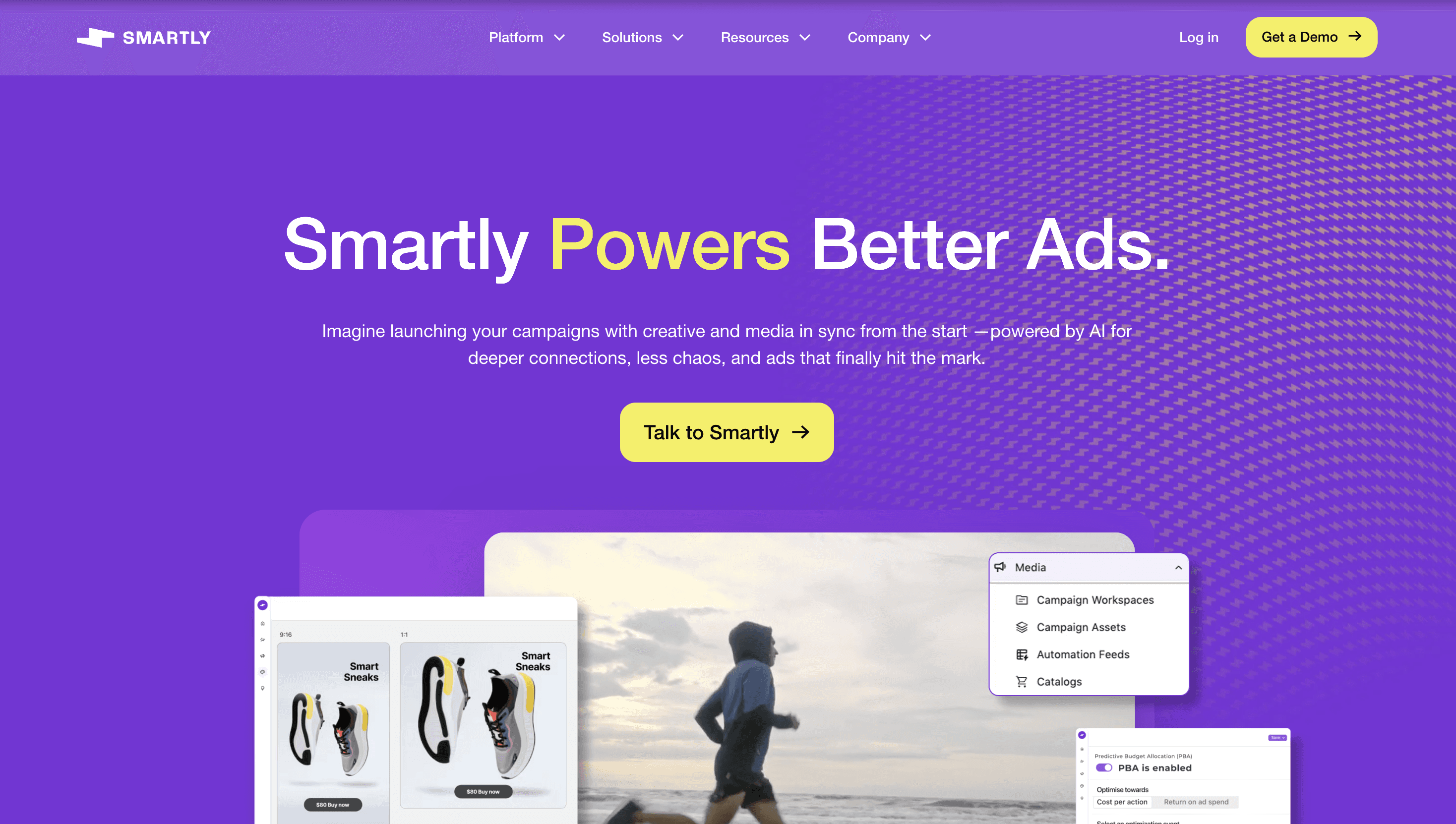
Smartly.io is an enterprise advertising platform that unifies creative production, media buying, and campaign optimization in a single interface. It's built for teams managing high volumes of social ad spend across Meta, TikTok, Pinterest, Snapchat, and Google, and its customer base reflects that. On G2, where Smartly holds a 4.4/5 rating from 468 reviews, 51.4% of reviewers come from mid-market companies and 29.6% from enterprise. Fewer than 20% are from small businesses.
The platform's dynamic creative automation system is its core differentiator. Rather than requiring a designer to manually build variants, Smartly generates ad combinations by pulling from templates, product catalog data, audience signals, and copy variants automatically. A brand with 1,000 products can produce tailored ads for every product and audience segment, refreshed in real time as performance data comes in. Uber Eats used this approach to push out 5,000 ad creative variations across Facebook, TikTok, Snapchat, and YouTube from a single execution workflow.
Smartly's AI Studio, launched in 2025, adds a generative layer on top of this automation. It has generated 1.9 million creative assets across 260+ customers since launch, with Smartly reporting 30x faster creative production and an average 27% performance lift vs. static creatives. TikTok-native video automation was meaningfully improved in 2025 updates, allowing feed-based video overlays on TikTok using the same template system as Meta, reducing the separate-workflow burden for cross-channel teams.
A concrete example: Zalando, Europe's leading fashion and lifestyle platform, used Smartly to scale 8,400+ assets across 24 markets while achieving 73% faster time to market, with a lean team overseeing both app campaigns and demand generation simultaneously. That kind of output would require a much larger team or a longer runway without catalog-scale automation.
Pros
Unified platform covering creative automation, media buying, and analytics in one place
Dynamic creative automation handles true catalog-scale personalization, not just template resizing
G2 reviewers prefer Smartly over AdCreative.ai for meeting business needs and product direction
TikTok-native video automation is a genuine strength for teams running cross-channel social campaigns
Cons
Pricing is fully opaque and percentage-of-spend based; not viable for teams spending below roughly $20K/month in social ads
Steep learning curve and real onboarding costs
No retailer-specific format support; strong for social, not for Amazon, Walmart, or Target listings
Pricing
Custom enterprise pricing based on percentage of ad spend managed. Minimum viable scale is approximately $20K/month in ad spend.
Smartly earns its place for large cross-channel paid social operations where creative automation needs to live inside the same system as campaign management and optimization. If your creative challenge is retailer catalog production rather than social ad management, it's the wrong fit.
4. Canva
Canva is the most widely used design tool in marketing, and that ubiquity is both its strength and its limitation. It covers an enormous range of creative needs: social posts, presentations, email headers, basic ad banners, short videos. It does so at a price point that's hard to argue with. Its Magic Studio AI tools, including background remover, Magic Resize, and Magic Write, make routine design tasks meaningfully faster for teams without dedicated designers.
For enterprise teams, Canva's brand kit functionality stores logos, fonts, and color values and applies them consistently across designs. The Teams and Enterprise plans add collaborative approval workflows, single sign-on, and multi-brand management. These are real capabilities that reduce the "someone used the wrong font" problem that plagues large, decentralized marketing organizations.
The honest limitation is scope. Canva is a generalist design tool that happens to support ad formats, not an ad production platform that happens to have design features. There's no feed-based dynamic ad generation, no retailer compliance logic, and no human review layer. For a team producing a handful of ad banners per month alongside other design work, that's fine. For a team whose primary output is retail ad creative at volume, the gaps compound quickly.
Canva's AI tools are also generalist by design. Magic Write produces copy. Magic Resize adapts dimensions. None of it is trained on what makes an ad perform, which matters when creative decisions are tied to ROAS targets rather than aesthetic preferences.
Pros
Free plan is genuinely capable; Pro at $15/user/month is accessible for individuals and small teams
Enormous template library covers most common ad formats
Brand kit enforces consistency at the team level without requiring design skills
Cons
Not built for ad production at scale; no dynamic feed generation or retailer-specific compliance
AI tools are generalist, not trained on ad performance data
Enterprise plan pricing starts around $30/user/month, custom and negotiable
No human review or QA layer; unsuitable for brands with strict compliance requirements
Pricing
Free plan available. Pro at $15/user/month ($120/year). Teams plan at roughly $10/user/month (annual, 3+ users minimum). Enterprise: custom pricing. See Canva's pricing page for current plans.
Canva is the right tool for teams that need general-purpose design capability on a budget. It becomes the wrong tool when the problem is producing hundreds of retailer-compliant assets per month, maintaining brand consistency across a large product catalog, or making creative that looks different from every other brand using the same template library.
5. Predis.ai
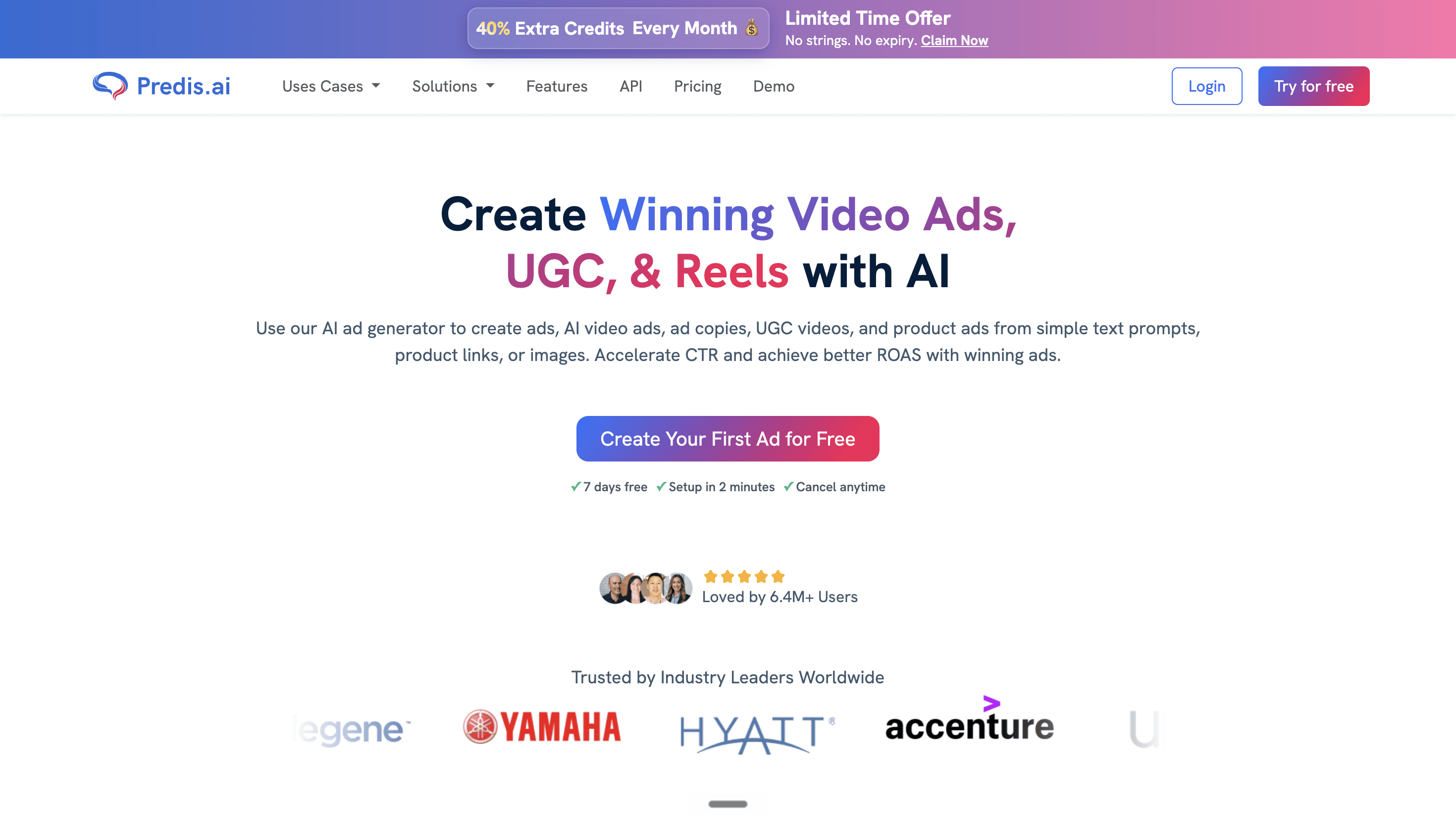
Predis.ai is an AI-powered content generation platform that automates social media post creation, short-form video production, and ad creative generation. It converts text prompts into ready-to-publish assets for Facebook, Instagram, TikTok, LinkedIn, and YouTube. It also monitors competitor content performance and surfaces what's working for other brands in your space. In practice, a social media manager can see which competitor posts drove the most engagement last week and use that signal to shape their own content calendar. It's a feedback loop that's otherwise only possible with dedicated social listening tools that cost significantly more.
The platform covers creation, scheduling, and publishing in one place, which reduces context-switching for small social media teams managing multiple channels. Predis.ai is trusted by over a million users worldwide, with its use cases skewing toward solo marketers, small business owners, and lean agency teams who need consistent output without a large creative team behind them. DigiTech Solutions, a digital marketing agency cited in Predis.ai's own case study library, used the platform to consolidate their social media production workflow and reduce manual content creation time across client accounts.
Predis.ai carries a 4.8/5 rating on G2 with a 9.4/10 ease-of-use score. The free plan includes 15 generated posts and 10 competitor analysis runs per month, which is enough to evaluate core functionality before committing to a paid tier.
The honest trade-off is focus. Predis.ai is built for organic social content, not performance paid advertising. Reviewers on G2 and Capterra note that outputs for paid campaigns require meaningful editing before they're launch-ready. The platform has no retailer compliance logic, no dynamic product feed integration, and no human review layer. Scheduling bugs and support delays appear in negative reviews too. That's a real risk for teams that depend on reliable automated publishing.
Pros
All-in-one workflow: create, schedule, and publish across platforms without switching tools
Competitor content monitoring functions as a built-in social listening layer, a feature most tools in this category don't offer
High ease-of-use scores; fast to get started with no design skills required
Free plan available; paid plans from $19/month
Cons
Built primarily for organic social content; outputs for paid campaigns require material editing before launch
No retailer compliance logic, dynamic product feeds, or human review layer
Scheduling bugs and support delays mentioned across Capterra and G2 reviews
Pricing
Core plan from $19/month. Three tiers up to $211.95/month. Free plan available.
Predis.ai fits content marketers and small teams running organic social channels who want to produce more content faster, with a competitive edge built in. For paid ad production at scale, retailer-specific assets, or brands with strict compliance needs, it's not designed for that job.
Top 6 AdCreative.ai alternatives
1. Rocketium AI Studio
Rocketium AI Studio is a managed creative production service built for enterprise and consumer retail brands that need on-brand assets at scale. It combines a Creative OS covering adaptation, production, and concepting, a team of experts including AI engineers, creative strategists, designers, and QA, and Intelligence built from brand guidelines, retailer platform rules, and LLM integrations.
The model is different from every other tool on this list. You don't use AI Studio as a self-serve platform. Your team submits a brief and reviews assets. The complexity happens between AI agents and Rocketium's expert team.
Key features
Adaptation takes a master design and versions it across 30+ formats, with retailer-specific specs enforced automatically. One static asset costs one credit; a video over 15 seconds costs two credits. No seat fees, no per-user charges.
Production creates net-new assets from a brief: copy, translation, AI-generated lifestyle imagery, motion graphics video, and live-action video. Customers provide pack shots, product photos, brand guidelines, and the asset type needed. AI Studio delivers finished assets ready for Adaptation.
Concepting delivers 2-3 master design directions as fully realized layouts, shown across 2-3 key formats so teams can evaluate how a concept works before committing to production. Without Rocketium, a creative agency charges $5,000-$30,000 per campaign concept with 3-6 weeks of back-and-forth. Through AI Studio's credit model, concepting runs at 15-30 credits per direction, typically $225-$450, delivered in 3-5 business days.
Who benefits most
Mid-size to enterprise retail brands with 5+ SKUs selling on 5+ retailers, $100M+ e-commerce revenue, and a need to produce hundreds to thousands of on-brand assets across multiple platforms. Brands with a lean team that currently outsources production to agencies or freelancers. Of the six tools in this post, AI Studio is the only one that pairs human experts (creative strategists, designers, and QA) with AI production at every stage. Every other option on this list is self-serve: the output quality is entirely determined by how well your team uses the tool.
Pros
Human expert review at every stage, so output quality is production-ready, not draft-ready
Retailer compliance baked into the workflow, not a manual checklist
One credit per static asset makes cost predictable at volume
30-70% savings over agencies on a per-asset basis
Pilot turnaround in 24-48 hours, with about 40 minutes of customer time
Cons
Not a self-serve tool; requires brief submission and a review cycle
No public pricing page; requires a conversation with sales
Pricing
Annual platform fee from $50K, with $15-25 per credit at standard rates (lower at volume). At scale, 500 adaptations/month works out to roughly $7,500-$12,500/year vs. $25,000-$100,000/year with an agency. See [Rocketium's pricing page] for current details.
Why choose Rocketium AI Studio over AdCreative.ai:
Rocketium AI Studio | AdCreative.ai | |
|---|---|---|
Human quality review | Yes, at every stage | No |
Retailer compliance | Built in (Amazon, Walmart, Target, etc.) | Not native |
Brand enforcement | Systematic, guided by brand guidelines | Template-based, manual |
Video production | Yes, end-to-end | Locked behind $249/month plan |
Concepting | Yes, with AI + expert strategists | No |
Asset volume sweet spot | 500+ assets/month | 10-1,000 downloads/month |
Pricing transparency | Per-credit, no per-seat fees | Per-credit, tiered plans |
Support model | Dedicated account team | Self-serve |
2. Pencil
Pencil started as a predictive ad creative tool and has since repositioned significantly. Owned by Brandtech Group since 2023, it now describes itself as an enterprise agentic marketing OS: a single platform designed to cover the full marketing workflow from brief to results, with AI agents handling work at every step. Insights, briefing, planning, creation, adaptation, approval, deployment, activation, analysis, and reporting all live in one place rather than across separate tools.
What sets the platform apart technically is its Open Garden approach to AI models. Rather than locking teams into one vendor's output quality, Pencil integrates OpenAI, Google Gemini, Adobe Firefly, Bria, and Runway into a single orchestration layer. When a new model launches and produces better output for a given task, teams automatically benefit without switching platforms. Brand guardrails are enforced across every generation regardless of which model produced it.
Performance prediction remains a core capability. Pencil draws on data from over $1 billion in ad spend across 4,000+ brands to score creatives before they go live, giving teams a data-backed reason to prioritize one variant over another before committing media budget. The platform integrates directly with Meta, TikTok, YouTube, Google Display, and LinkedIn, so teams move from creation to launch without context-switching.
It's trusted by 1,000+ enterprise brands including Diageo, Unilever, L'Oréal, and Indeed, with 88,000+ users and over 10 million generations completed to date. Enterprise security is included as standard: SOC2 compliance, IP indemnity, and data ringfencing are part of every enterprise plan, not add-ons.
Pros
Full workflow coverage from brief to results in one platform, not just creative generation
Multi-model approach means teams always get the best available AI output without vendor lock-in
Named a Gartner Cool Vendor 2025 and Most Innovative Company 2024 by Fast Company
SOC2 compliance and IP indemnity included as standard on enterprise plans
Strong G2 rating: 4.8/5 from 14 reviews, with 10/10 for quality of support
Cons
Core plan ($14/month) caps at 50 generations per month. High-volume teams burn through this quickly.
Growth plan ($55/month) raises the limit to 250 generations, but Pro requires contacting sales for custom volume
No competitor ad tracking or competitive intelligence features, unlike some alternatives
Enterprise-first direction since the Brandtech acquisition makes the self-serve experience less predictable for smaller teams
Pricing
Core plan at $14/month for 50 generations. Growth plan at $55/month for 250 generations (as of March 2026). Pro plans with custom generation limits require contacting sales.
Pencil is the right fit if your primary challenge is running a complete campaign workflow from brief through to performance analysis, with AI handling production at every step. Teams primarily producing retailer-spec catalog assets, or those who need competitive intelligence built into their creative process, will find it less suited to their needs.
3. Smartly.io
Smartly.io is an enterprise advertising platform that unifies creative production, media buying, and campaign optimization in a single interface. It's built for teams managing high volumes of social ad spend across Meta, TikTok, Pinterest, Snapchat, and Google, and its customer base reflects that. On G2, where Smartly holds a 4.4/5 rating from 468 reviews, 51.4% of reviewers come from mid-market companies and 29.6% from enterprise. Fewer than 20% are from small businesses.
The platform's dynamic creative automation system is its core differentiator. Rather than requiring a designer to manually build variants, Smartly generates ad combinations by pulling from templates, product catalog data, audience signals, and copy variants automatically. A brand with 1,000 products can produce tailored ads for every product and audience segment, refreshed in real time as performance data comes in. Uber Eats used this approach to push out 5,000 ad creative variations across Facebook, TikTok, Snapchat, and YouTube from a single execution workflow.
Smartly's AI Studio, launched in 2025, adds a generative layer on top of this automation. It has generated 1.9 million creative assets across 260+ customers since launch, with Smartly reporting 30x faster creative production and an average 27% performance lift vs. static creatives. TikTok-native video automation was meaningfully improved in 2025 updates, allowing feed-based video overlays on TikTok using the same template system as Meta, reducing the separate-workflow burden for cross-channel teams.
A concrete example: Zalando, Europe's leading fashion and lifestyle platform, used Smartly to scale 8,400+ assets across 24 markets while achieving 73% faster time to market, with a lean team overseeing both app campaigns and demand generation simultaneously. That kind of output would require a much larger team or a longer runway without catalog-scale automation.
Pros
Unified platform covering creative automation, media buying, and analytics in one place
Dynamic creative automation handles true catalog-scale personalization, not just template resizing
G2 reviewers prefer Smartly over AdCreative.ai for meeting business needs and product direction
TikTok-native video automation is a genuine strength for teams running cross-channel social campaigns
Cons
Pricing is fully opaque and percentage-of-spend based; not viable for teams spending below roughly $20K/month in social ads
Steep learning curve and real onboarding costs
No retailer-specific format support; strong for social, not for Amazon, Walmart, or Target listings
Pricing
Custom enterprise pricing based on percentage of ad spend managed. Minimum viable scale is approximately $20K/month in ad spend.
Smartly earns its place for large cross-channel paid social operations where creative automation needs to live inside the same system as campaign management and optimization. If your creative challenge is retailer catalog production rather than social ad management, it's the wrong fit.
4. Canva
Canva is the most widely used design tool in marketing, and that ubiquity is both its strength and its limitation. It covers an enormous range of creative needs: social posts, presentations, email headers, basic ad banners, short videos. It does so at a price point that's hard to argue with. Its Magic Studio AI tools, including background remover, Magic Resize, and Magic Write, make routine design tasks meaningfully faster for teams without dedicated designers.
For enterprise teams, Canva's brand kit functionality stores logos, fonts, and color values and applies them consistently across designs. The Teams and Enterprise plans add collaborative approval workflows, single sign-on, and multi-brand management. These are real capabilities that reduce the "someone used the wrong font" problem that plagues large, decentralized marketing organizations.
The honest limitation is scope. Canva is a generalist design tool that happens to support ad formats, not an ad production platform that happens to have design features. There's no feed-based dynamic ad generation, no retailer compliance logic, and no human review layer. For a team producing a handful of ad banners per month alongside other design work, that's fine. For a team whose primary output is retail ad creative at volume, the gaps compound quickly.
Canva's AI tools are also generalist by design. Magic Write produces copy. Magic Resize adapts dimensions. None of it is trained on what makes an ad perform, which matters when creative decisions are tied to ROAS targets rather than aesthetic preferences.
Pros
Free plan is genuinely capable; Pro at $15/user/month is accessible for individuals and small teams
Enormous template library covers most common ad formats
Brand kit enforces consistency at the team level without requiring design skills
Cons
Not built for ad production at scale; no dynamic feed generation or retailer-specific compliance
AI tools are generalist, not trained on ad performance data
Enterprise plan pricing starts around $30/user/month, custom and negotiable
No human review or QA layer; unsuitable for brands with strict compliance requirements
Pricing
Free plan available. Pro at $15/user/month ($120/year). Teams plan at roughly $10/user/month (annual, 3+ users minimum). Enterprise: custom pricing. See Canva's pricing page for current plans.
Canva is the right tool for teams that need general-purpose design capability on a budget. It becomes the wrong tool when the problem is producing hundreds of retailer-compliant assets per month, maintaining brand consistency across a large product catalog, or making creative that looks different from every other brand using the same template library.
5. Predis.ai
Predis.ai is an AI-powered content generation platform that automates social media post creation, short-form video production, and ad creative generation. It converts text prompts into ready-to-publish assets for Facebook, Instagram, TikTok, LinkedIn, and YouTube. It also monitors competitor content performance and surfaces what's working for other brands in your space. In practice, a social media manager can see which competitor posts drove the most engagement last week and use that signal to shape their own content calendar. It's a feedback loop that's otherwise only possible with dedicated social listening tools that cost significantly more.
The platform covers creation, scheduling, and publishing in one place, which reduces context-switching for small social media teams managing multiple channels. Predis.ai is trusted by over a million users worldwide, with its use cases skewing toward solo marketers, small business owners, and lean agency teams who need consistent output without a large creative team behind them. DigiTech Solutions, a digital marketing agency cited in Predis.ai's own case study library, used the platform to consolidate their social media production workflow and reduce manual content creation time across client accounts.
Predis.ai carries a 4.8/5 rating on G2 with a 9.4/10 ease-of-use score. The free plan includes 15 generated posts and 10 competitor analysis runs per month, which is enough to evaluate core functionality before committing to a paid tier.
The honest trade-off is focus. Predis.ai is built for organic social content, not performance paid advertising. Reviewers on G2 and Capterra note that outputs for paid campaigns require meaningful editing before they're launch-ready. The platform has no retailer compliance logic, no dynamic product feed integration, and no human review layer. Scheduling bugs and support delays appear in negative reviews too. That's a real risk for teams that depend on reliable automated publishing.
Pros
All-in-one workflow: create, schedule, and publish across platforms without switching tools
Competitor content monitoring functions as a built-in social listening layer, a feature most tools in this category don't offer
High ease-of-use scores; fast to get started with no design skills required
Free plan available; paid plans from $19/month
Cons
Built primarily for organic social content; outputs for paid campaigns require material editing before launch
No retailer compliance logic, dynamic product feeds, or human review layer
Scheduling bugs and support delays mentioned across Capterra and G2 reviews
Pricing
Core plan from $19/month. Three tiers up to $211.95/month. Free plan available.
Predis.ai fits content marketers and small teams running organic social channels who want to produce more content faster, with a competitive edge built in. For paid ad production at scale, retailer-specific assets, or brands with strict compliance needs, it's not designed for that job.
What to consider before you decide
Three factors separate tools that look similar on a comparison table.
Scale of output. Tools like Canva, Predis.ai, and Creatopy are optimized for teams producing tens of assets per month. Tools like AI Studio and Smartly are built for teams producing hundreds to thousands. Picking the wrong tier means either paying for capacity you'll never use or hitting walls mid-campaign.
Brand compliance vs. creative speed. There's a real trade-off here. Template-based AI tools give you speed. Managed production services like AI Studio give you brand integrity and retailer compliance, but require a brief submission and a review cycle. For brand-sensitive categories like beauty, health, and personal care, the managed approach tends to pay back through fewer rejections and less revision time.
Pricing model transparency. Credit-based models vary significantly in how they handle iterations, revisions, and outputs that don't make it to final export. Before signing anything, ask: Do iterations consume credits? Do failed generations count? What's the credit cost for video vs. static? For AdCreative.ai specifically, confirm trial billing terms in writing before entering a card. The documented complaints around unintended charges are consistent enough to warrant the extra step.
Wrapping Up
The fact that you're evaluating alternatives doesn't mean AdCreative.ai failed. It likely did exactly what it was built to do. The question is whether that's still the job you need done.
For teams whose creative needs have grown beyond fast template generation: more retailer formats, tighter brand standards, higher asset volumes, video production. The tools above offer different paths forward. The right one depends on where your actual bottleneck is. If it's running a full campaign workflow with AI from brief to results, Pencil. If it's managing complex cross-channel campaigns with creative automation tied to media buying, Smartly. If it's producing retailer-compliant, on-brand assets at volume with human QA, AI Studio.

Frequently asked questions (FAQs)
What is the best free AdCreative.ai alternative?
Canva's free plan is the most capable free option for general ad creative needs. Predis.ai also has a free plan covering 15 generated posts and 10 competitor analysis runs per month. Pencil lets you create six ads free through a guided experience before requiring a paid plan. None of these replaces AdCreative.ai's performance scoring, but all are usable starting points for teams with limited budgets.
Is AdCreative.ai worth it for enterprise retail brands?
For enterprise retail brands producing hundreds of SKU-specific assets across multiple retailers, AdCreative.ai's template-based approach and limited retailer compliance features create meaningful friction at scale. Video features are locked behind the $249/month plan, and the billing issues documented across Trustpilot, G2, and Capterra add procurement risk. Most enterprise teams outgrow it once they need Amazon-specific specs, Walmart display compliance, or brand guardrails enforced automatically.
What's the difference between AdCreative.ai and a managed service like AI Studio?
AdCreative.ai is a self-serve SaaS tool: you input your brand, select a template, and download generated variants. AI Studio is a managed production service: you submit a brief, and a team of AI agents and human experts delivers production-ready assets with compliance checks and brand QA included. The trade-off is speed vs. quality control. Self-serve is faster to start; managed is more reliable at scale.
Which AdCreative.ai alternative is best for small businesses?
Predis.ai (from $19/month) or Creatopy (from $36/month) are the most accessible paid options for small businesses. Pencil's Core plan ($14/month) suits solo advertisers who want performance prediction on paid campaigns. Canva's free plan covers basic ad creation without any spend.
How do I migrate from AdCreative.ai to a new tool?
Start by exporting all brand assets, logos, fonts, and approved templates from AdCreative.ai. Most tools on this list support direct brand kit import or manual setup. For managed services like AI Studio, the onboarding process codifies your brand guidelines into the system automatically. The Rocketium pilot takes about 40 minutes of customer time and delivers results in 24-48 hours, making it one of the lower-friction ways to evaluate a switch.
Do any of these tools handle video ads?
Yes, but with different scopes. Rocketium AI Studio produces motion graphics and AI-generated video end-to-end. Pencil includes video generation agents across multiple AI models. Smartly handles video ad automation natively for social platforms. Predis.ai supports short-form video for social channels. Creatopy supports animated HTML5 and video banners. Canva handles basic video design but not performance-grade ad video at scale. AdCreative.ai supports video, but UGC video, product videos, and storytelling ad formats are locked behind the $249/month Professional plan.