
6 best enterprise creative agency alternatives for consumer brands (2026)
Research
Claron Kinny
|
Growth & Content
Reviewed By Satej Sirur


6 best enterprise creative agency alternatives for 2026
These alternatives are not ranked by brand fame. They're ranked by how effectively they replace the production and versioning layer traditionally handled by agencies-the work that consumes the most budget and time across enterprise marketing teams.
One important caveat: traditional hero-campaign concepting (think Super Bowl spots, global brand films, or full brand identity overhauls) often still stays with top creative shops. What we're evaluating here is everything else-the content production engine that feeds your marketing efforts day after day
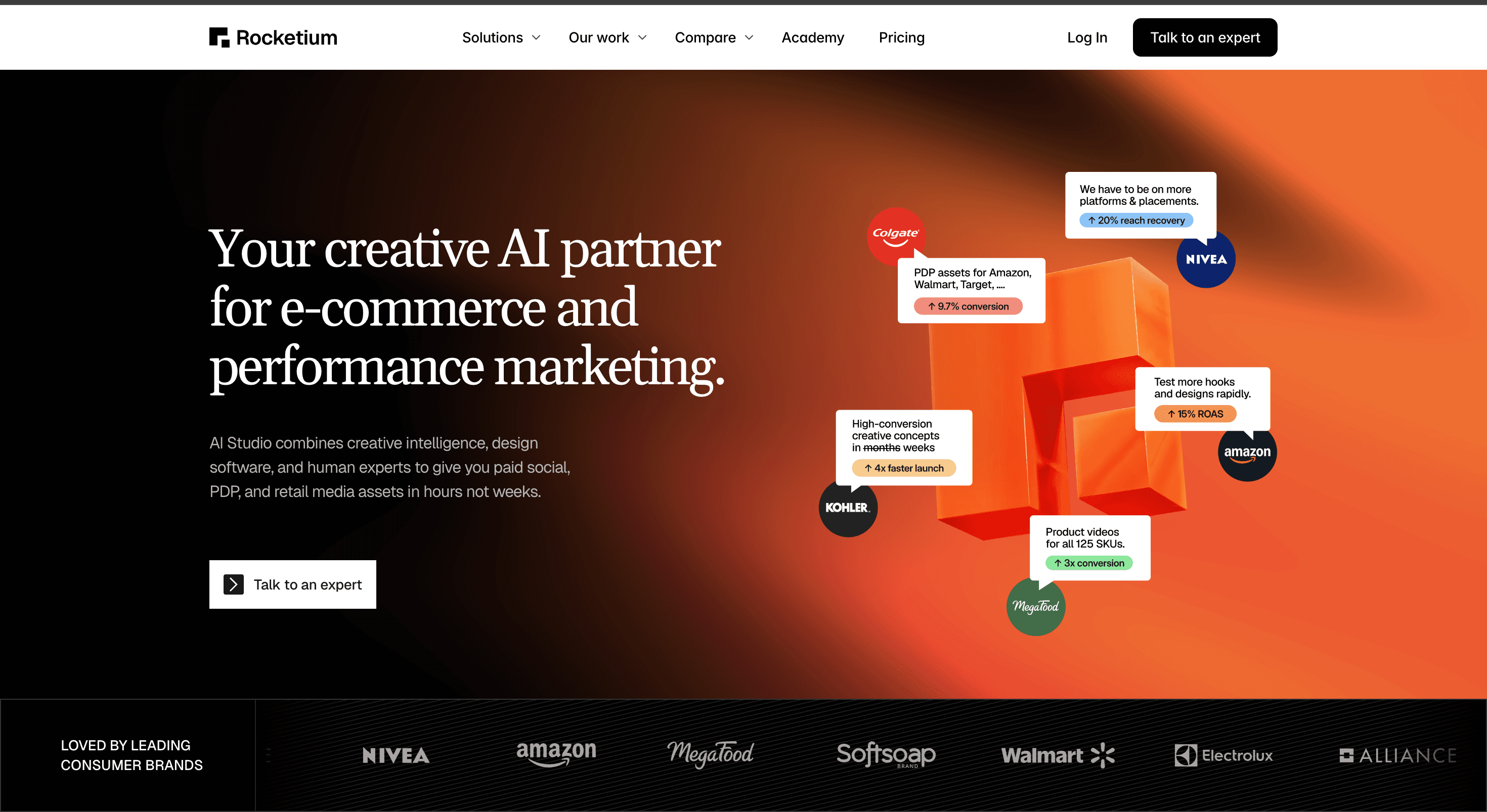
Rocketium AI Studio - best AI CreativeOps studio for high-volume, multi-channel campaigns.
Rocketium is an AI-powered CreativeOps studio that combines a platform with expert services to help enterprise brands produce and manage thousands of on-brand assets across retail media, social, and display. It's designed for organisations where creative production is a continuous operational function, not a periodic project.
Why it stands out
Most creative automation tools start at the brief. AI Studio starts before it.
Every brand that onboards gets a shared memory system trained on their specific context: Amazon reviews, Reddit keywords, Instagram audience data, past creative performance, competitor activity, and brand documents. This feeds five intelligence layers (audience, brand, competition, performance, and platform) that inform what gets made, not just how fast it ships.
In practice, that looks like this: before a Nivea team briefs a new campaign, AI Studio runs an AI focus group across customer segments (eco-conscious households, results-driven performance seekers) to surface which claims and visuals actually land. Before MegaFood refreshes a PDP, performance intelligence flags which hero images drove conversion and which fell flat.
Best for
Global e-commerce marketplaces producing category, event, and seller campaigns every week across dozens of placements.
Brands selling via Amazon, Walmart Connect, Instacart, and other retail media networks that need retailer-specific templates and compliance. Retail platforms have unique compliance requirements for ads, and Rocketium handles these natively.
Key strengths
Agentic AI workflows that generate, adapt, and QA large creative sets with minimal manual intervention while respecting locked brand templates.
Support for both static and video creatives, including automated aspect ratio changes, dynamic text swaps, and local language variants. For enterprises running creative localization for enterprises, this eliminates a major bottleneck.
Enterprise-grade brand governance with approvals, roles, audit trails, and built-in checks against retailer and platform specifications.
Native or API-based integrations into major ad platforms, DAMs, and collaboration tools so the platform fits existing enterprise workflows.
Hybrid offering (software plus expert services) where Rocketium's Creative Strategists and AI Engineers help design templates, workflows, and optimization loops-bridging the gap between a pure SaaS tool and a full-service agency.
Possible limitations
Not intended to replace top-tier brand consultancies for zero-to-one brand identity or global rebranding initiatives. That strategic direction work requires deep expertise that sits outside production automation.
Best suited for organizations already committed to systematic, data-informed creative operations rather than purely ad-hoc brand campaigns.
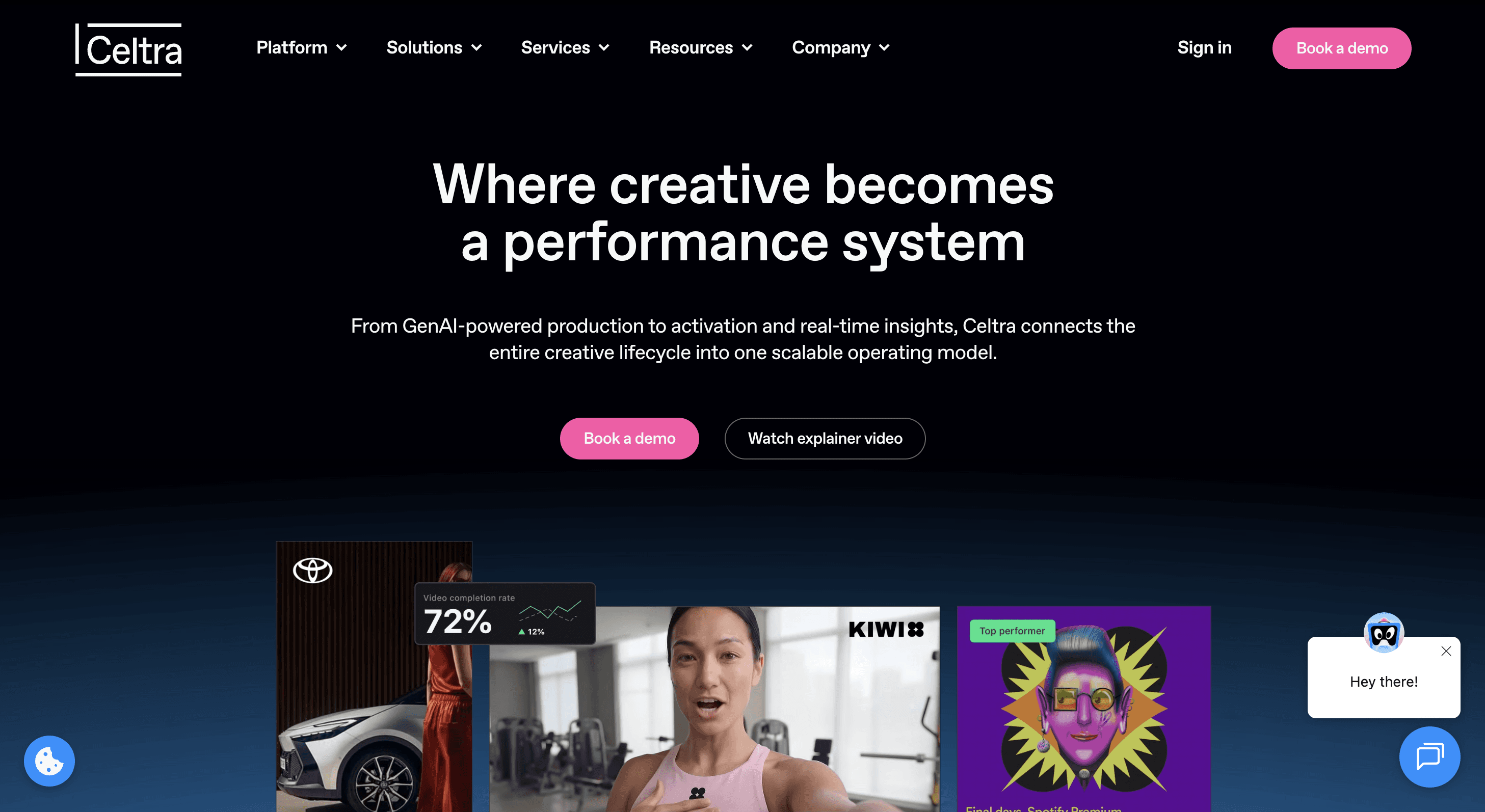
Celtra - best for in-house teams standardizing modular design systems
Celtra is an enterprise creative management platform designed for large in-house creative teams that want to build modular creative systems across regions and channels. It positions itself upstream of media execution, focusing on creative intelligence and component-based design.
Why it stands out
Celtra's architecture is built around modular creative systems-reusable components, layouts, and brand systems that support repeatable campaign assembly. The platform claims over 5 million creative assets produced per year across its customer base, supporting 100+ media channels. For enterprise teams managing brand work across multiple business units and markets, this component-based approach enforces brand consistency without micromanaging every design decision.
Best for
Enterprises with established in-house design teams that want stronger consistency and reuse across global campaigns.
Brands running frequent but structurally similar campaigns who can benefit from a robust component library and cohesive systems for creative assembly.
Key strengths
Architecture built around modular creative systems that scale across markets and formats, making it a strong reference point for how to formalize multi market production.
Strong brand governance-templates, locked elements, and multi-step approvals to protect brand integrity across large teams with multiple stakeholders.
Support for display, social, and rich media formats suitable for always-on campaigns, with more than 100 integrations into DSPs and ad platforms.
Possible limitations
Less focused on retail media-specific requirements compared to tools deeply embedded in commerce ecosystems. If your primary channel is Amazon or Walmart, you may need supplementary tooling.
AI capabilities are more assistive than fully agentic-meaning your own team still handles more manual design input. Creative decisions stay closer to the designer, which is a strength for some teams and a bottleneck for others.
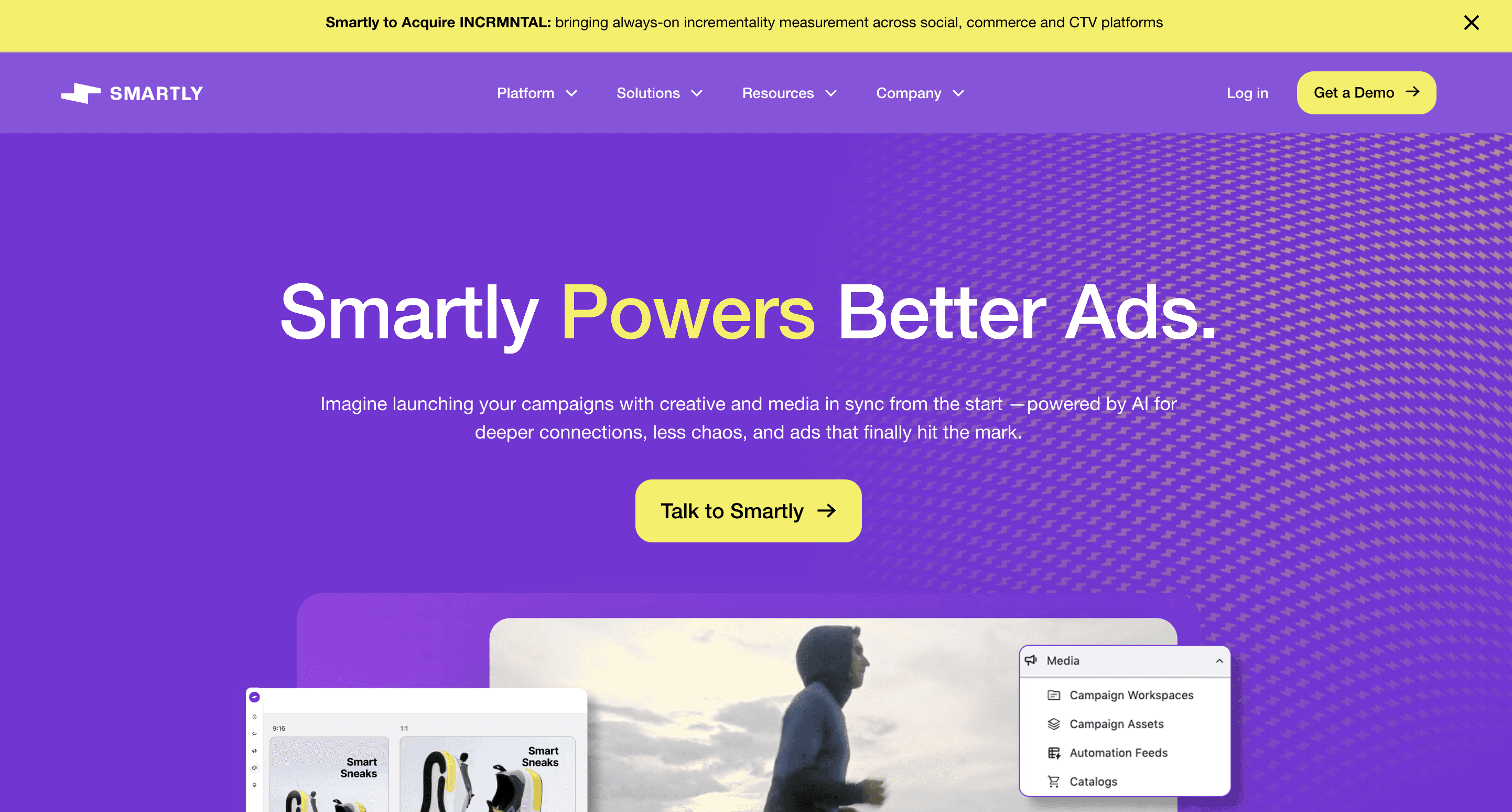
Smartly.io - best for paid social campaigns where media and creative are tightly coupled
Smartly.io integrates creative automation with media buying, making it a natural fit for enterprise brands whose paid media strategy centers on social platforms like Meta, TikTok, and Snapchat.
Why it stands out
The unique advantage is the tight pairing of creative testing with media optimization inside one platform. Where most creative tools hand off assets to a separate media team, Smartly.io lets performance marketing teams spin up variants, test them, suppress underperformers, and reallocate budget-all without switching tools. For teams focused on campaign performance in paid social, this closed loop is powerful.
Best for
Brands spending heavily on paid social who need to spin up, test, and rotate hundreds of ad creative variants per month.
Performance marketing teams that want to keep creative and bidding strategies in one integrated environment, minimizing the gap between creative production and measurable outcomes.
Key strengths
Deep integrations with major social platforms for campaign setup, optimization, and reporting.
Templated creative workflows that support fast ad variant production for A/B and multivariate testing-essential for combating ad fatigue.
Useful automation for feed-based ads and catalog-driven campaigns, particularly for DTC and e-commerce brands.
Possible limitations
Primarily focused on social; does not cover full cross-channel or retail media needs for large omnichannel enterprise brands. If your channel mix extends well beyond social media management, you'll need additional tools.
Pricing tends to scale with ad spend, which can create unpredictable cost escalations. Unlike seat-based or credit-based pricing models, spend-linked pricing makes it harder to forecast project fees.
Bannerflow - best for display and dynamic creative optimization at scale
Bannerflow is a platform specialized in display advertising and dynamic creative optimization (DCO) for enterprise teams running heavy programmatic activity across multiple markets.
Why it stands out
Bannerflow reports 10x faster ad production than manual workflows for display campaigns. Its centralized management of thousands of display formats-with real-time content updates driven by data feeds-makes it a strong choice for brands where display is a primary channel. The platform's HTML5 banner creation tools, shared component libraries, and easy resizing keep teams from losing momentum during production cycles.
Best for
Enterprises with large display budgets and complex localization needs across regions, where global delivery of localized display ads is a weekly or daily requirement.
Marketing teams that rely heavily on data feeds (pricing, inventory, offers) for dynamic display ads and need a collaborative environment for managing these assets centrally.
Key strengths
Powerful HTML5 banner production with shared components and network scale across 100+ platform integrations.
Feed-driven personalization and DCO for performance-driven display campaigns.
Collaborative environment for marketers and designers to manage display assets centrally, with built-in governance for brand compliance.
Possible limitations
Display-centric focus; not a comprehensive solution for video, social, and retail placements. If your content strategy spans the full channel mix, Bannerflow covers one slice well.
Requires solid ad ops and data infrastructure to maximize DCO capabilities. Without clean product feeds and technical SEO on landing pages, dynamic creative can't deliver its full value.
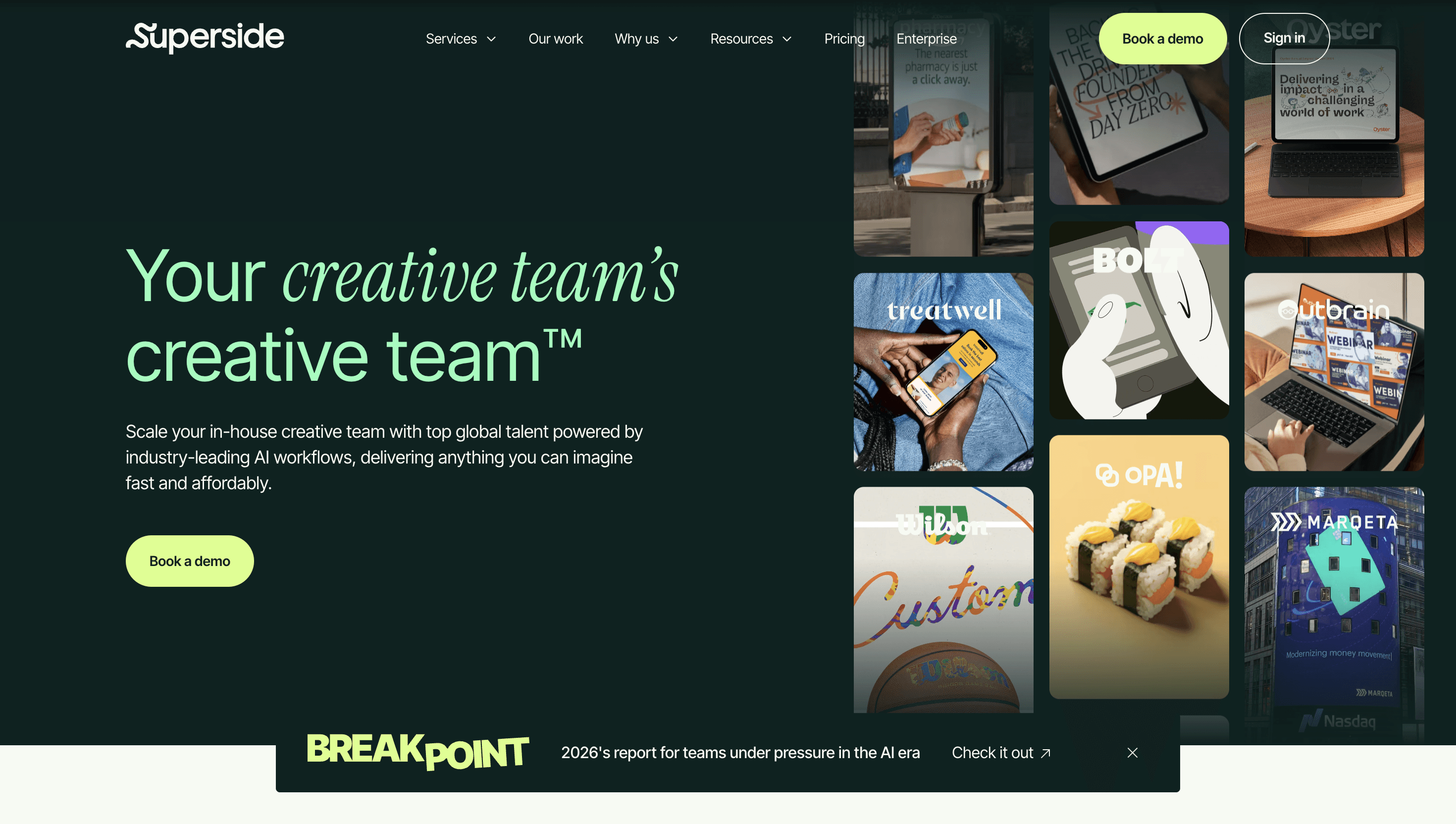
Superside - best subscription studio for human-led creative volume without hiring full-time
Superside is a subscription-based creative service-sometimes called a Creative-as-a-Service (CaaS) model-that gives enterprise clients access to a distributed team of designers, animators, and art directors. It allows access to creative production on a subscription basis, with dedicated pods assigned to each brand.
Why it stands out
The subscription model gives brands predictable monthly creative capacity without the overhead of staffing a full internal agency quickly. Superside's platform increased click-through rate by 240% in documented cases, demonstrating that human-led creative quality at scale can still deliver strong business outcomes. Superside is best for 0–50 assets per month, making it ideal for teams that need consistent, high-craft output at moderate volume.
Best for
Marketing teams that need predictable monthly creative capacity across a variety of formats-static, motion, social content, presentation design, and more.
Companies without enough internal design headcount to support always-on campaigns, or those navigating long sales cycles for internal hiring approvals.
Organizations exploring brand visibility improvements where directly accessing senior-level talent results in higher-quality creative output.
Key strengths
Dedicated pods that learn the brand and can handle a steady flow of briefs, functioning like self-managed micro-agencies or creative pods that offer efficiency similar to traditional agencies for ongoing projects.
Human-led creative quality for campaigns where nuance, visual craft, and brand film-level attention to detail are critical.
Useful bridge option while enterprise teams build out in-house CreativeOps systems. Specialized freelancer networks offer access to high-quality talent for specific projects, and Superside centralizes this into one engagement model.
Possible limitations
Turnaround times and cost structures are still constrained by human bandwidth, unlike AI-native platforms. For content marketing at enterprise velocity, the math shifts.
May not be economical for enterprises needing 1,000+ highly similar variants per month where automation wins decisively. At those volumes, the per-asset cost advantage of a platform like Rocketium becomes significant.
6. Fully in-house creative team – best for brands wanting maximum control and embedded expertise
Building and scaling an internal creative department-designers, motion specialists, copywriters, and a CreativeOps lead-gives large organizations maximum control over their creative output.
Why it stands out
In-house creative teams are effective for continuous high-volume asset production. The depth of brand knowledge, tighter collaboration with product and sales, and faster feedback loops that come from embedded teams are hard to replicate externally. Small dedicated teams are more efficient for ongoing creative demands than traditional agency structures, and over time, the return on investment compounds as the team builds institutional knowledge.
In-house teams cost $270,000–$350,000 annually for small teams (3–5 people including salary, benefits, and management overhead), which represents a significant fixed cost but can be highly efficient at scale when paired with the right tooling.
Best for
Global enterprise brands with steady multi-market campaign calendars and a clear need for always-on creative capacity across business units.
Organizations with strong operational discipline that can pair their own team with CreativeOps platforms like Rocketium for efficiency-using creative versioning tools to multiply output without multiplying headcount.
Key strengths
Deep understanding of product, customers, and internal stakeholders that no external partner can fully replicate.
Ability to directly shape brand systems, templates, creative testing strategies, and strategic planning for the entire creative function.
Full control over priorities, processes, and tooling selection-including the freedom to adopt or drop platforms as needs evolve.
Possible limitations
Higher fixed costs (salaries, benefits, management overhead) compared to software-led alternatives. The team structure needs to be well designed to avoid bloat.
Challenging to scale headcount quickly for seasonal peaks without external partners or automation. Many enterprise teams supplement with freelance collectives that provide on-demand talent ecosystems for project-specific creative needs, or creator marketplaces that provide direct access to a pool of content creators for rapid creative testing.
Risk of burnout if the in-house team is asked to handle both strategic concepting and high-volume production without CreativeOps support. This is where platforms like Rocketium or Celtra become force multipliers rather than replacements.
How to choose the right enterprise creative agency alternative
The "right" option depends on four variables: your monthly creative volume, your channel mix, the maturity of your internal team, and your appetite for AI-led workflows. Generalist agencies used to absorb all of these variables under one retainer. Today, each variable points you toward a different operating model.
The following subsections walk through the most decisive factors and map them to the options above. When examining your marketing needs, think of this as a decision tree rather than a single comparison.
Choose based on monthly creative volume and complexity
Volume is the single biggest differentiator between alternatives. Rough thresholds:
Under ~50 assets/month: subscription studios (Superside) or boutique agencies may suffice. Boutique agencies specialize in a single vertical or discipline for creative marketing, delivering focused quality at lower volumes.
50–300 assets/month: in-house team plus Celtra or Superside, depending on whether your mix leans toward strategic direction or production volume.
300+ assets/month or major retail/event spikes: Rocketium AI Studio plus in-house or light external support. At this level, creative automation saves 30%–70% versus traditional agency retainers.
Complexity matters too. Product promos across dozens of markets and languages favor automation-first platforms. If you're running multi market campaigns in 20+ languages, the economics of human-only production break down quickly. Creative localization at enterprise scale requires systematic template management that most generalist agencies aren't built for.
Choose based on channel mix (retail media, social, display, CRM)
Your channel mix should directly influence which tools you prioritize:
Retail and marketplace ads across Amazon, Walmart, Instacart, and similar networks-prioritize Rocketium for template-based, retailer-compliant volume. How Rocketium AI Studio works shows how the platform handles retailer-specific specs automatically.
Paid social as primary growth engine-consider Smartly.io plus an AI/automation layer or internal CreativeOps processes for non-social formats.
Display-heavy, DCO-driven campaigns-Bannerflow for display plus Rocketium or in-house teams for non-display formats.
Many enterprise teams end up with a hybrid stack: a platform for volume production plus channel-specific tools for optimisation. Businesses can enhance creative output with a hybrid operating system that integrates AI and specialized human talent, rather than forcing one platform to do everything. Hybrid models combine in-house teams with external specialist resources for flexible creative execution.
Choose based on internal team structure and maturity
Your own team's capabilities should shape which alternative you lean into:
For lean teams with limited design headcount, independent agencies often operate without the overhead and bureaucracy of traditional agency models, which can be a good supplement.
For mature in-house studios with strong design ops, Celtr unlocks systemized templates, brand governance, and faster creative versioning. Strategic tips for selecting an alternative agency include examining staffing models and incentive alignment to ensure the partner's economics reward your outcomes, not just their hours.
For teams early in building internal capability, Rocketium AI Studio or Superside can act as a bridge while defining long-term CreativeOps foundations. This approach lets you invest in strategic planning while external partners handle production.
Choose based on governance, compliance, and risk tolerance
Regulated industries and global operations demand robust approvals, auditability, and template locking. If your marketing activity spans financial services, pharma, or alcohol, governance isn't optional-it's a legal requirement.
Strict brand and legal oversight: Rocketium or Celtra with role-based access and approval workflows. Both offer the audit trails and locked template systems needed for regulated enterprise brands.
Lower risk tolerance and experimental campaigns: social-led tools and subscription studios can add agility for testing new creative approaches. Email marketing campaigns and organic search traffic content, for example, may have lighter compliance requirements than paid media.
For all large organizations, verify SSO support, security certifications, and data hosting locations.
Which enterprise creative agency alternative is best for you?
Here's a concise decision framework to help you self-select:
Choose Rocketium AI Studio if your biggest challenge is producing and governing hundreds or thousands of on-brand assets every month across multiple channels and markets-especially if you need insight-driven and retailer-compliant creatives for Amazon, Walmart, Instacart, or similar platforms. It's built for the volume layer that agencies handle slowly and expensively.
Choose Celtra if you already have a sizable in-house design team and need a system to standardize and scale modular creative across global operations. It's a digital product for formalizing how enterprise teams build and reuse creative components.
Choose Smartly.io if most of your budget is in paid social and you want creative testing tightly integrated with media buying. It excels when creative decisions and media optimization need to happen in the same workflow at global scale.
Choose Bannerflow if you run complex, large-scale display and DCO programs and need centralized banner control across markets and business units. It's the specialist pick for display-first enterprise brands.
Choose Superside or a fully in-house team if you prioritize human craft and embedded brand expertise, and your volume is meaningful but not extreme. A brand agency model-whether internal or via subscription-works well when every asset requires thoughtful brand strategy and nuance.
Most enterprise companies don't pick just one. A common pattern: Rocketium for high-volume multi-market production, strategic concepting and brand work, and specialist media partners for channel-specific optimization. This hybrid approach replaces the traditional all-in-one creative agency model with something more modular, measurable, and efficient.
Final thoughts
The real shift in 2026 isn't simply "away from agencies." It's toward systems that treat creative as an operational capability-something you can measure success against, optimize continuously, and scale without linear cost increases. When you look at how the best creative automation platforms are being adopted, the pattern is clear: enterprise level organizations are building cohesive systems around templates, AI, governance, and analytics rather than relying on agency retainers alone.
AI-powered platforms like Rocketium don't replace strategic creativity. They free marketing teams from production bottlenecks so those teams can focus on better ideas, stronger content strategy, and deeper brand identity work. The brand film, the breakthrough concept, the campaign that defines a cultural moment-those still need great creative minds. Everything else-the resizing, the versioning, the 47th variant for a Tuesday retail promo-should be automated, governed, and fast.
Start by auditing your current creative workflow: brief to template to versioning to approvals to analytics. Identify where your team is spending the most hours on repetitive work, and where agency retainers are paying for capacity you aren't fully using. Then model the cost and speed gains from adopting a solution against your current web design and ad creative production spend. Map last quarter's asset count, channels, and production costs. That single exercise will tell you exactly where an enterprise creative agency alternative can deliver measurable outcomes-and where your current setup is still the right fit.