
Updated On:
Brand compliance: what it is, failure points, and fixes
Brand compliance: what it is, failure points, and fixes
Written By

" height="20px" id="fXPtLeYUp" width="20px"/></svg>)
Growth Marketer
Reviewed By

Co-founder and CEO

Brand compliance doesn’t fail because teams don’t know the rules. It fails because production volume outpaces the processes built to enforce them.
For consumer brands managing five or more brands across Amazon, Walmart, and a dozen other retailers, the math compounds fast. Each retailer adds its own spec layer - file dimensions, claim restrictions, imagery guidelines - on top of your internal brand standards. A team of four checking hundreds of assets against dozens of rule sets, manually, will miss things. Not because they’re careless. Because the volume is impossible.
This guide covers what brand compliance actually requires at the production level, where enforcement breaks down, and what a modern brand compliance framework looks like for teams producing creative at scale.
Key takeaways
01
Brand compliance is a production problem as much as a policy problem. Rules that live in a PDF get broken at the point of asset creation.
02
Consumer brands managing multiple brands across multiple retailers face compounded compliance requirements. Each retailer adds its own spec layer on top of internal brand standards.
03
Effective brand compliance requires three layers: codified rules, production-level enforcement, and ongoing monitoring.
04
Manual review processes can't keep pace with the volume most brands need to stay competitive on retail platforms.
05
AI-assisted compliance tools catch spec and visual violations reliably. Nuanced judgment - claim accuracy, tone, legal review - still requires human oversight.
What brand compliance actually means for consumer brands
Brand compliance is the set of processes that keeps your creative assets aligned with your brand guidelines, retailer requirements, and any relevant regulatory standards - every time an asset goes out, not just when someone remembers to check.
That definition sounds obvious. The harder question is what it means in practice when you’re managing a spring campaign across Amazon, Walmart, and Instacart, producing assets for eight SKUs in three size variants each.
Most brand compliance guidance focuses on the policy layer: create brand guidelines, distribute them, train your team. That’s the right starting point. It’s not where the problem lives.
The problem lives in the gap between knowing the rules and having a production system that enforces them. A brand guidelines PDF that lives in a shared drive gets ignored the moment a designer is under deadline and working from a template that was last updated eighteen months ago.
Brand compliance is the combination of documented standards, production-level enforcement mechanisms, and ongoing monitoring that keeps creative assets aligned with brand and retailer requirements across every touchpoint. |
Brand compliance doesn’t fail because teams don’t know the rules. It fails because production volume outpaces the processes built to enforce them.
For consumer brands managing five or more brands across Amazon, Walmart, and a dozen other retailers, the math compounds fast. Each retailer adds its own spec layer - file dimensions, claim restrictions, imagery guidelines - on top of your internal brand standards. A team of four checking hundreds of assets against dozens of rule sets, manually, will miss things. Not because they’re careless. Because the volume is impossible.
This guide covers what brand compliance actually requires at the production level, where enforcement breaks down, and what a modern brand compliance framework looks like for teams producing creative at scale.
Key takeaways
01
Brand compliance is a production problem as much as a policy problem. Rules that live in a PDF get broken at the point of asset creation.
02
Consumer brands managing multiple brands across multiple retailers face compounded compliance requirements. Each retailer adds its own spec layer on top of internal brand standards.
03
Effective brand compliance requires three layers: codified rules, production-level enforcement, and ongoing monitoring.
04
Manual review processes can't keep pace with the volume most brands need to stay competitive on retail platforms.
05
AI-assisted compliance tools catch spec and visual violations reliably. Nuanced judgment - claim accuracy, tone, legal review - still requires human oversight.
What brand compliance actually means for consumer brands
Brand compliance is the set of processes that keeps your creative assets aligned with your brand guidelines, retailer requirements, and any relevant regulatory standards - every time an asset goes out, not just when someone remembers to check.
That definition sounds obvious. The harder question is what it means in practice when you’re managing a spring campaign across Amazon, Walmart, and Instacart, producing assets for eight SKUs in three size variants each.
Most brand compliance guidance focuses on the policy layer: create brand guidelines, distribute them, train your team. That’s the right starting point. It’s not where the problem lives.
The problem lives in the gap between knowing the rules and having a production system that enforces them. A brand guidelines PDF that lives in a shared drive gets ignored the moment a designer is under deadline and working from a template that was last updated eighteen months ago.
Brand compliance is the combination of documented standards, production-level enforcement mechanisms, and ongoing monitoring that keeps creative assets aligned with brand and retailer requirements across every touchpoint. |
Where brand compliance breaks down
Most compliance failures aren't the result of teams who don't care about brand standards. They're the result of production processes that make it difficult to comply at the speed and volume the business needs.
A few specific places where things go wrong.
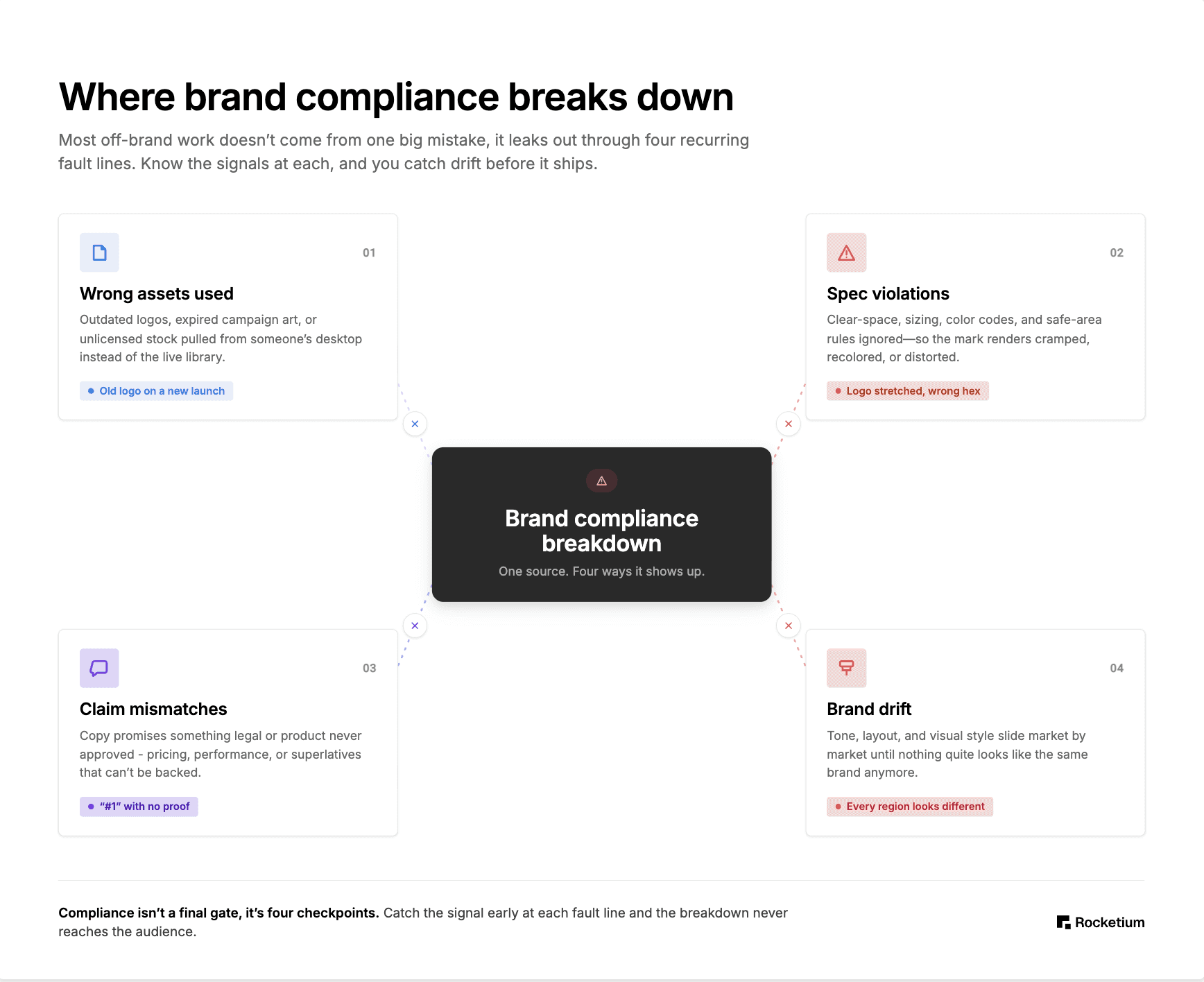
Wrong assets get used. A designer pulls a product image from a shared drive that hasn't been tagged or organized. The image is from a previous packaging iteration. Nobody catches it before the asset ships to a retailer. This is a volume and asset management problem, not a knowledge problem.
Spec violations slip through. Amazon, Walmart, and other retailers each maintain detailed technical specifications for ad formats - file size limits, resolution requirements, text-to-image ratios, safe zone rules. These specs also change. A team manually adapting assets across ten formats is going to miss updates.
Claims don't match retailer guidelines. Regulatory and retail compliance rules vary by country, category, and sometimes by retailer. A claim that's approved for one market or channel may not be approved for another. When copy is duplicated manually across assets rather than governed by a system, errors spread.
Brand drift happens gradually. No single asset looks wildly off-brand. But across a year of adaptations - different designers, different agencies, different briefs - logo placement shifts slightly, typography gets substituted, color values drift. By the time someone notices, the inconsistency is built into dozens of live assets.
The common thread in all of these: they're the result of production processes that rely on humans to apply rules consistently at high volume. That's not a scalable model.
The three layers every brand compliance framework needs
A brand compliance framework that holds at scale requires three distinct layers working together. Most teams have the first. Fewer have the second and third.
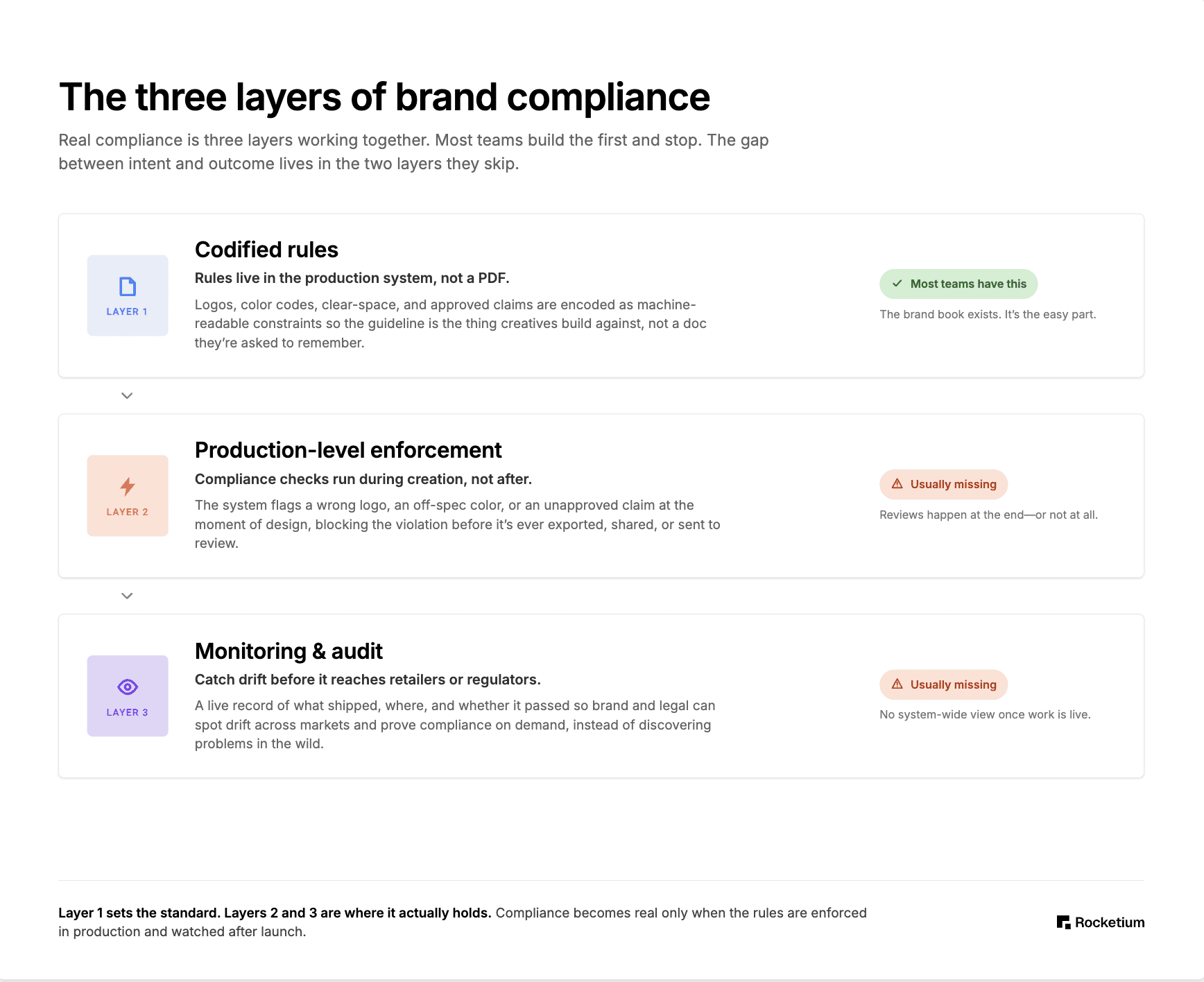
Layer 1: Codified rules
Brand guidelines that exist only as a document are harder to enforce than brand guidelines that are encoded into the tools your team uses to create assets. This means color palettes, typography, logo placement rules, safe area guides, and approved imagery libraries should live inside your production system, not alongside it.
The practical difference: a designer working in a system where off-brand fonts aren't available can't accidentally use them. A designer working in Photoshop with a PDF brand guide open in another window can.
Layer 2: Production-level enforcement
Compliance checks that happen after an asset is created are reactive. Compliance checks that happen during asset creation are preventive.
This is where the biggest efficiency gains are available. AI agents can check whether a logo placement violates the safe zone rule at the point of generation, not after a human reviewer spends twenty minutes on a batch review. Retailer spec checks - file dimensions, resolution, text-safe areas - can run automatically before an asset ever reaches a review queue.
This matters for two reasons. First, it's faster. Second, it catches problems when they're cheap to fix (before the asset is finalized) rather than expensive (after it's been sent to a retailer and rejected).
Layer 3: Monitoring and audit
Even with good codification and production-level enforcement, brand compliance needs an audit layer. Assets change over time. Platforms update their guidelines. Legal requirements shift. A brand compliance audit - reviewing live assets against current standards on a defined cadence - is how you catch drift before it becomes a larger problem.
The honest trade-off: audits take time. For teams already stretched thin, a quarterly brand compliance audit can feel like a low-priority task. The alternative is discovering compliance issues after a retailer rejection or, worse, a legal challenge. The audit cadence that's actually sustainable is better than the theoretical one that never happens. |
|---|
Brand compliance at scale: the specific challenge for multi-brand, multi-retailer teams
The compliance requirements for a consumer brand selling on one retailer are manageable. The requirements for a brand selling five product lines across Amazon, Walmart, Target, and Instacart are not the same problem.
Each retailer adds its own compliance layer on top of your internal brand standards. Amazon's guidelines for main product images differ from its guidelines for lifestyle images, which differ from its guidelines for A+ content, which differ again from its guidelines for Sponsored Brand ads. Walmart has its own requirements. Target has its own. And all of them update their specs.
Consumer brands in this position face compounding complexity. The number of rules to track grows with every retailer and every format. The volume of assets that need to comply with those rules grows with every product and every campaign.
This is where manual compliance processes reliably fail. Not because the team lacks diligence. Because the combinatorial math of rules times assets is too large for a manual process to cover.
The three layers every brand compliance framework needs
A brand compliance framework that holds at scale requires three distinct layers working together. Most teams have the first. Fewer have the second and third.
Layer 1: Codified rules
Brand guidelines that exist only as a document are harder to enforce than brand guidelines that are encoded into the tools your team uses to create assets. This means color palettes, typography, logo placement rules, safe area guides, and approved imagery libraries should live inside your production system, not alongside it.
The practical difference: a designer working in a system where off-brand fonts aren't available can't accidentally use them. A designer working in Photoshop with a PDF brand guide open in another window can.
Layer 2: Production-level enforcement
Compliance checks that happen after an asset is created are reactive. Compliance checks that happen during asset creation are preventive.
This is where the biggest efficiency gains are available. AI agents can check whether a logo placement violates the safe zone rule at the point of generation, not after a human reviewer spends twenty minutes on a batch review. Retailer spec checks - file dimensions, resolution, text-safe areas - can run automatically before an asset ever reaches a review queue.
This matters for two reasons. First, it's faster. Second, it catches problems when they're cheap to fix (before the asset is finalized) rather than expensive (after it's been sent to a retailer and rejected).
Layer 3: Monitoring and audit
Even with good codification and production-level enforcement, brand compliance needs an audit layer. Assets change over time. Platforms update their guidelines. Legal requirements shift. A brand compliance audit - reviewing live assets against current standards on a defined cadence - is how you catch drift before it becomes a larger problem.
The honest trade-off: audits take time. For teams already stretched thin, a quarterly brand compliance audit can feel like a low-priority task. The alternative is discovering compliance issues after a retailer rejection or, worse, a legal challenge. The audit cadence that's actually sustainable is better than the theoretical one that never happens. |
|---|
Brand compliance at scale: the specific challenge for multi-brand, multi-retailer teams
The compliance requirements for a consumer brand selling on one retailer are manageable. The requirements for a brand selling five product lines across Amazon, Walmart, Target, and Instacart are not the same problem.
Each retailer adds its own compliance layer on top of your internal brand standards. Amazon's guidelines for main product images differ from its guidelines for lifestyle images, which differ from its guidelines for A+ content, which differ again from its guidelines for Sponsored Brand ads. Walmart has its own requirements. Target has its own. And all of them update their specs.
Consumer brands in this position face compounding complexity. The number of rules to track grows with every retailer and every format. The volume of assets that need to comply with those rules grows with every product and every campaign.
This is where manual compliance processes reliably fail. Not because the team lacks diligence. Because the combinatorial math of rules times assets is too large for a manual process to cover.
How to run a brand compliance audit without slowing production
A brand compliance audit doesn't have to be a month-long project. It's more useful - and more likely to actually happen - if it's structured as a regular, bounded review.
Here's a practical starting point for teams managing creative across retail channels.
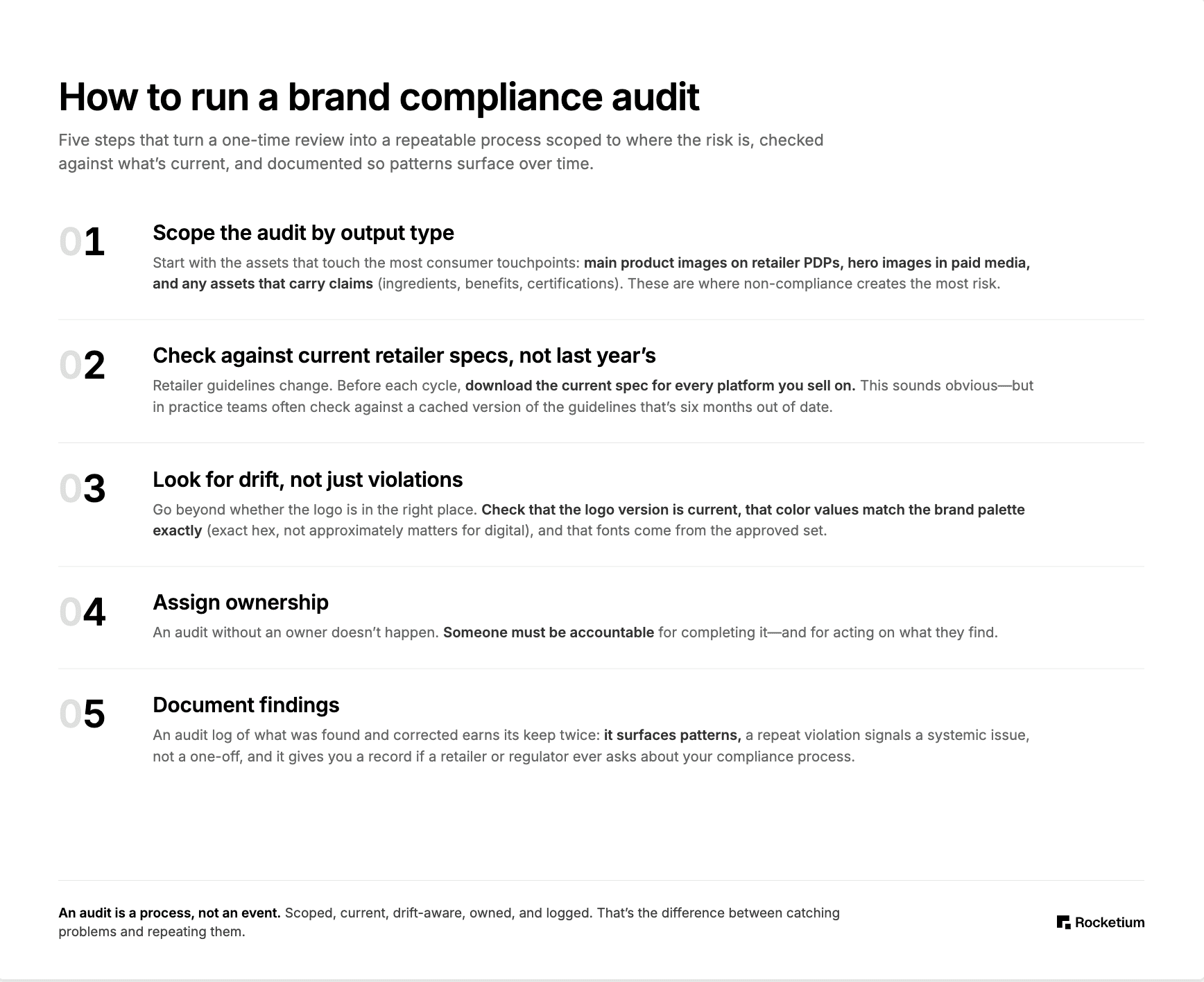
The honest constraint here: this kind of audit is time-intensive if done manually. For teams producing hundreds of assets per month, automating the spec-check layer and reserving human review time for judgment calls is a more sustainable model than trying to review everything manually.
What good brand compliance monitoring looks like in 2026
Brand compliance monitoring has changed meaningfully over the past few years. The combination of AI tools that can check assets against codified rules and platforms that give brands more visibility into what's actually running means there are fewer excuses for discovering compliance problems after the fact.
A few things worth knowing about where the technology is and where it isn't.
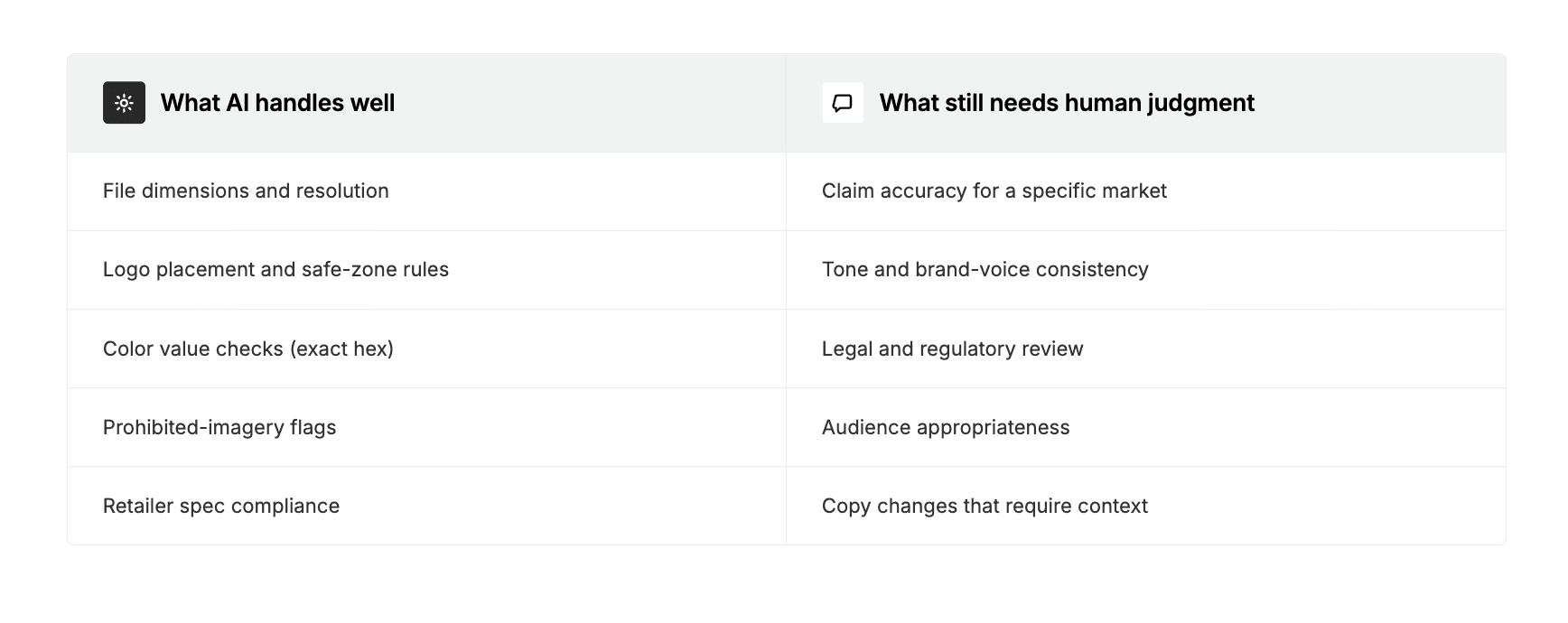
AI tools are reliable for spec and visual rule checks. File dimensions, resolution, text-safe areas, logo placement rules, color values, prohibited imagery - these are well-defined rules that AI can check programmatically and accurately. If you're not automating these checks, you're spending human review time on work that a machine can do better and faster.
AI tools are less reliable for judgment-dependent compliance. Whether a claim is accurate for a given market, whether a piece of copy is compliant with a retailer's content policies, whether an image is appropriate for a specific audience - these require human judgment. AI can flag things for review, but a human needs to make the call.
Monitoring needs to cover both pre-publish and post-publish. Pre-publish checks catch violations before they reach a retailer. Post-publish monitoring catches violations that appear after an asset is live - because a platform updated its guidelines, or because an approved asset was modified downstream without going back through the review process.
Codifying your brand rules makes monitoring meaningful. Brand compliance monitoring is only as useful as the rules it checks against. If your brand guidelines exist only as a document, monitoring tools have nothing to check against. Translating your guidelines into machine-readable rules - color values, approved typography, logo safe areas, prohibited phrases - is the prerequisite for automated monitoring to work.
For consumer brands running large volumes of assets, the practical implication is this: build compliance into the production workflow rather than treating it as a separate review step. The teams that manage brand compliance most effectively at scale are not the ones with the most thorough post-production review processes. They're the ones with systems that make non-compliant assets harder to produce in the first place.
Frequently asked questions
What is brand compliance?
Brand compliance is the combination of processes, tools, and standards that keeps a brand's creative assets aligned with its brand guidelines, retailer requirements, and applicable regulatory rules. It applies to every customer touchpoint, from product detail pages to paid media.
What are the most common causes of brand compliance failures?
Most brand compliance failures come from production processes that rely on manual review at high volume. The specific causes: assets being created from outdated templates, spec requirements not being checked before export, compliance rules not being encoded into production tools, and no regular audit process to catch drift over time.
How often should a brand run a brand compliance audit?
A quarterly audit is a reasonable baseline for most teams. Brands selling on multiple retail platforms with high creative volume - or operating in regulated categories - benefit from more frequent audits. The audit cadence should be one that can actually be completed, not an ideal that gets skipped.
What's the difference between brand compliance and brand governance?
Brand governance covers the policies and decision-making structures that determine how a brand is managed - who has approval authority, what the review process looks like, how brand standards get updated. Brand compliance is the operational execution of those policies. Governance defines the rules; compliance is the system that enforces them.
Can AI handle brand compliance, or does it still require human review?
AI handles spec and visual rule checks well - file dimensions, color values, logo placement, resolution requirements. These are rule-based checks that AI can run faster and more consistently than humans. Judgment-dependent compliance - claim accuracy, legal review, tone - still requires human oversight. The most effective compliance workflows combine AI for rule-based checks with human review for judgment calls.
How to run a brand compliance audit without slowing production
A brand compliance audit doesn't have to be a month-long project. It's more useful - and more likely to actually happen - if it's structured as a regular, bounded review.
Here's a practical starting point for teams managing creative across retail channels.
The honest constraint here: this kind of audit is time-intensive if done manually. For teams producing hundreds of assets per month, automating the spec-check layer and reserving human review time for judgment calls is a more sustainable model than trying to review everything manually.
What good brand compliance monitoring looks like in 2026
Brand compliance monitoring has changed meaningfully over the past few years. The combination of AI tools that can check assets against codified rules and platforms that give brands more visibility into what's actually running means there are fewer excuses for discovering compliance problems after the fact.
A few things worth knowing about where the technology is and where it isn't.
AI tools are reliable for spec and visual rule checks. File dimensions, resolution, text-safe areas, logo placement rules, color values, prohibited imagery - these are well-defined rules that AI can check programmatically and accurately. If you're not automating these checks, you're spending human review time on work that a machine can do better and faster.
AI tools are less reliable for judgment-dependent compliance. Whether a claim is accurate for a given market, whether a piece of copy is compliant with a retailer's content policies, whether an image is appropriate for a specific audience - these require human judgment. AI can flag things for review, but a human needs to make the call.
Monitoring needs to cover both pre-publish and post-publish. Pre-publish checks catch violations before they reach a retailer. Post-publish monitoring catches violations that appear after an asset is live - because a platform updated its guidelines, or because an approved asset was modified downstream without going back through the review process.
Codifying your brand rules makes monitoring meaningful. Brand compliance monitoring is only as useful as the rules it checks against. If your brand guidelines exist only as a document, monitoring tools have nothing to check against. Translating your guidelines into machine-readable rules - color values, approved typography, logo safe areas, prohibited phrases - is the prerequisite for automated monitoring to work.
For consumer brands running large volumes of assets, the practical implication is this: build compliance into the production workflow rather than treating it as a separate review step. The teams that manage brand compliance most effectively at scale are not the ones with the most thorough post-production review processes. They're the ones with systems that make non-compliant assets harder to produce in the first place.
Frequently asked questions
What is brand compliance?
Brand compliance is the combination of processes, tools, and standards that keeps a brand's creative assets aligned with its brand guidelines, retailer requirements, and applicable regulatory rules. It applies to every customer touchpoint, from product detail pages to paid media.
What are the most common causes of brand compliance failures?
Most brand compliance failures come from production processes that rely on manual review at high volume. The specific causes: assets being created from outdated templates, spec requirements not being checked before export, compliance rules not being encoded into production tools, and no regular audit process to catch drift over time.
How often should a brand run a brand compliance audit?
A quarterly audit is a reasonable baseline for most teams. Brands selling on multiple retail platforms with high creative volume - or operating in regulated categories - benefit from more frequent audits. The audit cadence should be one that can actually be completed, not an ideal that gets skipped.
What's the difference between brand compliance and brand governance?
Brand governance covers the policies and decision-making structures that determine how a brand is managed - who has approval authority, what the review process looks like, how brand standards get updated. Brand compliance is the operational execution of those policies. Governance defines the rules; compliance is the system that enforces them.
Can AI handle brand compliance, or does it still require human review?
AI handles spec and visual rule checks well - file dimensions, color values, logo placement, resolution requirements. These are rule-based checks that AI can run faster and more consistently than humans. Judgment-dependent compliance - claim accuracy, legal review, tone - still requires human oversight. The most effective compliance workflows combine AI for rule-based checks with human review for judgment calls.
Recent Posts
Explore expert insights, creative strategies, and practical guides to help your brand create better content and scale faster.



See AI Studio in action for a real brief of your brand at zero cost and commitment.
See AI Studio in action for a real brief of your brand at zero cost and commitment.
See AI Studio in action for a real brief of your brand at zero cost and commitment.
See AI Studio in action for a real brief of your brand at zero cost and commitment.