
Updated On:

Comparing the best creative compliance software for consumer brands
Rocketium AI Studio
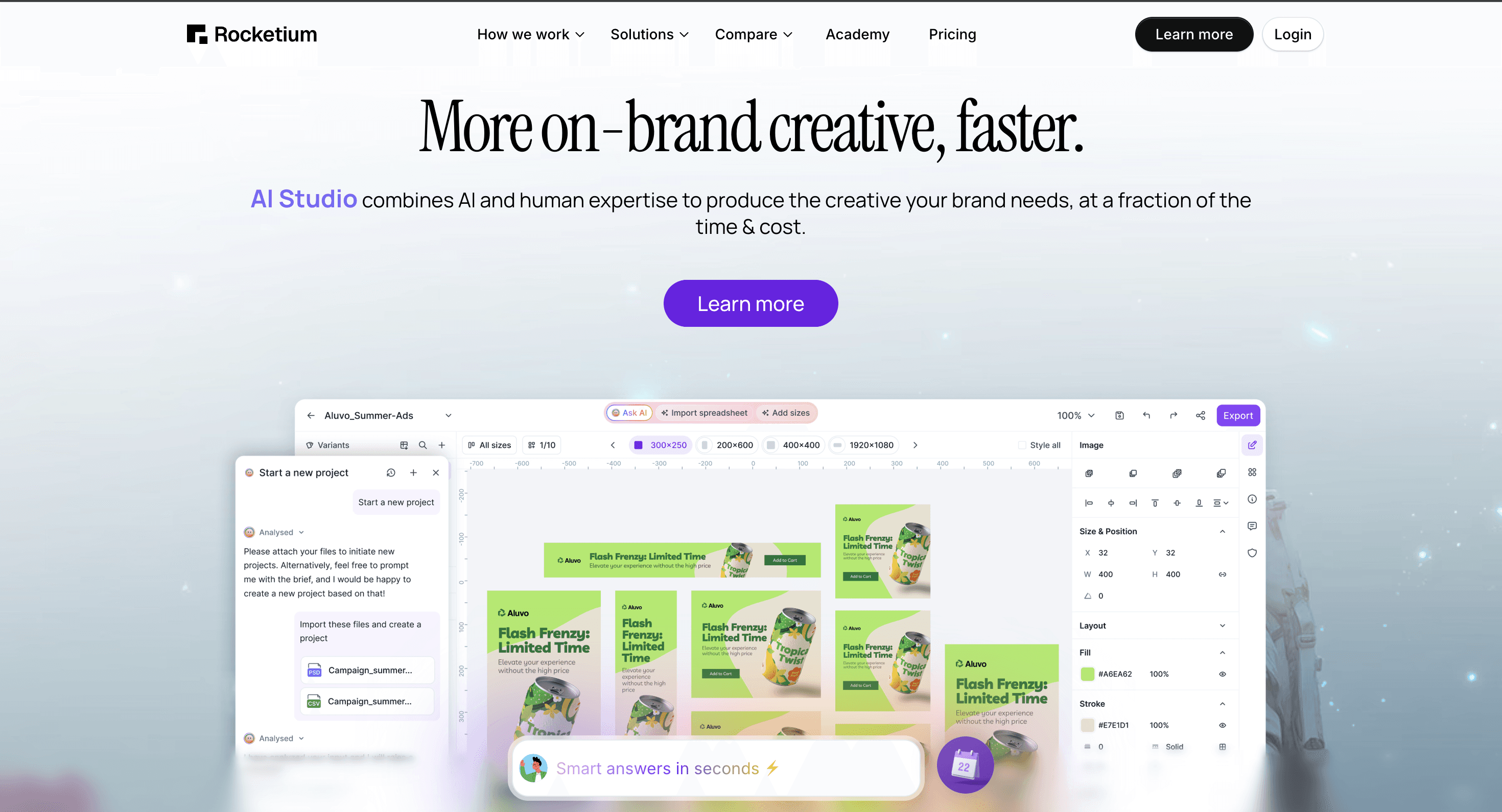
Rocketium AI Studio is a managed creative production infrastructure, not a standalone brand compliance platform. Most compliance tools check whether an asset is compliant after it's been created. AI Studio produces assets that are compliant by default, because brand guidelines, retailer specs, file naming conventions, compression requirements, and restricted claim rules are encoded into the production workflow before a single asset is exported.
The workflow runs through three layers. AI agents handle the mechanical production - resizing, reformatting, applying brand rules, checking against retailer requirements for each platform. A dedicated QA team then reviews every output against the brief, brand guidelines, and channel specs before anything reaches the customer. The customer gets final approval and can self-serve edits inside the platform.
Platform specs are not uniform across retailers. A 1200x628 banner that passes Amazon DSP requirements may fail Walmart Connect's. Manually QA-ing dozens of format variants against a dozen platform spec sets doesn't scale.
AI Studio covers the full production cycle. Adaptation takes an approved master design and produces all required sizes, format variants, and localizations with correct specs. Production creates net-new assets from a brief - AI-generated imagery, copy, video - all checked against brand and platform rules. Concepting handles the design thinking upstream: master layouts, storyboards, and visual directions built around the brief. The brand governance module codifies prohibited claims, required disclaimers, visual rules, and maintains audit trails.
The honest trade-off
For a brand that only needs to govern access to existing assets, it's more infrastructure than the problem needs. For a brand producing hundreds of assets per month across multiple retailer platforms, the math works differently.
Pricing
$50K annual platform fee. This includes a dedicated account director, designers, AI specialists, unlimited self-serve editing, brand workspaces, and compliance automation. Assets are billed at $15-25 per credit at standard rates, lower at volume. One static asset equals one credit. Video over 15 seconds equals two credits. Credits are consumed on finalized exported assets only - iterations and internal edits don't count.
Bynder
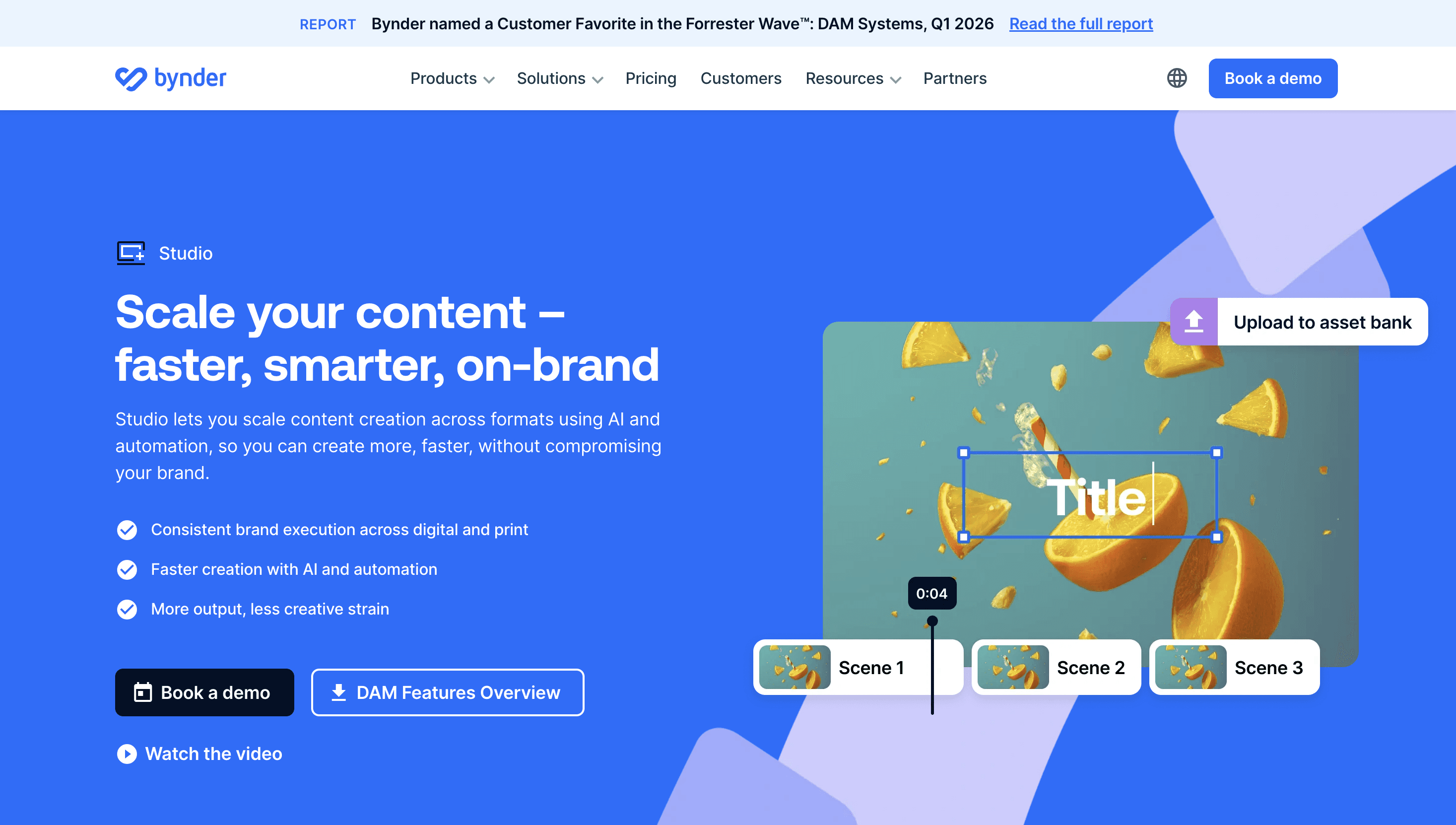
Bynder is an enterprise digital asset management platform used by 4,000+ brands, including Puma, Spotify, and Five Guys. It was named a Leader in the November 2025 Gartner Magic Quadrant for Digital Asset Management.
Its compliance approach is asset-first. The platform controls which assets teams and agencies can find, access, and download - ensuring only approved, current-version assets are in circulation. AI agents handle metadata enrichment, asset transformation across markets, and automated compliance audits against brand guidelines. The AI Compliance Agent flags content that deviates from brand standards before it's distributed.
For teams that need to go further, Bynder Studio is a creative automation add-on built on top of the DAM. Regional managers or agency partners can pull an approved template, swap the copy for their market, and export a compliant asset without involving the central design team. The value is strongest when Bynder is already the system of record for brand assets - the Studio layer extends an existing investment rather than adding a new one.
Buyers who have evaluated Bynder consistently flag two things on G2 and Gartner Peer Insights: the search and asset discovery experience is strong, and performance can slow with very large asset libraries.
The practical limit
Bynder governs compliance at the access and distribution level. It prevents unauthorized asset use. It doesn't prevent someone from creating non-compliant content with assets they've downloaded. Bynder Studio extends into creation, but it's an add-on, not the core product, and it wasn't built for the technical spec requirements of Amazon or Walmart PDP production.
Pricing
Custom enterprise. Verified transaction data from third-party sources indicates annual contracts of $12,160-$78,893, with first-year implementation costs of $25,000-$70,000. [NEEDS SOURCE - confirm directly with Bynder before publishing]
Frontify
Frontify is a brand management platform headquartered in Switzerland, used by Uber, Lufthansa, and BMW, among others. Its strongest capability is the brand portal - a structured, building-block interface that gives design teams a governed way to create centralized brand hubs covering guidelines, approved assets, and templates.
BMW uses Frontify to give global dealers and agencies access to up-to-date brand assets and guidelines. That's the use case Frontify is built for: making brand standards accessible to a large, distributed group of people who create content using their own tools.
The compliance approach is guidelines-first. Frontify makes it easy to find the right rules and the right assets. This addresses a real problem - at large organizations, a significant share of off-brand content happens because people genuinely didn't know the current standard, not because they ignored it. Making guidelines accessible and structured reduces that category of failure.
What it doesn't do
Enforce those guidelines when someone creates content in another tool. A user can read the correct logo placement rules in Frontify and still place the logo wrong in Photoshop. For organizations where the compliance risk is knowledge, Frontify solves it. For organizations where the risk is execution, it doesn't go far enough. Gartner reviewers and third-party evaluations note AI capabilities as a relative weakness compared to DAM-focused competitors. [NEEDS SOURCE - add Gartner/G2 citation and link]
Pricing
Custom enterprise. Annual agreements typically fall between $25,000 and $100,000+, depending on scale, number of brands, and user count. [NEEDS SOURCE - confirm before publishing]
IntelligenceBank
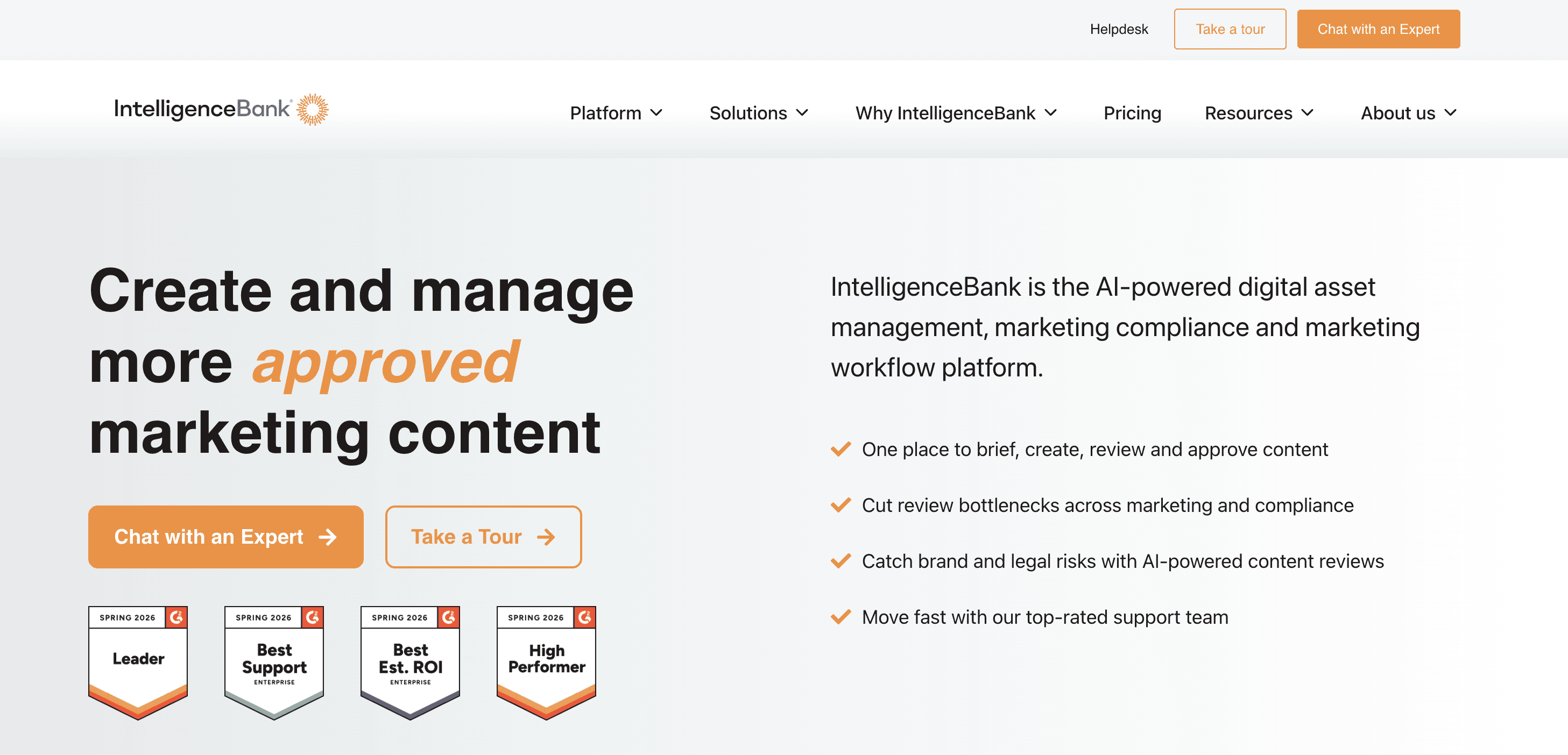
IntelligenceBank is a DAM platform with workflow automation and compliance management built in. It goes further than most DAM platforms because it checks compliance at three points: during content creation, during review, and after publication.
The post-publish monitoring is what sets it apart. Most compliance tools hand off once an asset is approved and distributed. IntelligenceBank continues scanning for issues after assets go live - useful for regulated industries where a live claim can become a liability after approval if regulatory guidance changes.
AI-driven risk detection flags off-brand or potentially non-compliant content before it enters the approval queue. Configurable approval management routes assets to the right reviewers in the right order. Audit trails log every action with timestamps for regulatory reporting.
Integrations cover the enterprise marketing stack
Adobe Creative Cloud, Microsoft Office, Salesforce, Google Drive, Slack, Dropbox, Hootsuite, WordPress, Shopify, and Marketo. The platform serves four distinct buyer types through separate packages - Digital Asset Management, Brand Management, Marketing Workflow Approval, and Marketing Compliance - priced on request.
The honest limit
IntelligenceBank is the right choice when compliance workflow depth is as important as asset governance. For consumer brands whose primary need is high-volume retail asset production across Amazon and Walmart, the platform wasn't designed for that use case and lacks the retailer-specific spec enforcement that makes those workflows viable.
Pricing
Contact IntelligenceBank for a custom quote across their four package tiers.
Artwork Flow
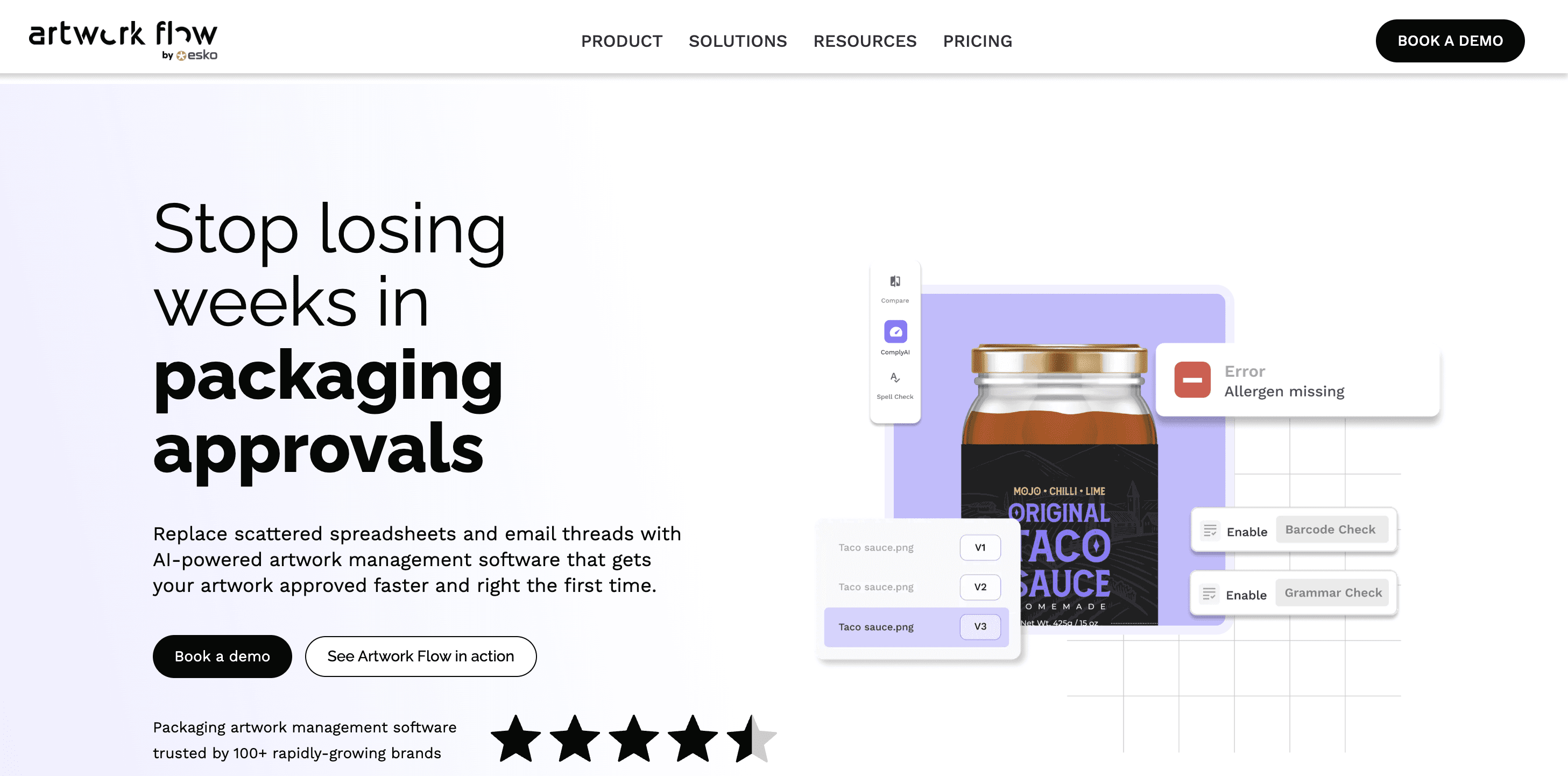
Artwork Flow is an AI-powered artwork management and label compliance platform purpose-built for packaging, marketing, and regulatory teams. It's not a general-purpose brand compliance tool. The problem it solves is narrower and more consequential: ensuring that product labels, packaging variants, and regulated claims are correct before they go to print.
In CPG, food and beverage, pharma, and cosmetics, a compliance error on a label isn't a rejected ad - it's a potential recall or a regulatory penalty. Artwork Flow addresses that specific risk through online proofing tools with real-time annotations, side-by-side version comparison, and print inspection. Teams replace email chains and shared drives with a single workspace where every annotation, approval, and version change is logged.
ComplyAI, the platform's automation layer, lets teams build custom rulebooks that check labels against regulatory requirements automatically - ingredient declarations, required claims, regional legal language. The barcode scanner and print inspection tools in the proofing module catch physical print errors that digital review misses.
Brands including Vita Coco, HomeChef, and Trinchero Family Estates use the platform for packaging and label workflows.
The limit
Artwork Flow's depth in packaging compliance comes at the cost of breadth. For teams whose primary compliance challenge is digital ad production across paid media platforms, its strengths are outside the use case. It's a specialist tool, and that's the right reason to choose it.
Pricing: Custom. Contact Artwork Flow for a quote based on team size, industry, and use case.
Marq
Marq (formerly Lucidpress) is a brand compliance platform built for distributed teams - sales organizations, franchisees, regional offices, field marketing teams - that create content without design expertise and without a central design team reviewing every output.
The mechanism is template locking. Design teams build master templates with locked fields covering legally required claims, logo placement, required disclaimers, and approved brand elements. Non-designers work inside those templates, editing only what they're permitted to change: local copy, product photos, promotional offers, contact details. The locked elements can't be touched regardless of what the user tries to do.
AI Marqet, Marq's workflow automation layer, triggers compliant asset generation from business events - new product listings, sales opportunities, seasonal campaigns - without requiring a manual brief for each one. CRM integrations with Salesforce and HubSpot support automated content personalization within brand guardrails.
Marq positions itself as covering compliance at creation, approval, and distribution in a single workflow, and that positioning is accurate for its target use case. Third-party evaluations note it as the strongest option for distributed teams in regulated industries like financial services, insurance, and healthcare, where the compliance risk is field-level content creation rather than centralized agency production.
The limit
Template locking solves the distributed team problem. It doesn't solve the retailer spec problem. For consumer brands whose primary compliance challenge is Amazon or Walmart asset production at volume, Marq was built for a different failure mode.
Pricing
Pro and Team plans with a 7-day free trial. Enterprise pricing on request.
Adobe GenStudio for Performance Marketing
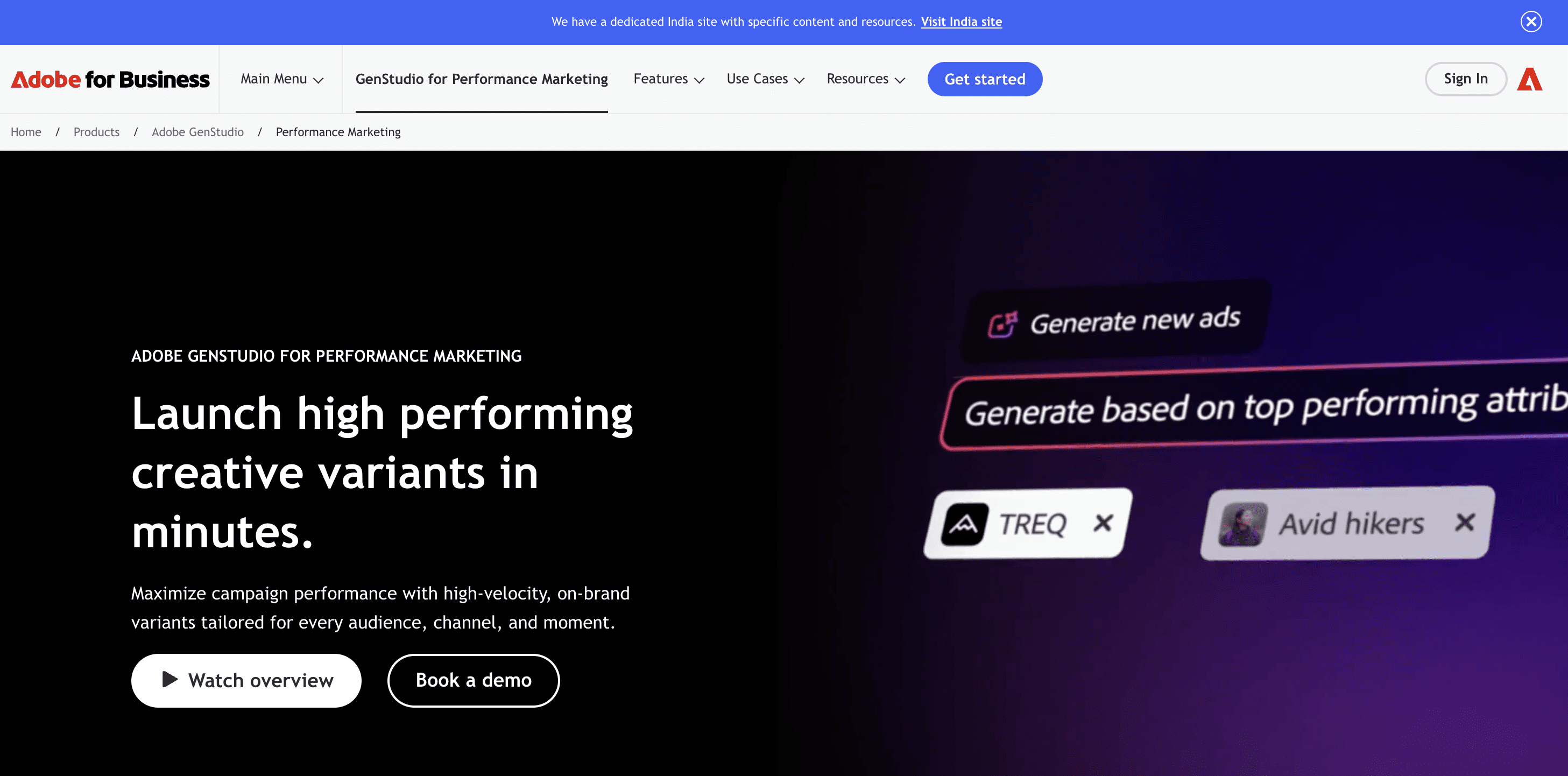
Adobe GenStudio for Performance Marketing is Adobe's AI content generation and brand compliance platform, aimed at enterprise marketing teams producing high-volume campaign content across multiple paid channels. It sits inside the Adobe ecosystem - integrating with Adobe Experience Manager Assets, Workfront for approvals, and Creative Cloud for design.
Organizations upload their brand guidelines, which train the AI content generation models on voice, tone, and channel-specific direction. Every piece of generated content receives a brand score that shows where it meets standards and where it doesn't, before it enters the approval queue. Approval workflows route content through creative, legal, and marketing operations teams, with Workfront handling annotation and version comparison.
Channel compliance is built into the template layer. Paid social and display ad templates automatically check for platform-specific guidelines, including ADA accessibility requirements and regulatory standards. Regional branding for localized content is listed as coming soon as of mid-2026.
The value of GenStudio compounds with existing Adobe investment. Teams already running AEM Assets and Workfront get a natural extension of their existing infrastructure. Teams outside that ecosystem face integration complexity and implementation cost that changes the cost-benefit calculation.
The practical scope
GenStudio's compliance coverage is focused on social and display. It wasn't designed for the technical spec requirements of Amazon PDP production or Walmart retail media, where image dimensions, compression specs, file naming conventions, and restricted claim rules vary by placement and require enforcement at the output level.
Pricing
Custom enterprise. Contact Adobe sales.
Recent Posts
Explore expert insights, creative strategies, and practical guides to help your brand create better content and scale faster.