
Creative fatigue: why it happens and how to beat it
Article
Cameron Nelson
|
Sr. Marketing Manager
Reviewed By Satej SIrur
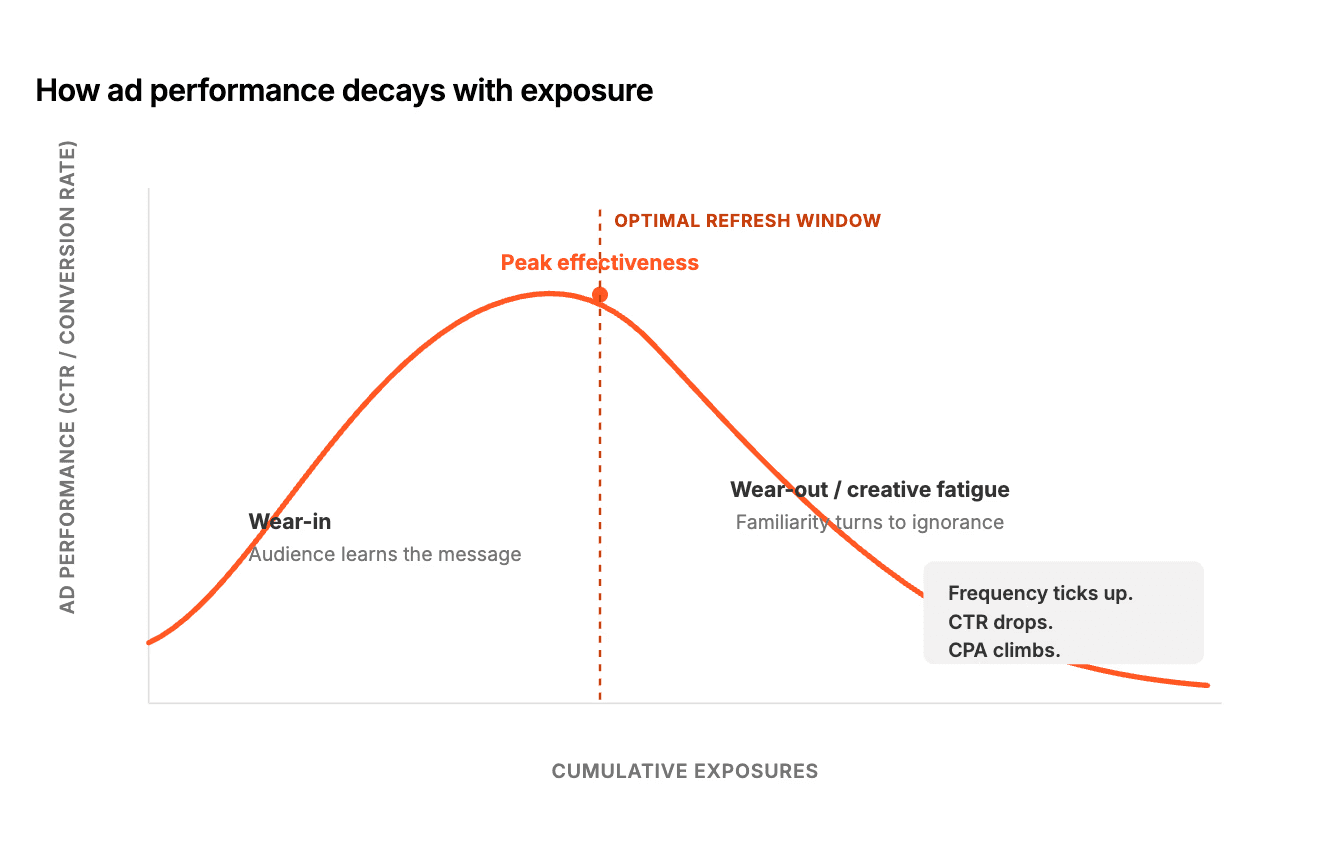
Creative fatigue vs. ad fatigue
These terms are often used interchangeably. They describe different things.
Ad fatigue describes a single ad losing effectiveness with the same audience over time. Creative fatigue describes something broader: a pattern where visually similar creative across multiple ads - same layout, same color palette, same format causes the audience to habituate even if the individual ads are technically different.
This matters because of how Meta measures frequency. Frequency is reported at the ad level. But if you're running six ads that all look like variations of the same template, your audience's effective exposure is much higher than the reported per-ad frequency suggests. Meta's own analytics documentation flags this: fatigue happens at the creative level, not the ad-set level. Reported frequency understates real exposure when creative variety is low.
Creative fatigue vs. audience saturation
Brands routinely misdiagnose one as the other and the wrong diagnosis leads to the wrong fix.
Creative fatigue means the creative is the problem. The audience could still convert, they're just ignoring what you're showing them. The fix is new creative.
Audience saturation means you've reached most of the people likely to convert. Fresh creative won't move the needle because the issue is coverage, not the asset itself. The fix is expanding targeting.
Applying a creative fix to a saturation problem wastes production capacity. Applying a targeting fix to a fatigue problem wastes media spend. The signals that distinguish them are below.
What causes creative fatigue?
Four causes appear consistently across platforms and categories.
Overexposure is the most obvious. When budget concentrates spend on a small audience, individuals see the same creative too many times in too short a window.
Too few creatives accelerate it. A single strong performer attracts the majority of impressions - the algorithm backs winners, so one creative can consume 70-80% of spend in a given ad set. That concentration builds frequency fast.
Cosmetic variation doesn't solve it. Recoloring a banner, swapping the headline font, or tweaking the CTA copy are not genuine variations. The visual template is the same. The audience's brain processes it as the same ad, because the structural pattern matches what they've already habituated to.
Single-format reliance multiplies exposure on the same brain circuits. Static ads, video ads, and carousels are processed differently. A brand running only static banners across all placements is stacking frequency on the same cognitive pathway.
The underlying pattern in all four causes: creative fatigue is a throughput problem wearing a creative disguise. The knowledge that fatigue exists is widespread. The ability to produce enough genuine variation fast enough to stay ahead of it is not.
How to spot creative fatigue
Five signals, each measurable from standard platform exports.
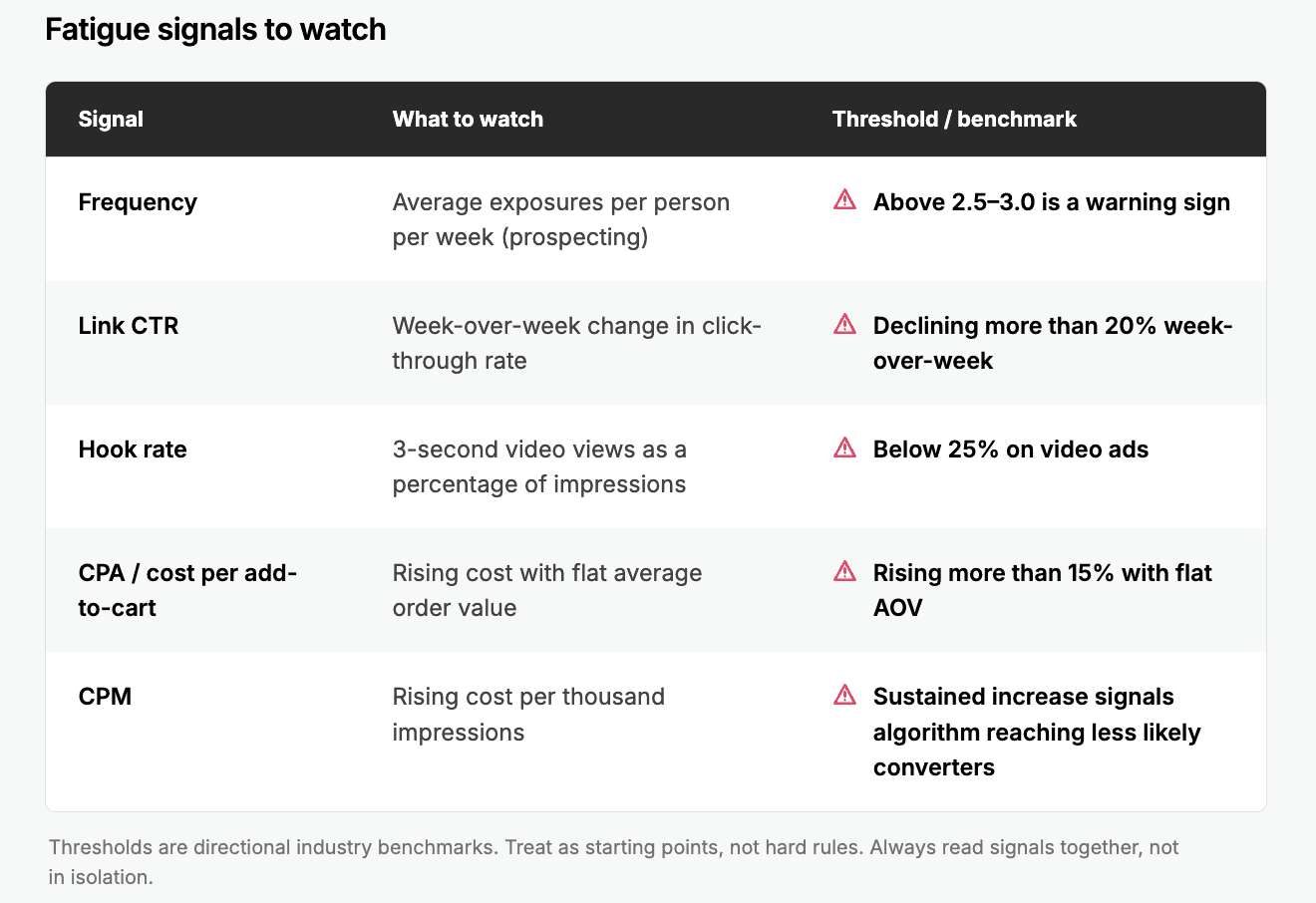
Frequency: When prospecting frequency climbs above 2.5-3.0 per person per week, the average person in your audience has seen the creative three or more times in seven days. That's a warning sign, not a certainty - but it warrants checking the other signals.
Link CTR: A week-over-week decline of more than 20% in link click-through rate, with no major change to targeting or placement, points to the creative losing its ability to stop the scroll.
Hook rate: For video ads, hook rate measures the percentage of impressions that result in a 3-second view. Below 25% means most of your audience is scrolling past before the message registers.
CPA and cost per add-to-cart: Rising cost per acquisition or cost per add-to-cart with flat average order value indicates the algorithm is reaching progressively less likely converters - a signal that the creative is no longer doing the work of pre-qualifying intent.
CPM: A sustained rise in CPM with stable targeting can indicate the algorithm expanding reach to less receptive segments because the creative isn't performing well enough to win auctions at lower cost.
Read these signals together, not in isolation. One metric moving in the wrong direction can have many causes. Three or four moving together, with no changes to budget, targeting, or seasonality, points to the creative.
A note on thresholds: the numbers above are directional industry benchmarks from sources including AdGPT and admetrics. Treat them as starting points calibrated to your own baseline, not universal laws.
Fatigue signals by channel
Platforms differ in how fast fatigue sets in. TikTok's fast-scroll, high-frequency feed habituates audiences faster than any other major platform. Meta sits in the middle. YouTube's longer-form format has a slower wear-out curve - audiences can tolerate more exposures before performance drops, partly because skip behavior absorbs some of the early fatigue effect.
These are directional estimates based on industry guidance and agency data; your actual experience will vary by category, audience size, and creative quality.
How often should you refresh ad creative?
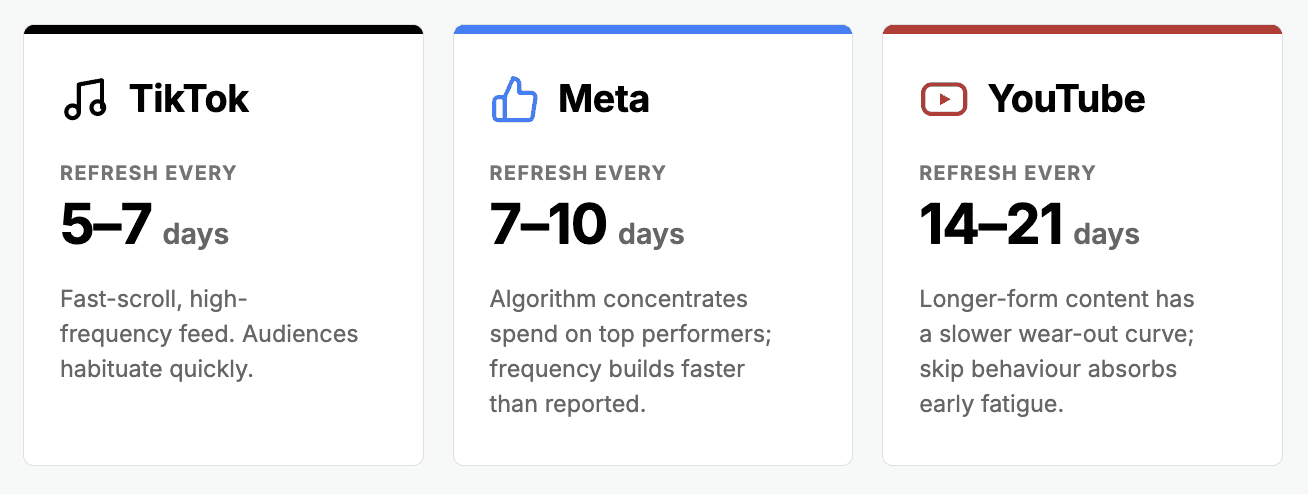
TikTok: Every 5-7 days. The platform's feed rewards novelty and punishes familiarity faster than anywhere else.
Meta (Facebook / Instagram): Every 7-10 days. The algorithm concentrates spend on top performers, which builds frequency faster than the reported per-ad number suggests.
YouTube: Every 14-21 days. Longer-form content has a slower wear-out curve. Skip behavior at the opening seconds absorbs early fatigue, giving creative a longer effective run.
How many variations do you need? Industry benchmarks suggest 8-12 active variations per ad set for accounts spending below $50,000 per month. Above $100,000 per month, 15-30 new variations per month is a more common operating cadence. These are estimates, not rules - scale with your audience size and spend concentration.
One counterargument worth acknowledging: some practitioners argue that running too many creative variations dilutes algorithmic learning. A smaller set of genuinely strong performers, refreshed on a disciplined cadence, can outperform a sprawling library of mediocre variants. The 70-20-10 allocation model - 70% proven performers, 20% tests, 10% experiments - reflects this view. The tension is real: velocity and quality both matter, and scaling one without the other doesn't work.
The compounding effect of cadence matters more than the individual refresh. A team on a monthly cycle optimizes 12 times per year. A team on a weekly cycle optimizes 52 times. That's four times more signal, four times more learning, four times more opportunity to scale what's working. The constraint that keeps most brands on monthly cycles isn't strategy - it's production capacity.
How to beat creative fatigue
Genuine variation, not cosmetic variation
Three colors of the same ad is not creative scaling. Genuine variation means changing the hook - the first three seconds of a video or the primary visual in a static - not just surface elements.
What genuine variation looks like: new opening angles (product-led vs. benefit-led vs. social proof), different formats (static, video, UGC-style, motion graphics, carousel), different emotional registers (aspirational vs. problem-solution vs. urgency), and different visual compositions (model-forward vs. product-forward vs. lifestyle).
The brief for a refresh should answer: what new thing does this creative show the audience? If the answer is "the same thing in a slightly different color," it's not a genuine variation.
Format diversity and algorithmic preservation
Running a genuinely different format - a short video where you had a static, a carousel where you had a single image - processes differently in the audience's attention system. It resets some of the habituation that's built up.
One tactical note with real value: when refreshing creative, update the creative assets inside existing campaigns and ad sets rather than creating new campaigns from scratch. New campaigns reset algorithmic learning and lose accumulated social proof (likes, comments, shares). Refreshing inside an existing structure preserves that learning while giving the algorithm new material to optimize.
Structured testing
One variable per test. Isolating the element being tested is what produces actionable signal - if you change the hook and the format and the CTA simultaneously, you can't trace what drove the performance shift.
Allocating roughly 10-15% of budget to creative testing is a commonly cited practice across performance marketing teams. It keeps testing from cannibalizing proven performers while generating enough data to identify meaningful winners.
Scale winners fast. The window between a creative hitting peak effectiveness and entering wear-out is often shorter than the production cycle for a new asset. The faster you can identify a winner and scale it - while simultaneously refreshing the assets already in fatigue - the more value you extract from the insight.
The production bottleneck nobody talks about
Here's the part that most advice on creative fatigue never reaches: all of the above assumes you can actually produce that volume of creative fast enough to matter.
You learn on Monday that your top creative has fatigued. Your performance team writes the brief. It goes to creative on Wednesday. Creative is already running behind on three other projects. A new asset is ready ten days later. By then, you've spent ten days of budget on a fatigued flight, and the brief you started with is based on a signal that's already two weeks old.
That is the insight-to-production lag. It lives inside most consumer brand marketing operations, and it's what keeps teams perpetually reactive rather than ahead of fatigue.
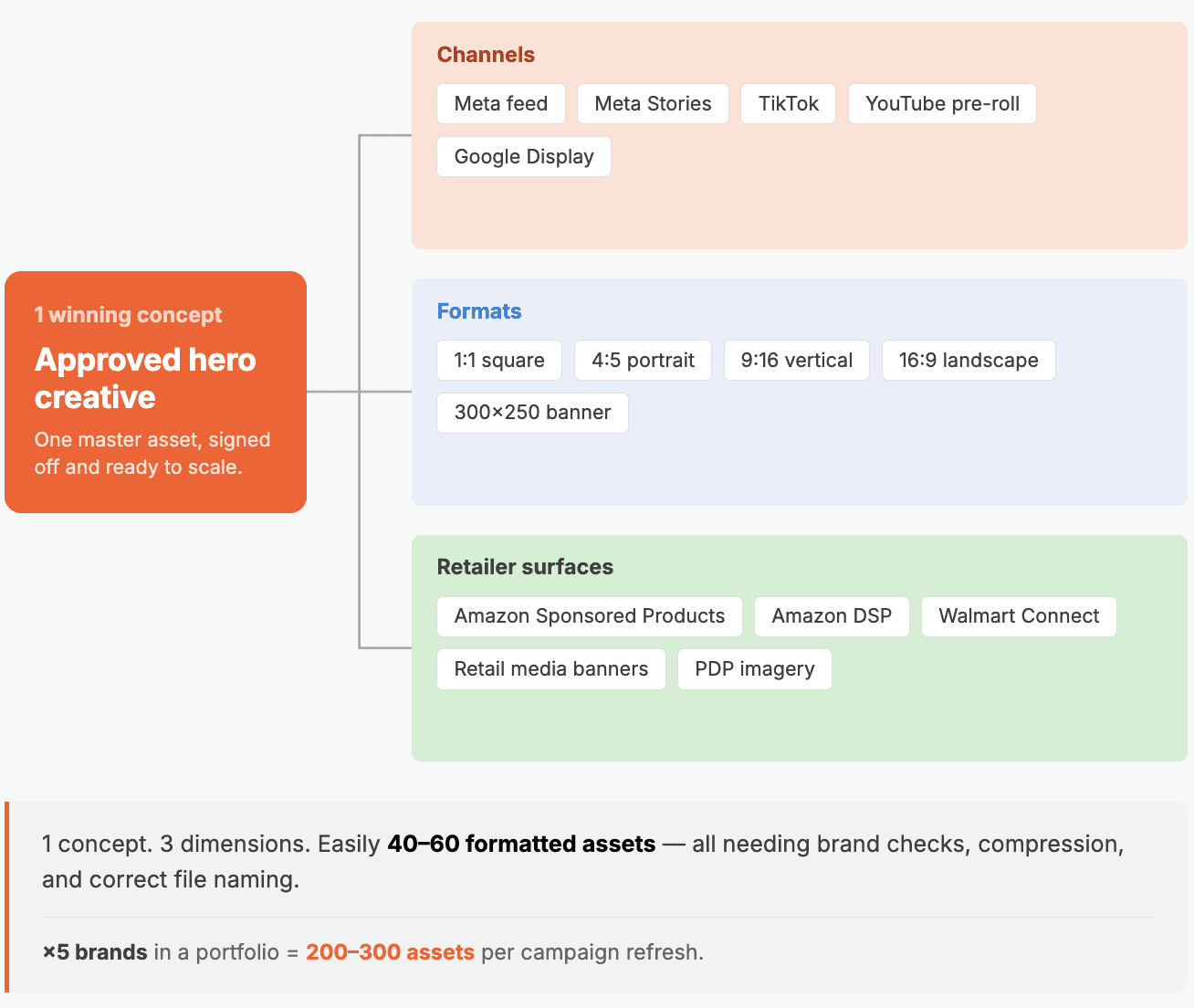
The asset math makes it worse for brands with real retail media presence. A single winning concept needs to be adapted across aspect ratios (1:1, 4:5, 9:16, 16:9, 300x250 banner), across channels (Meta feed, Meta Stories, TikTok, YouTube pre-roll, Google Display), and across retailer surfaces (Amazon Sponsored Products, Amazon DSP, Walmart Connect, retailer-specific PDP imagery). A full-funnel refresh from one approved hero concept can require 40-60 formatted assets, each with brand checks, correct file naming, and platform-specific compression settings.
For consumer brands selling across five or more brands on five or more retailers - beauty, electronics, food, personal care, home - that asset math runs in parallel across every active campaign, every channel, and every seasonal moment. That isn't a media-buying problem. That is a production operations problem.
The brands that win the fatigue arms race have built a production system that closes the insight-to-production loop. They don't just know when to refresh - they can actually do it, at volume, on-brand, across every placement, before the performance signal has gone stale. That's what AI-assisted creative production makes possible: taking a winning concept from brief to adapted, brand-checked assets across every required format, in hours rather than weeks.
Frequently asked questions
What is creative fatigue?
Creative fatigue is the decline in ad effectiveness that occurs when the same audience is exposed to visually similar creative too many times. Performance follows a wear-in / wear-out curve: effectiveness rises in early exposures, peaks, then declines as familiarity builds. It is measured through signals including frequency, CTR, hook rate, and CPA.
What's the difference between creative fatigue and ad fatigue?
Ad fatigue describes a single ad losing effectiveness with a specific audience. Creative fatigue is broader: it describes performance decay driven by visual similarity across multiple ads, even technically different ones. Because fatigue happens at the creative level rather than the ad level, reported per-ad frequency often understates real audience exposure.
What causes creative fatigue?
The main causes are overexposure through high frequency, too few active creatives concentrating impressions, cosmetic variation mistaken for genuine variation, and single-format reliance. The underlying issue in most cases is production throughput: teams that can't generate enough genuinely different creative fast enough get stuck in fatigue cycles.
How many creative variations do you need?
As a directional benchmark: 8-12 active variations per ad set at lower spend levels, scaling to 15-30 new variations per month above $100,000 per month in spend. The right number is partly a function of audience size - a large audience builds frequency more slowly than a small one, giving each creative more runway.
Is creative fatigue different from audience saturation?
Yes, and confusing them leads to the wrong fix. Creative fatigue means the creative is the problem - the audience could still convert but is ignoring your ads. The fix is new creative. Audience saturation means you've reached most people likely to convert. The fix is expanding targeting. Three or four fatigue signals moving together (frequency, CTR, hook rate, CPA) with no targeting changes points to creative fatigue, not saturation.
How do you prevent creative fatigue?
Prevention comes down to two things: a genuine variation strategy (not cosmetic changes) and a production system that can execute refreshes fast enough to stay ahead of the fatigue cycle. Most brands have the strategy. Fewer have the production infrastructure to act on it at the cadence their spend levels require.
The brands that stay ahead build a production system, not just a strategy
Creative fatigue is inevitable. Every creative peaks and declines. The question is whether your production pipeline can keep pace with the insight-to-refresh cycle - or whether you're always two weeks behind the signal.
The answer to creative fatigue isn't a better media strategy. It's a shorter distance between knowing what's fatiguing and launching what's next.