
Pencil AI is a serious platform. It has been running AI in marketing production since 2018, it's backed by Brandtech Group, and it's trusted by names like Diageo, Unilever, and L'Oréal. If you're evaluating it, you're not looking at a startup tool. You're looking at a mature marketing OS built for scale.
So the reasons teams look elsewhere aren't about hype. They're about fit.
The generation limits on lower plans hit fast. The pricing is opaque at enterprise tier. The workflow complexity takes real investment to master. And for retail and eCommerce teams producing hundreds of retailer-specific assets (Amazon listings, Walmart display, Target Roundel), Pencil's strength in paid social creative doesn't map cleanly onto the problem.
This post covers six Pencil AI alternatives worth evaluating in 2026, who each one is built for, and where each falls short.
Key takeaways
|
|---|
Why brands look for a Pencil AI alternative?
Pencil AI describes itself as the enterprise agentic marketing OS: a single platform covering insights, briefing, planning, creation, adaptation, approval, deployment, activation, analysis, and reporting. Its Open Garden model approach integrates OpenAI, Google Gemini, Adobe Firefly, Bria, and Runway into one orchestration layer. On G2, it holds a 4.8/5 rating with a 10/10 for quality of support. The review count is modest, but the scores are consistent and the support rating is unusually high for an enterprise tool.
The platform is genuinely differentiated. Its performance prediction engine draws on data from $1 billion+ in ad spend across 4,000+ brands, and its enterprise governance stack (SOC2, IP indemnity, data ringfencing, role-based access) covers what IT, legal, and procurement teams require.
As of May 2026, Pencil's own pricing page reports 35,000+ teams making 2,000,000+ ads on the platform. The G2 profile cites 88,000+ users and 10 million+ generations, both figures from Pencil-owned properties using different counting methodologies. For enterprise marketing teams that want AI handling the full workflow from brief to results, Pencil is a credible option.
The reasons teams look elsewhere fall into four areas.
Generation limits on lower plans
The Core plan at $14/month (or $11/month billed annually) includes only 50 generations. High-volume teams burn through that in days. The Growth plan at $55/month ($44/month annually) raises the limit to 250 generations, but Pro requires contacting sales for custom volume and pricing, which means a longer procurement cycle before teams can scale.
Billing and account management
Pencil's Trustpilot profile (trypencil.com) has 4 reviews as of June 2026. The sample is small, too small to draw statistical conclusions. But the specific complaints from real accounts are documented and specific enough to flag. One reviewer, posting July 1, 2025, described being locked out of their agency account with unresponsive support: "Pencil (trypencil.com) isn't a platform I can recommend unfortunately. I have an agency account with them that they have locked me out of. Support hasn't been of any help. They don't care." A second reviewer posted an older complaint about inability to cancel and continued card charges. These are not widespread patterns but they are documented experiences from verified users. If subscription and account management reliability matters to your team, ask Pencil directly about their support SLAs before signing.
Paid social focus
Pencil's production strengths are in Meta, TikTok, YouTube, Google Display, and LinkedIn. That's a wide channel set, but it doesn't include retailer-specific formats. For brands producing Amazon A+ content, Walmart display banners, or Target Roundel assets, the compliance rules and spec requirements that govern those formats aren't built into Pencil's workflow.
Learning curve
G2 reviewers note a slight learning curve with Pencil. Importantly, those same reviewers say the responsive support team mitigates it. So this is not a deal-breaker for most teams, but it is a real onboarding cost to budget for. The agent-based interface and breadth of features mean new users shouldn't expect to be fully productive in the first week.
Pencil AI is a serious platform. It has been running AI in marketing production since 2018, it's backed by Brandtech Group, and it's trusted by names like Diageo, Unilever, and L'Oréal. If you're evaluating it, you're not looking at a startup tool. You're looking at a mature marketing OS built for scale.
So the reasons teams look elsewhere aren't about hype. They're about fit.
The generation limits on lower plans hit fast. The pricing is opaque at enterprise tier. The workflow complexity takes real investment to master. And for retail and eCommerce teams producing hundreds of retailer-specific assets (Amazon listings, Walmart display, Target Roundel), Pencil's strength in paid social creative doesn't map cleanly onto the problem.
This post covers six Pencil AI alternatives worth evaluating in 2026, who each one is built for, and where each falls short.
Key takeaways
|
|---|
Why brands look for a Pencil AI alternative?
Pencil AI describes itself as the enterprise agentic marketing OS: a single platform covering insights, briefing, planning, creation, adaptation, approval, deployment, activation, analysis, and reporting. Its Open Garden model approach integrates OpenAI, Google Gemini, Adobe Firefly, Bria, and Runway into one orchestration layer. On G2, it holds a 4.8/5 rating with a 10/10 for quality of support. The review count is modest, but the scores are consistent and the support rating is unusually high for an enterprise tool.
The platform is genuinely differentiated. Its performance prediction engine draws on data from $1 billion+ in ad spend across 4,000+ brands, and its enterprise governance stack (SOC2, IP indemnity, data ringfencing, role-based access) covers what IT, legal, and procurement teams require.
As of May 2026, Pencil's own pricing page reports 35,000+ teams making 2,000,000+ ads on the platform. The G2 profile cites 88,000+ users and 10 million+ generations, both figures from Pencil-owned properties using different counting methodologies. For enterprise marketing teams that want AI handling the full workflow from brief to results, Pencil is a credible option.
The reasons teams look elsewhere fall into four areas.
Generation limits on lower plans
The Core plan at $14/month (or $11/month billed annually) includes only 50 generations. High-volume teams burn through that in days. The Growth plan at $55/month ($44/month annually) raises the limit to 250 generations, but Pro requires contacting sales for custom volume and pricing, which means a longer procurement cycle before teams can scale.
Billing and account management
Pencil's Trustpilot profile (trypencil.com) has 4 reviews as of June 2026. The sample is small, too small to draw statistical conclusions. But the specific complaints from real accounts are documented and specific enough to flag. One reviewer, posting July 1, 2025, described being locked out of their agency account with unresponsive support: "Pencil (trypencil.com) isn't a platform I can recommend unfortunately. I have an agency account with them that they have locked me out of. Support hasn't been of any help. They don't care." A second reviewer posted an older complaint about inability to cancel and continued card charges. These are not widespread patterns but they are documented experiences from verified users. If subscription and account management reliability matters to your team, ask Pencil directly about their support SLAs before signing.
Paid social focus
Pencil's production strengths are in Meta, TikTok, YouTube, Google Display, and LinkedIn. That's a wide channel set, but it doesn't include retailer-specific formats. For brands producing Amazon A+ content, Walmart display banners, or Target Roundel assets, the compliance rules and spec requirements that govern those formats aren't built into Pencil's workflow.
Learning curve
G2 reviewers note a slight learning curve with Pencil. Importantly, those same reviewers say the responsive support team mitigates it. So this is not a deal-breaker for most teams, but it is a real onboarding cost to budget for. The agent-based interface and breadth of features mean new users shouldn't expect to be fully productive in the first week.
What your ad creative production platform must handle
Before comparing tools, get clear on which requirements actually apply to your team.
Full workflow vs. creative production only
Some tools handle creative generation and stop there. Others, like Pencil and Smartly, connect generation to campaign management, analysis, and optimization. Know whether you need a creative tool or an end-to-end system.
Retailer compliance
Does the platform encode platform-specific specs for Amazon, Walmart, Target, and other retailers? Most don't. For brands selling through multiple retailers, this is the gap that causes the most rework.
Human review
AI makes mistakes. For enterprise brands where a compliance error means a rejected listing or a brand violation on a live campaign, a QA layer is not optional. Only one tool on this list provides it.
Generation volume and predictability
How many assets do you actually need per month? Generation caps, credit rollover policies, and pricing per additional generation vary significantly. Map your actual volume before comparing plans.
Brand governance
Can the system enforce your brand guidelines automatically across all outputs, regardless of which AI model generated them? For global brands with multiple markets and multiple agencies, this is the capability that determines whether you can trust the output without checking every asset.
Pricing transparency
Can your finance team predict the monthly bill? Custom enterprise pricing requires sales conversations that add weeks to procurement timelines. Some teams can't wait.
TL;DR comparison: Pencil AI alternatives
Tool | Best for | Free trial |
|---|---|---|
Rocketium AI Studio | Consumer brands, retailer compliance, 500+ assets/month with human QA | Pilot on real brief, 40 min setup |
AdCreative.ai | Performance marketers, fast template-based generation, predictive scoring | 7-day trial (card required) |
Smartly.io | Enterprise ad management, $50K+/month ad spend, creative tied to campaign management | No |
Celtra | Enterprise creative governance, rich media, display at global scale | No |
The Brief (formerly Creatopy) | In-house teams, display ad automation, multi-format versioning, feed-based personalization | 7-day free trial, no card required |
What your ad creative production platform must handle
Before comparing tools, get clear on which requirements actually apply to your team.
Full workflow vs. creative production only
Some tools handle creative generation and stop there. Others, like Pencil and Smartly, connect generation to campaign management, analysis, and optimization. Know whether you need a creative tool or an end-to-end system.
Retailer compliance
Does the platform encode platform-specific specs for Amazon, Walmart, Target, and other retailers? Most don't. For brands selling through multiple retailers, this is the gap that causes the most rework.
Human review
AI makes mistakes. For enterprise brands where a compliance error means a rejected listing or a brand violation on a live campaign, a QA layer is not optional. Only one tool on this list provides it.
Generation volume and predictability
How many assets do you actually need per month? Generation caps, credit rollover policies, and pricing per additional generation vary significantly. Map your actual volume before comparing plans.
Brand governance
Can the system enforce your brand guidelines automatically across all outputs, regardless of which AI model generated them? For global brands with multiple markets and multiple agencies, this is the capability that determines whether you can trust the output without checking every asset.
Pricing transparency
Can your finance team predict the monthly bill? Custom enterprise pricing requires sales conversations that add weeks to procurement timelines. Some teams can't wait.
TL;DR comparison: Pencil AI alternatives
Tool | Best for | Free trial |
|---|---|---|
Rocketium AI Studio | Consumer brands, retailer compliance, 500+ assets/month with human QA | Pilot on real brief, 40 min setup |
AdCreative.ai | Performance marketers, fast template-based generation, predictive scoring | 7-day trial (card required) |
Smartly.io | Enterprise ad management, $50K+/month ad spend, creative tied to campaign management | No |
Celtra | Enterprise creative governance, rich media, display at global scale | No |
The Brief (formerly Creatopy) | In-house teams, display ad automation, multi-format versioning, feed-based personalization | 7-day free trial, no card required |
Top 6 Pencil AI alternatives
1. Rocketium AI Studio
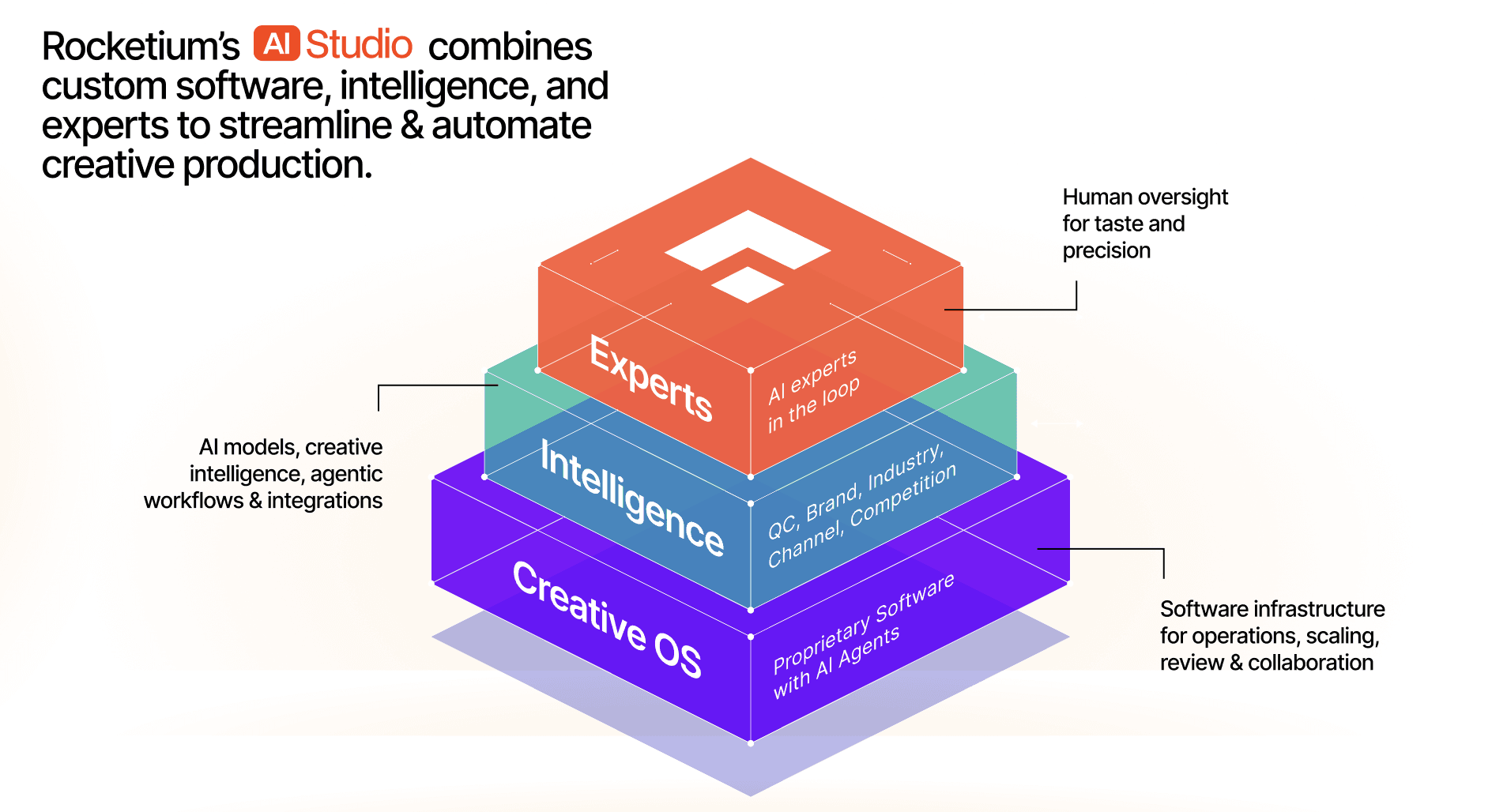
Rocketium AI Studio is a managed creative production infrastructure built for consumer brands that need on-brand assets at scale. You submit a brief. A team of AI agents and human experts delivers production-ready assets with brand compliance, retailer spec checks, and QA built into every step.
The service runs on three capabilities.
Adaptation takes a master design and versions it across 30+ formats with retailer-specific specs enforced automatically. One static asset costs one credit; a video over 15 seconds costs two credits. No seat fees, no per-user charges, no credit expiry on committed packages.
Production creates net-new assets from a brief: copy, translation, AI-generated lifestyle imagery, motion graphics video, and live-action video. Customers provide pack shots, product photos, and brand guidelines. AI Studio delivers finished assets ready for Adaptation.
Concepting delivers 2-3 master design directions as fully realized layouts across 2-3 key formats, so teams evaluate how a concept works before committing to full production. A creative agency charges $5,000-$30,000 per campaign concept with 3-6 weeks of back-and-forth. Through AI Studio's credit model, concepting runs at 15-30 credits per direction, typically $225-$450, delivered in 3-5 business days.
Who benefits most
Consumer brands with 5+ SKUs on 5+ retailers, $100M+ eCommerce revenue, and a need to produce hundreds to thousands of on-brand assets across multiple platforms. Of all six tools on this list, AI Studio is the only one that pairs human experts (creative strategists, designers, QA) with AI production at every stage. Every other option here is primarily self-serve: the output quality depends entirely on how well your team uses whichever self-serve tool you choose.
Pros
Human expert review at every stage; output is production-ready, not draft-ready
Retailer compliance enforced automatically for Amazon, Walmart, Target, and 100+ retail ad platforms
Credit-based pricing makes per-asset cost predictable at volume
30-70% savings vs. agencies on a per-asset basis
Pilot delivers results in 24-48 hours with about 40 minutes of setup time
Cons
Minimum credit package applies; best suited to teams producing 50+ assets per month
Setup involves onboarding your brand guidelines and assets into the system; allow 40 minutes of team time upfront
Pricing
Annual platform fee from $50K, with $15-25 per credit at standard rates (lower at volume). At scale, 500 adaptations/month costs roughly $7,500-$12,500/year vs. $25,000-$100,000/year with an agency.
Why choose Rocketium AI Studio over Pencil AI
Rocketium AI Studio | Pencil AI | |
|---|---|---|
Human quality review | Yes, at every stage | No |
Retailer compliance | Built in (Amazon, Walmart, Target, etc.) | Not native |
Brand enforcement | Systematic, human-supervised | AI brand guardrails, no human QA |
Video production | End-to-end, including live-action | AI video generation agents |
Workflow model | Managed service; brief in, assets out with self-serve flexibility | Self-serve agentic OS |
Asset volume sweet spot | 500+ assets/month | Enterprise; volume by plan tier |
Pricing model | Per-credit, no per-seat fees | Per-generation, tiered plans |
Support model | Dedicated account team, named contacts | Chat support; enterprise SLAs on Pro |
2. AdCreative.ai
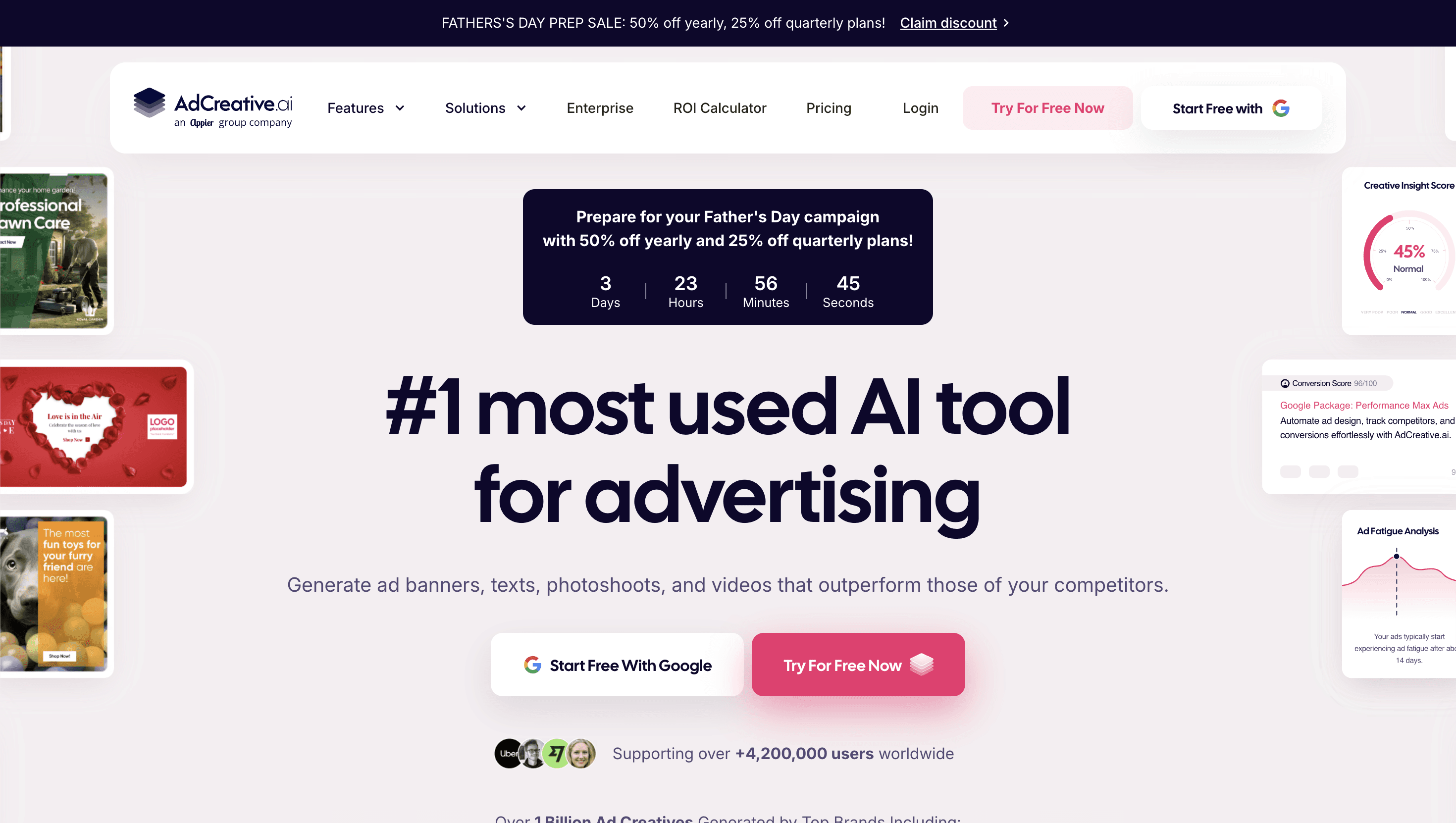
AdCreative.ai is the highest-volume self-serve AI creative tool in this comparison. It launched in 2021, now claims 3 million+ users through its parent company Appier Group (publicly listed on the Tokyo Stock Exchange), and holds a 4.3/5 rating on G2 from 792 verified reviews.
On Capterra, the picture is starkly different: 3.3/5 from 167 reviews, with 57 negative reviews and a value-for-money score of 3.1/5. The gap likely reflects audience mix: G2 skews toward power users; Capterra toward a broader SMB base. Both data points are real. For performance marketers who need ad variants fast, it removes a genuine bottleneck.
The platform's standout capability is Creative Scoring AI: it predicts which ad variants are likely to perform before you spend media budget. This is a real differentiator. Knowing which creative to prioritize before committing to spend matters more as CPMs rise.
AdCreative.ai integrates directly with Meta and Google ad accounts, so scoring uses your actual account data rather than industry averages. That account-specific signal separates it from Pencil's industry-average scoring model. It matters most if your brand or category performs differently from market norms.
Its typical workflow is straightforward. Connect your brand assets, select a format, generate variants, score them, and export the top performers. For a D2C team running Meta campaigns without a dedicated design team, that cycle takes minutes rather than days.
A solo eCommerce operator running three product lines on Meta can produce, score, and push a full month's ad variants in a single afternoon. The same task previously required a freelancer and a week of back-and-forth.
The limitations that drive teams to look elsewhere tend to cluster in three areas. Customization is restricted: 26 G2 reviews call out limited control over typography, layout, and spacing. For brands with strict visual identity standards, this is a real friction point. Output can also converge toward a generic look when millions of teams use the same underlying system.
Billing has generated consistent complaints across Trustpilot, G2, and Capterra. Users report trial-to-annual auto-subscriptions, difficulty cancelling, and charges that don't match what was agreed. One G2 reviewer documented being charged $406.80 twice after a trial they had not actively converted. Confirm billing terms in writing before entering a card.
The pricing structure is credit-based. The Starter plan begins at $39/month on monthly billing ($29/month quarterly, $20/month annually), with 10 credits per month. Credits don't roll over. Video features (UGC video, product videos, storytelling ads) require the $249/month Professional plan or higher: a 6x price jump from Starter just to access video, confirmed by multiple 2026 sources including Capterra and superscale.ai.
Pros
Creative Scoring AI predicts performance before spend; a genuine differentiator vs. most alternatives
Fast generation workflow; ad variants in minutes without a designer
Direct Meta and Google integration; scoring uses real account data, not industry averages
4.3/5 G2 rating from 792 reviews provides meaningful social proof at scale
Cons
Customization limits frustrate brands with strict visual identity standards
Capterra rates AdCreative.ai at 3.3/5 from 167 reviews with a 3.1/5 value-for-money score; billing complaints are the most common negative theme
Video features locked behind $249/month plan; a 6x jump from Starter
No retailer compliance logic; unsuitable for Amazon or Walmart asset production
Pricing
Starter from $39/month (monthly), $29/month (quarterly), $20/month (annual). Professional from $249/month. Credits reset monthly without rollover.
AdCreative.ai earns its place for performance marketers running Meta and Google campaigns who need volume and scoring without a design team behind them. For teams that need brand customization, retailer compliance, or enterprise-grade QA, it's not built for that job.
3. Smartly.io
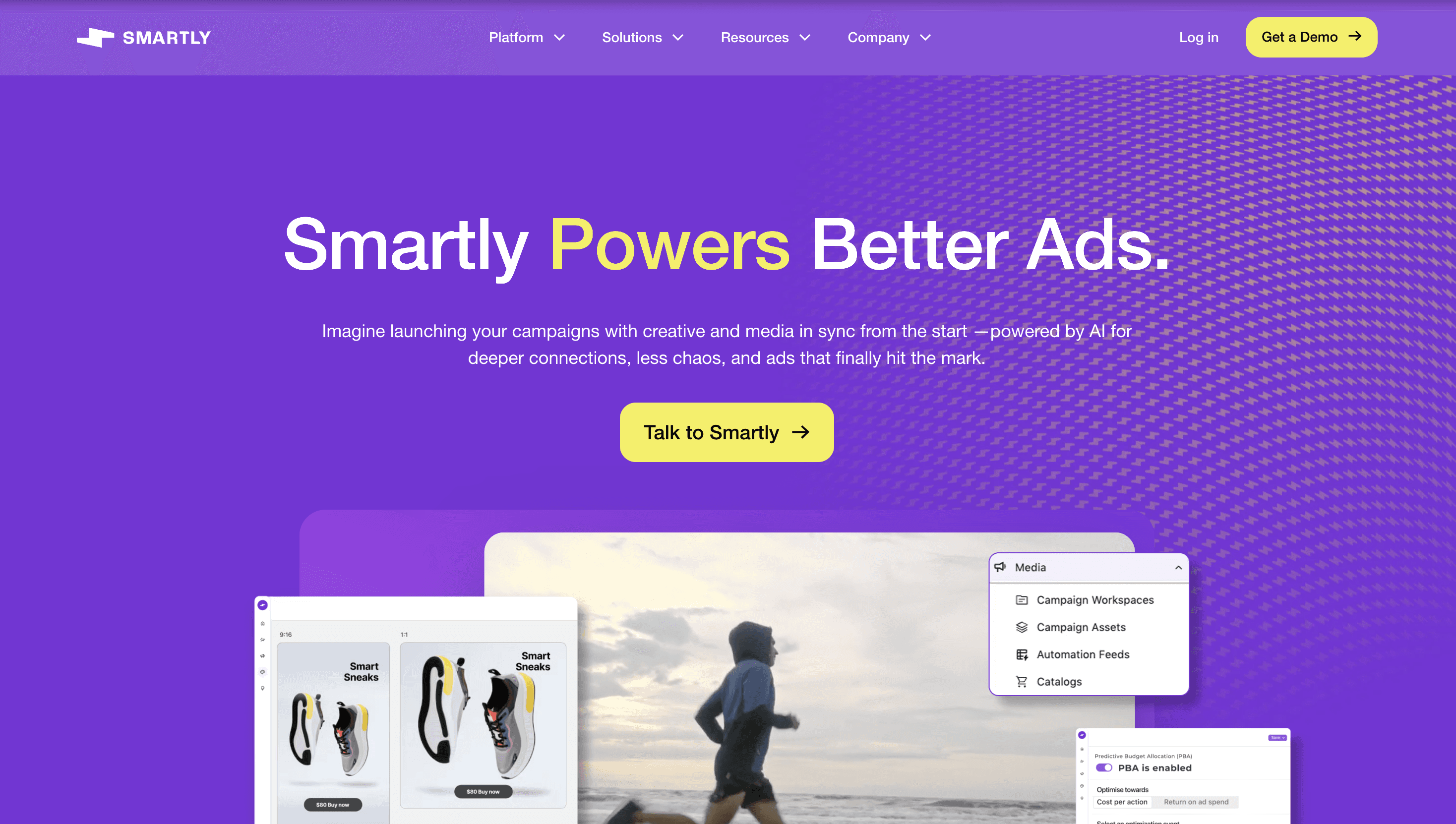
Smartly.io is an enterprise advertising platform that connects creative production, media buying, and campaign optimization in a single interface. It's built for teams managing large-scale social ad spend across Meta, TikTok, Pinterest, Snapchat, and Google.
On G2, it holds a 4.4/5 rating from 468 reviews, with 51.4% of reviewers from mid-market and 29.6% from enterprise. Fewer than 20% are from small businesses. That distribution tells you who this tool is actually for.
The architecture is different from Pencil's in one important way. Pencil separates creative production from media execution. Smartly connects them.
Creative performance data feeds directly into which variants get scaled, which audiences get targeted, and how budgets move in real time. For teams managing both creative and media buying in-house, that closed loop removes the manual handoff that typically costs days per campaign cycle.
Its dynamic creative automation system generates ad variants by pulling from templates, product catalog data, audience signals, and copy variants automatically. A fashion brand with 2,000 SKUs can have Smartly generate tailored ads for every product, audience segment, and placement combination, refreshed automatically when catalog data changes, with no designer touching each variant. Zalando, Europe's leading fashion and lifestyle platform, used Smartly to scale 8,400+ assets across 24 markets while achieving 73% faster time to market, with a lean team running both app campaigns and demand generation simultaneously.
Smartly's AI Studio, launched in 2025, has generated 1.9 million creative assets across 260+ customers, with Smartly reporting 30x faster creative production and an average 27% performance lift vs. static creatives. TikTok-native video automation was meaningfully improved in 2025, allowing feed-based video overlays on TikTok using the same template system as Meta. One workflow for both platforms rather than two separate production pipelines.
The pricing model is worth understanding before any evaluation call. Smartly charges a percentage of the ad spend managed, confirmed in Capterra's vendor-verified listing. At a representative rate of 3%, a team spending $50K/month in ads pays roughly $1,500/month in fees before contract minimums.
Independent reviews cite median annual costs of approximately $90K. The model aligns Smartly's incentives with performance. If automation doesn't improve results, the fee is hard to justify.
Cost also scales directly with ambition. Confirm exact rates and minimums during the sales process.
Pros
Creative automation and media buying in one system; creative performance data drives media decisions in real time
Dynamic creative automation handles true catalog-scale personalization across thousands of SKUs
TikTok-native video automation reduces the separate-pipeline burden for cross-channel teams
Strong enterprise customer support ratings; onboarding quality consistently praised in G2 reviews
Cons
Percentage-of-spend pricing is fully opaque; not viable for teams spending below roughly $20K/month in social ads
Steep learning curve; onboarding requires real investment of time and budget
No retailer-specific format support for Amazon, Walmart, or Target listing requirements
Contract minimums and percentage fees make cost hard to predict without a sales conversation first
Pricing
Custom enterprise pricing based on percentage of ad spend managed. Contact Smartly.io for exact rates and contract minimums.
Smartly earns its place for large cross-channel paid social operations where creative automation needs to live inside the same system as campaign management and performance optimization. If your creative challenge is retailer catalog production rather than social ad management, or if you're spending below $20K/month in social ads, it's the wrong fit.
4. Celtra
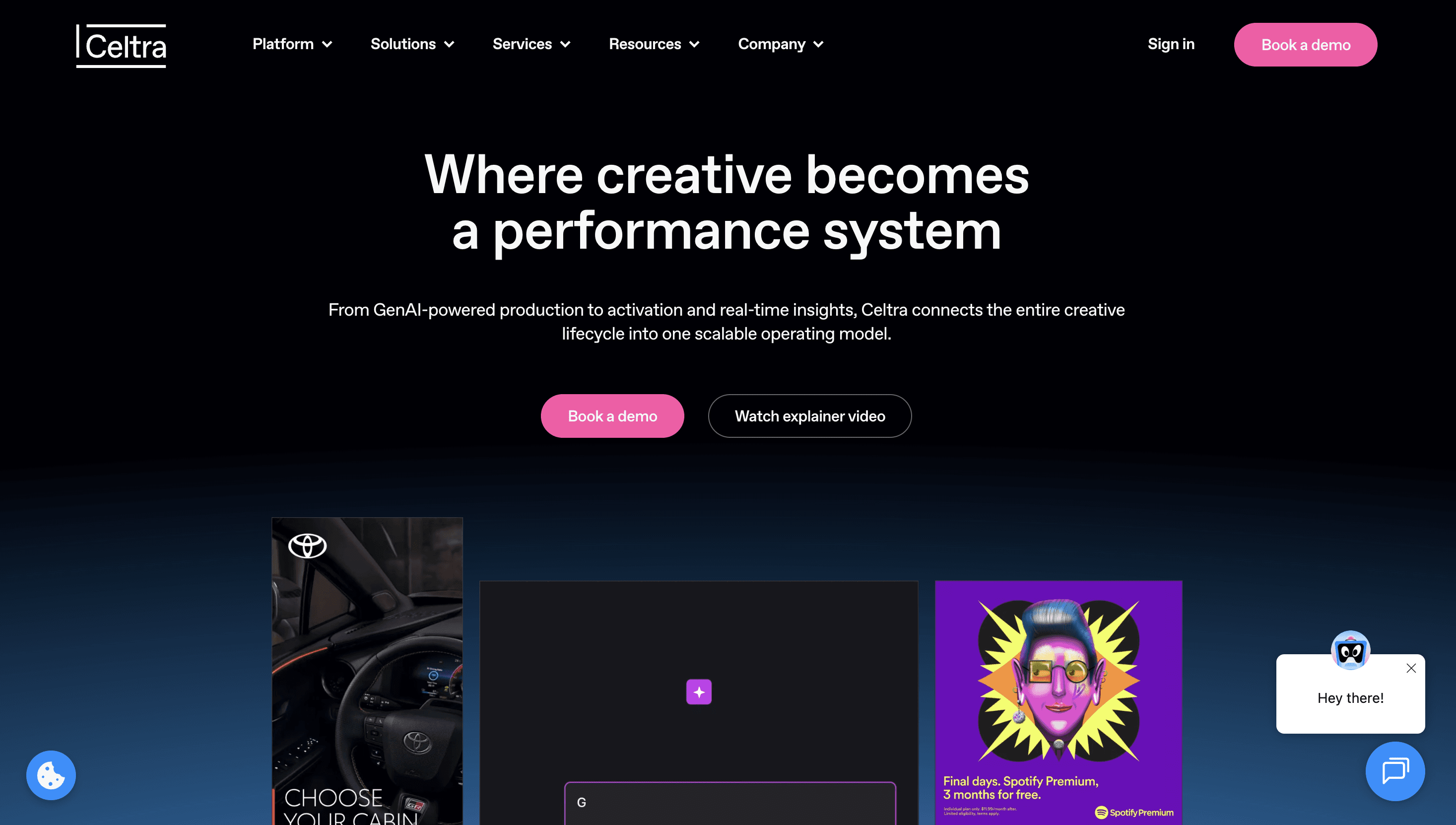
Celtra is an enterprise creative automation platform built for a specific problem: producing and trafficking display advertising at global scale, inside a governed workflow that brands, agencies, and media owners can all use simultaneously. Its customer list includes Spotify, Adidas, Unilever, Bloomberg, CNN, and NBCUniversal.
On G2, it holds a 4.4/5 rating from 397+ verified reviews. On Capterra, 93% of 286 verified reviewers rate it positively, citing ease of template reuse, multi-format production, and responsive support. In 2025, Celtra won the Netty Award for Best Marketing Automation Software.
The scale at which Celtra operates is worth stating directly. The platform supports production of over 5 million creative assets annually across 400+ enterprise customers, serving more than 120 billion ad impressions per year across 100+ DSP and SSP integrations.
For a global brand managing creative at that volume across dozens of markets and multiple agencies, the question isn't whether Celtra has the capacity. It demonstrably does. The question is whether your team's use case justifies the procurement process to get there.
The platform's core workflow centers on master templates. A creative team builds and approves one design; Celtra's automation layer generates hundreds of locale, size, and audience-specific variants without rebuilding each one manually. Dynamic Product Ads connect live catalog data to creative, so price updates, availability changes, and promotional offers appear in ads automatically. No manual creative refresh is needed when a sale goes live or a product sells out.
Celtra's rich media authoring tools go beyond what performance ad tools offer. The platform supports bespoke interactive ad formats, HTML5 banners, and video experiences that meet the technical requirements of premium publishers and OTT environments. That's relevant for brands running display beyond social, into publisher networks, streaming platforms, and connected TV. Generic social ad templates don't meet the technical specs of those environments.
Governance is where Celtra differentiates most sharply from Pencil. It offers enterprise-grade approval workflows, role-based access, audit trails, and multi-market brand safety controls. For a global brand managing creative across 20+ markets with multiple agencies involved, that governance layer reduces the coordination overhead that kills production speed.
Pros
Enterprise governance and approval workflows built for complex multi-market, multi-agency operations
5M+ creative assets produced annually; 120B+ impressions served; 100+ DSP/SSP integrations: demonstrated production scale
Rich media and HTML5 authoring supports premium display formats beyond social
Used by Spotify, Adidas, Unilever, Bloomberg, CNN, and NBCUniversal; won 2025 Netty Award for Best Marketing Automation Software
Cons
Custom enterprise pricing with no public rate card; requires a full sales process before you can evaluate fit
Some G2 reviewers note difficulty migrating templates out of the platform; rebuilding may be required when switching
Not built for performance ad generation or predictive scoring, unlike Pencil or AdCreative.ai
Overkill for teams primarily running social ads rather than multi-channel display at global scale
Pricing
Custom enterprise pricing. No public rate card. Contact Celtra for a quote based on your organization's scope and requirements.
Celtra is the right fit for consumer brand and enterprise marketing teams that need to produce display advertising at global scale, inside a governed workflow, across formats that go beyond what social ad tools support. For teams primarily focused on performance paid social or retailer-specific asset production, it's a different tool solving a different problem.
5. The Brief (formerly Creatopy)
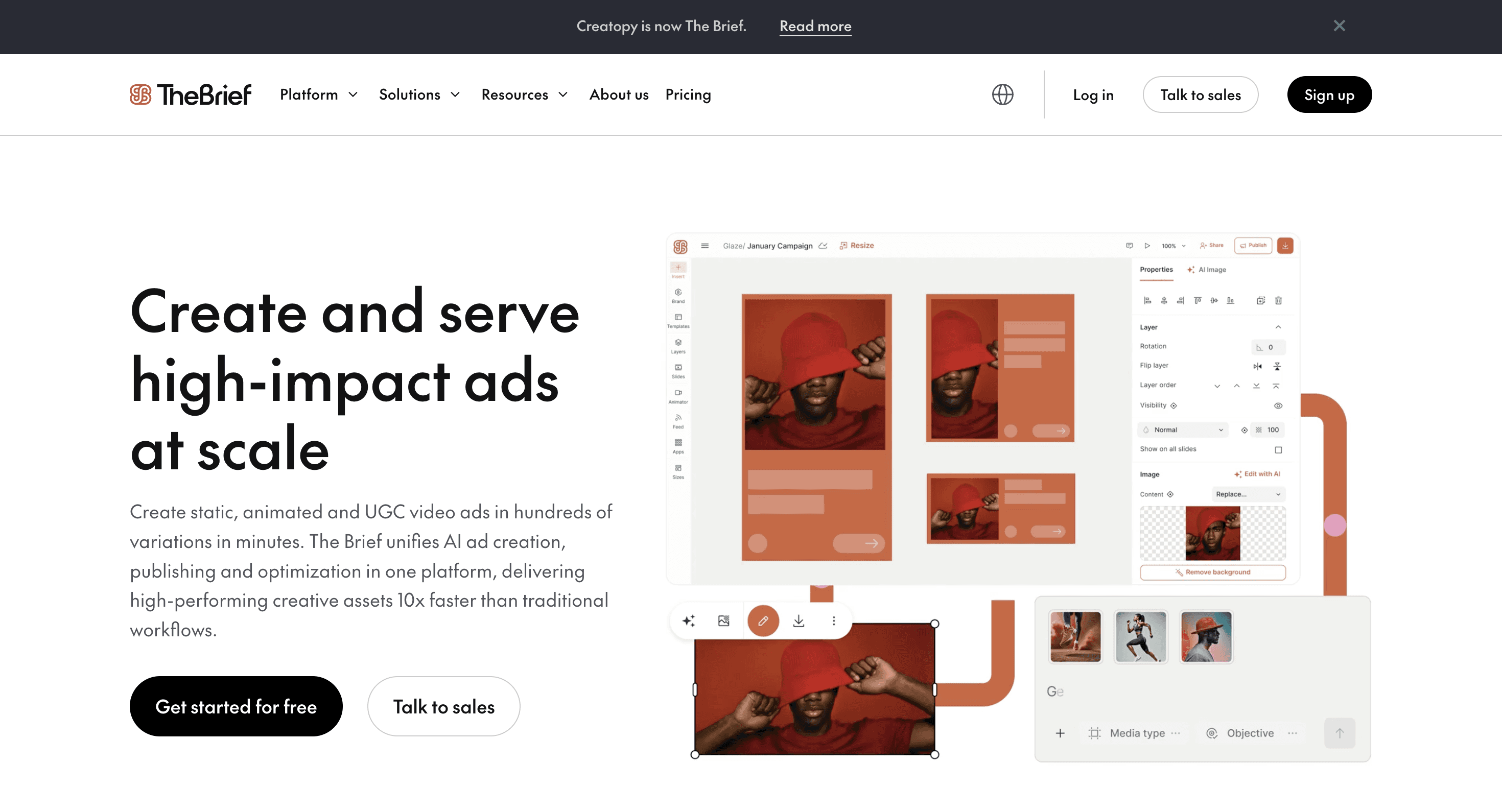
Creatopy has fully rebranded as The Brief as of 2026, and this is not a cosmetic name change. The platform has been repositioned from a display ad automation tool into a full AI-powered ad campaign platform covering discovery, creation, launch, and optimization in one workflow. The Brief describes itself as "the AI agency for marketers," with connected AI agents handling market intelligence, creative production, ad serving, and performance reporting. The underlying AI stack integrates GPT-5.1, Claude Opus 4.5, and Google Gemini 3 Pro, each model assigned to the task it handles best rather than one model handling everything.
What this means in practice is different from what Creatopy was. A team can now start with the Infinite Canvas to research competitor ads and gather inspiration, move into AI-generated image and video production from that brief, apply automated resizing across 100+ formats, and push live to Meta, Google, and LinkedIn directly from the same platform. Performance results feed back into the workflow through live dashboards, so the next creative iteration starts with actual data rather than a blank brief. That's a more complete loop than most tools in this price range offer.
The feed integration is still present and still the most relevant capability for eCommerce teams specifically. The Brief connects to Shopify stores and CSV product feeds, pulling product data into templates automatically. A team with a 500-SKU catalog can build one master template, connect the feed, and produce hundreds of format-specific ad variants in minutes. Enterprise tools like Celtra and Smartly charge significantly more to deliver equivalent feed-based personalization at catalog scale.
On G2, where The Brief holds a rating from verified reviewers, The Brief is consistently praised for multi-format smart resize, value-for-money relative to enterprise alternatives, and the Shopify integration. According to GetApp's analysis of 285 verified reviews, 83% of price-related commentary is positive. That's a strong signal for teams comparing it to tools requiring months-long sales processes.
The pricing structure, confirmed from G2's vendor-supplied pricing in June 2026, is: Pro at $36/month for a single editor (annual billing), Plus at $245/month for up to 5 editors (annual). Enterprise is custom. A free plan is available alongside the 7-day trial.
Pros
Full campaign lifecycle in one platform: research, creation, publishing, and performance tracking without switching tools
Four AI agents built on GPT-5.1, Claude Opus 4.5, and Gemini 3 Pro for different production tasks
Shopify and CSV feed integration enables catalog-level personalization at a fraction of enterprise tool pricing
Direct publishing to Meta, Google Ads, CM360, and DV360 with automated format compliance
Free plan available; Pro at $36/month (annual) is accessible for individual marketers
Cons
The rebrand from Creatopy to The Brief is recent; some third-party integrations, review listings, and documentation still reference the old product name
Persistent bugs and slow customer service flagged across G2, SaaSworthy, and Capterra reviews; this is a recurring theme dating back to the Creatopy era
No retailer compliance logic for Amazon, Walmart, or Target listing formats
Enterprise governance features (SSO, ISO audit support, API distribution) require the Enterprise plan; custom pricing applies
Pricing
Pro at $36/month (annual), $45/month (monthly). Plus at $245/month (annual, up to 5 editors). Enterprise: custom. Free plan available. 7-day free trial.
The Brief is the right fit for performance marketing teams that need AI-assisted research, multi-format ad production, feed-based personalization, and direct ad publishing in one platform, all at a price point well below enterprise tools. It doesn't solve for retailer-specific compliance or the systematic brand enforcement and human QA that brands producing at retailer scale need.
Top 6 Pencil AI alternatives
1. Rocketium AI Studio
Rocketium AI Studio is a managed creative production infrastructure built for consumer brands that need on-brand assets at scale. You submit a brief. A team of AI agents and human experts delivers production-ready assets with brand compliance, retailer spec checks, and QA built into every step.
The service runs on three capabilities.
Adaptation takes a master design and versions it across 30+ formats with retailer-specific specs enforced automatically. One static asset costs one credit; a video over 15 seconds costs two credits. No seat fees, no per-user charges, no credit expiry on committed packages.
Production creates net-new assets from a brief: copy, translation, AI-generated lifestyle imagery, motion graphics video, and live-action video. Customers provide pack shots, product photos, and brand guidelines. AI Studio delivers finished assets ready for Adaptation.
Concepting delivers 2-3 master design directions as fully realized layouts across 2-3 key formats, so teams evaluate how a concept works before committing to full production. A creative agency charges $5,000-$30,000 per campaign concept with 3-6 weeks of back-and-forth. Through AI Studio's credit model, concepting runs at 15-30 credits per direction, typically $225-$450, delivered in 3-5 business days.
Who benefits most
Consumer brands with 5+ SKUs on 5+ retailers, $100M+ eCommerce revenue, and a need to produce hundreds to thousands of on-brand assets across multiple platforms. Of all six tools on this list, AI Studio is the only one that pairs human experts (creative strategists, designers, QA) with AI production at every stage. Every other option here is primarily self-serve: the output quality depends entirely on how well your team uses whichever self-serve tool you choose.
Pros
Human expert review at every stage; output is production-ready, not draft-ready
Retailer compliance enforced automatically for Amazon, Walmart, Target, and 100+ retail ad platforms
Credit-based pricing makes per-asset cost predictable at volume
30-70% savings vs. agencies on a per-asset basis
Pilot delivers results in 24-48 hours with about 40 minutes of setup time
Cons
Minimum credit package applies; best suited to teams producing 50+ assets per month
Setup involves onboarding your brand guidelines and assets into the system; allow 40 minutes of team time upfront
Pricing
Annual platform fee from $50K, with $15-25 per credit at standard rates (lower at volume). At scale, 500 adaptations/month costs roughly $7,500-$12,500/year vs. $25,000-$100,000/year with an agency.
Why choose Rocketium AI Studio over Pencil AI
Rocketium AI Studio | Pencil AI | |
|---|---|---|
Human quality review | Yes, at every stage | No |
Retailer compliance | Built in (Amazon, Walmart, Target, etc.) | Not native |
Brand enforcement | Systematic, human-supervised | AI brand guardrails, no human QA |
Video production | End-to-end, including live-action | AI video generation agents |
Workflow model | Managed service; brief in, assets out with self-serve flexibility | Self-serve agentic OS |
Asset volume sweet spot | 500+ assets/month | Enterprise; volume by plan tier |
Pricing model | Per-credit, no per-seat fees | Per-generation, tiered plans |
Support model | Dedicated account team, named contacts | Chat support; enterprise SLAs on Pro |
2. AdCreative.ai
AdCreative.ai is the highest-volume self-serve AI creative tool in this comparison. It launched in 2021, now claims 3 million+ users through its parent company Appier Group (publicly listed on the Tokyo Stock Exchange), and holds a 4.3/5 rating on G2 from 792 verified reviews.
On Capterra, the picture is starkly different: 3.3/5 from 167 reviews, with 57 negative reviews and a value-for-money score of 3.1/5. The gap likely reflects audience mix: G2 skews toward power users; Capterra toward a broader SMB base. Both data points are real. For performance marketers who need ad variants fast, it removes a genuine bottleneck.
The platform's standout capability is Creative Scoring AI: it predicts which ad variants are likely to perform before you spend media budget. This is a real differentiator. Knowing which creative to prioritize before committing to spend matters more as CPMs rise.
AdCreative.ai integrates directly with Meta and Google ad accounts, so scoring uses your actual account data rather than industry averages. That account-specific signal separates it from Pencil's industry-average scoring model. It matters most if your brand or category performs differently from market norms.
Its typical workflow is straightforward. Connect your brand assets, select a format, generate variants, score them, and export the top performers. For a D2C team running Meta campaigns without a dedicated design team, that cycle takes minutes rather than days.
A solo eCommerce operator running three product lines on Meta can produce, score, and push a full month's ad variants in a single afternoon. The same task previously required a freelancer and a week of back-and-forth.
The limitations that drive teams to look elsewhere tend to cluster in three areas. Customization is restricted: 26 G2 reviews call out limited control over typography, layout, and spacing. For brands with strict visual identity standards, this is a real friction point. Output can also converge toward a generic look when millions of teams use the same underlying system.
Billing has generated consistent complaints across Trustpilot, G2, and Capterra. Users report trial-to-annual auto-subscriptions, difficulty cancelling, and charges that don't match what was agreed. One G2 reviewer documented being charged $406.80 twice after a trial they had not actively converted. Confirm billing terms in writing before entering a card.
The pricing structure is credit-based. The Starter plan begins at $39/month on monthly billing ($29/month quarterly, $20/month annually), with 10 credits per month. Credits don't roll over. Video features (UGC video, product videos, storytelling ads) require the $249/month Professional plan or higher: a 6x price jump from Starter just to access video, confirmed by multiple 2026 sources including Capterra and superscale.ai.
Pros
Creative Scoring AI predicts performance before spend; a genuine differentiator vs. most alternatives
Fast generation workflow; ad variants in minutes without a designer
Direct Meta and Google integration; scoring uses real account data, not industry averages
4.3/5 G2 rating from 792 reviews provides meaningful social proof at scale
Cons
Customization limits frustrate brands with strict visual identity standards
Capterra rates AdCreative.ai at 3.3/5 from 167 reviews with a 3.1/5 value-for-money score; billing complaints are the most common negative theme
Video features locked behind $249/month plan; a 6x jump from Starter
No retailer compliance logic; unsuitable for Amazon or Walmart asset production
Pricing
Starter from $39/month (monthly), $29/month (quarterly), $20/month (annual). Professional from $249/month. Credits reset monthly without rollover.
AdCreative.ai earns its place for performance marketers running Meta and Google campaigns who need volume and scoring without a design team behind them. For teams that need brand customization, retailer compliance, or enterprise-grade QA, it's not built for that job.
3. Smartly.io
Smartly.io is an enterprise advertising platform that connects creative production, media buying, and campaign optimization in a single interface. It's built for teams managing large-scale social ad spend across Meta, TikTok, Pinterest, Snapchat, and Google.
On G2, it holds a 4.4/5 rating from 468 reviews, with 51.4% of reviewers from mid-market and 29.6% from enterprise. Fewer than 20% are from small businesses. That distribution tells you who this tool is actually for.
The architecture is different from Pencil's in one important way. Pencil separates creative production from media execution. Smartly connects them.
Creative performance data feeds directly into which variants get scaled, which audiences get targeted, and how budgets move in real time. For teams managing both creative and media buying in-house, that closed loop removes the manual handoff that typically costs days per campaign cycle.
Its dynamic creative automation system generates ad variants by pulling from templates, product catalog data, audience signals, and copy variants automatically. A fashion brand with 2,000 SKUs can have Smartly generate tailored ads for every product, audience segment, and placement combination, refreshed automatically when catalog data changes, with no designer touching each variant. Zalando, Europe's leading fashion and lifestyle platform, used Smartly to scale 8,400+ assets across 24 markets while achieving 73% faster time to market, with a lean team running both app campaigns and demand generation simultaneously.
Smartly's AI Studio, launched in 2025, has generated 1.9 million creative assets across 260+ customers, with Smartly reporting 30x faster creative production and an average 27% performance lift vs. static creatives. TikTok-native video automation was meaningfully improved in 2025, allowing feed-based video overlays on TikTok using the same template system as Meta. One workflow for both platforms rather than two separate production pipelines.
The pricing model is worth understanding before any evaluation call. Smartly charges a percentage of the ad spend managed, confirmed in Capterra's vendor-verified listing. At a representative rate of 3%, a team spending $50K/month in ads pays roughly $1,500/month in fees before contract minimums.
Independent reviews cite median annual costs of approximately $90K. The model aligns Smartly's incentives with performance. If automation doesn't improve results, the fee is hard to justify.
Cost also scales directly with ambition. Confirm exact rates and minimums during the sales process.
Pros
Creative automation and media buying in one system; creative performance data drives media decisions in real time
Dynamic creative automation handles true catalog-scale personalization across thousands of SKUs
TikTok-native video automation reduces the separate-pipeline burden for cross-channel teams
Strong enterprise customer support ratings; onboarding quality consistently praised in G2 reviews
Cons
Percentage-of-spend pricing is fully opaque; not viable for teams spending below roughly $20K/month in social ads
Steep learning curve; onboarding requires real investment of time and budget
No retailer-specific format support for Amazon, Walmart, or Target listing requirements
Contract minimums and percentage fees make cost hard to predict without a sales conversation first
Pricing
Custom enterprise pricing based on percentage of ad spend managed. Contact Smartly.io for exact rates and contract minimums.
Smartly earns its place for large cross-channel paid social operations where creative automation needs to live inside the same system as campaign management and performance optimization. If your creative challenge is retailer catalog production rather than social ad management, or if you're spending below $20K/month in social ads, it's the wrong fit.
4. Celtra
Celtra is an enterprise creative automation platform built for a specific problem: producing and trafficking display advertising at global scale, inside a governed workflow that brands, agencies, and media owners can all use simultaneously. Its customer list includes Spotify, Adidas, Unilever, Bloomberg, CNN, and NBCUniversal.
On G2, it holds a 4.4/5 rating from 397+ verified reviews. On Capterra, 93% of 286 verified reviewers rate it positively, citing ease of template reuse, multi-format production, and responsive support. In 2025, Celtra won the Netty Award for Best Marketing Automation Software.
The scale at which Celtra operates is worth stating directly. The platform supports production of over 5 million creative assets annually across 400+ enterprise customers, serving more than 120 billion ad impressions per year across 100+ DSP and SSP integrations.
For a global brand managing creative at that volume across dozens of markets and multiple agencies, the question isn't whether Celtra has the capacity. It demonstrably does. The question is whether your team's use case justifies the procurement process to get there.
The platform's core workflow centers on master templates. A creative team builds and approves one design; Celtra's automation layer generates hundreds of locale, size, and audience-specific variants without rebuilding each one manually. Dynamic Product Ads connect live catalog data to creative, so price updates, availability changes, and promotional offers appear in ads automatically. No manual creative refresh is needed when a sale goes live or a product sells out.
Celtra's rich media authoring tools go beyond what performance ad tools offer. The platform supports bespoke interactive ad formats, HTML5 banners, and video experiences that meet the technical requirements of premium publishers and OTT environments. That's relevant for brands running display beyond social, into publisher networks, streaming platforms, and connected TV. Generic social ad templates don't meet the technical specs of those environments.
Governance is where Celtra differentiates most sharply from Pencil. It offers enterprise-grade approval workflows, role-based access, audit trails, and multi-market brand safety controls. For a global brand managing creative across 20+ markets with multiple agencies involved, that governance layer reduces the coordination overhead that kills production speed.
Pros
Enterprise governance and approval workflows built for complex multi-market, multi-agency operations
5M+ creative assets produced annually; 120B+ impressions served; 100+ DSP/SSP integrations: demonstrated production scale
Rich media and HTML5 authoring supports premium display formats beyond social
Used by Spotify, Adidas, Unilever, Bloomberg, CNN, and NBCUniversal; won 2025 Netty Award for Best Marketing Automation Software
Cons
Custom enterprise pricing with no public rate card; requires a full sales process before you can evaluate fit
Some G2 reviewers note difficulty migrating templates out of the platform; rebuilding may be required when switching
Not built for performance ad generation or predictive scoring, unlike Pencil or AdCreative.ai
Overkill for teams primarily running social ads rather than multi-channel display at global scale
Pricing
Custom enterprise pricing. No public rate card. Contact Celtra for a quote based on your organization's scope and requirements.
Celtra is the right fit for consumer brand and enterprise marketing teams that need to produce display advertising at global scale, inside a governed workflow, across formats that go beyond what social ad tools support. For teams primarily focused on performance paid social or retailer-specific asset production, it's a different tool solving a different problem.
5. The Brief (formerly Creatopy)
Creatopy has fully rebranded as The Brief as of 2026, and this is not a cosmetic name change. The platform has been repositioned from a display ad automation tool into a full AI-powered ad campaign platform covering discovery, creation, launch, and optimization in one workflow. The Brief describes itself as "the AI agency for marketers," with connected AI agents handling market intelligence, creative production, ad serving, and performance reporting. The underlying AI stack integrates GPT-5.1, Claude Opus 4.5, and Google Gemini 3 Pro, each model assigned to the task it handles best rather than one model handling everything.
What this means in practice is different from what Creatopy was. A team can now start with the Infinite Canvas to research competitor ads and gather inspiration, move into AI-generated image and video production from that brief, apply automated resizing across 100+ formats, and push live to Meta, Google, and LinkedIn directly from the same platform. Performance results feed back into the workflow through live dashboards, so the next creative iteration starts with actual data rather than a blank brief. That's a more complete loop than most tools in this price range offer.
The feed integration is still present and still the most relevant capability for eCommerce teams specifically. The Brief connects to Shopify stores and CSV product feeds, pulling product data into templates automatically. A team with a 500-SKU catalog can build one master template, connect the feed, and produce hundreds of format-specific ad variants in minutes. Enterprise tools like Celtra and Smartly charge significantly more to deliver equivalent feed-based personalization at catalog scale.
On G2, where The Brief holds a rating from verified reviewers, The Brief is consistently praised for multi-format smart resize, value-for-money relative to enterprise alternatives, and the Shopify integration. According to GetApp's analysis of 285 verified reviews, 83% of price-related commentary is positive. That's a strong signal for teams comparing it to tools requiring months-long sales processes.
The pricing structure, confirmed from G2's vendor-supplied pricing in June 2026, is: Pro at $36/month for a single editor (annual billing), Plus at $245/month for up to 5 editors (annual). Enterprise is custom. A free plan is available alongside the 7-day trial.
Pros
Full campaign lifecycle in one platform: research, creation, publishing, and performance tracking without switching tools
Four AI agents built on GPT-5.1, Claude Opus 4.5, and Gemini 3 Pro for different production tasks
Shopify and CSV feed integration enables catalog-level personalization at a fraction of enterprise tool pricing
Direct publishing to Meta, Google Ads, CM360, and DV360 with automated format compliance
Free plan available; Pro at $36/month (annual) is accessible for individual marketers
Cons
The rebrand from Creatopy to The Brief is recent; some third-party integrations, review listings, and documentation still reference the old product name
Persistent bugs and slow customer service flagged across G2, SaaSworthy, and Capterra reviews; this is a recurring theme dating back to the Creatopy era
No retailer compliance logic for Amazon, Walmart, or Target listing formats
Enterprise governance features (SSO, ISO audit support, API distribution) require the Enterprise plan; custom pricing applies
Pricing
Pro at $36/month (annual), $45/month (monthly). Plus at $245/month (annual, up to 5 editors). Enterprise: custom. Free plan available. 7-day free trial.
The Brief is the right fit for performance marketing teams that need AI-assisted research, multi-format ad production, feed-based personalization, and direct ad publishing in one platform, all at a price point well below enterprise tools. It doesn't solve for retailer-specific compliance or the systematic brand enforcement and human QA that brands producing at retailer scale need.
What to consider before you decide
Three factors separate tools that look similar on a feature comparison.
Managed vs. self-serve. Every tool on this list except AI Studio is primarily self-serve. Self-serve tools give you control and speed. A managed system with self-serve flexibility gives you quality assurance and compliance at the cost of a review cycle. For brands where a compliance error on a live Amazon listing costs real revenue, the managed model pays back quickly.
Social ad focus vs. retailer focus. Pencil, Smartly, and AdCreative.ai are built for paid social. The Brief and Celtra cover display. Only AI Studio is built specifically for retailer-compliant creative across Amazon, Walmart, Target, and the rest of the retail media ecosystem. That's not a marketing claim. It's reflected in AI Studio's intelligence layer, which encodes retailer platform rules and spec requirements directly.
Pricing model and budget threshold. Pencil's Core plan starts at $14/month but caps at 50 generations, a very low ceiling for any consumer brand team producing at volume. Smartly and Celtra require custom enterprise quotes. AI Studio requires a $50K annual commitment. AdCreative.ai starts under $40/month on monthly billing. The Brief starts at $29/month for solo users on annual billing. Know your monthly asset volume before comparing pricing tiers, because the apparent cost difference between plans changes significantly once you factor in volume and per-generation or per-credit overages.
Your next move
Pencil AI is a well-built platform. If it fits your workflow, your channel mix, and your team's capacity to master a complex tool, there's no reason to leave it. Most teams evaluating alternatives have a specific gap: retailer compliance that Pencil doesn't cover, generation volume that the Core and Growth plans can't sustain, or a need for managed production that removes the self-serve burden entirely.
The right alternative depends on where your production breaks down. If it's campaign management tied to creative performance, Smartly. If it's enterprise display governance at global scale, Celtra. If it's fast multi-format versioning with feed-based personalization, The Brief.
For consumer brands producing retailer-compliant creative at volume, the self-serve model has a ceiling. Every tool on this list except AI Studio puts the quality burden on your team. That's fine when volume is low. It stops working when the brief-to-approval cycle is the bottleneck on every campaign.
What to consider before you decide
Three factors separate tools that look similar on a feature comparison.
Managed vs. self-serve. Every tool on this list except AI Studio is primarily self-serve. Self-serve tools give you control and speed. A managed system with self-serve flexibility gives you quality assurance and compliance at the cost of a review cycle. For brands where a compliance error on a live Amazon listing costs real revenue, the managed model pays back quickly.
Social ad focus vs. retailer focus. Pencil, Smartly, and AdCreative.ai are built for paid social. The Brief and Celtra cover display. Only AI Studio is built specifically for retailer-compliant creative across Amazon, Walmart, Target, and the rest of the retail media ecosystem. That's not a marketing claim. It's reflected in AI Studio's intelligence layer, which encodes retailer platform rules and spec requirements directly.
Pricing model and budget threshold. Pencil's Core plan starts at $14/month but caps at 50 generations, a very low ceiling for any consumer brand team producing at volume. Smartly and Celtra require custom enterprise quotes. AI Studio requires a $50K annual commitment. AdCreative.ai starts under $40/month on monthly billing. The Brief starts at $29/month for solo users on annual billing. Know your monthly asset volume before comparing pricing tiers, because the apparent cost difference between plans changes significantly once you factor in volume and per-generation or per-credit overages.
Your next move
Pencil AI is a well-built platform. If it fits your workflow, your channel mix, and your team's capacity to master a complex tool, there's no reason to leave it. Most teams evaluating alternatives have a specific gap: retailer compliance that Pencil doesn't cover, generation volume that the Core and Growth plans can't sustain, or a need for managed production that removes the self-serve burden entirely.
The right alternative depends on where your production breaks down. If it's campaign management tied to creative performance, Smartly. If it's enterprise display governance at global scale, Celtra. If it's fast multi-format versioning with feed-based personalization, The Brief.
For consumer brands producing retailer-compliant creative at volume, the self-serve model has a ceiling. Every tool on this list except AI Studio puts the quality burden on your team. That's fine when volume is low. It stops working when the brief-to-approval cycle is the bottleneck on every campaign.
Recent Posts
Explore expert insights, creative strategies, and practical guides to help your brand create better content and scale faster.