Top 5 AI tools for scaling creative production in 2026
Research
Claron Kinny
|
Growth Marketer
What AI tools for scaling creative production must do
✦ Production from a brief, not just resizing
The bottleneck is usually net-new assets. Tools that only adapt existing templates don't solve volume. Without production, every new creative direction still needs an agency or freelancer.
✦ Brand enforcement at the asset level
A brand kit with manual checking is a checklist dressed up as enforcement, and at 500 assets per campaign the checklist breaks. Guidelines, color palettes, typography, logo placement, and safe-area specs should be ingested once and applied programmatically on every output.
✦ Retailer and ad platform rule coverage
Amazon, Walmart, Target, Meta, TikTok, and DV360 have different specs that change without warning. A platform that doesn't auto-check against these rules pushes the compliance burden back to the team.
✦ Adaptation across formats from one master
The efficiency gain at scale comes from producing one master well, then versioning it automatically. Tools that require manual resizing per format cap throughput at what a human can click through.
✦ Human review before assets ship
Autonomous publishing is a bad idea. Assets need a named person signing off, even when the AI has already scored them against brand and platform rules.
✦ Pricing that scales with volume
Per-seat pricing punishes teams for inviting stakeholders into the workflow. Credit-based or volume-linked pricing aligns cost to output. It's the biggest cost-structure gap between enterprise-ready tools and SMB tools.
Top 5 AI tools for scaling creative production
1. Rocketium AI Studio
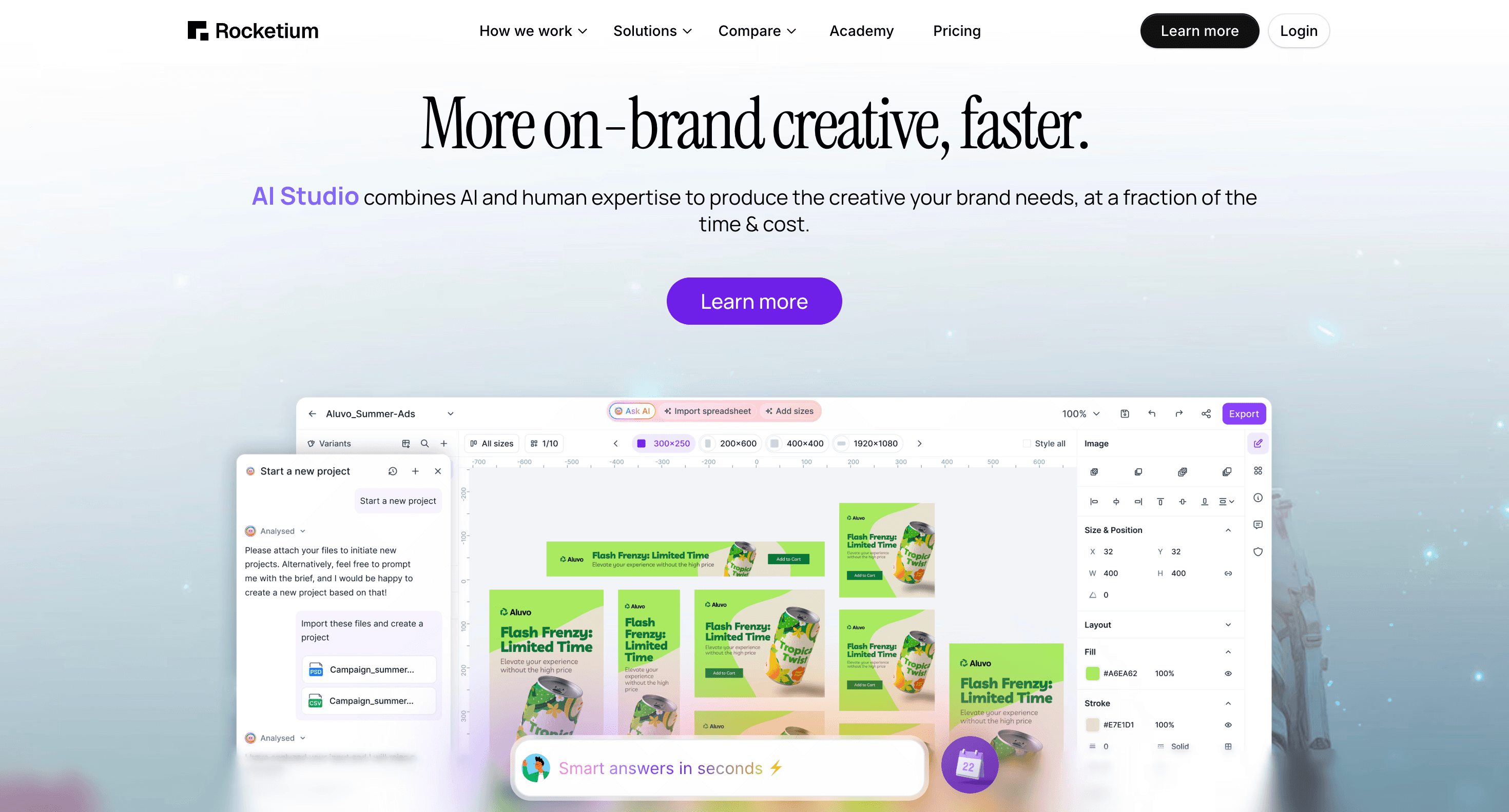
Rocketium AI Studio is the creative platform for consumer brands. AI agents handle adaptation (resizing a master across every required format), production (net-new assets from a brief including copy, transcreation, imagery, and video), and concepting (master layouts and storyboards). An Intelligence layer ingests brand guidelines, retailer rules, and platform specs and applies them programmatically on every asset.
➤ Where it wins
Retail-first rule coverage across retail ad platforms. AI agents orchestrate multiple LLMs and design software in one workflow, so teams don't stitch point tools together. Credit-based pricing that doesn't penalize adding seats.
➤ Trade-offs
Rocketium AI Studio is demo-led, so evaluation needs a conversation rather than a self-serve trial. The $50K annual platform floor rules it out for brands under ~$10M revenue.
➤ Pricing
$50K annual platform fee. The fee covers the full AI agent layer for adaptation, production, and concepting. It also covers the Intelligence layer that ingests brand guidelines and applies 100+ retailer rule sets programmatically on every asset. Access to the Experts team, including AI Engineers, Creative Strategists, Designers, and QA, is included as strategic support and quality review, not a paid add-on.
➤ Best for
Consumer retail brands with $100M+ revenue, 5+ brands across 5+ retailers, ready to move production in-house without growing headcount. User review score: 4.6/5 on GetApp across 74 reviews (value for money 4.7, customer support 4.7).
2. The Brief (formerly Creatopy)
The Brief rebranded from Creatopy on October 8, 2025, repositioning from a banner automation platform into what it publicly calls "the first AI agency for marketers." The platform runs four AI agents across Discover (competitive and market intelligence), Create (ad variants, copy, imagery, video), Launch (direct publishing to Meta, Google, TikTok, and Pinterest, with dynamic product catalogs), and Optimize (live performance data and AI chat, powered by Anthropic's Claude Sonnet 4.0).
Where it wins. Time-to-first-asset is short, and the new AI agent layer closes part of the production gap the old Creatopy had. Self-serve onboarding, a free tier, and a 7-day trial make it an easy fit for individual creators, small teams, and the 800+ agencies The Brief publicly reports as customers. Direct ad publishing to Meta, Google, TikTok, and Pinterest from the same workflow as the creative editor is a step up from the banner-first Creatopy era. For teams whose entire production scope is paid social and paid search, The Brief can cover more ground than its predecessor did.
Trade-offs. Retail platform coverage is still narrow. Publishing covers Meta, Google, TikTok, and Pinterest. Amazon, Walmart, and Target retail ad platforms sit outside that scope. Brand governance sits at brand-kit level rather than programmatic rule ingestion, so manual checking returns at asset #500. Per-seat pricing caps the Team plan at 10 seats, and anything larger goes to Enterprise, which has no public rate card. The AI agency positioning is also new, so enterprise proof points are early-stage compared to Celtra's or Smartly.io's track record. Public review data still sits under the Creatopy name for now.
Pricing. Free tier at $0 with 1 seat and up to 5 designs. Pro at $29 per month (annual billing) with unlimited designs, 5 Brand Kits, AI Resize, and a 7-day trial. Team at $49 per seat per month (annual), covering up to 10 seats, 20 Brand Kits, and 2.4M ad-serving impressions. Enterprise is custom. Legacy Vendr transaction data for the Creatopy name shows an average annual spend of ~$3,000 across completed deals (range $50–$6,500), though that figure pre-dates the AI agency pivot and the new Team and Enterprise tiers.
Best for. Individual creators, small in-house marketing teams, and agencies producing ads for Meta, Google, TikTok, and Pinterest, without heavy retail platform or brand governance requirements. User review score: 4.5/5 aggregated across 3,292 reviews on G2, Capterra, and TrustPilot per Tekpon (data reflects the Creatopy product prior to the October 2025 rebrand).
3. Celtra
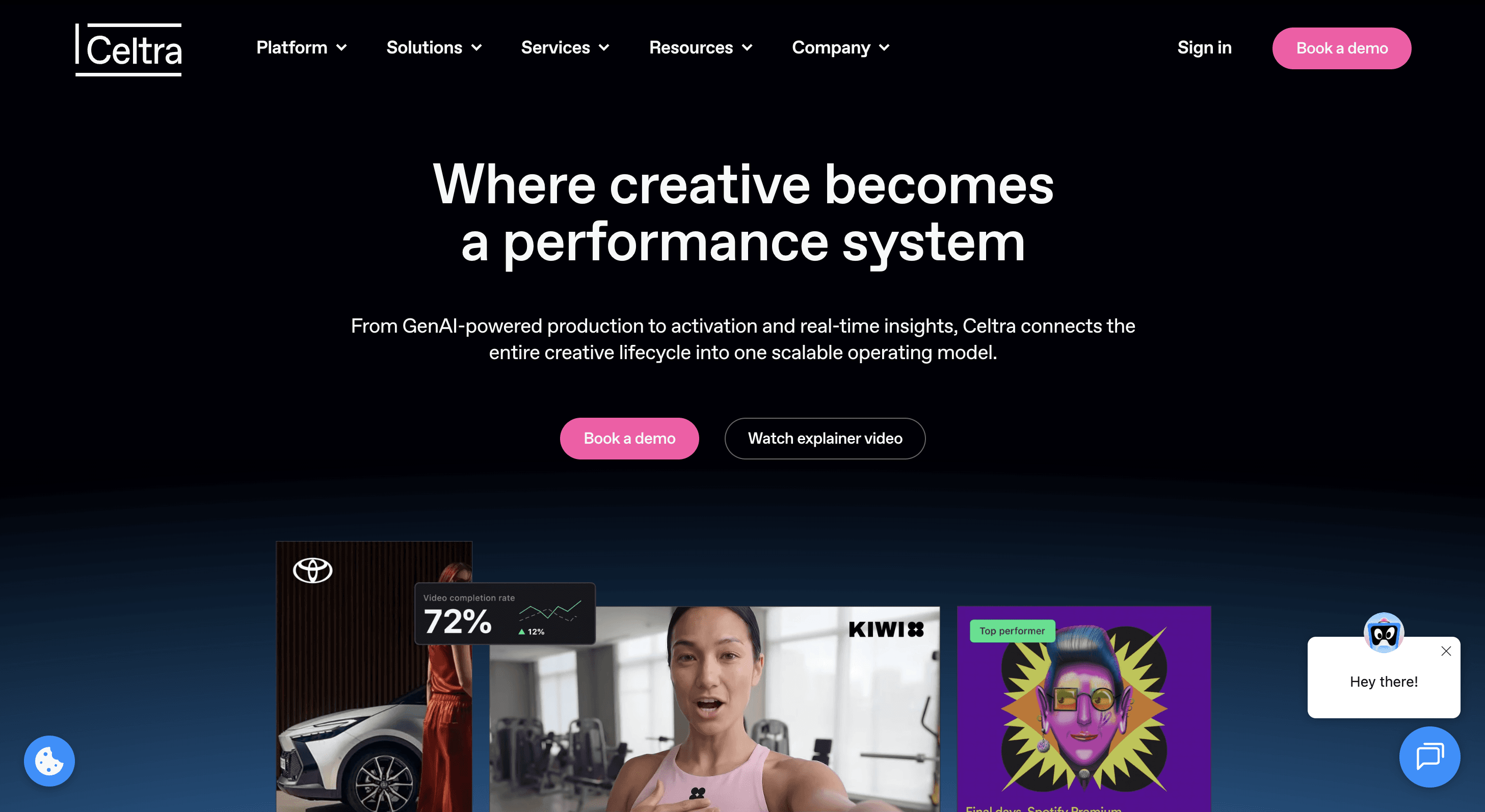
Celtra is an enterprise creative automation platform with a strong Dynamic Creative Optimization (DCO) focus. It's built for display, programmatic, and social creative that varies by audience, placement, or context, with its own ad server and integrations into major DSPs like DV360 and The Trade Desk.
➤ Where it wins
DCO for programmatic display is the strongest fit. Celtra supports data-feed-driven variant logic, so one master produces thousands of audience or context-specific versions. Governance controls are enterprise-grade, with approval workflows and version control baked in. Integrations with ad servers and DSPs are deep, and reporting ties creative versions back to media performance. For enterprise brands with heavy programmatic display spend and creative ops capacity to run the platform, Celtra is a specialist fit few others match.
➤ Trade-offs
Display and social-first. Retail marketplace content like Amazon A+ pages and Walmart PDPs (product detail pages) isn't the core strength, and the retailer rule coverage is thinner than a retail-first platform. The self-serve model also puts the production burden on internal teams, which assumes a certain level of creative ops maturity. Setup is measured in weeks, and onboarding typically requires a services engagement. Smaller teams often find the platform too heavy for their volume.
➤ Pricing
Enterprise license with no public rate card. Median buyer pays ~$73,250 per year according to Vendr, with a reported range from $32,500 to $159,000. No self-serve trial. Contracts are typically annual with services-led onboarding.
➤ Best for
Enterprise brands with heavy programmatic display spend, existing DCO workflows, and an in-house creative ops team that can own the platform end to end. User review score: 4.2/5 on GetApp across 286 verified reviews.
4. Smartly.io
What it is. Smartly.io is a creative and media platform tied directly to paid social activation, primarily Meta, TikTok, Pinterest, and Snap. It combines creative production with media buying and optimization in one workflow, and integrates tightly with product catalogs for dynamic product ads.
Where it wins. The integration between creative and media buying is Smartly.io's thesis and its strongest differentiator. For performance teams running high-volume paid social, the loop between producing a variant, launching it, measuring performance, and iterating is tightest here. Meta and TikTok workflows are well-developed, with catalog-driven dynamic product ads, auto-scaling budget rules, and bulk variant generation from a single template. Reporting ties creative versions directly to media outcomes, which matters for performance teams running continuous A/B tests.
Trade-offs. Paid social-first. Retail marketplace content, PDP imagery, and non-media assets aren't the primary design. Brands whose creative production need is broader than paid social will end up with a gap, and the platform's price point assumes significant paid social spend. For retail-heavy D2C brands with exposure across Amazon, Walmart, and Target, Smartly.io fits alongside a production platform, not instead of one. Onboarding also requires services support, so time-to-value is longer than self-serve tools.
Pricing. Enterprise license tied to ad spend volume. Reported minimums of $4,000–$5,000 per month, with contracts commonly priced at 1–5% of ad spend as volume scales. No self-serve trial. Onboarding is services-led and multi-month for advanced automation features.
Best for. Performance marketing teams with large paid social budgets where creative and media activation sit in one workflow. G2 rating: 4.4/5 across approximately 468 reviews.
5. Pencil (Brandtech)
What it is. Pencil is a GenAI-native ad variant generation tool aimed at performance marketers, now part of the Brandtech Group. It's built around generative workflows that produce ad variants from a brief, a product image, or an existing ad, then predict performance before spend.
Where it wins. Fast variant testing on paid social. For performance teams running aggressive A/B tests on top-of-funnel Meta and TikTok placements, Pencil's GenAI-first workflow produces volume quickly from a prompt or an input asset. The performance prediction layer scores variants before launch, which helps teams prioritize what to actually spend on. For a team that already has strong brand documentation and just needs variant volume at speed, Pencil removes a real step.
Trade-offs. Brand governance is limited compared to platforms with programmatically ingested guidelines. The industry reality on raw GenAI still holds: 10 to 30 prompts are often needed to land one acceptable, on-brand asset. That hit rate is workable for exploration and expensive for production at scale, especially for regulated categories or brands with strict visual systems. Retail platform coverage is narrower than retail-first platforms, so Pencil rarely stands alone for brands producing across Amazon, Walmart, or Target. Output quality is also closely tied to input brief quality.
Pricing. Self-serve plans are public. Core at $11/month billed annually ($14 month-to-month) covers 50 generations and 1 workspace. Growth at $44/month billed annually ($55 month-to-month) covers 250 generations and unlimited workspaces. Pro is custom enterprise pricing with unlimited generations, IP assignment, data ring-fencing, and dedicated customer success. A free tier is available for initial exploration.
Best for. Performance teams running GenAI-led variant tests on top-of-funnel paid social, with lower brand governance requirements. Social proof: Brandtech Group reports Pencil is used by brands including Lancel, Barilla, and William Grant & Sons as part of its GenAI ad production stack [NEEDS SOURCE: public G2 rating not available at time of writing].
How to choose the right tool for your stage
These tools don't substitute cleanly. Many enterprise brands run two in combination.
Start with volume and platform mix. If asset volume spans 5+ retailers and multiple ad platforms, Rocketium AI Studio is the strongest fit because retail coverage is the design center. If the bottleneck is media activation rather than production, Smartly.io fits. If the need is display-only and programmatic-heavy, Celtra is the specialist. For GenAI tests on paid social without strict brand governance, Pencil works. For sub-$10M brands producing a handful of display ads a month, Creatopy is enough.
The honest read: most enterprise retail teams end up running Rocketium AI Studio for Production and Adaptation, plus a media-side tool for activation. Trying to make one tool do both is where evaluations usually go wrong.
Conclusion
The right tool matches asset volume, retailer coverage, and brand control requirements. For consumer retail brands producing thousands of assets across retailers and platforms, Rocketium AI Studio is the strongest fit in this comparison.
See how MegaFood refreshed 1,100 assets in under 4 weeks while saving 40% versus freelancers. Book a 20-minute Rocketium AI Studio demo.