

Key takeaways
|
|---|
An approved campaign can still take weeks to reach every retailer. The hero visual is ready, but the Amazon gallery needs updating, Walmart requires different creative, and the paid media team is waiting on another round of assets.
Sometimes the bottleneck starts earlier. The team hasn't decided which product benefit to emphasize, what shoppers need to see, or whether the proposed creative direction is worth producing.
Both situations call for creative expertise, but not necessarily the same service.
Search for ecommerce creative services, and you'll find photography studios, Amazon agencies, design subscriptions, enterprise production networks and managed AI creative partners. They differ in what they create, how they work, and how much responsibility they take off your team.
We've compared nine ecommerce creative service providers for consumer brands to help you decide which fits your requirements.
9 ecommerce creative services compared at a glance
Provider | Best for | Choose this provider when... | Pricing model |
|---|---|---|---|
Rocketium AI Studio | Research-informed creative development and ecommerce production | You need help developing creative ideas and producing or scaling assets across retailers and performance channels | Custom-scoped |
Superside | Broad managed creative services | Your team needs access to multiple creative disciplines through an ongoing service | Subscription |
ManyPixels | Recurring graphic design | You have a steady queue of banners, ads, and other graphic design requests | Subscription |
WPP Production | Global production | You're coordinating complex campaign production across countries | Enterprise contract |
OLIVER | Embedded creative teams | You want external creative capabilities operating closely within your business | Custom |
Pattern | Marketplace management and creative | You need marketplace services beyond standalone creative production | Custom |
Kenji ROI | Amazon listing content | You need a defined Amazon photography, infographic, or A+ Content project | Project packages |
soona | Product photography and video | You need new product imagery or footage without arranging a traditional shoot independently | Per asset and membership |
Front Row | Category-specialist ecommerce marketing | You want creative connected to marketplace and marketing services, particularly in beauty or wellness | Custom |
These aren't interchangeable services. Nor is the provider with the widest offering automatically the best choice.
The more useful question is how closely its capabilities match the work your team needs to complete.
What ecommerce creative services should you compare?
Ecommerce creative work generally involves four connected activities.
Creative strategy and concepting determine what the work should communicate and which creative direction to develop. The process may include shopper research, brand context, competitor analysis, and previous creative performance.
Design translates the chosen direction into layouts, key visuals, listing graphics, banners and other executions.
Production creates new assets such as product photography, video, lifestyle compositions, copy and other content.
Creative scaling prepares creative for the products, placements and markets where it will appear. This includes adaptation, creative variation, and localization, which serve different purposes.
Adaptation takes one approved master visual into different sizes and formats. Creative variation changes elements such as product imagery, messaging, or offers. Localization adjusts content for languages and markets.
Those distinctions matter when choosing between a managed service and creative automation tools for ecommerce, where your own team may still be responsible for much of the production workflow.
We evaluated the nine providers based on their published capabilities, operating models, relevant experience, channel specialization, quality controls, and work left with the customer.
G2 ratings are included where available, using the draft's October 2026 review snapshot. Ratings and review counts should be refreshed from the corresponding product listing before publication.
1. Rocketium AI Studio
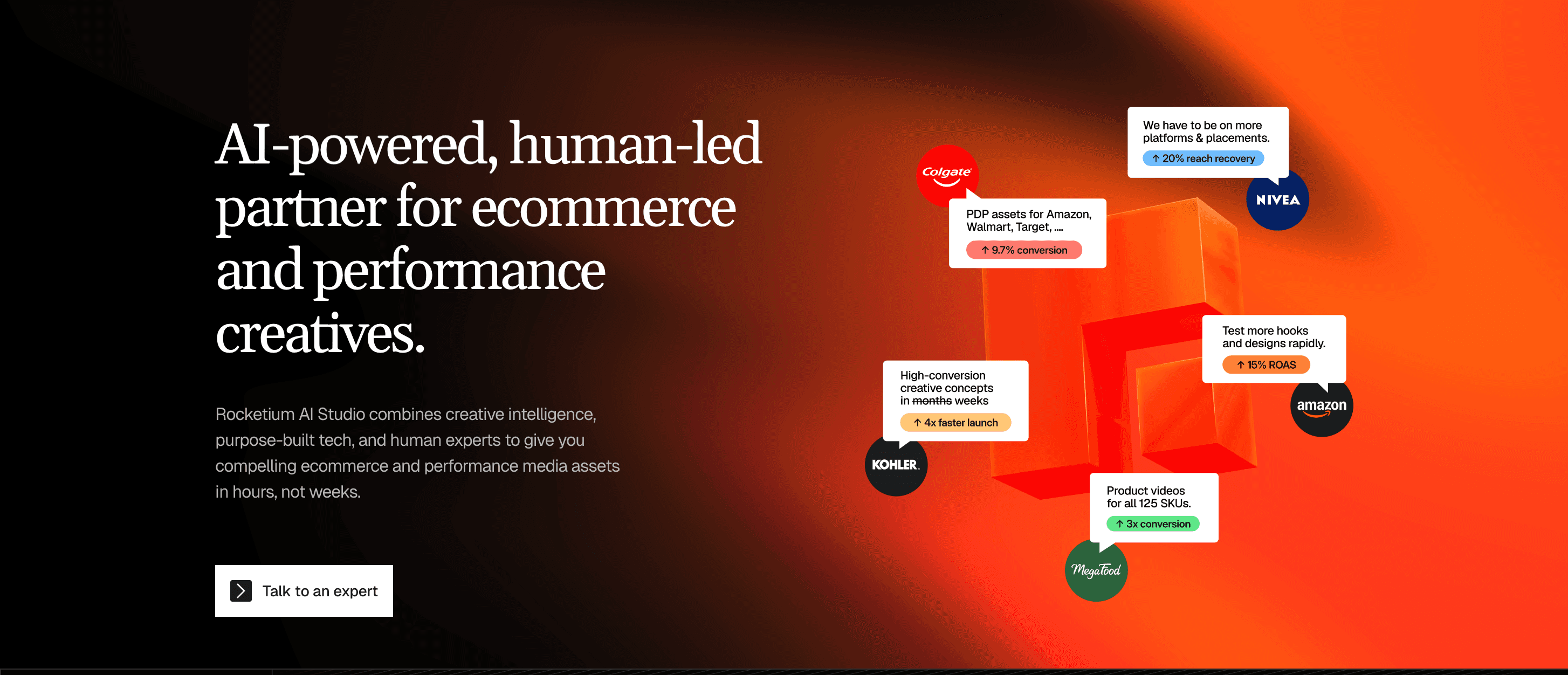
Best for: Brands needing research-informed creative concepts, production and scaling across ecommerce, retailer media and performance channels.
AI Studio is our AI-native creative partner. We combine creative intelligence, AI agents, design software and human expertise to develop and deliver creative.
Our work can begin before there's an approved master design.
We analyze customer reviews, competitor advertising, category conversations, product detail pages, brand guidelines, and historical creative performance to understand what the creative should communicate.
Those findings inform Concepting, where we develop visual directions, key layouts and storyboards. Our creative strategy framework explains how audience needs, competitor claims and brand truths can shape creative decisions.
From there, our teams produce new assets and help scale approved creative for different formats, products and markets.
How this works in practice
To show how research shapes creative before production begins, we ran Neutrogena through our Brand Intelligence prototype. It’s an outside-in analysis of 2,232 Meta ads across eight skincare brands, Amazon listings, and SPF discussion themes from Reddit.
The headline finding: Neutrogena has the trust. The next unlock is sharper proof at the point of choice.
Meta: Neutrogena’s ads lean on benefits. Competitors use more authority, science and friction-specific angles. Neutrogena’s ads ran 7.4 days on average, against 38.3 for La Roche-Posay.
Amazon: 25 SKUs average 4.64 stars across 517,110 reviews. The product page now has to do more of the conversion work, through skin-tone proof, texture demos and A+ education.
SPF: Ultra Sheer wins or loses on daily-use blockers: white cast, greasy feel, pilling, eye sting, acne fear and reapplying over makeup. The last one is unanswered on the page today.
From there, the analysis borrows ideas from outside skincare and turns them into three creative routes and a pre-production QA checklist.
What published customer results show
MegaFood's relaunch demonstrates a different part of the offering: recurring ecommerce production.
The brand needed to update creative across a large product portfolio. MegaFood was able to refresh more than 100 products in approximately a month while lowering costs by 30% compared with its earlier approach.


They also illustrate why scaling creative production requires more than generating new designs. Briefing, production, brand review, and final delivery must work together.
Strongest at: Research-informed Concepting, ecommerce creative production, and scaling across retailers, products, and placements.
Right for: Brands managing several product lines, recurring creative requirements, or increasing production demand.
What your team still manages: Business objectives, approved product claims, and final creative decisions. We can work alongside your existing agency or internal team.
Main limitation: AI Studio isn't a media-buying service or a specialist physical film-production company.
Pricing: Custom-scoped according to the work required.
Design subscriptions
Design subscriptions give marketing teams recurring access to creative professionals.
They can work well when demand is reasonably predictable, and the organization needs more design capacity without managing separate freelancers for every assignment.
The important distinction is what each subscription includes and how much work its team can complete.
2. Superside

Best for: Organizations outsourcing a wide variety of creative work through a managed service.
Superside combines creative professionals with AI-assisted workflows and collaborative software.
Its service offering spans campaign design, advertising, video, motion graphics, presentations, brand work and creative strategy.
It also offers concept development and customer-specific AI capabilities, making it broader than a conventional design subscription.
A marketing team producing campaigns, social content and supporting sales materials may find that range useful. Instead of managing several vendors, it can work through an established creative service relationship.
Strongest at: Broad creative disciplines, managed execution, campaign support and access to specialist talent.
Right for: Marketing teams with recurring requirements across several formats.
What your team still manages: Brand objectives, briefing and approvals. Retailer-specific responsibilities depend on the engagement.
Main limitation: The subscription commitment and available service capacity must match your workload. Ask for relevant samples if Amazon PDPs, A+ Content, or Walmart assets make up a large share of production.
Pricing: Flex starts at $15,000 per month with an annual commitment, alongside a published $1,000 monthly software fee.
For buyers comparing subscriptions with technology-led models, our guide to AI tools for scaling creative production examines how the production responsibilities differ.
3. ManyPixels

Best for: Teams needing steady graphic design support.
ManyPixels offers subscription-based design services for marketing materials, social content, advertising graphics, banners, and related work.
Customers submit design requests, and work is completed according to the capacity and services included in their plan.
For an ecommerce team with established brand guidelines, this can be a practical alternative to briefing freelancers for every promotional graphic. It is less dependent on the team needing a new strategic concept for every request.
Strongest at: Recurring graphic design and routine marketing materials.
Right for: Ecommerce businesses and marketing teams with predictable design demand.
What your team still manages: Creative direction, product photography, final approval, and specialized requirements outside the plan.
Main limitation: Unlimited requests don't mean unlimited simultaneous output. Production capacity, turnaround, and supported formats need to be checked against your actual workload. If you routinely need hundreds of assets across retailers, ask how those requests would be scheduled and reviewed.
Pricing: Subscription plans, with current prices and capacity varying by tier.
Enterprise production networks and embedded teams
WPP Production and OLIVER address larger creative operations, but their models differ.
WPP Production provides global production resources. OLIVER builds and operates teams integrated into the customer's business.
4. WPP Production
Best for: Global brands managing complex production across countries and campaign formats.
WPP Production launched in 2026, bringing together Hogarth and production capabilities across WPP's agency network.
Its offering includes original production, post-production, CGI, creative technology, virtual production and localization.
This model is relevant when campaigns require several specialist production disciplines.
A global product launch might involve live-action footage, CGI product work, editing and localized executions for different markets.
Strongest at: Enterprise production, complex campaigns, specialist production capabilities and global coordination.
Right for: Large advertisers with international requirements.
What your team still manages: Business objectives, creative approvals, and the stakeholder responsibilities defined in the engagement.
Main limitation: Buyers need to establish how the proposed team would support their specific ecommerce requirements. A large global production network doesn't automatically mean every retailer deliverable is included in the project scope.
Pricing: Custom enterprise agreements.
What to verify: Who manages recurring production requests, and what happens when approved campaigns need retailer-specific changes after launch?
5. OLIVER

Best for: Brands that want creative teams working closely within their own marketing organization.
OLIVER, part of The Brandtech Group, offers an in-house agency model supported by technology and AI-enabled workflows.
Instead of commissioning each assignment as a separate external project, the customer works with an ongoing team.
This can be useful when marketing requirements are continuous and the creative team benefits from understanding internal stakeholders, approval processes, and brand priorities.
Strongest at: Embedded creative teams, ongoing marketing support and long-term brand familiarity.
Right for: Larger advertisers seeking an integrated operating model.
What your team still manages: Governance, business priorities, and the responsibilities retained by internal teams.
Main limitation: The engagement needs a clearly defined team structure and scope. Specialist roles and implementation requirements depend on the agreement.
Pricing: Custom.
What to verify: Which roles are dedicated, which are shared, and how would the team respond to significant changes in workload?
Design subscriptions
Design subscriptions give marketing teams recurring access to creative professionals.
They can work well when demand is reasonably predictable, and the organization needs more design capacity without managing separate freelancers for every assignment.
The important distinction is what each subscription includes and how much work its team can complete.
2. Superside
Best for: Organizations outsourcing a wide variety of creative work through a managed service.
Superside combines creative professionals with AI-assisted workflows and collaborative software.
Its service offering spans campaign design, advertising, video, motion graphics, presentations, brand work and creative strategy.
It also offers concept development and customer-specific AI capabilities, making it broader than a conventional design subscription.
A marketing team producing campaigns, social content and supporting sales materials may find that range useful. Instead of managing several vendors, it can work through an established creative service relationship.
Strongest at: Broad creative disciplines, managed execution, campaign support and access to specialist talent.
Right for: Marketing teams with recurring requirements across several formats.
What your team still manages: Brand objectives, briefing and approvals. Retailer-specific responsibilities depend on the engagement.
Main limitation: The subscription commitment and available service capacity must match your workload. Ask for relevant samples if Amazon PDPs, A+ Content, or Walmart assets make up a large share of production.
Pricing: Flex starts at $15,000 per month with an annual commitment, alongside a published $1,000 monthly software fee.
For buyers comparing subscriptions with technology-led models, our guide to AI tools for scaling creative production examines how the production responsibilities differ.
3. ManyPixels
Best for: Teams needing steady graphic design support.
ManyPixels offers subscription-based design services for marketing materials, social content, advertising graphics, banners, and related work.
Customers submit design requests, and work is completed according to the capacity and services included in their plan.
For an ecommerce team with established brand guidelines, this can be a practical alternative to briefing freelancers for every promotional graphic. It is less dependent on the team needing a new strategic concept for every request.
Strongest at: Recurring graphic design and routine marketing materials.
Right for: Ecommerce businesses and marketing teams with predictable design demand.
What your team still manages: Creative direction, product photography, final approval, and specialized requirements outside the plan.
Main limitation: Unlimited requests don't mean unlimited simultaneous output. Production capacity, turnaround, and supported formats need to be checked against your actual workload. If you routinely need hundreds of assets across retailers, ask how those requests would be scheduled and reviewed.
Pricing: Subscription plans, with current prices and capacity varying by tier.
Enterprise production networks and embedded teams
WPP Production and OLIVER address larger creative operations, but their models differ.
WPP Production provides global production resources. OLIVER builds and operates teams integrated into the customer's business.
4. WPP Production
Best for: Global brands managing complex production across countries and campaign formats.
WPP Production launched in 2026, bringing together Hogarth and production capabilities across WPP's agency network.
Its offering includes original production, post-production, CGI, creative technology, virtual production and localization.
This model is relevant when campaigns require several specialist production disciplines.
A global product launch might involve live-action footage, CGI product work, editing and localized executions for different markets.
Strongest at: Enterprise production, complex campaigns, specialist production capabilities and global coordination.
Right for: Large advertisers with international requirements.
What your team still manages: Business objectives, creative approvals, and the stakeholder responsibilities defined in the engagement.
Main limitation: Buyers need to establish how the proposed team would support their specific ecommerce requirements. A large global production network doesn't automatically mean every retailer deliverable is included in the project scope.
Pricing: Custom enterprise agreements.
What to verify: Who manages recurring production requests, and what happens when approved campaigns need retailer-specific changes after launch?
5. OLIVER
Best for: Brands that want creative teams working closely within their own marketing organization.
OLIVER, part of The Brandtech Group, offers an in-house agency model supported by technology and AI-enabled workflows.
Instead of commissioning each assignment as a separate external project, the customer works with an ongoing team.
This can be useful when marketing requirements are continuous and the creative team benefits from understanding internal stakeholders, approval processes, and brand priorities.
Strongest at: Embedded creative teams, ongoing marketing support and long-term brand familiarity.
Right for: Larger advertisers seeking an integrated operating model.
What your team still manages: Governance, business priorities, and the responsibilities retained by internal teams.
Main limitation: The engagement needs a clearly defined team structure and scope. Specialist roles and implementation requirements depend on the agreement.
Pricing: Custom.
What to verify: Which roles are dedicated, which are shared, and how would the team respond to significant changes in workload?
Marketplace specialists
Marketplace services connect creative decisions with the requirements of selling products through online retailers.
Some focus on preparing listing content. Others combine creative with marketplace strategy, advertising and commercial operations.
6. Pattern

Best for: Brands seeking broader marketplace services that include creative support.
Pattern provides ecommerce acceleration services, including marketplace operations, advertising, analytics, and creative-related capabilities.
That model can help brands coordinate listing content with their marketplace activity.
It's different from hiring a studio to produce a standalone batch of product images.
Strongest at: Integrated marketplace operations and services.
Right for: Brands looking for support beyond creative execution alone.
What your team still manages: Brand objectives, approved messaging, and responsibilities outside the commercial agreement.
Main limitation: Buyers seeking only creative production should confirm whether the service is available independently and what the proposed arrangement includes.
Pricing: Custom.
What to verify: Scope of creative services, account access, ownership of completed assets and source files, and the arrangements if the partnership ends.
7. Kenji ROI
Best for: Brands commissioning Amazon-focused listing creative.
Kenji ROI offers Amazon listing services including photography, graphics, infographics, video, and A+ Content.
A project-based offering may suit a brand that has identified a specific listing problem and wants to commission defined deliverables.
But the decision shouldn't begin with the number of images included in a package.
Start by assessing the product page. Is the hero image accurate? Does the gallery communicate benefits clearly? Are important objections answered? What does the A+ Content add?
Our Amazon PDP optimization framework provides a way to examine those elements before deciding what to produce.
Strongest at: Amazon listing photography and defined creative projects.
Right for: Brands whose immediate creative requirements are concentrated on Amazon.
What your team still manages: Product claims, creative approvals, and any work outside the quoted scope.
Main limitation: Its public positioning centers on Amazon. Confirm support for other retailers and advertising formats separately.
Pricing: Project packages; request a current quote for the exact deliverables.
What to verify: Source files, revisions, image types, ownership and usage rights.
Product photo and video studios
Sometimes the issue isn't the design process. The brand lacks suitable source imagery. When a product needs new photography or video, a studio can be the right starting point.
8. soona
Best for: Brands needing product photography, short video, and related content services.
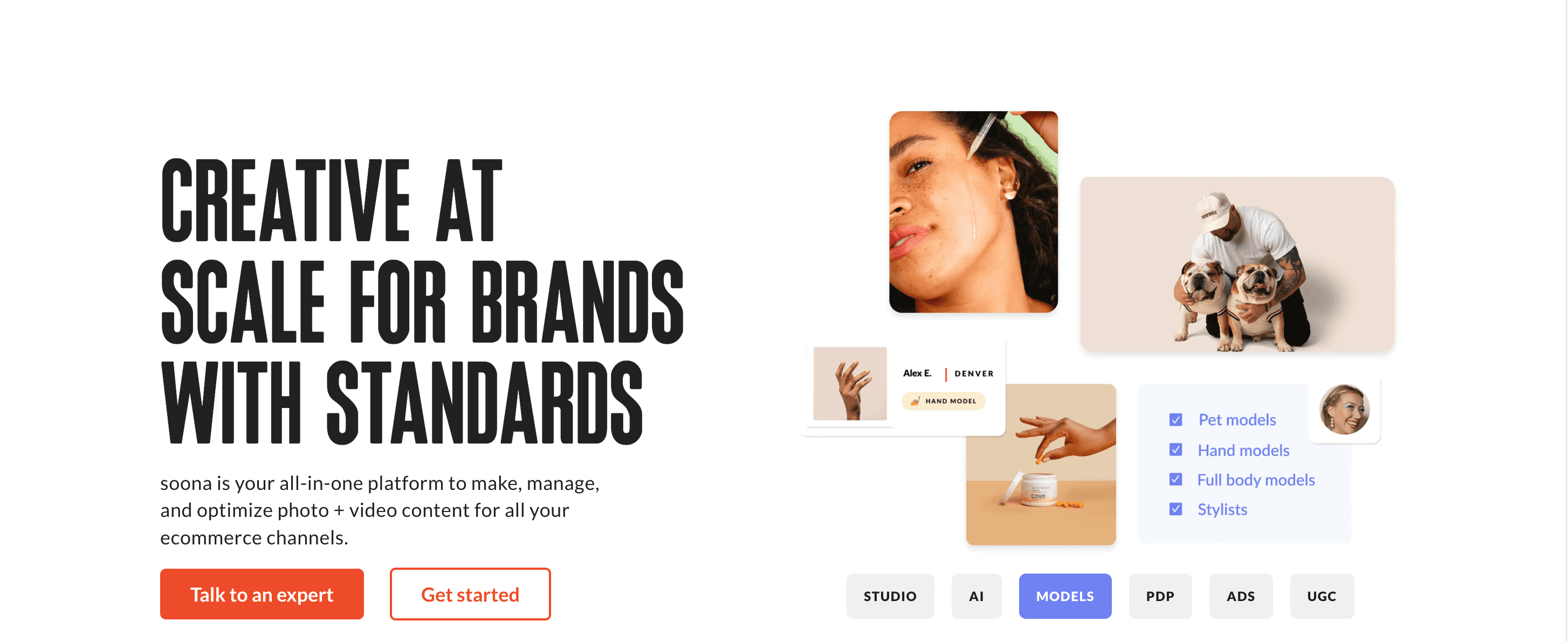
soona provides a platform for planning shoots, reviewing imagery, and ordering finished assets. Its services cover product photography, video, and optional creative production support, with AI-related editing and imagery capabilities.
For an ecommerce team preparing a new product launch or refresh, it can reduce the work involved in organizing a shoot.
Strongest at: Product imagery, short video, and managed studio workflows.
Right for: Brands that need new product photography or footage.
What your team still manages: Product samples, briefing, shot selection, and final approval.
Main limitation: Base pricing doesn't include every service or format a buyer may need. Models, stylists, premium editing, and additional deliverables can affect the complete cost.
Pricing: Published base prices are $39 per photo and $93 per video clip. The company also lists a $149 studio pass for occasional bookings, with membership options.
What to verify: Full shoot cost, editing, rights, turnaround, and any additional formats.
9. Front Row

Best for: Brands seeking category-focused ecommerce marketing and creative services.
Front Row combines content-related capabilities with wider marketing and marketplace services.
Its focus includes categories such as beauty, health, wellness, and lifestyle. That can be relevant when a brand needs creative work connected to ecommerce merchandising, advertising, and the conventions of a particular product category.
Strongest at: Creative and ecommerce marketing services, particularly in beauty and wellness.
Right for: Brands seeking a partner with relevant category experience.
What your team still manages: Brand decisions and any responsibilities not included in the engagement.
Main limitation: The exact content-production capabilities and volume should be assessed against the proposed scope. Category specialization doesn't establish that other industries are excluded.
Pricing: Custom.
What to verify: Which content types are included and how creative, marketplace, and paid media work is coordinated.
Marketplace specialists
Marketplace services connect creative decisions with the requirements of selling products through online retailers.
Some focus on preparing listing content. Others combine creative with marketplace strategy, advertising and commercial operations.
6. Pattern
Best for: Brands seeking broader marketplace services that include creative support.
Pattern provides ecommerce acceleration services, including marketplace operations, advertising, analytics, and creative-related capabilities.
That model can help brands coordinate listing content with their marketplace activity.
It's different from hiring a studio to produce a standalone batch of product images.
Strongest at: Integrated marketplace operations and services.
Right for: Brands looking for support beyond creative execution alone.
What your team still manages: Brand objectives, approved messaging, and responsibilities outside the commercial agreement.
Main limitation: Buyers seeking only creative production should confirm whether the service is available independently and what the proposed arrangement includes.
Pricing: Custom.
What to verify: Scope of creative services, account access, ownership of completed assets and source files, and the arrangements if the partnership ends.
7. Kenji ROI
Best for: Brands commissioning Amazon-focused listing creative.
Kenji ROI offers Amazon listing services including photography, graphics, infographics, video, and A+ Content.
A project-based offering may suit a brand that has identified a specific listing problem and wants to commission defined deliverables.
But the decision shouldn't begin with the number of images included in a package.
Start by assessing the product page. Is the hero image accurate? Does the gallery communicate benefits clearly? Are important objections answered? What does the A+ Content add?
Our Amazon PDP optimization framework provides a way to examine those elements before deciding what to produce.
Strongest at: Amazon listing photography and defined creative projects.
Right for: Brands whose immediate creative requirements are concentrated on Amazon.
What your team still manages: Product claims, creative approvals, and any work outside the quoted scope.
Main limitation: Its public positioning centers on Amazon. Confirm support for other retailers and advertising formats separately.
Pricing: Project packages; request a current quote for the exact deliverables.
What to verify: Source files, revisions, image types, ownership and usage rights.
Product photo and video studios
Sometimes the issue isn't the design process. The brand lacks suitable source imagery. When a product needs new photography or video, a studio can be the right starting point.
8. soona
Best for: Brands needing product photography, short video, and related content services.
soona provides a platform for planning shoots, reviewing imagery, and ordering finished assets. Its services cover product photography, video, and optional creative production support, with AI-related editing and imagery capabilities.
For an ecommerce team preparing a new product launch or refresh, it can reduce the work involved in organizing a shoot.
Strongest at: Product imagery, short video, and managed studio workflows.
Right for: Brands that need new product photography or footage.
What your team still manages: Product samples, briefing, shot selection, and final approval.
Main limitation: Base pricing doesn't include every service or format a buyer may need. Models, stylists, premium editing, and additional deliverables can affect the complete cost.
Pricing: Published base prices are $39 per photo and $93 per video clip. The company also lists a $149 studio pass for occasional bookings, with membership options.
What to verify: Full shoot cost, editing, rights, turnaround, and any additional formats.
9. Front Row
Best for: Brands seeking category-focused ecommerce marketing and creative services.
Front Row combines content-related capabilities with wider marketing and marketplace services.
Its focus includes categories such as beauty, health, wellness, and lifestyle. That can be relevant when a brand needs creative work connected to ecommerce merchandising, advertising, and the conventions of a particular product category.
Strongest at: Creative and ecommerce marketing services, particularly in beauty and wellness.
Right for: Brands seeking a partner with relevant category experience.
What your team still manages: Brand decisions and any responsibilities not included in the engagement.
Main limitation: The exact content-production capabilities and volume should be assessed against the proposed scope. Category specialization doesn't establish that other industries are excluded.
Pricing: Custom.
What to verify: Which content types are included and how creative, marketplace, and paid media work is coordinated.
Why ecommerce creative services need retailer-specific expertise
A campaign can be visually consistent while requiring different assets for every destination.
Consider a hypothetical skincare brand launching eight products across Amazon, Walmart, its own website, and paid social.
The brand has approved one creative direction, but the requirements vary.
Amazon main images have specific restrictions. Secondary gallery images communicate product benefits. A+ Content has its own module requirements. Paid social may require different visual framing, copy, and formats.
The team also has to account for product variations, claims, retailer approvals, and market-specific requirements. That work creates different responsibilities for the provider.
A photography studio may supply the raw images. A creative team may develop the concept and key visual. A production partner may prepare the different executions and manage the review process.
The goal is to confirm that every required stage has an owner.
A provider with excellent creative work can still be a poor operational fit if the brand must repeatedly correct assets before retailer submission.
That's why retailer rules should be considered during production. Our creative compliance software comparison explains how automated checks, human review, and approval workflows serve different purposes.
How to choose the right ecommerce creative service
Start with the work that's consuming the most resources or preventing campaigns from launching.
Your situation | Providers to consider | Most important trade-off |
|---|---|---|
New product photography is missing | soona, Front Row | Shoot and editing scope |
Amazon listings need updating | Kenji ROI, Pattern | Standalone creative versus wider marketplace services |
Recurring graphics are overwhelming your team | ManyPixels, Superside | Capacity and breadth of services |
You need concept development and ecommerce execution | Rocketium AI Studio | Scope of research, production and scaling |
You need major campaign production across countries | WPP Production | Global coordination and specialist production |
You want a team embedded in your organization | OLIVER | Implementation, governance and staffing |
You want creative connected to marketplace operations | Pattern, Front Row | Commercial and operational scope |
The shortlist is only a starting point.
Before selecting a provider, look beyond its portfolio and ask what it will actually deliver, how quality is reviewed, and how much work remains with your team.
For recurring production, the most useful creative operations metrics include turnaround, first-pass approval, revision rounds, and internal review effort.
How much do ecommerce creative services really cost?
A supplier's quoted price doesn't always represent the cost of getting an approved asset ready for use.
Consider two providers quoting for 100 comparable graphic assets.
Illustrative calculation:
Cost component | Provider A | Provider B |
|---|---|---|
Vendor fee | $3,000 | $3,800 |
Internal review and correction time | 30 hours | 10 hours |
Assumed loaded internal labor cost | $50/hour | $50/hour |
Total cost | $4,500 | $4,300 |
Approved usable assets | 100 | 100 |
Cost per approved asset | $45 | $43 |
Provider A has the lower quoted fee. But once internal work is included, Provider B costs less per approved asset in this example.
The calculation is:
Cost per approved asset = (vendor fees + implementation and internal labor + review and correction costs) ÷ approved usable assets.
This is useful when comparing similar production tasks.
For a new campaign concept or premium original film, use a project-level comparison instead. Those deliverables shouldn't be evaluated as though they were interchangeable with simple format adaptations.
Our guide to creative automation costs provides additional detail on cost categories, although its historical Rocketium-specific prices should be updated to the current commercial model.
How to test an ecommerce creative service before switching
A portfolio establishes the standard of previous work. A pilot establishes how a provider works with your actual requirements.
Start with a brief your team has already completed.
The brief should include the campaign objective, audience, product facts, approved claims, required formats, brand guidelines, and acceptance criteria.
Our guide to writing a creative brief explains how to establish those inputs without prescribing every creative decision.
Give shortlisted vendors equivalent requirements and agree on how the results will be evaluated.
Practical vendor pilot scorecard
Criterion | What to measure | Illustrative weight |
|---|---|---|
Creative quality | Accuracy, design quality and suitability for the brief | 25% |
Concept development | Quality of research and proposed directions, if in scope | 15% |
Channel suitability | Ability to produce the required retailer or advertising formats | 20% |
Quality assurance | Errors caught before customer review; required corrections | 15% |
Operational effort | Briefing, coordination and review time required internally | 15% |
Commercial fit | Total cost and contractual suitability | 10% |
Total | 100% |
These weights are illustrative, not an industry standard. A studio photography pilot would place more emphasis on image quality, while a recurring creative scaling engagement might prioritize accuracy, throughput, and internal effort.
Agree on minimum acceptance standards before scoring. For example, a material product claim error or an inability to supply a required retailer format may be a disqualifier regardless of the weighted total.
The pilot should also record:
Time from brief to approved assets
Number of revision rounds
First-pass approval rate
Time spent by the internal team
Technical or retailer-related errors
Cost of the accepted work
A demo and a pilot answer different questions.
A demo confirms that the provider offers a capability. A pilot tests whether it can execute that capability with your brand, inputs, and constraints.
Once assets are approved, whether the creative performs better in advertising is a separate question. Our creative testing framework covers how to evaluate that performance rather than assuming faster production leads to better conversion.
How to switch providers without disrupting launches
Start with work that is repeatable and relatively low-risk.
Don't move every active campaign before the new provider has demonstrated reliable delivery.
Agree on who owns master files, source imagery, revisions, product data, and approval responsibilities. Make sure the incoming provider understands existing brand and retailer requirements.
Run the new workflow alongside the current one for a defined pilot, then compare the outcomes.
If quality, internal effort and delivery meet your expectations, expand the scope gradually.
The right decision may be to replace a provider, add specialist capacity, or retain an existing agency while moving only selected work to a different team.
There isn't one correct operating model for every brand.
Which ecommerce creative service should you choose?
If your priority is new photography or video, start with a studio such as soona.
If Amazon listing production is the main requirement, evaluate Kenji ROI or a broader marketplace partner such as Pattern.
ManyPixels and Superside offer different levels of recurring design support, while WPP Production and OLIVER address larger production and embedded-team needs.
For brands that need research-informed creative development alongside ecommerce production and creative scaling, AI Studio connects those activities through a managed workflow.
We can work with your existing agency, support your internal team or take responsibility for a wider creative requirement.
Bring us a campaign, PDP refresh, or recurring creative challenge. We'll review the scope and show how AI Studio would approach it.
Frequently asked questions
What do ecommerce creative services include?
They can include creative strategy, concept development, design, product photography, video, ecommerce content, and creative scaling. The exact scope depends on the provider.
What is creative scaling?
Creative scaling is the broader process of preparing creative for different products, placements, and markets. It includes format adaptation, creative variation, and localization. These are related but distinct activities.
How is adaptation different from creative versioning?
Adaptation takes one approved master visual into different platform sizes and formats. Creative versioning changes elements such as product imagery, messaging, or offers to produce different executions.
Do I need an Amazon specialist for listing content?
An Amazon specialist may be suitable if most of your creative requirements are concentrated on that marketplace. Brands working across several retailers should compare the full scope of content, advertising, and compliance requirements.
How should I compare ecommerce creative service pricing?
Compare complete project costs for equivalent work, including vendor fees, internal labor, revisions, and unusable output. For comparable recurring production, cost per approved asset is a useful measure.
Should I replace my existing creative agency?
Not necessarily. Keep the agency where it provides valuable expertise and delivers efficiently. Another partner may be useful for concept development, specialist production, retailer compliance, or creative scaling where your current process needs support.
Recent Posts
Explore expert insights, creative strategies, and practical guides to help your brand create better content and scale faster.



Bring us a brief you need done. We’ll show you what AI Studio produces and what it takes from your team.
Bring us a brief you need done. We’ll show you what AI Studio produces and what it takes from your team.
Bring us a brief you need done. We’ll show you what AI Studio produces and what it takes from your team.
Bring us a brief you need done. We’ll show you what AI Studio produces and what it takes from your team.