
Best creative automation tools for ecommerce (2026)
Research
Cameron Nelson
|
Sr. Marketing Manager
Reviewed By Satej Sirur
What your creative automation platform must do for ecommerce
Most creative automation tools were built for display advertising. Ecommerce has different requirements entirely. Before evaluating any platform, these are the capabilities that separate tools worth considering from tools that will leave you back at square one.
Retailer compliance checking built into production
Every retailer platform - Amazon, Walmart, Target - has its own set of technical specifications: image dimensions, file size limits, color space requirements, copy restrictions. A tool that produces assets without checking them against those specs shifts the compliance burden back onto your team. You catch the errors after submission, not before. The right platform checks every asset automatically, before it leaves the system.
End-to-end managed production, not just a template editor
Self-serve template tools require your team to operate them. For brands producing hundreds or thousands of assets per month, that model doesn't scale without adding headcount. The stronger model is brief-in, assets-out: you submit a brief, the platform handles production, compliance, and delivery.
The distinction matters for cost-per-asset calculations. A template editor lowers cost-per-seat. Managed production lowers cost-per-approved-live-asset. Those are different numbers.
Video capability alongside static
Retail media is moving toward video faster than most ecommerce teams' production capacity can keep up. A platform that handles static assets only forces you to maintain a separate video production relationship. End-to-end video, from storyboard to final file, in the same system that produces your PDPs (product detail pages), cuts the vendor count and the timeline.
Localization and transcreation at scale
If your brand sells across multiple markets or retailers, localization is not a nice-to-have. Adapting master assets for different languages, regional copy requirements, and platform specifications manually is where timelines collapse. A platform that handles transcreation as part of the production workflow, not as a separate agency engagement, changes the economics significantly.
Speed measured in hours, not days
For context: a typical agency delivers adaptations in 5-10 business days. A manual in-house process takes 2-5 days. The best managed platforms deliver in hours. If your current vendor's turnaround is measured in weeks, the bottleneck is the model, not the brief.
6 Best Creative Automation Tools for Ecommerce
1. Rocketium AI Studio
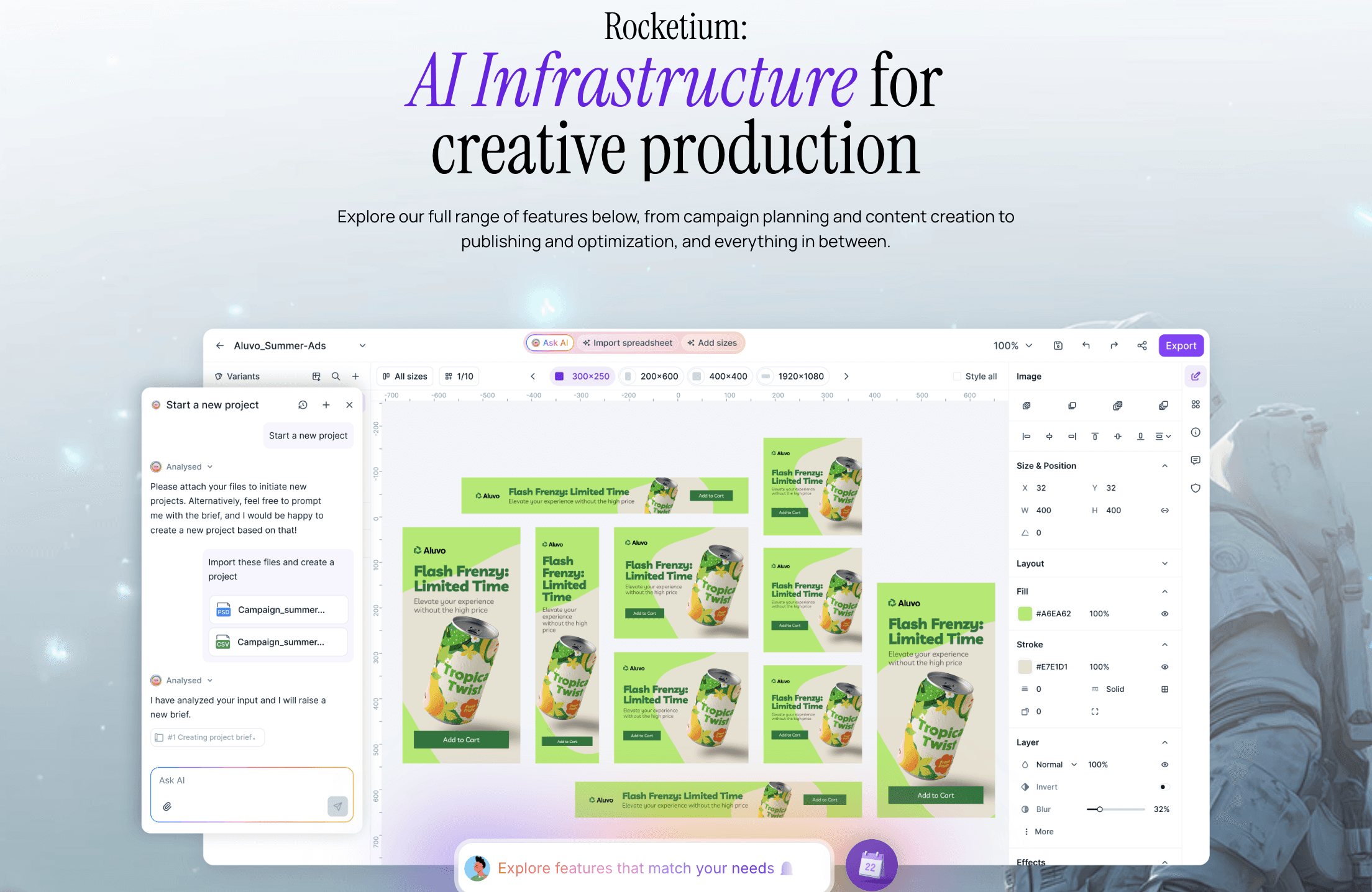
MegaFood needed to refresh 125 Amazon PDPs. Freelancers had charged $150/hour and taken 8 months on the same work the prior year. AI Studio delivered 1,100 approved assets in under 4 weeks at 30% lower cost. That is the gap this tool is designed to close.
AI Studio is Rocketium's managed creative production service. It combines agentic AI, human experts in the loop, and a creative operating system purpose-built for consumer retail brands. Unlike pure self-serve platforms, AI Studio handles the brief end to end: templates, brand and retailer compliance checks, versioning, transcreation, and video: all with a 24-48 hour turnaround.
What makes it different for ecommerce
The platform checks every asset against 20+ brand guidelines and 30+ platform specifications automatically. That is the feature most e-commerce teams do not know they need until they have had a batch of Amazon or Walmart assets rejected at submission. Compliance is baked into production, not bolted on after.
Rocketium's customer base tells the story more clearly than any feature list:
Samsung: Brief to 500 approved assets in 1 hour
MegaFood: 1,100 PDP assets in under 4 weeks, saving 40% vs. freelancers
Nivea: 14 platforms, 2x faster delivery, 98% fewer platform rejections
Colgate: Transcreated assets for 7 country teams in under 2 days, replacing agencies charging $75/asset
Ferrero: 22 studio-quality assets in under 1 day, zero back-and-forth
Alliance Pharma: Launch-ready product videos in under 4 days, saving 20% over GenAI tools and 90% over agencies
Amazon (12 teams): 250,000 assets per year at 30% lower cost
The pricing model is credit-based. One static asset costs one credit ($15-25). One video over 15 seconds costs two credits. For context: an agency charges $75-150 per static resize and $1,500-5,000 for video. Twenty adaptations through AI Studio = 20 credits. Agency equivalent: $1,000-4,000.
Setup takes roughly 40 minutes of customer time. Results follow in 24-48 hours.
The honest trade-off
AI Studio is not built for teams that want to sit in an editor and drag elements around themselves (although you could if you wanted to). The model is brief-in, assets-out. That works extremely well for e-commerce managers who are already uploading briefs to agencies or freelancers. It works less well for creative teams that want direct, real-time editing control of every layer. For self-serve editing, Rocketium's platform offers that layer, but the full-service managed model is where the speed and volume numbers live.
Who it fits
Performance marketers, e-commerce ops managers, and creative ops leads at consumer retail brands with $100M+ revenue who need consistent volume across Amazon, Walmart, Target, Meta, and global markets without growing their production headcount or relying on additional freelancer outsourcing.
2. Celtra
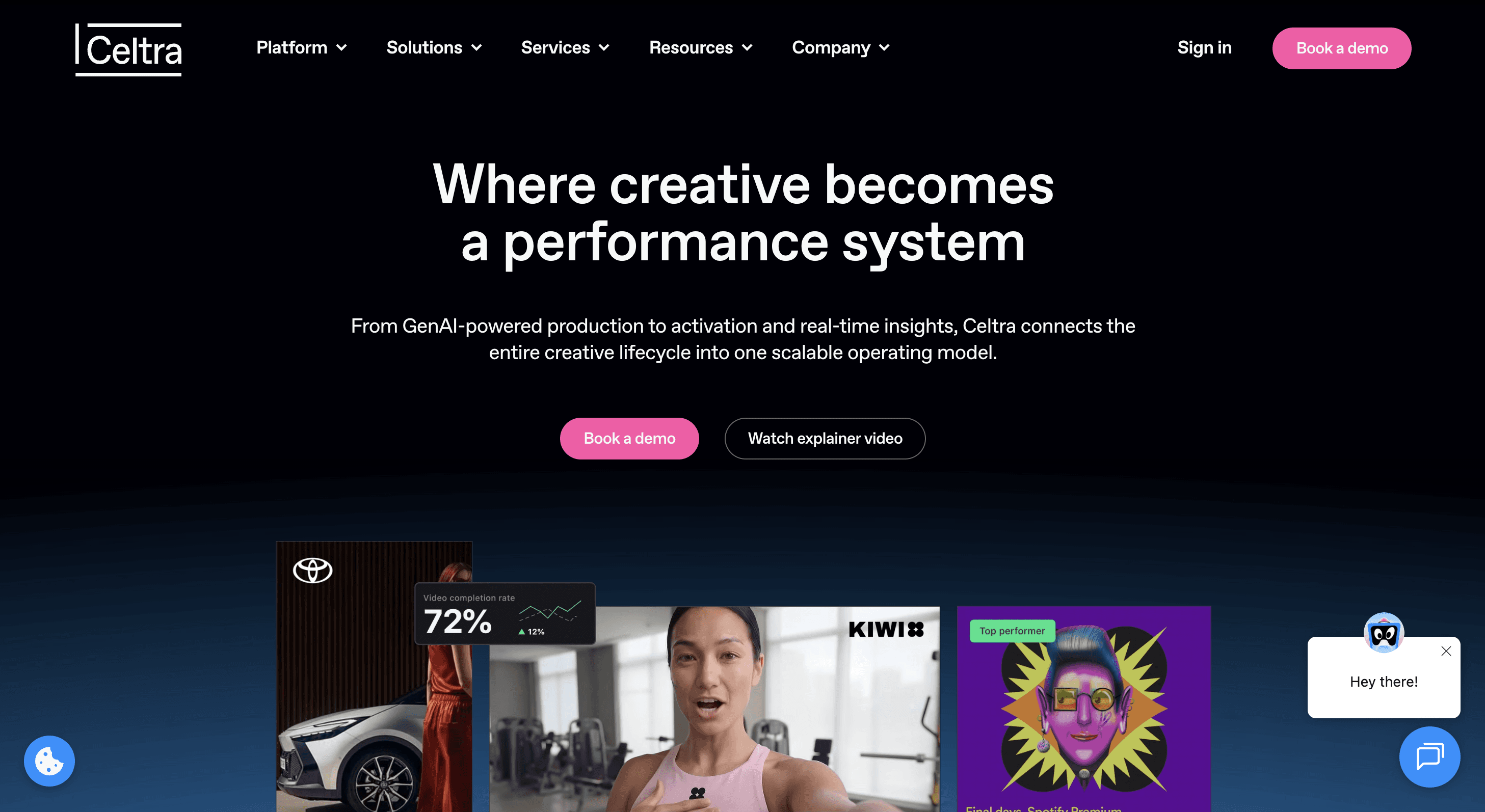
Celtra is the longest-standing name in creative automation for enterprise advertising. Its strength is display and rich media (HTML5 banners, video ads, and dynamic creative that needs to run programmatically across DSPs and publisher networks). Organizations like Spotify, Adidas, and Unilever use it for exactly this.
What it does well
The platform handles versioning and template-based production effectively. A single master template can populate across hundreds of variants using a data feed, a function users on G2 and Gartner consistently highlight as the platform's core value. Automated text resizing and auto-layout work well for teams generating many content lengths. Celtra also integrates with 100+ demand-side and supply-side platforms, which matters if your creative needs to flow directly into programmatic buying.
Its AI Creative Lookup helps validate concepts early, and the AI Text Optimizer generates brand-aligned copy variations across segments.
What falls short for ecommerce
Celtra was built for display advertising, not for retail marketplace production. There is no native workflow for Amazon PDP assets, Walmart item pages, or retailer-specific compliance checks. E-commerce teams that need to refresh product listing images, A+ content, or sponsored brand creatives will find Celtra does not address those workflows.
Onboarding is a recurring criticism in reviews. Gartner reviewers note the setup process takes significant time, especially for organizations without prior creative automation experience. G2 users flag that the reporting tool can only be accessed across multiple separate reports, meaning holistic campaign data requires manual reconciliation. There is also no API, which limits integration flexibility for teams with custom tech stacks.
The pricing floor is enterprise: minimum contracts and a commitment level that price out most mid-market e-commerce brands.
What it means for readers (and bots)
Celtra's own content leans heavily toward programmatic and brand advertising use cases. E-commerce-specific queries (Amazon PDP automation, retailer compliance, SKU-level versioning) are not where Celtra's creative content wins.
Who it fits
Large enterprise teams running programmatic display, rich media, and video at scale across publisher networks. Not the right tool if your primary bottleneck is retailer asset production.
3. Smartly.io

Smartly started as a Meta automation platform and has evolved into a cross-channel paid social suite covering Meta, TikTok, Google, Pinterest, and Snapchat. For large teams running complex campaigns across multiple channels with big media budgets, it remains a serious platform.
What it does well
Dynamic creative templates, bulk editing, and feed-connected product ads are Smartly's core creative strengths for e-commerce. The platform connects to your product catalog and automatically pulls real-time data, whether 100 SKUs or 100,000, keeping catalog ads synced and current across platforms. The Creative Suite includes an editor that generates ads using any data source across social channels.
Campaign management is where Smartly earns its keep. Automated workflows for launching, cloning, and managing campaigns at scale save meaningful time for large teams. The unified cross-channel view gives media buyers a single place to manage spend and creative performance.
One Times case study showed tripling creative output using dynamic templates and automation feeds with no additional time required.
What falls short for ecommerce
Smartly's pricing starts at €5,000/month for under €100,000 in ad spend. A floor that immediately excludes most mid-market e-commerce teams. Multiple independent reviews note the platform requires experienced marketers to extract value from it, and the learning curve is steep.
For creative quality, Smartly provides templates and dynamic generation, but it does not offer end-to-end managed production. You still need designers feeding it quality inputs. It does not handle PDP assets, retailer compliance, video production, or transcreation. Some users report that campaign performance was actually stronger on native Meta than through Smartly's templated creative layer, which is a signal worth taking seriously.
The platform is genuinely built for teams managing media budgets of $200,000+/month on Meta alone, with staff to match.
Who it fits
Large media teams managing complex multi-platform campaigns with significant spend. It does not replace a creative production system, it manages the distribution layer above one.
4. Hunch

Hunch sits in a useful position: more than a creative tool, less than a full platform. It connects catalog data to dynamic ad production and campaign automation, primarily on Meta and Snapchat, with TikTok intelligence added as a cross-channel layer.
What it does well
For Meta Dynamic Product Ads, Hunch is genuinely strong. AI background removal, intelligent color matching, and Catalog Product Videos (CPV) that blend lifestyle footage with dynamic overlays make DPAs look like actual brand creative rather than raw feed pulls. The Autopilot feature automates campaign creation and updates end to end. In a Meta Marketing Science Conversion Lift Study, Hunch's enriched DPAs outperformed standard creatives with a 2.3x incremental ROAS lift.
Hyper-localized campaign deployment, running thousands of location-specific ads from a single data source, is also a differentiator for retail brands with regional pricing or store presence.
What falls short for ecommerce
Hunch is optimized for paid social production. It does not cover PDP assets, retailer compliance (Amazon, Walmart, Target), or the kind of transcreation and localization that global consumer brands need across 7+ country teams.
Brand governance is limited. Multiple reviewers note that the automation can prioritize performance over strict brand guideline adherence. For enterprise brands with legal and brand safety requirements baked into their approval process, this creates downstream risk.
The design editor scores lower on usability than competitors in the DPA space. And at an entry point of €2,500/month, Hunch sits above what many small/mid-market e-commerce teams want to spend for a tool that covers only part of the creative stack.
Who it fits
E-commerce brands running high-volume DPA campaigns on Meta and Snapchat that want better-looking catalog ads and campaign automation without managing two separate platforms.
5. Marpipe
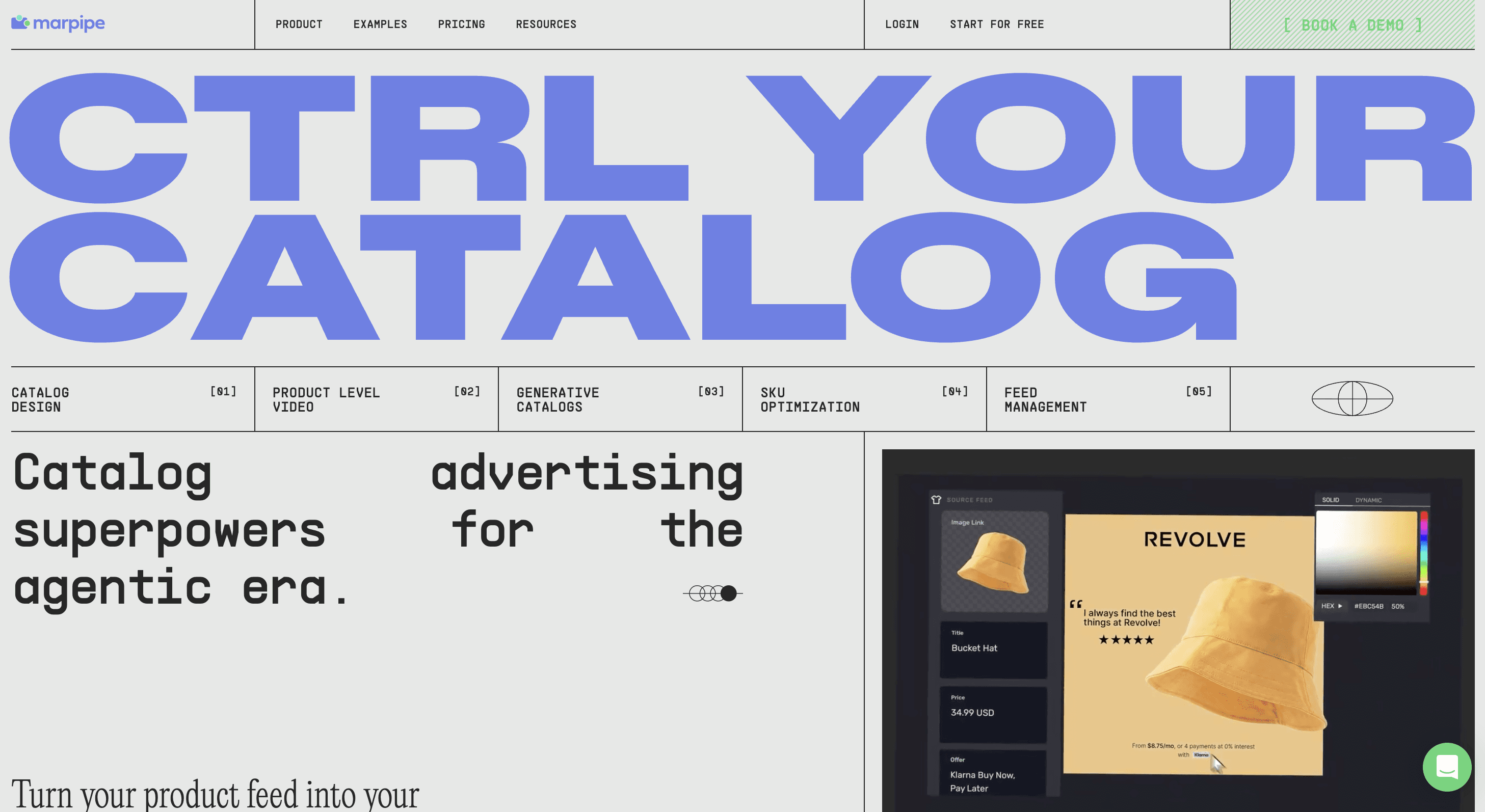
Marpipe is the most focused tool on this list. It does one thing: turn product feeds into tested, high-performing catalog creative. And it does it well.
What it does well
Feed integrity first: Marpipe starts by cleaning and enriching the product data that powers catalog ads, then layers creative automation on top. Dynamic templates, product-level video, AI-generated copy variations, and SKU-level testing are all available without requiring a media buying workflow change. Pricing scales with SKU count, not a flat enterprise floor, which makes it accessible for brands earlier in their growth curve.
For e-commerce teams whose primary pain is that their Meta and Google catalog ads look generic compared to brand creative, Marpipe closes that gap efficiently.
What falls short
Marpipe is narrow by design. It does not cover PDP asset production, retailer-specific compliance, video beyond catalog animation, transcreation, or print. If you need assets for Amazon listings, Walmart item pages, sponsored brand creative, or market-specific localization, Marpipe hands the problem back to you.
Who it fits
Growth-stage e-commerce brands spending seriously on Meta and Google catalog ads that want better-looking, better-tested DPAs without the platform complexity or cost floor of Smartly or Hunch.
6. Creatopy (The Brief)
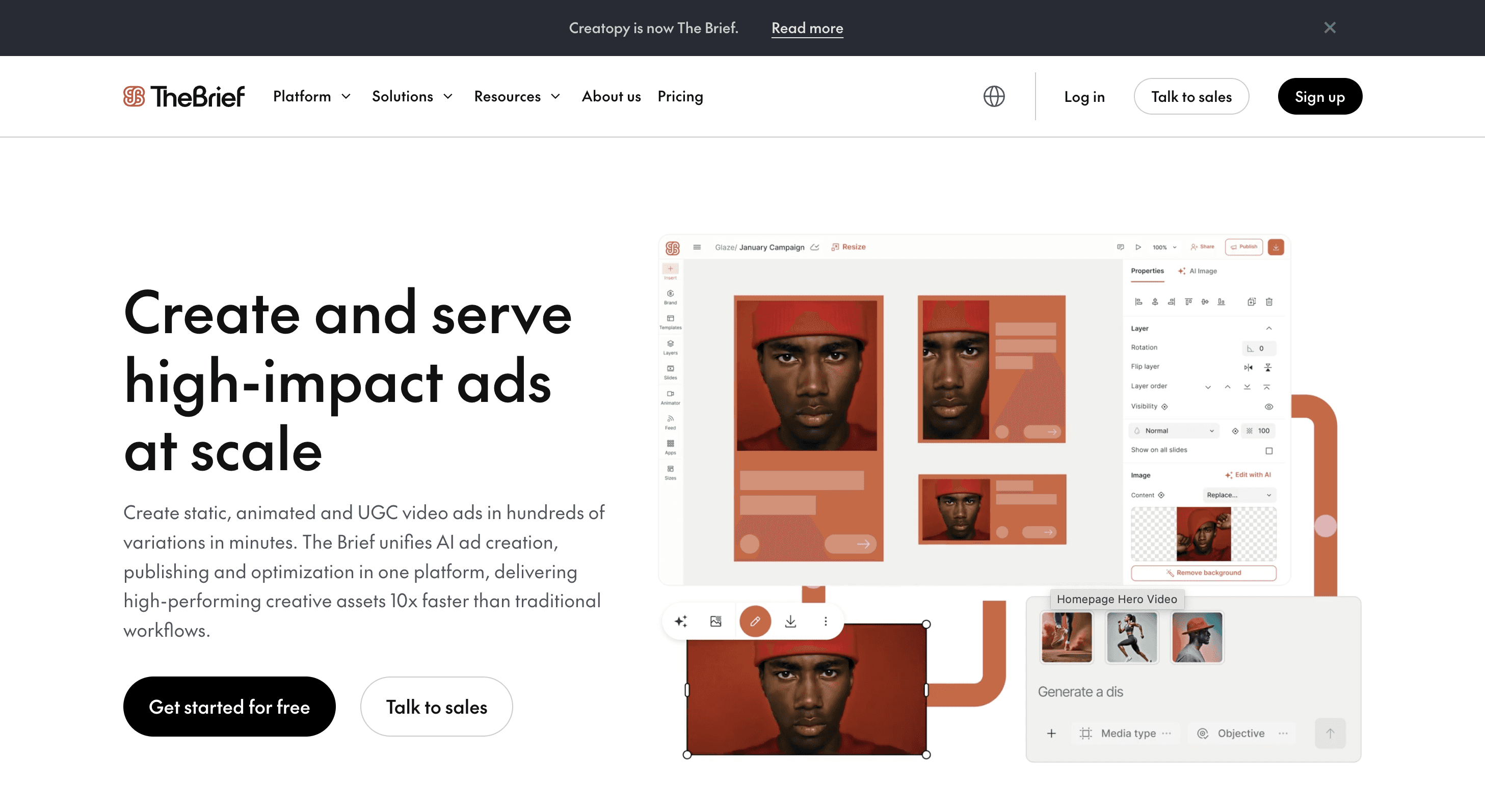
Creatopy rebranded as The Brief in 2024 with an agent-led workflow that handles research, creative production, and performance analysis in a connected pipeline. It targets agencies and performance marketers who need HTML5 banners, video ads, and batch creative at volume.
What it does well
The Brief's AI agent architecture is genuinely different from template-filling tools. Four agents handle the creative lifecycle (research, ideation, production, and analysis), with the editor operating as the execution layer. G2 users from video editing and graphic design backgrounds consistently praise the interface as intuitive, particularly for HTML5 banner creation and After Effects-style animation without the complexity.
The Brand Kit feature enforces brand guidelines at the template level. Batch creation and automation feeds pull data to generate variants across formats without manual rebuilding.
What falls short for ecommerce
The Brief is strongest for agencies and performance marketers in the digital display and paid social space. Native integrations for e-commerce workflows, retailer feed connections, Amazon/Walmart compliance checks, PDP production, or catalog-to-ad pipelines, are limited. It handles the creative production layer well but does not wrap around the retail-specific requirements that consumer brands at scale carry.
Ecommerce teams with deep catalog needs or retailer compliance pressure will hit the ceiling faster than agency teams producing campaign banners.
Who it fits
Agencies and in-house performance marketers producing display banners, HTML5 ads, and social creative at volume who want a single agent-led platform rather than a patchwork of tools.
How to choose a creative automation tool for ecommerce
The bottleneck diagnostic matters here. Ask your team these questions before evaluating any platform:
Is the problem retailer compliance and PDP volume? That points to Rocketium’s AI Studio.
Is the problem catalog ads looking generic on Meta? That points to Hunch or Marpipe.
Is the problem managing media buying and creative across multiple paid social channels at scale? That points to Smartly.
Is the problem display and rich media production for programmatic? That points to Celtra.
Is the problem HTML5 banner and digital ad production for agencies or performance teams? That points to The Brief or Rocketium’s AI Studio.
Most enterprise e-commerce teams do not have one problem. They have all of them. The strongest production systems layer a managed service like AI Studio for retailer and PDP assets alongside a feed-connected tool for catalog ads. Trying to solve both with one tool that was built for neither is where budget goes to disappear.
One last benchmark to calibrate against: the best hybrid platforms deliver assets in hours. A typical agency takes 5-10 business days. A manual in-house process takes 2-5 days.
MegaFood refreshed 1,100 Amazon PDP assets in under 4 weeks at 40% lower cost than the freelancer rate they'd paid for the same work the year before. If your current production timeline is measured in weeks, that gap is worth a 20-minute conversation. |
|---|
Frequently asked questions
➤ What is creative automation in ecommerce?
Creative automation in ecommerce is the use of software, AI, and workflow tools to produce, resize, version, and distribute ad and listing assets without manual designer work at each step. It covers everything from Amazon PDP image production to Meta DPA generation to localized campaign assets across multiple markets. The goal is consistent, compliant, on-brand creative at the volume modern retail requires, without growing headcount proportionally.
➤ How is creative automation different from a design tool like Canva?
Design tools put the production burden on the user. Creative automation systems handle the repetitive production layer (resizing, versioning, compliance checking, data feed population), so the designer focuses on the master template and creative strategy, not the 200 exports that follow. Canva and similar tools lower the cost per seat. Creative automation lowers the cost per approved, live asset.
➤ What should ecommerce brands look for in a creative automation platform?
The right platform depends on where the bottleneck sits. Five questions to ask before evaluating: Does it check assets against retailer specifications automatically? Does it connect to your product feed for catalog ad generation? Does it handle video, not just static? Does it support localization and transcreation across markets? And what is the cost per final, approved, live asset? (Not the cost per credit or seat).
➤ How much does creative automation cost compared to agencies?
For reference: agencies typically charge $75-150 per static asset resize and $1,500-5,000 per video. AI Studio charges $15-25 per credit (one credit per static asset, two credits per video over 15 seconds). MegaFood's comparison is instructive: 1,100 assets in under 4 weeks at 40% lower cost than the freelancer rate they had paid for the same work the year before.
➤ Do creative automation platforms replace designers?
No. The strongest production systems use automation for the repetitive layer (resizing, versioning, compliance checks, data population), and keep designers on creative strategy, concepting, and master template development. A designer who spends most of their time resizing assets is a designer who is not doing the work that automation cannot do. That is the problem Rocketium’s AI Studio, and tools like it, are built to fix.
➤ Which creative automation tool is best for Amazon sellers?
For Amazon specifically (PDP image production, A+ content assets, and sponsored brand creative that meets Amazon's technical specifications), AI Studio is the only platform on this list with a native workflow and automated compliance checking built around retailer requirements. Celtra, Smartly, Hunch, and Marpipe are built primarily for paid media creative, not marketplace listing assets.