
Creative brief examples before your next campaign
Article
Cameron Nelson
|
Sr. Marketing Manager
Reviewed By Satej Sirur
Most creative projects don't fail in production. They fail in the brief.
The campaign launches late. The assets look off-brand. The designer built something technically correct but tonally wrong. You go back and forth across five revision cycles. Then you launch three weeks behind schedule with a diluted version of the original idea.
Trace it back and the brief was vague, or missing, or written after the creative team had already started.
A joint study by Nielsen and Nielsen Catalina Solutions found that creative quality contributes as much to in-market success as all other advertising factors combined, and when the creative is strong, it accounts for up to 89% of a digital campaign's results. Getting the brief right is where that quality is either built or lost.
Key takeaways
|
|---|
What a creative brief actually is (and what it isn't)
A creative brief is a short written document that defines the problem a piece of creative needs to solve. It tells the creative team, agency, or production partner: who you're talking to, what you need them to think or feel or do, and what constraints exist.It is not a design specification. It is not a mood board request. It is not a list of deliverables.The best briefs are short. Two pages is standard. One page is better. Ten pages is a proposal masquerading as a brief. Every brief, regardless of context, needs to answer five questions:
What is the business goal this creative supports?
Who exactly is the audience, and what do they already think?
What is the single most important message?
What must be true about the output (brand, legal, format)?
How will we know it worked?
The fifth question gets skipped most often. That's a mistake. Without success criteria, revision cycles become opinion contests.
The anatomy of a strong creative brief: section by section
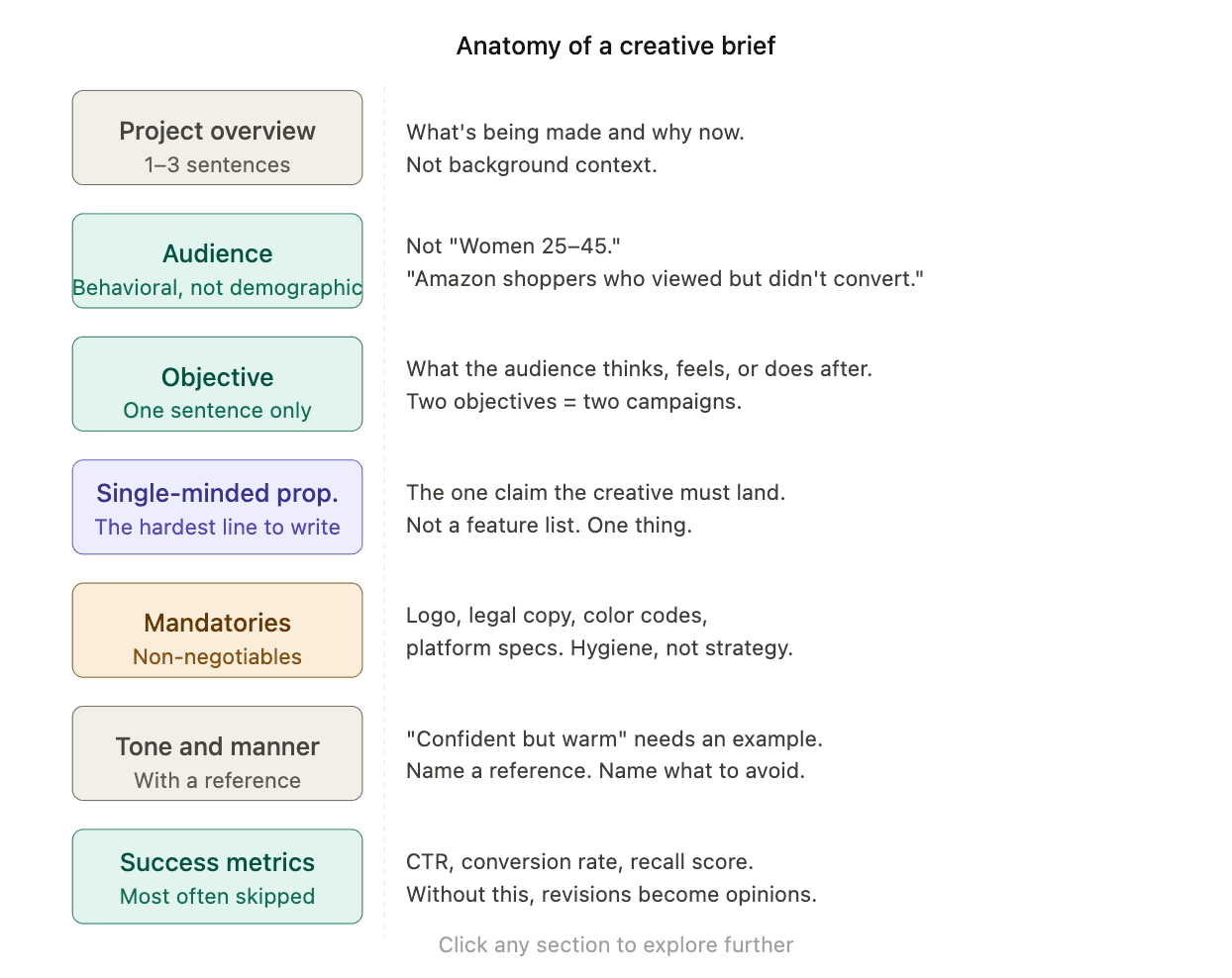
Most brief templates cover the same ground but name sections differently. Here's the standard structure with notes on what makes each section work.
Project overview. One to three sentences. What's being made and why now. Not a paragraph of context. If you need three paragraphs to explain the background, the brief isn't the right document for that information.
Audience. The more specific, the better. "Women 25–45" is not an audience. "First-time supplement buyers on Amazon who are comparison-shopping between three similar products" is an audience. The brief should describe what this person already believes, not just who they are demographically.
Objective. One sentence. What should the audience think, feel, or do after seeing this? There can only be one primary objective. Two objectives means the brief is doing two jobs. Briefs that do two jobs produce creative that does neither well.
Single-minded proposition. The one thing the creative must communicate. Not the product's full feature set. Not the brand vision. One claim that earns attention and shifts perception. This is the hardest line to write, and the most important one.
Mandatories. What cannot change. Logo placement, legal copy, color codes, image restrictions, platform specs. Everything that would trigger a rejection if missing. For consumer brands, this includes Amazon's image requirements and the equivalent spec sheets for Walmart Connect, Target Roundel, and any other retailers in your channel mix.
Tone and manner. Adjectives are fine here, but they need grounding. "Confident but warm" without an example leaves room for ten different interpretations. A good brief includes a reference, a competitor to avoid, or a description of what the wrong tone looks like.
Success metrics. How will this be measured? Click-through rate, conversion on a product detail page (PDP), recall score, engagement rate? Name it.
Creative brief examples: advertising
Advertising briefs tend to be more rigorous than internal marketing briefs because they're shared with external agencies. The stakes of misalignment are higher: time, budget, and the agency relationship.
What strong advertising briefs include that internal briefs often skip:
A defined insight. Not just "people want convenience." An actual behavioral or attitudinal observation that the creative can use. For example: "Our target audience has tried three different supplements in the past year. They're not skeptical of the category, they're skeptical of the label claims."
A clear single message. Most advertising briefs that fail do so because the client added a second message after the first review.
The reason to believe. The proof that earns the claim. Without this, the creative team makes something that sounds good but can't be defended.
What advertising briefs commonly get wrong:
Too long. An agency brief that's eight pages is usually a brand document repackaged as a brief. It gives the creative team more information than they can act on.
Multiple objectives. "Build awareness AND drive conversion" is two campaigns. Pick one.
No stated audience tension. The brief describes who the audience is but not what they're struggling with. Creative that doesn't connect to a real tension tends to feel generic.
Creative brief examples: marketing
Marketing briefs cover a wider range of output types: email campaigns, social posts, landing pages, paid ads, retail media banners, product listing images. The structure is similar to advertising but the briefs need to carry more operational detail.
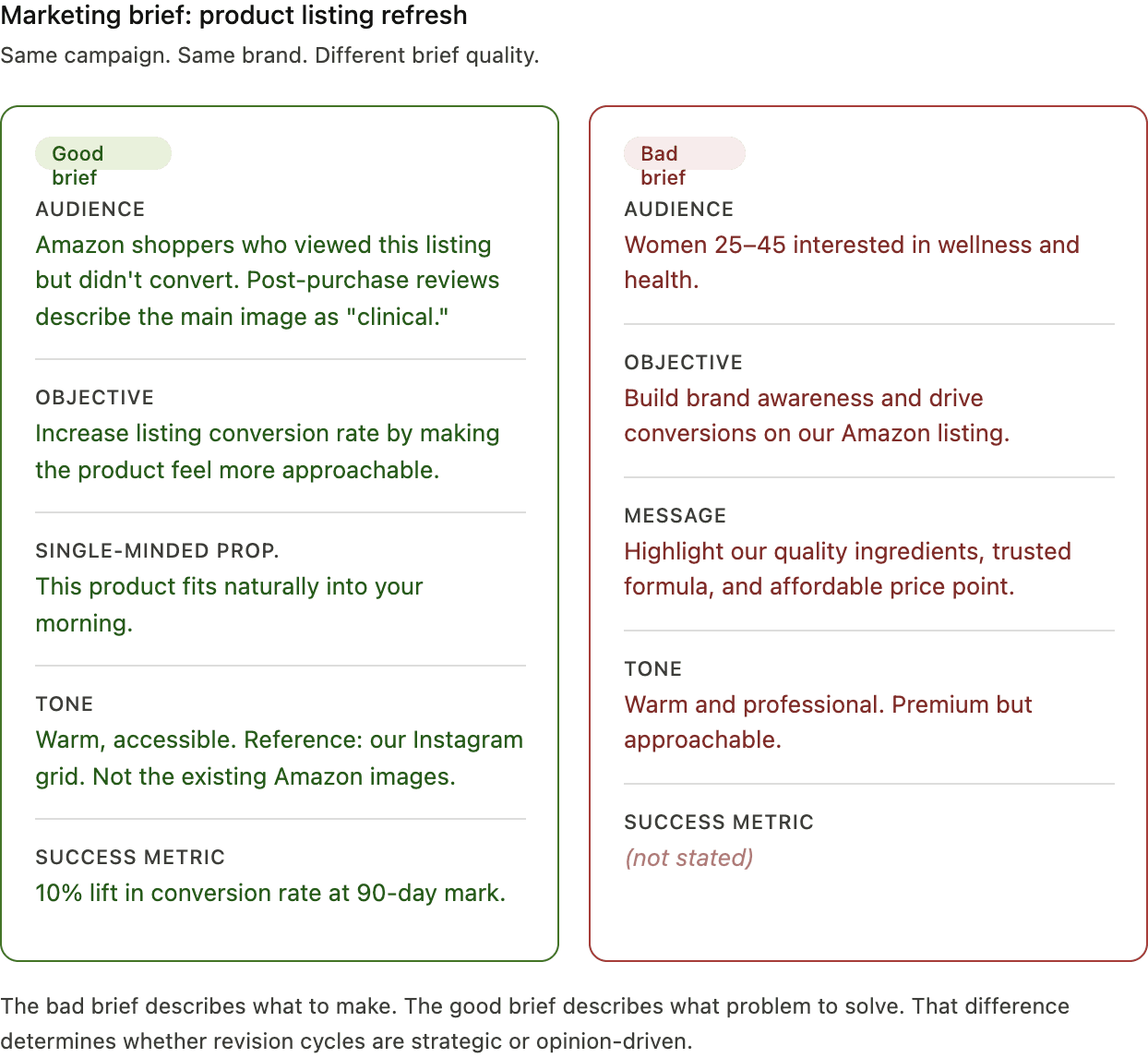
🔸 A good marketing brief for a product refresh campaign at a consumer brand might look like this:
Project: Refresh hero image and top three carousel images for the brand's Amazon main listing for product X.
Audience: Amazon shoppers who have viewed the product page but not converted. Most recent purchasers describe the main image as "clinical" in post-purchase reviews.
Objective: Increase conversion rate on the main listing by making the product feel more approachable.
Single-minded proposition: This product fits naturally into your morning.
Mandatories: Product must be front and center. No lifestyle images without product visible. Logo in top-left. Use brand hex #XXXXXX for background. Images must meet Amazon's 1000px minimum on the longest side.
Tone: Warm, accessible. Not clinical or pharmaceutical. Reference: the brand's Instagram grid, not the existing Amazon images.
Success metric: 10% lift in conversion rate at 90-day mark.
This brief is specific enough to brief a designer, an agency, or an AI-assisted production workflow. It also contains a stated reason for the refresh (the review insight about "clinical" perception), which means the creative team knows what problem to solve, not just what to make.
Creative brief examples: graphic design
Before going into graphic design briefs specifically, it's worth knowing which brief type fits which context. The table below shows where the emphasis shifts across the three formats.
Brief type | Primary emphasis | Most often missing | Typical use case |
|---|---|---|---|
Advertising | Audience insight, single message, reason to believe | Strategic tension, success criteria | Agency campaigns, brand TV, OOH |
Marketing | Operational detail, channel specs, refresh rationale | Behavioral audience description, one clear objective | PDP refreshes, paid social, retail media |
Graphic design | Technical specs, reference clarity, file requirements | Audience context, message intent | Banners, social templates, brand collateral |
Graphic design briefs sit between advertising and marketing briefs in terms of formality. They tend to be more output-focused than advertising briefs and more design-specific than marketing briefs.
🔹 A well-written graphic design brief includes:
File format and size requirements upfront (not at the end)
A description of where the asset will actually appear
Color mode specification (RGB vs CMYK matters for print vs digital)
A clear distinction between "reference for direction" and "mandatory to replicate"
The last point matters more than it sounds. Sharing a reference and calling it "inspiration" is ambiguous. Sharing a reference and saying "replicate this layout, not this color palette" is specific. Designers interpret broad references differently. The brief should close that gap.
♦️ What bad graphic design briefs typically look like:
They include a vision board and a deliverable list but nothing about the audience or the message. The designer produces something technically correct and visually polished that nobody can use because it doesn't connect to what the brand is actually saying.
A brief that just says "design a banner for our spring promotion" is not a brief. It's an open-ended design prompt. The designer will make assumptions about size, platform, tone, CTA copy, product featured, and brand voice. Each assumption is an opportunity for a revision cycle.
What makes a brief genuinely good vs. technically complete
🔸 A brief can check every box and still be bad. Technically complete briefs fail when:
The objective is vague. "Drive awareness" is not a campaign objective. "Get first-time visitors to subscribe to our newsletter at a 5% conversion rate" is an objective.
The audience is described by demographics instead of behavior. A 34-year-old woman in Denver and a 34-year-old woman in Atlanta who are both interested in wellness are not the same audience if one is comparison-shopping and the other has already decided.
The single-minded proposition doesn't make a choice. "We're high quality, affordable, and fast" is three things. Effective creative picks one and commits.
There's no stated tension. Great briefs describe what the audience is struggling with, not just who they are. Advertising legend Bill Bernbach built much of Doyle Dane Bernbach's work on the principle that creative must connect to a real human truth. The brief is where that truth gets named.
The mandatories are the only specific part. When the most precise section of a brief is the logo size, the brief is structured backwards. Mandatories matter, but they're hygiene factors. The strategy is the brief.
How brief quality affects creative production at scale
For brands producing a handful of assets per quarter, a vague brief is an inconvenience. You have a few revision rounds, you sort it out, you move on.
For brands producing thousands of assets per year across multiple retailers, formats, and markets, a vague brief is an operational problem.
Colgate operates across seven country teams. Before structured creative production workflows, each team relied on separate agencies, paid $75 per asset for 24 product variants, and waited days for adaptation work to turn around. With AI Studio, transcreation and adaptation are completed in under two days across all seven teams. That speed is only possible because the briefs are structured correctly before production starts. Ambiguous inputs at the brief stage multiply into hundreds of wrong assets downstream.
MegaFood created and approved 1,100 assets in under four weeks. The previous approach used freelancers at $150 per hour and took eight months. The brief structure didn't change. What changed was how AI Studio processed it: scoring assets for brief adherence, brand guideline compliance, and channel requirements before any human review.
This is the shift that matters. In traditional production, a brief is a handover document. In AI-assisted production, the brief becomes a scoring input. AI Studio runs outputs against the brief automatically, checking whether the asset matches the stated objective, tone, and audience. The better the brief, the fewer iterations before approval.
For Amazon teams running at high volume, this compounds quickly. Amazon's teams produce 250,000 asset adaptations per year through AI Studio. Each asset is adapted against brand guidelines and format requirements. The brief is not a courtesy document at that scale. It's the primary control mechanism.
How to write a brief that works inside an AI-assisted production workflow
If your creative production process includes AI in any form, whether for concepting, copywriting, or asset generation, brief quality becomes more important, not less.
One pattern Rocketium's production team sees repeatedly: brands come to us after a failed attempt at raw generative AI. They ran 20 prompts, got 20 outputs, couldn't use any of them, and concluded that "AI doesn't work for our brand." In most cases the model wasn't the problem. The input was. There was no stated audience, no single message, no reference for tone. The AI reproduced the ambiguity it was given.
Raw generative AI tools require 10 to 30 prompts to produce one acceptable asset. A vague prompt produces a vague output. The same applies to structured AI production workflows.
When customers submit a brief to AI Studio, they provide campaign goals, target audience, key messages, competitive context, brand guidelines, reference assets, and mandatory visual elements. The more complete that input, the faster and more accurate the output. AI Studio's team fills gaps and structures files when inputs are incomplete, but every gap adds a round of clarification.
Three things make a brief work inside an AI-assisted workflow:
✦ Specificity on the audience. AI agents can optimize for audience fit, but only if the audience is described in terms of behavior and intent, not just demographics.
✦ A clear single message. Multi-objective briefs produce multi-directional creative. AI systems don't resolve that tension; they reproduce it across however many assets you've ordered.
✦ Named success criteria. Post-production scoring against brief adherence requires a defined target. If the brief doesn't state what "correct" looks like, the scoring step can't function.
One framework: the three-question brief test
🔸 Before sending any brief for production, ask three questions.
Could someone who has never heard of this brand produce an asset from this brief alone? If yes, it's complete. If they'd need to ask even one question, it's missing something.
Does this brief make a choice, or does it try to cover all options? A brief that says "we want to feel premium but also accessible" hasn't made a choice. Rewrite it until it has.
What does the audience believe right now, and why should this creative change that? If the brief can't answer this question, the creative will feel generic.
These three questions aren't exhaustive. But they catch the most common failures: incomplete information, unresolved strategy, and missing audience insight.
The brief is the cheapest place to fix a problem
Revision cycles at the production stage cost time and money. A rejected asset on Amazon costs a resubmission and a delay. A campaign that misses the brief costs campaign performance.
The brief is the cheapest place in the creative process to fix a problem. It costs nothing to rewrite a brief. It costs a lot to rebuild 500 assets because the original direction was wrong.
Write it before you brief anyone. Make it short. Make it specific. Make it choose.
If you want to see how structured briefs feed directly into a managed creative production workflow, read: How AI Studio handles creative production for consumer brands
For a broader view of how briefs fit into the full creative ops process, read: What creative operations metrics every consumer brand should track
If revision cycles are the specific problem you're trying to solve, read: How Rocketium achieves 90% brand compliance
Last reviewed: April 2026
FAQ
➤ What should a creative brief include?
A creative brief should include the business objective, a specific audience description (behavioral, not just demographic), a single-minded proposition, mandatory requirements (brand, legal, format), the desired tone with a reference example, and measurable success criteria. Every section should contain one specific answer. Vague answers at any section produce ambiguous creative.
➤ How long should a creative brief be?
One to two pages is the standard. If a brief runs beyond two pages, it's usually carrying information that belongs in a background document, not the brief itself. A brief should be readable in under five minutes. If it requires ten minutes, it's too long.
➤ What's the difference between a creative brief and a marketing brief?
A creative brief focuses on a single piece or campaign of creative output: what it should say, who it's for, and why it should work. A marketing brief is broader and may cover campaign strategy, channel mix, budget, and timeline in addition to creative direction. In practice, the terms are often used interchangeably, but the distinction matters when briefing external agencies: they need creative briefs, not marketing plans.
➤ What makes a creative brief bad?
Bad briefs share a few common traits: multiple objectives, audiences described by demographics instead of behavior, propositions that try to say three things at once, no stated audience tension, and mandatories as the only specific section. The most common failure is a brief that describes what to make rather than what problem the creative needs to solve.
➤ How is a creative brief used in AI-assisted creative production?
In AI-assisted workflows, the brief serves as a scoring input, not just a handover document. AI systems check outputs for brief adherence, brand guideline compliance, and channel requirements. The more specific the brief, the more accurately the system can score outputs before they reach human review. Vague briefs produce more iteration cycles at the production stage because the system has less to evaluate against.
➤ Do you need a different brief format for graphic design vs. advertising?
The core structure is the same, but the emphasis differs. Graphic design briefs need precise technical specifications (file format, size, color mode) and clear guidance on which reference assets show direction vs. which must be replicated. Advertising briefs require a sharper strategic foundation: a named insight, a single message, and a stated reason to believe. Using an advertising template for a graphic design job often produces briefs that are strategically rich but technically incomplete, and vice versa.
➤ What's a single-minded proposition in a creative brief?
It's the one claim the creative must land. Not the product's benefit list. Not the brand positioning statement. One specific thing the target audience should think, feel, or believe after engaging with the creative. Writing it forces a strategic choice. That choice is usually the hardest and most valuable part of the briefing process.