
Outsource creative services: What to consider
Article
Cameron Nelson
|
Sr. Marketing Manager
Reviewed By Satej Sirur
Most brands treating creative production as an outsourcing decision are asking the wrong question. The question is not "should we outsource?" It is "which parts of creative should we own, and which parts are just volume problems in disguise?"
Get that distinction right and every subsequent decision becomes clearer: who to hire, what to keep in-house, and how to evaluate a partner without paying for months of back-and-forth to find out if they were right for you.
This post breaks down how to think about outsourcing creative services: what the options actually are, the real trade-offs most vendors will not tell you, and the specific signals that tell you a given approach is or isn't working.
Key takeaways
|
|---|
The three things you might actually be outsourcing
People use "creative services" to mean very different things. Before you evaluate any partner or model, it helps to be specific about which layer of creative work you need help with.
▸ Concepting is the upstream work: master layouts, visual directions, campaign storyboards, design systems. This is where brand intuition and strategic judgment matter most. Concepting done badly creates rework at every stage that follows. Traditionally, this lives with a creative agency or your internal brand team.
▸ Production is creating new assets from raw inputs: copywriting, translation, lifestyle photography, video. You have a brief and a pack shot. You need a finished asset. This is skilled work, but the output is predictable once the brief is clear.
▸ Adaptation is resizing and versioning a finished design across formats, platforms, and markets. A master design adapted for Amazon, for Instagram, for Walmart, in three languages. This is high-volume, repetitive, and has nothing to do with creative judgment. But it eats enormous amounts of agency and freelancer time at rates that do not reflect that reality.
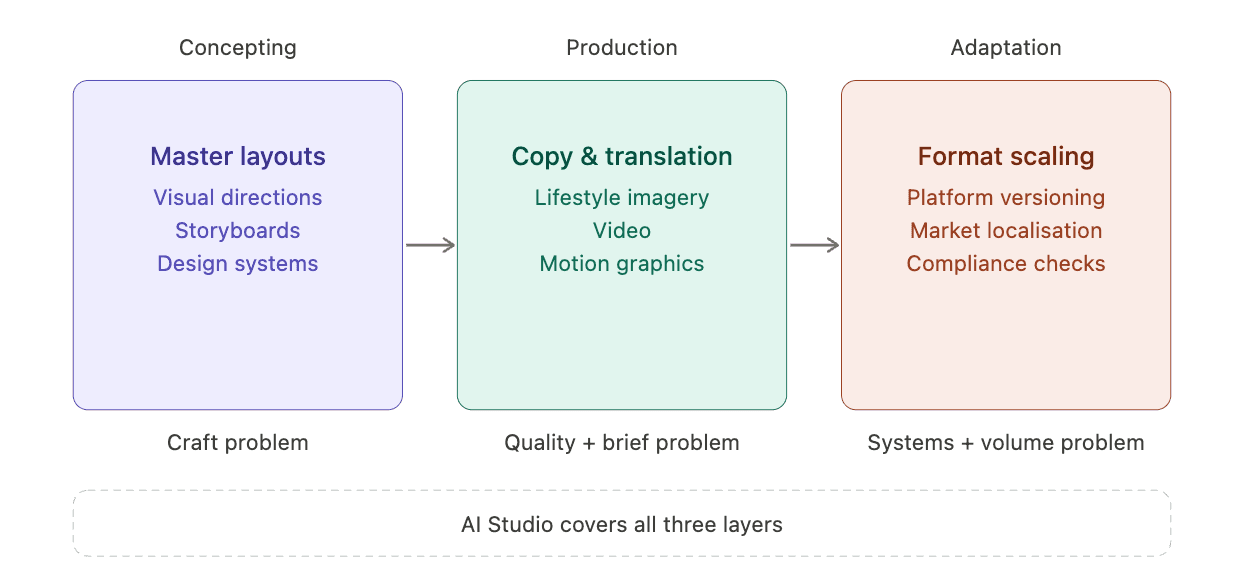
Most outsourcing decisions fail because brands treat all three as the same problem. They're not. Concepting is a craft problem. Production is a quality-and-brief problem. Adaptation is a systems and volume problem.
Why the agency model works well - and where it doesn't
Agencies remain the default for a reason. They bring creative leadership, category knowledge, and accountability in a single relationship. For concepting and campaign strategy, that package is hard to replicate.
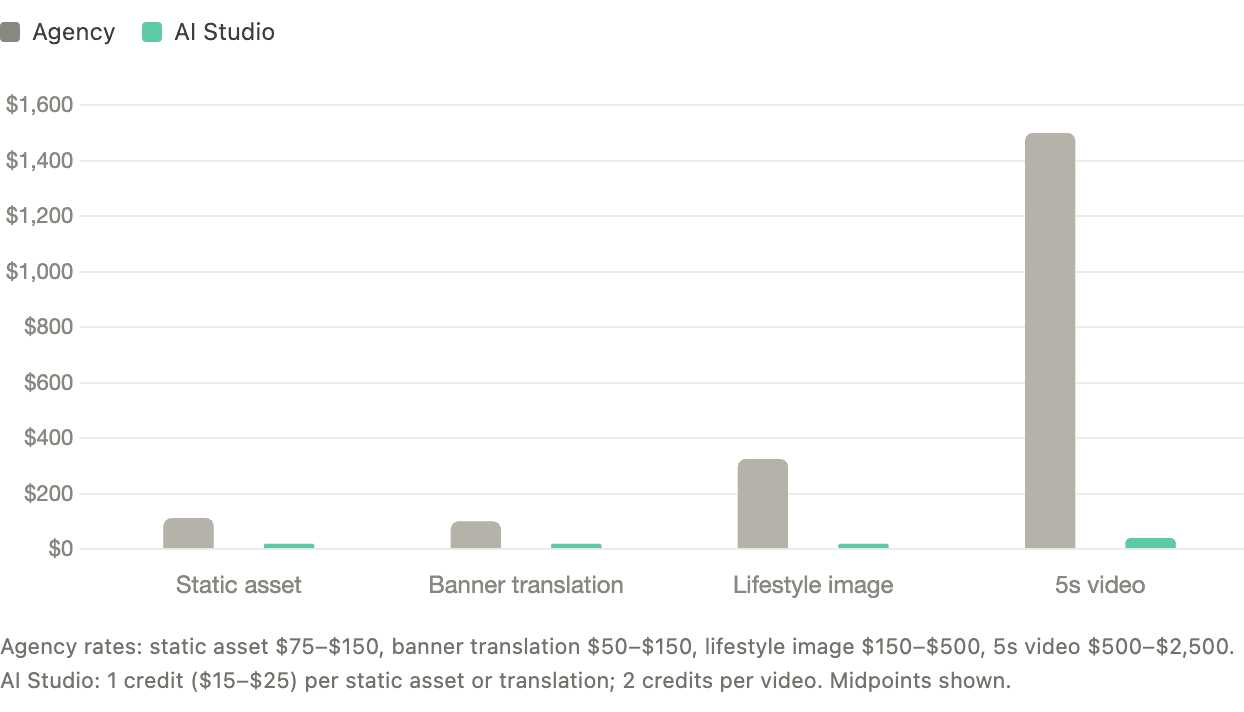
The problem is that most agencies charge agency rates regardless of what they're actually doing. Resizing a banner from 300x250 to 728x90 costs the same as writing new copy in their billing structure. At $75–$150 per static asset and $1,500–$3,000 for a video, that pricing held up when brands produced 20 assets per campaign. It does not hold up when a serious consumer brand needs hundreds of format variations across 10+ platforms.
The other friction point is speed. Agencies are set up for feedback cycles, not volume. When NIVEA needed to launch campaigns across 14 platforms simultaneously, the manual redesign process created constant bottlenecks. That's an adaptation problem, not a creative strategy problem, and the agency model wasn't designed to solve it.
The honest trade-off: agencies are the right call when your constraint is creative quality, strategic direction, or campaign leadership. They are the wrong call when your constraint is volume, velocity, or cost per asset.
Why freelancers are more fragile than they appear
Freelancers work for many brands that have high volume needs and limited budget. The cost per asset looks attractive until you account for what you're actually buying.
A freelancer brings their own judgment, workflow, and interpretation of your brand guidelines. Without a system that encodes your brand standards, every brief is a negotiation. The quality of the first delivery tells you little about the twentieth, because that depends on how well they retained the context from the last nineteen briefs.
MegaFood found this out the hard way. Their freelancer took 8 months to refresh assets across 100 Amazon product listings, at $150/hour. The problem wasn't the freelancer's skill. It was that a brand refresh at that scale requires a system, not a person.
Freelancers also do not absorb risk. If they're unavailable, sick, or at capacity when your campaign launches, that's your problem. You don't get SLAs with a freelance relationship.
The honest trade-off: freelancers work when you have consistent, well-defined briefs, low volume, and time to build a long-term working relationship. They break down when volume spikes, briefs change frequently, or brand consistency across a large catalog matters.
What "outsourcing" looks like when AI is part of the workflow
This is where the category has changed most in the past two years. The conventional framing was: agency (expensive, slow, high quality) vs. freelancer (cheaper, variable, limited capacity) vs. in-house (overhead, slow to scale). Those are still real options. But there's now a fourth model worth understanding.
A managed service that combines AI agents with human experts operates differently. AI handles the repeatable, high-volume work: adaptation, format scaling, compliance checking, template application. Human experts handle judgment calls: brief interpretation, brand fidelity review, edge cases, and anything where context matters.
The math looks different at scale. Twenty static asset adaptations cost roughly $300–$500 through AI Studio. The agency equivalent runs $1,500–$3,000. That's the same output, measured the same way.
Speed changes too. Adaptation and versioning that takes agencies 5–10 business days now takes hours. Colgate completes transcreation and adaptation across 7 country teams in under 2 days, work that previously went to multiple agencies at $75 per asset for 24 product variants.
That said, this model has real limitations. It works best for brands with consistent visual identity and clear brand guidelines. The system is only as good as what you put into it. A brand that cannot articulate its own standards will still get inconsistent outputs. And for concepting, genuinely strategic first-principles creative thinking, human judgment remains the constraint, with or without AI in the loop.
The four questions that actually matter when evaluating a creative partner
Most RFP processes for creative services miss what matters. They compare portfolios, hourly rates, and turnaround times. None of those tell you whether the relationship will work at the volume and velocity you actually need.
These four questions get closer to the truth.
🔸 How do you encode brand knowledge? Not 'do you read our guidelines,' but how do your brand's visual standards, compliance rules, and retail platform requirements get built into the production workflow? If the answer is "our designers review everything," the quality is person-dependent and will not hold at scale.
🔸 What does the feedback loop look like? How many rounds of revision are typical before an asset is approved? If the answer is more than two, the brief process or the brand knowledge transfer isn't working. More revision rounds mean more cost, regardless of the pricing model.
🔸 How do you handle platform compliance? Retailers like Amazon, Walmart, and Target each have specific technical requirements and content policies. Rejections cost time and sometimes ad spend. Ask how your potential partner tracks platform changes and applies them automatically. Most agencies don't.
🔸 What does your pilot look like? Any serious partner should offer a structured evaluation before you commit. Rocketium's setup takes about 40 minutes of a customer's time across two short sessions. Results come back in 24–48 hours. If a partner can't show you work on a real brief before you sign, that's a signal.
How to choose: a framework, not a formula
There is no single right answer here. The right model depends on where your production bottleneck actually sits, and often it sits in more than one place.
The brands that get this right don't pick one model and apply it to everything. They diagnose first. Is the problem that concepting takes too long and produces too many rounds of revision? That production is expensive because every image requires a photoshoot? That adaptation is a manual, repetitive drain on people who should be doing something else? Each of those is a different bottleneck with a different fix.
What's changed recently is that a single partner can now address all three. AI Studio handles concepting (master layouts, visual directions, storyboards), production (copy, translation, lifestyle imagery, video), and adaptation (format scaling, versioning, platform compliance) under one roof, with AI doing the heavy lifting on repeatable work and human experts stepping in where brand judgment matters. That's a different proposition from an agency that does concepting well but charges adaptation rates that don't make sense at scale, or a freelancer who handles production competently but can't absorb volume spikes.
Alliance Pharma is a good illustration of this. Their team needed product videos, Amazon assets, and ongoing adaptation across two brands, ScarAway and Amberen, without the overhead of an agency relationship or relying on freelancers for each work type. AI Studio handled all three: concepting the storyboards, producing launch-ready videos in under 4 days, and adapting assets across formats. That's 90% less than agency cost on the video work, and 20% less than raw GenAI solutions.
The honest caveat: AI Studio works best when your brand guidelines are documented and your brief process is reasonably consistent. A brand that can't articulate its own visual standards will get inconsistent outputs from any partner, AI-powered or not. The system encodes what you give it, which means the setup investment pays off, but it is an investment.
What to watch out for
A few patterns come up repeatedly when outsourced creative relationships break down.
Brand knowledge that lives in a person, not a system. When the freelancer who "knows your brand" leaves, you're starting over. When the agency account manager rotates, quality dips. If your brand knowledge isn't encoded somewhere, in a system, in documented standards, in a platform, you're dependent on continuity that rarely holds.
Pricing that doesn't scale. Per-asset agency pricing sounds reasonable at low volume. At 500 assets per campaign, it's untenable. Map out your actual volume requirements before comparing costs, not after.
Feedback cycles that grow with complexity. As campaign complexity increases, more markets, more formats, more SKUs, feedback cycles at agencies tend to grow linearly. That's not a project management problem. It's a structural one.
GenAI tools that create consistency problems. Raw GenAI outputs (Midjourney, Canva AI, stock image generation) can produce individual assets quickly. They cannot produce 50 on-brand, retailer-compliant assets consistently, with correct file naming, proper compression, and version control. That requires orchestration, not just generation.
The shift worth tracking
The creative services market is not going to look the same in two years. Over the past five years, more than 100 retail ad platforms have added new formats and specifications. The volume requirement per brand has grown. Agencies have not gotten cheaper.
What's changed is the underlying capability of AI-augmented production. Not AI replacing creative judgment, that's still a human job. But AI handling the adaptation and versioning work that was eating creative teams alive, at a cost structure that finally makes sense.
The brands that figure this out first will have a production capacity that their competitors, still working through traditional agency pipelines, won't be able to match at the same budget.
If you're working through which outsourcing model fits your team's specific situation, read: How to choose the best creative automation platform for your team, which breaks down the evaluation criteria in more detail with side-by-side comparisons.
FAQs
➤ What does it mean to outsource creative services?
Outsourcing creative services means using an external partner, an agency, freelancer, or managed production service, to produce marketing and advertising assets. This can include concepting (master layouts and campaign directions), production (copywriting, photography, video), or adaptation (resizing and versioning assets across formats and platforms). Most brands outsource some combination of all three, though the right model for each layer differs significantly.
➤ What are the main options for outsourcing creative production?
The main models are: traditional creative agencies (high quality, high cost, slow at volume), freelancers (more flexible pricing, person-dependent quality), and AI-powered managed services (high volume, fast turnaround, best suited to adaptation and production rather than strategic concepting). Many brands combine all three, using agencies for strategy and managed services for high-volume execution.
➤ How much does it cost to outsource creative work?
Costs vary widely by output type and model. Agencies typically charge $75–$150 per static asset and $1,500–$3,000 per video. Freelancers run a similar rate range at lower minimum fees. AI-powered managed services like AI Studio operate on a credit model: one static asset equals one credit, priced at $15–$25 per credit at standard rates, with lower rates at volume. At scale, that represents a 30–70% reduction compared to agency costs for the same output.
➤ What are the biggest risks of outsourcing creative services?
The most common failure mode is brand knowledge that lives in a person rather than a system. When the designer who "knows your brand" moves on, quality suffers. Other risks include: pricing that looks reasonable at low volume but becomes unsustainable at scale; feedback cycles that grow as complexity increases; and GenAI tools used without proper brand guidelines and compliance review, which produce individually acceptable assets that are inconsistent across a campaign.
➤ How do I know if a creative outsourcing partner is the right fit?
Evaluate fit on four dimensions: how they encode your brand standards into their workflow (not just "we'll read your guidelines"), the typical number of feedback rounds before approval, how they handle retailer-specific compliance requirements, and whether they offer a structured pilot before you commit. A partner that cannot show you results on a real brief before you sign is not ready to work at the pace you likely need.
➤ Is outsourcing creative services right for smaller teams?
Often yes. Lean teams benefit most from outsourcing because they get production capacity without headcount. The risk is over-indexing on cost per asset without accounting for brief preparation time, feedback cycles, and rework. A smaller team with a clear brief process and well-documented brand guidelines will get better results from any outsourcing model than a larger team with neither.