Creative testing framework for consumer brands (2026)
Playbook
Growth & Content
Reviewed by Satej Sirur, Co-founder & CEO
Creative testing becomes unreliable when the number of variants exceeds the conversion volume available for evaluation. A team may produce 20 assets, but if each one receives only a handful of conversions, the test can't support a dependable decision.
The cost of getting those wrong compounds across channels. At agency rates of $75 to $150 per static asset, a 20-variant batch runs $1,500 to $3,000, and the total rises once placement sizes and retailer versions are added. The pressure is growing too: US retail media ad spending is forecast at roughly $69 billion in 2026, which means more budget is flowing through channels that most teams have never built a testing discipline for.
This guide covers the four layers of a working creative testing framework for consumer brands selling on Meta, Amazon, and retail media networks: the production system, the channel methodology, the evaluation criteria that prevent false positives, and the feedback loop that compounds learning. It also covers the mistakes that quietly cap most programs, and a step-by-step build sequence.
Key takeaways
|
Why most creative testing fails
Most creative testing programs fail on execution rather than ideas, and the failures cluster into three patterns.
The test is sized by budget instead of conversions. A team gets a production quote, works out it can afford six variants, and runs six. The number came from a rate card. If the account's conversion volume supports 20, the test answers a narrower question than it needed to; if it supports four, two arms return nothing.
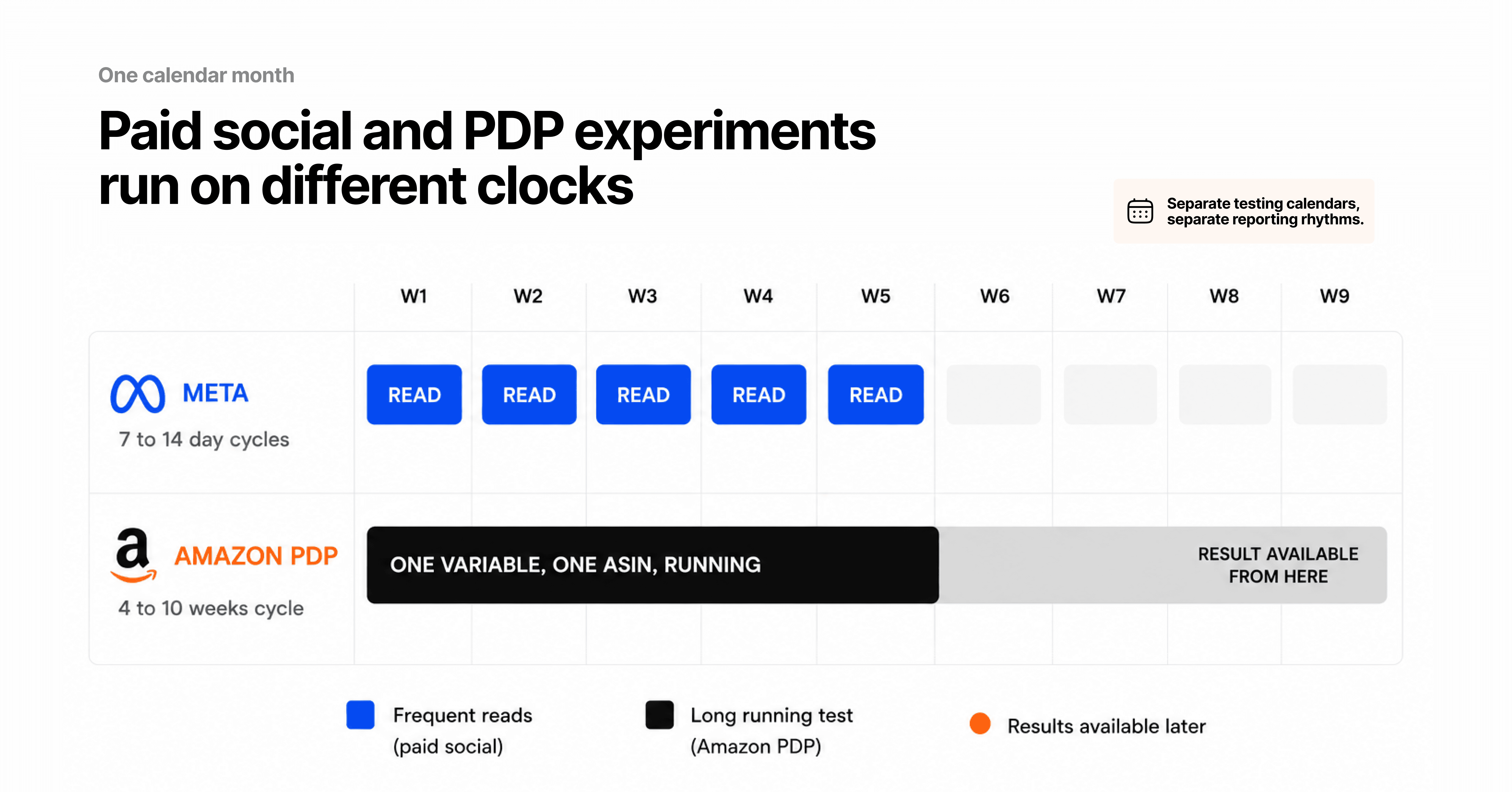
One calendar is applied to channels that run on different clocks. A Meta creative test can be completed in seven to fourteen days. An Amazon PDP experiment runs for several weeks and only on eligible listings. Teams that force both onto one reporting rhythm either stop Amazon experiments early or give up on PDP testing entirely.
Nothing is written down. Tests run, winners ship, the reasoning evaporates, and the same hypothesis gets retested a year later by someone new.
Each failure maps to a missing layer, which is what the rest of this framework supplies.
What a creative testing framework actually needs to include
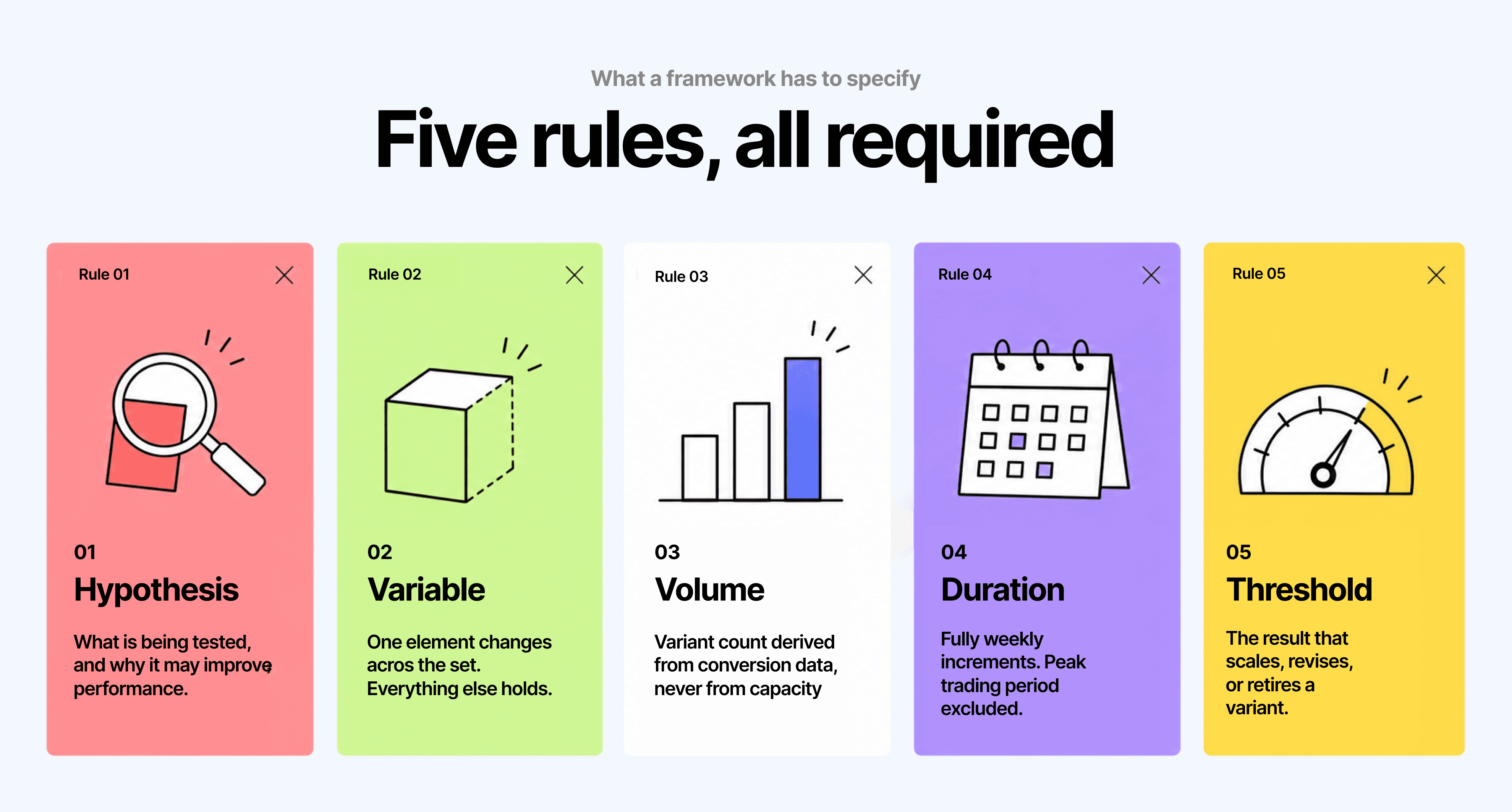
A creative testing framework is a documented set of rules for planning, running, and evaluating creative experiments. At a minimum, it defines five things: the hypothesis being tested, the variable that changes between variants, the number of variants the sample can support, the duration before review, and the threshold that determines whether a variant is scaled, revised, or retired.
![]() Define the five creative testing frameworks before production begins |
Those five rules operate across four layers. Miss a layer, and the others stop working.
Layer 1: The production system most brands don't have
A framework only works when the team can produce the required concepts, formats, and retailer-ready versions inside the test window.
The matharithmetic is unforgiving. A Meta test with 12 concepts across three formats is 36 assets. Add two Amazon PDP versions with A+ Content modules, six retail media display variants across two networks, and review cycles, and one properly sized month lands between 40 and 80 finished assets, for one product line.
This is the gap behind a familiar pattern: teams testing five to ten ads a month while knowing the account could read 30 to 50. At the spend levels of most consumer brands on Amazon and retail media, the conversion math supports a far higher variant count than ever ships. The binding constraint is the creative production bottleneck, rather than the sample.
When turnaround takes weeks, assets arrive after the launch date. Teams then cut arms or launch incomplete ones, and both choices weaken the test. Much of that delay is resizing and reformatting rather than design, which is where the cost of manual versioning accumulates.
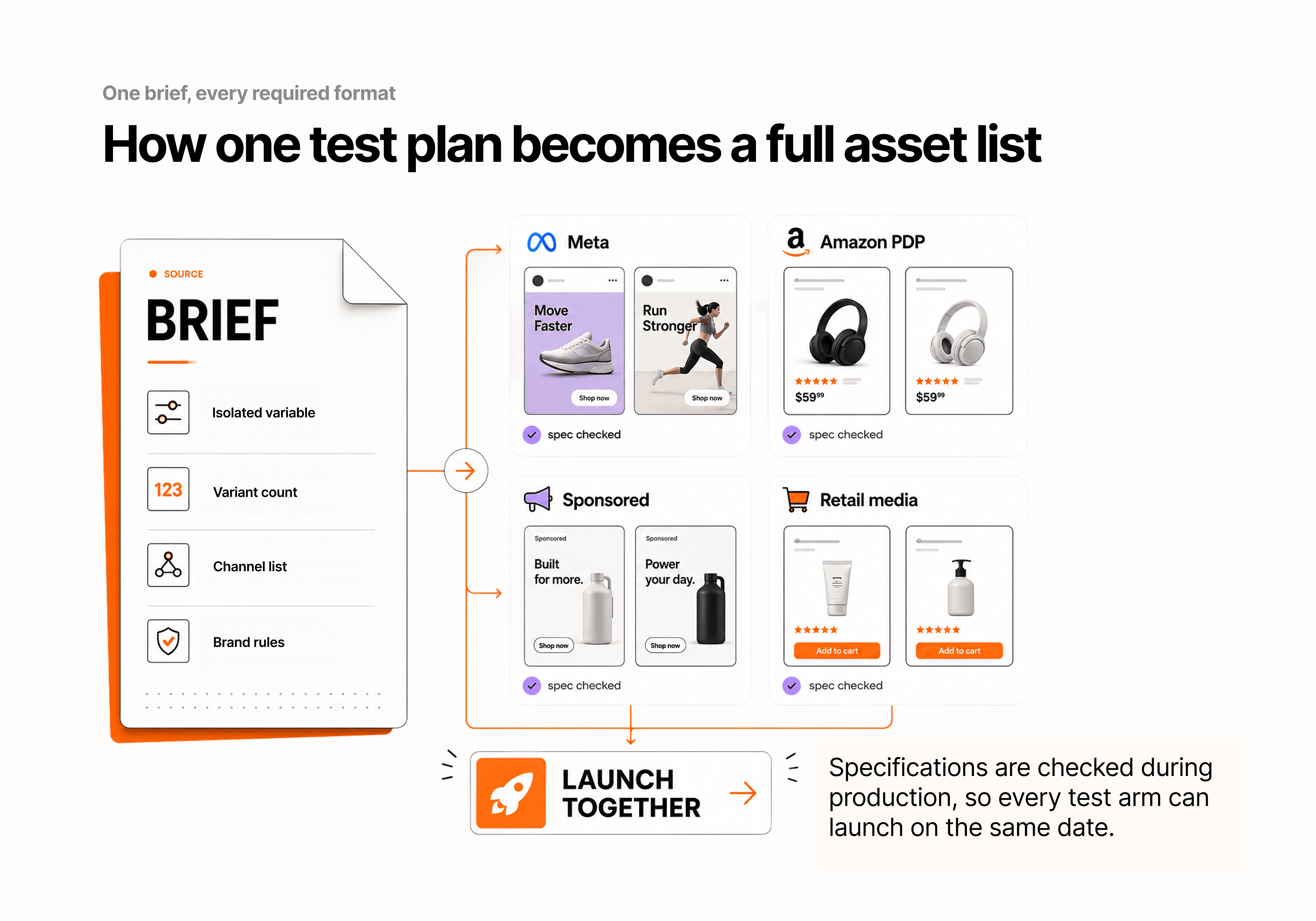
![]() Checking specifications during production reduces the risk of one test arm being delayed by a compliance or formatting issue. |
A production system built for testing supports distinct concepts rather than format variations alone, placement and aspect-ratio adaptations, retailer specifications with compliance checks, brand and legal review with version control, and delivery inside the campaign window.
Calculate the real asset load A test may involve 10 concepts, but each one can require multiple sizes, aspect ratios, formats, and retailer-specific versions. Work out the complete production requirement before the brief is approved. |
Layer 2: Testing methodology by channel
An ecommerce creative testing framework has to account for retailer channels, and this is where most published advice falls short. Meta, Amazon PDPs, sponsored ads, and retail media placements support different variables and run on different timelines, so they can't share one testing calendar. A brand can hold one testing discipline while running separate execution rules for each.
Meta creative testing runs on the fastest cycles of any channel. Teams can launch several concepts, monitor delivery, and review over seven to fourteen days, testing hooks, offers, formats, product demonstrations, customer proof, and opening video sequences.
Amazon PDP testing works differently. Manage Your Experiments supports controlled A/B tests on eligible listings, covering main images, titles, bullets, descriptions, A+ Content, Brand Story content, and video. Three operational differences follow: it compares two versions of a single element rather than a batch of concepts; an experiment typically runs for 4 to 10 weeks depending on traffic; and lower-volume ASINs may not qualify at all, so prioritize the listings where a conversion lift has the greatest commercial impact.
![]() Amazon and paid social therefore need separate testing calendars and separate reporting rhythms. |
For ASINs that don't qualify, three approaches work:
Run native experiments on high-velocity listings and transfer the learning to structurally similar ones as an informed hypothesis rather than proof.
Use Sponsored Brands and Sponsored Display as a faster proxy for messaging and image treatments, allowing for the difference in shopper intent. Or,
Sequence the roadmap quarterly, with a small number of high-value hypotheses per flagship ASIN.
Worth knowing Amazon reports that listing content optimized through Manage Your Experiments can increase sales by up to 25%. Treat that as an upper-end result rather than a typical outcome. Even a small conversion lift compounds on a high-volume listing, because it applies to future organic and paid traffic alike. |
Before testing between PDP elements, confirm the listing has the elements in place. Jungle Scout's listing guidance covers the baseline, and our breakdown of the PDP elements that drive conversion covers what to fix before you experiment.
How often should you test on each channel?
Channel | What you can test | Typical duration | Variants per cycle | Primary metrics | Decision approach |
|---|---|---|---|---|---|
Meta and Instagram | Hook, angle, format, copy, CTA | 7 to 14 days | Based on conversion volume | CPA, ROAS, conversion rate | Compare with control after minimum sample and full period |
Amazon PDP | Images, title, bullets, A+ Content, video | 4 to 10 weeks | 2 | Conversion rate, units sold | Allow the platform to complete the experiment |
Amazon sponsored ads | Creative image, headline, product set | Around 14 days | 4 to 10 | ACOS, CTR, conversion rate | Compare with the agreed ACOS or conversion benchmark |
Retail media display (Walmart Connect, Roundel) | Layout, imagery, offer, message | 14 to 30 days | 4 to 8 | ROAS, CTR, sales lift | Review against placement-specific benchmarks |
Programmatic display | Layout, size, imagery, offer | Around 14 days | 8 to 20 | Viewable CTR, CPA | Evaluate after a full flight and sufficient delivery |
ACOS is advertising cost of sale, the retail media equivalent of a cost-per-acquisition target. These are starting ranges; final durations should reflect traffic, conversion volume, buying cycle, and objective. One shared brief and reporting calendar won't serve every channel, which is why teams that scale creative production usually run separate brief cycles per channel rather than one master calendar.
Build separate channel testing calendars Paid social, retail media, and Amazon PDP content need different specifications, approval rules, and refresh schedules. AI Studio produces channel-ready variations from a central brief while holding brand and retailer requirements. |
Layer 3: Evaluation criteria that prevent false positives
False positives in ad creative testing come from two sources: tests too thin to read, and tests read too early. Both are preventable in design.
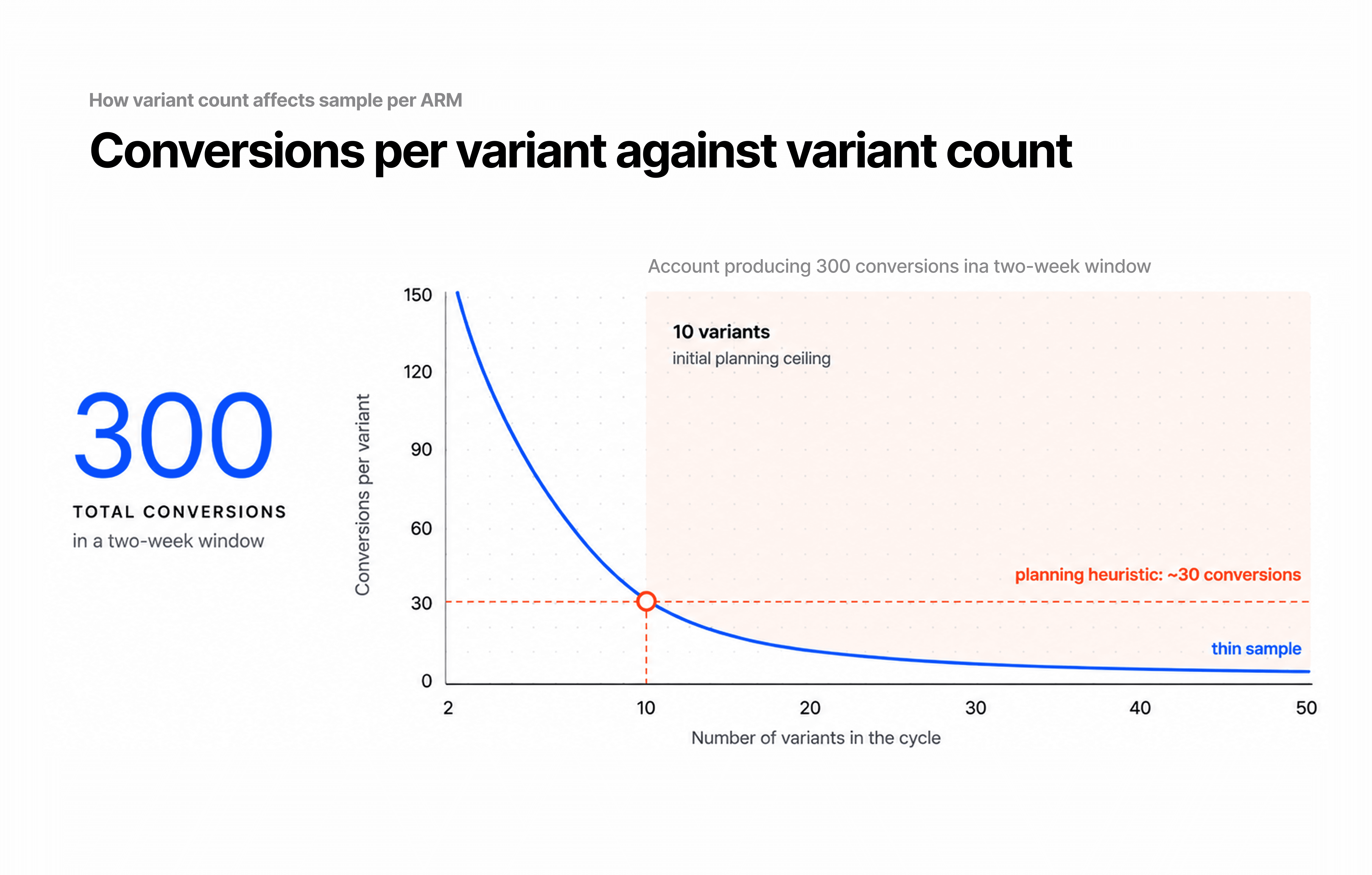
Size the test from conversions. The maximum variant count depends on the conversions expected during the window. As a planning heuristic:
Expected conversions during the test window ÷ approximately 30 = initial variant ceiling Planning heuristic only. Formal sample size depends on the baseline conversion rate, confidence level, and minimum detectable effect. |
If your account expects 300 conversions over two weeks, plan around 10 variants. Running 40 leaves fewer than eight conversions per test arm, meaning each variant is rarely enough for a confident decision.
![]() Past the crossing point, each additional arm carries a thinner share of the same sample |
A starting point for variant planning
Expected conversions in the test window | Initial variant ceiling | Recommended approach |
|---|---|---|
Around 90 | 3 | Small controlled test, one variable |
Around 300 | 10 | One multi-concept cycle |
Around 600 | 20 | Larger test, or two isolated groups |
Around 1,500 | 50 | Multiple structured tests in parallel |
3,000 and above | 100+ | Continuous testing across defined groups |
Use recent performance on the same placement to estimate the conversion figure, since rates vary by category, price point, and average order value.
A separate constraint applies on Meta. Its Business Help Center guidance states that an ad set needs roughly 50 optimization events, meaning the conversion you've told Meta to optimize for, within seven days, to exit the learning phase. That threshold sits at the ad set level, so several ads share one pool of 50. It measures delivery stability rather than significance, but the overlap matters: splitting a test across many ad sets multiplies the event requirement while dividing the same conversions.
Set decision rules before launch. Define the minimum sample, the duration, the primary metric, the benchmark, and the threshold for scaling, revising, or retiring. Run across complete weekly periods where day-of-week effects influence behavior, and avoid Prime Day or Black Friday as benchmarks for ordinary performance. Without pre-agreed rules, the same result gets interpreted differently depending on which variant appears to be leading.
Separate a weak concept from creative fatigue. Rising frequency alongside falling click-through usually points to fatigue rather than a bad idea. The two diagnoses need different responses. The appropriate rotation trigger varies by audience size, purchase cycle, and placement, so establish yours from account history. Our guide to diagnosing creative fatigue explains how to distinguish an overexposed asset from an underperforming one.
Treat distinctness as a design input. Changing only the crop or background color may satisfy placement requirements without creating a new hypothesis. This matters more since Meta's Andromeda retrieval system, published in December 2024, began reading the creative itself when deciding which ads are eligible for the auction.
Practitioners report that near-identical assets get grouped and treated as one concept, though that grouping is widely observed rather than documented by Meta. A small set of genuinely different ideas tends to produce clearer signals than a large batch of template variations.
A null result, meaning no significant difference between arms, is also a valid outcome. It tells you the variable you isolated doesn't move much for that audience, which is useful information about where to stop spending attention.
Layer 4: The feedback loop that compounds learning
Ask your team what its ad creative testing taught it eighteen months ago and the answer is usually incomplete. The tests ran, the winners shipped, nothing was recorded, and the same hypothesis resurfaces next spring.
A test log fixes this at almost no cost:
Field | What to record |
|---|---|
Hypothesis | The claim being tested |
Constraint | The business or performance problem |
Isolated variable | The creative element that changed |
Test design | Channel, duration, and variant count |
Sample | Conversions per arm at read |
Outcome | Winner, loss, or no meaningful difference |
Decision | What was scaled, revised, or retired |
Next test | The next unresolved question |
Update it as each test closes. Keep Amazon, paid social, and retail media findings separated. A result from one channel can seed a hypothesis for another, though it isn't proof. Teams that already report creative ops metrics usually add the log to the same review, so wins and null results get discussed on the same rhythm as output and turnaround.
Practical tip The log matters more as creative volume explodes. Meta's engineering team reports that more than one million advertisers created over 15 million ads in a single month using its generative tools. The teams that compound learning from that volume are the ones writing it down. |
What consumer brands get wrong about creative testing
Most creative testing best practices published online assume a DTC brand running one channel it fully controls. Consumer brands operate differently, and four misconceptions follow.
Applying paid social advice to retailer channels. A weekly multi-variant cadence can't be applied to Amazon PDP content, where a single A/B runs for weeks on eligible ASINs only. The channels need separate frameworks, briefs, and reporting rhythms.
Counting versions as tests. Twenty crops of one concept is one test with extra production cost. Distinct concepts carry the learning; adaptations carry the placements.
Testing only paid media while PDP carries the revenue. A winning ad fatigues in weeks. A winning listing improvement compounds on every future visit, organic and paid, which is why the retailer half of the program usually holds the larger prize for a consumer brand.
Treating inconclusive as failure. Most well-run tests don't produce a significant winner. Programs that report a winner every cycle are usually reading noise, and programs that record null results stop repeating them.
How to diagnose a weak testing program
Symptom | Likely cause | Recommended action |
|---|---|---|
Most tests are inconclusive | Too many arms for the available sample | Reduce the variant count or extend the test |
A winner is chosen after a few days | The test is read before minimum sample | Set a review date and sample floor before launch |
Several similar assets decline at once | Variants are minor versions of one concept | Test distinct messages, visuals, or formats |
Amazon tests are stopped early | PDP testing follows a paid-social calendar | Use a separate quarterly roadmap |
The same hypotheses recur | Results are not documented | Maintain and review a central testing log |
One arm launches later than the others | Production or approval delays | Complete every required version before launch |
Fewer variants ship than planned | Production considered after test design | Calculate total asset requirements at briefing |
How to build a creative testing framework for a consumer brand
These seven steps put the four layers into a repeatable cycle. Each step produces an output the next one uses.
1. Start with the performance constraint. CPA rising in a scaled campaign, a flagship ASIN converting below category benchmark, or strong click-through with weak product-page conversion. Write it in one sentence before anyone proposes a creative idea.
Do this:
Review CPA, ROAS, CTR, and conversion trends by channel over 90 days
Pick the placement or SKU where a lift moves the most revenue
Define one constraint for the cycle
2. Write a hypothesis with a mechanism. "Shoppers can't judge product size from the current pack shot, so an in-hand lifestyle image may improve conversion" tells your creative team what to build and your performance team what a null result means. The hypothesis belongs in the creative brief, agreed before production begins.
Do this:
Name the shopper affected and the problem they're hitting
State the one element that changes between variants
Predict the direction of the result before launch
3. Size the test against conversion volume. Pull conversions from a comparable recent window, divide by roughly 30, and treat the result as your ceiling. If it comes out at four, run four good ones.
Do this:
Estimate the total sample from recent performance on the same placement
Extend the duration when the sample is small, rather than thinning the arms
Fix the count at briefing, before any production quote arrives
4. Build meaningfully different concepts. A studio product shot, a customer demonstration, a review-led treatment, a problem-first hook. Each one is a different bet on why a shopper responds.
Do this:
Give every variant a different angle, not just a different crop
Keep the isolated variable consistent so results stay comparable
Produce every required placement before launch so no arm goes live late
5. Set decision rules before launch. Minimum sample, duration, primary metric, benchmark, and threshold, written into the brief. A variant that's 12% behind on day four becomes "still early" if nobody wrote the rule down.
6. Read honestly, including the nulls. Compare against the pre-registered threshold, and separate fatigue from failure before retiring a concept. Most cycles won't crown a winner, and that's a finding too.
7. Log the decision. Hypothesis, variable, sample, outcome, decision. Review the log before writing any new brief, so resolved hypotheses stay resolved.
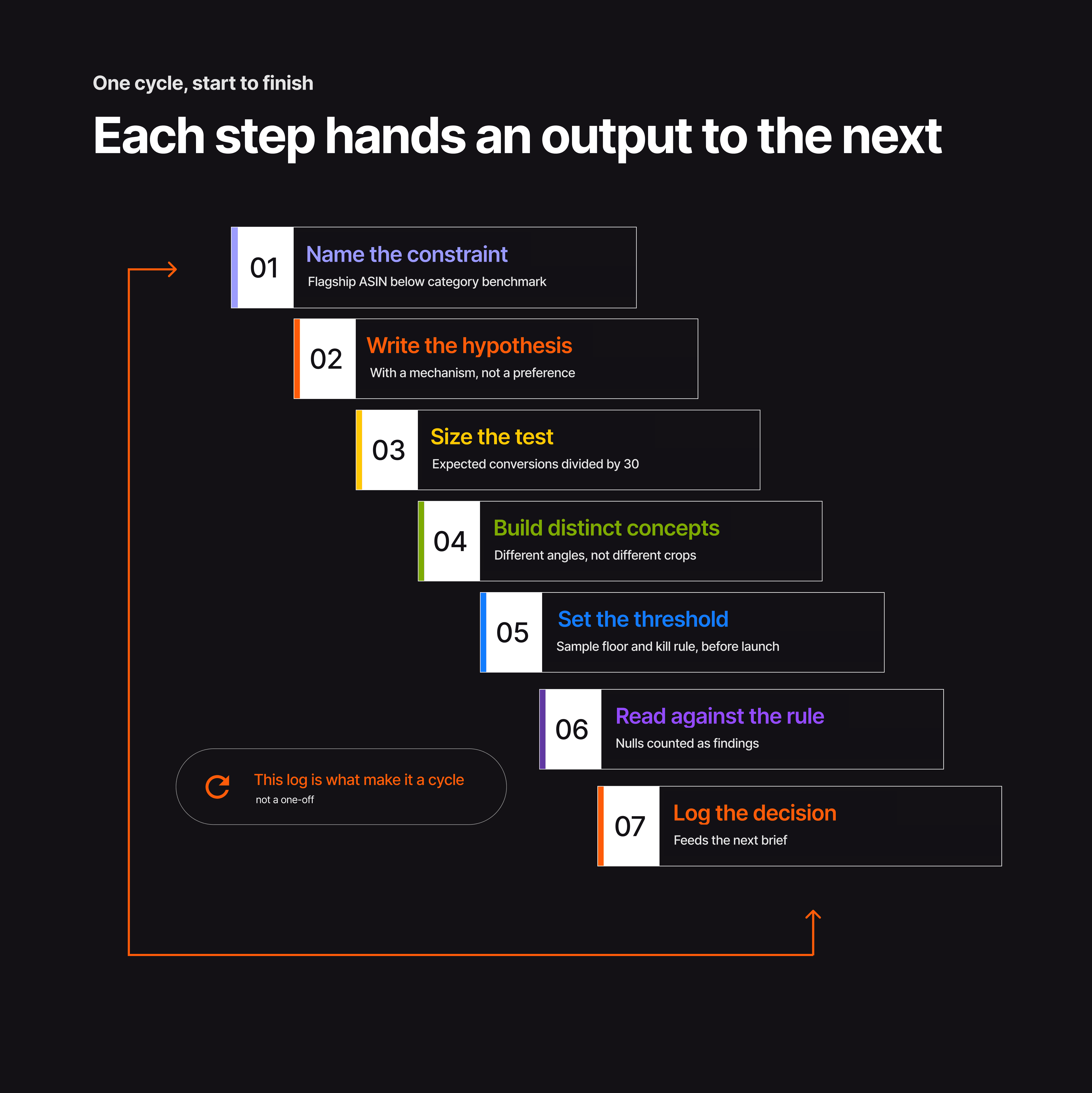
![]() Step seven is what carries the learning into the next cycle. |
Here's what we see across our customer base: the variant count in a brief almost always traces back to a budget line rather than a conversion estimate. MegaFood is the clearest example of what changes when that constraint moves. Their freelancer model had made every listing refresh a rationing decision, and once production stopped being the limit, the question became which hypotheses to run across 125 PDPs rather than which three they could afford.
How Rocketium compresses the production side of testing
Rocketium AI Studio works as a managed creative production layer. AI agents handle adaptation, versioning, specification checks, and file preparation, and human designers review outputs before delivery. Because specifications are checked during production rather than after, every arm of a test is more likely to launch on the same date.
AI Studio supports creative production rather than test measurement or attribution. It doesn't determine which creative won. It addresses the production constraint that stops teams from running the test plan they already designed.
The examples below are documented production outcomes. The final column is our reading of what that capacity makes possible for a testing program, rather than a claim about the testing roadmap each brand ran.
Brand | Production constraint | Documented outcome | Relevance to testing capacity |
|---|---|---|---|
125 Amazon PDPs needing refresh | 142 projects completed across PDP, A+, paid social, display, and video. | Supports consistent PDP optimization across a catalog | |
14 platforms, frequent rejections | Launches roughly twice as fast, far fewer rejections | Helps prevent arms launching on different dates |
Make test sizing part of every creative brief
Before you approve the next batch of creative, calculate how many variants your conversion volume can support. Then check whether each variant represents a genuine hypothesis, whether the duration and decision rules match the channel, and whether production can deliver every version before launch.
The aim is a test that produces enough evidence to make a decision, with enough production capacity to act on the result. Batch size is a means to that, rather than the objective.
Frequently asked questions
What is a creative testing framework?
A documented set of rules for planning, running, and evaluating creative experiments. It defines the hypothesis, the isolated variable, the number of variants the sample supports, the test duration, and the threshold that scales, revises, or retires a variant.
How many ad creatives should you test per month?
Divide the conversions you expect that month by roughly 30. An account producing 600 monthly conversions can read about 20 variants. Producing more than the ceiling splits the same sample into thinner, less conclusive slices.
How do you decide when to kill an ad?
Against a threshold written into the brief before launch. Retire a variant once it reaches its minimum conversion count over full weekly periods and still trails the control on the primary metric. Avoid reads during Prime Day or Black Friday.
What's the difference between creative testing and creative strategy?
Strategy decides which customer problems, messages, and angles are worth exploring. Testing determines which execution of those ideas performs against a metric. Strategy generates the hypothesis, and testing resolves it. Neither substitutes for the other.
How do you test creative for Amazon PDP and retail media?
Amazon's Manage Your Experiments runs A/B tests on eligible listings over four to ten weeks, requiring Brand Registry and sufficient traffic. Retail media display testing runs on 14- to 30-day cycles with fewer variants than paid social.
What's the biggest mistake brands make in creative testing?
Sizing the test to the production budget instead of the conversion volume. The batch fits the quote, every arm returns inconclusive, and the program gets blamed. Reading results before a full week is the close second.
How do you prevent creative fatigue?
Rotate before performance decays rather than after. Watch for rising frequency alongside falling click-through, keep two or three validated concepts in reserve, and build genuinely distinct concepts, since near-duplicates now tend to fatigue together.