

Key takeaways
|
|---|
Key takeaways
|
|---|
On June 30, 2025, Bath & Body Works opened its Halloween collection to more than 38 million loyalty members. That was 123 days before Halloween. The range ran to more than 70 products, reached stores a week later, and one fragrance, I Scream Float, sold out on TikTok Shop in a single day.
The name did half the work. Summerween was already a social media trend, and Bath & Body Works gave its biggest fans a reason to act on it months early. By the time most brands circulate a Halloween concept for approval, those shoppers have bought, decorated, and moved on.
That's Halloween marketing in 2026 in miniature. The winning ideas are often simple. What separates them is timing, and whether the creative is ready when each retailer's season opens, in every size and format that retailer asks for.
The eight campaigns in this guide show how that plays out. Each comes with why it worked, ways to adapt it for a portfolio selling through several retailers, and what it takes once the idea leaves the concept deck, which is where most Halloween plans slip.
What changed in Halloween marketing in 2026
The National Retail Federation released its 2026 Halloween survey on September 22, forecasting a record $13.5 billion in spending and $115.14 per person, with 74% of consumers planning to celebrate. Three shifts underneath that headline change how a Halloween campaign has to be planned.
1. Halloween now starts months before October
Forty-nine percent of shoppers plan to start buying in September or earlier, up from 34% a decade ago, and NRF's early-season read found a quarter had already bought Halloween items by early August. Retailers have moved to match. Home Depot put its 2026 range online on July 16, and Petco launched its Halloween drop on July 27.
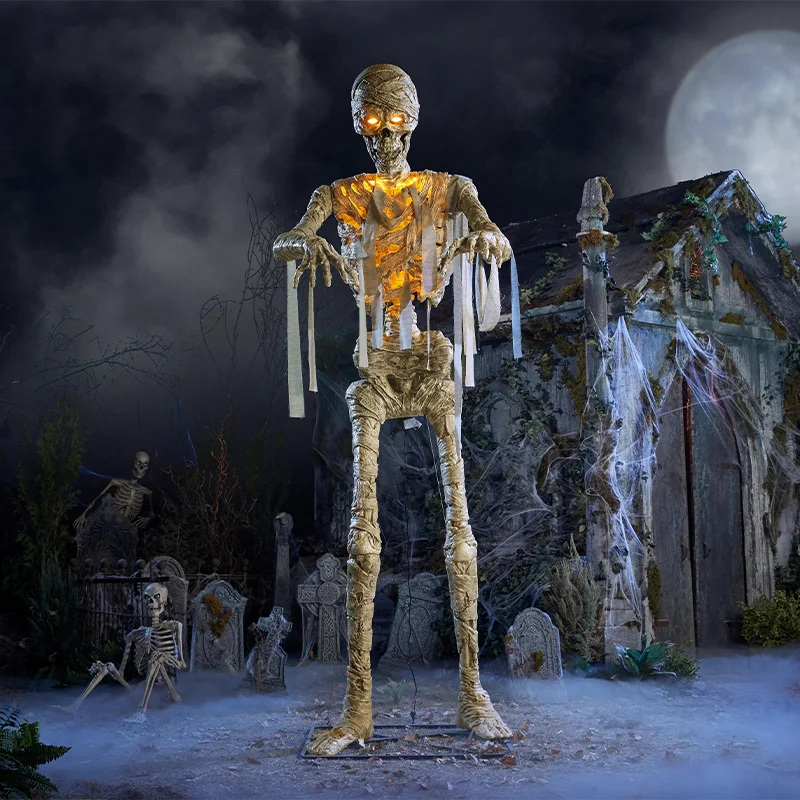

HomeDepot’s 2026 Halloween collection
That moves the creative deadline with it. If your Amazon and Walmart Halloween assets need to be live in late August, masters still sitting in approval in September are already late.
2. More categories and more retailers are competing for Halloween spend
Candy is still the most common Halloween purchase, bought by 96% of celebrants, but it's no longer the biggest line. NRF expects $4.4 billion on costumes and $4.3 billion on decorations this year, against $4.1 billion on candy. Pet costumes alone come to $0.92 billion.
Worth Knowing Adults now spend more on their own costumes than on their children's. NRF expects $2 billion on adult costumes in 2026, against $1.5 billion for kids. |
The spend is also spread across more doors. Only 27% of shoppers plan to buy Halloween items online, while 39% plan to use discount stores and 32% plan to use specialty Halloween stores. For pet, home, beauty, and personal care brands, that's a real opening with fewer competitors, and it means retailer app placements, in-store displays, and the product pages shoppers check in the aisle all need Halloween versions.
3. Retail media and AI shopping are adding more places to be seen
Sensor Tower measured 508 million candy impressions across retail media networks in October 2025, nearly triple the previous Halloween. Target grew 167%, Dollar General 147%, and Walmart 69%. The most common messages weren't spooky stories. They were delivery, discounts of up to 40%, and puns like "scary-fast" shipping.
At the same time, 47% of consumers say they'll use AI tools for Halloween shopping this year. That shifts part of discovery from your ads to your product content, since an AI assistant can only recommend what your listing clearly describes.
Practical Tip The top AI uses are brainstorming ideas (34%) and getting product recommendations (32%), according to NRF. A costume page that says "fits large dogs up to 90 pounds" gives an assistant more to work with than one that says "spooky and fun." |
Put together, an idea that only works on a hero banner won't survive the season. Test it at the size of a sponsored product tile first, and write Halloween titles, bullets, and A+ content that answer real questions, such as "non-toxic Halloween face paint for kids." The principles behind high-converting Amazon PDP assets apply to seasonal listings too.

Three shifts in Halloween marketing for 2026 covering early shopping, category spending, and retail media growth
On June 30, 2025, Bath & Body Works opened its Halloween collection to more than 38 million loyalty members. That was 123 days before Halloween. The range ran to more than 70 products, reached stores a week later, and one fragrance, I Scream Float, sold out on TikTok Shop in a single day.
The name did half the work. Summerween was already a social media trend, and Bath & Body Works gave its biggest fans a reason to act on it months early. By the time most brands circulate a Halloween concept for approval, those shoppers have bought, decorated, and moved on.
That's Halloween marketing in 2026 in miniature. The winning ideas are often simple. What separates them is timing, and whether the creative is ready when each retailer's season opens, in every size and format that retailer asks for.
The eight campaigns in this guide show how that plays out. Each comes with why it worked, ways to adapt it for a portfolio selling through several retailers, and what it takes once the idea leaves the concept deck, which is where most Halloween plans slip.
What changed in Halloween marketing in 2026
The National Retail Federation released its 2026 Halloween survey on September 22, forecasting a record $13.5 billion in spending and $115.14 per person, with 74% of consumers planning to celebrate. Three shifts underneath that headline change how a Halloween campaign has to be planned.
1. Halloween now starts months before October
Forty-nine percent of shoppers plan to start buying in September or earlier, up from 34% a decade ago, and NRF's early-season read found a quarter had already bought Halloween items by early August. Retailers have moved to match. Home Depot put its 2026 range online on July 16, and Petco launched its Halloween drop on July 27.
HomeDepot’s 2026 Halloween collection
That moves the creative deadline with it. If your Amazon and Walmart Halloween assets need to be live in late August, masters still sitting in approval in September are already late.
2. More categories and more retailers are competing for Halloween spend
Candy is still the most common Halloween purchase, bought by 96% of celebrants, but it's no longer the biggest line. NRF expects $4.4 billion on costumes and $4.3 billion on decorations this year, against $4.1 billion on candy. Pet costumes alone come to $0.92 billion.
Worth Knowing Adults now spend more on their own costumes than on their children's. NRF expects $2 billion on adult costumes in 2026, against $1.5 billion for kids. |
The spend is also spread across more doors. Only 27% of shoppers plan to buy Halloween items online, while 39% plan to use discount stores and 32% plan to use specialty Halloween stores. For pet, home, beauty, and personal care brands, that's a real opening with fewer competitors, and it means retailer app placements, in-store displays, and the product pages shoppers check in the aisle all need Halloween versions.
3. Retail media and AI shopping are adding more places to be seen
Sensor Tower measured 508 million candy impressions across retail media networks in October 2025, nearly triple the previous Halloween. Target grew 167%, Dollar General 147%, and Walmart 69%. The most common messages weren't spooky stories. They were delivery, discounts of up to 40%, and puns like "scary-fast" shipping.
At the same time, 47% of consumers say they'll use AI tools for Halloween shopping this year. That shifts part of discovery from your ads to your product content, since an AI assistant can only recommend what your listing clearly describes.
Practical Tip The top AI uses are brainstorming ideas (34%) and getting product recommendations (32%), according to NRF. A costume page that says "fits large dogs up to 90 pounds" gives an assistant more to work with than one that says "spooky and fun." |
Put together, an idea that only works on a hero banner won't survive the season. Test it at the size of a sponsored product tile first, and write Halloween titles, bullets, and A+ content that answer real questions, such as "non-toxic Halloween face paint for kids." The principles behind high-converting Amazon PDP assets apply to seasonal listings too.
Three shifts in Halloween marketing for 2026 covering early shopping, category spending, and retail media growth
8 Halloween marketing campaigns worth learning from
The eight campaigns below are from 2025 and 2026; each uses a different mechanic. Read them as evidence as much as inspiration: every mechanic creates a different production load, and that load decides whether a portfolio brand can pull it off.
Fanta went from renting horror icons to owning its own

What they did: In 2025, Fanta paired four licensed horror icons with four flavors: Chucky, The Grabber from Black Phone, Freddy Fazbear from Five Nights at Freddy's, and M3gan. The line-up varied by market, and The Grabber wasn't available in Latin America. That campaign delivered 10 billion impressions.
For 2026, Coca-Cola launched four original Fanta characters across 50 markets: a jack-o'-lantern scarecrow, a vampire, a cyborg Frankenstein, and a werewolf DJ, with collectible cans, a Haunted Fanta Factory experience, and Scream's Ghost Face as the first guest character.

Why it worked: Licensed icons bought Fanta instant relevance, but every licence ends, and many vary by territory. Owned characters keep their value, and this year's packaging, content, and fan recognition carry into next year. Ibrahim Khan, Fanta's global vice president of marketing, told Marketing Dive that "what Christmas is to Coke is what we want Halloween to be for Fanta." Bringing Ghost Face in as a guest keeps the pop-culture energy of a licence without handing the platform over to it.
Make it your own:
Build a seasonal cast for the whole portfolio: One small set of characters can appear on a snack brand's sponsored tile, a pet brand's product image, and a home brand's Brand Store banner, each styled in that brand's colors.
Write the character kit before the campaign: Poses, expressions, color variations, and a short voice guide. The kit is what keeps five retailers or fifty markets looking like one campaign.
Add a clearance column to the asset plan: If you do license, track which character is cleared in which market before design starts, and keep an owned-character fallback for markets where it isn't.
What happens at scale: Khan said the universe took a year and a half to build. For a portfolio brand, the characters are the smaller job. The bigger one is every character in every retailer size and every market, and one character missing from one region changes the pack line-up, retailer tiles, and social cutdowns for that whole region. When licences vary by territory, creative localization becomes a scheduling problem as much as a translation one.
Capri Sun made the pack the prank, for three days on Walmart
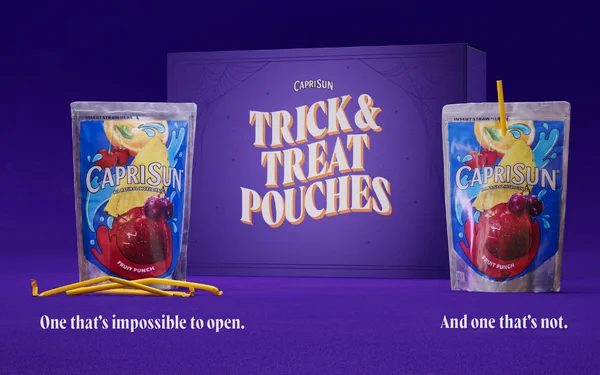
What they did: Capri Sun's Trick & Treat pouches came as a pack with one regular Fruit Punch pouch, one "impossible to pierce" trick pouch made from ripstop nylon, and 10 straws. In October 2025, the packs sold only as daily drops on Walmart.com from October 21 to 23. "The best jokes are the ones everyone's in on," said Kristina Hannant, Capri Sun's director of marketing.
Why it worked: The pouch turned the brand's best-known complaint, the straw that won't go in, into the joke, which made it shareable without any spooky storytelling. Three daily drops on one retailer created scarcity and gave Walmart an exclusive, right as shoppers were buying for parties. It was also Capri Sun's third novelty pouch drop of 2025, after an eclipse edition and a solstice edition, so the team was running a repeatable format rather than a one-off stunt.
Make it your own:
Spot the complaint your fans already joke about: A stubborn lid, a pump that jams, a pack that's hard to open. Halloween gives a brand permission to be in on the joke.
Pitch a retailer-exclusive drop: A small, dated drop on one retailer's site gives that retailer a reason to feature you and keeps the production run small.
Put retailer events on your Halloween calendar: In 2026, Amazon's Prime Big Deal Days runs October 6 and 7, and Walmart and Target hold their own October events the same week. Keep a swappable badge area in your Halloween creative so one asset can carry an event label for a few days.
What happens at scale: A three-day exclusive still needs its own product page images, retailer ad sizes, and social cutdowns, all approved before the first drop and retired on day four. Per day of use, short-lived creative is some of the most expensive a team makes, which is why it pays to build it from templates.
Mars gave three brands three different Halloween jobs

What they did: In 2025, Mars split its candy brands across the season.
M&M's brought back its Halloween Rescue Squad, delivering emergency candy through Gopuff on Halloween night.
Skittles ran a short-form sitcom about a man and his ghost roommate across TV, social, digital, and a podcast integration. Twix went the other way with "Hallowmas," a Halloween-meets-Christmas pop-up in Brooklyn with limited drops.
Why it worked: Each brand had a different job. M&M's solved a problem (running out of candy), Skittles told a story, and Twix created something to share. The portfolio covered more of the season than one shared campaign could have, and no two brands competed for the same moment.
Make it your own:
Give every brand in your portfolio one job: Utility, story, or collectible. Write the job on the brief so no two brands chase the same shopper with the same idea.
Share the system, not the idea: Use one seasonal design system with brand-specific variable zones. The brands look distinct, while production stays manageable.
Borrow Twix's bridge into the holidays: A Halloween-to-holiday idea stretches October creative into November, which helps when the same team is also building Black Friday.
What happens at scale: Three jobs mean three asset sets. Without a shared template layer underneath them, the portfolio pays for three separate campaigns in the same four weeks.
Bath & Body Works shipped Halloween in June
What they did: The June 30 launch went to loyalty members online first, reached stores on July 7, and used TikTok Shop as a separate sales channel, where I Scream Float sold out within a day.
Why it worked: Early access rewarded the brand's most engaged customers, and launching in summer meant almost no competing Halloween noise. TikTok Shop turned a trending fragrance into a sold-out product, which fed more attention back to the full collection.
Make it your own:
Borrow a retailer's early access: If you don't run your own loyalty program, launch Halloween SKUs in a retailer's early-access window or on TikTok Shop weeks before the store reset.
Decide what goes first, and build in that order: Pick three to five hero products for a July first look and finish their retailer images and app assets first. The rest of the range can follow for the store season.
Cut TikTok Shop from the same master: Vertical video and product cards for the hero SKUs should come from the approved retailer creative, so the early drop and the store range look like one collection.
What happens at scale: A June launch means 70 products' worth of product images, app assets, and TikTok creative signed off by May. The limit on an early drop is production, not demand.
Heinz made a limited-edition product for the whole campaign
What they did: In October 2025, Kraft Heinz Brazil launched Mayo Halloween, a jet-black mayonnaise made with black garlic, as a limited edition at major Brazilian retailers.
DAVID São Paulo shot the film like a classic horror movie, where the "blood" turns out to be the black mayo. Earlier Halloween editions in Australia and New Zealand had sold out quickly.
Why it worked: A black condiment is shareable before anyone reads a line of copy, and it gave Heinz a seasonal reason to introduce a flavor, black garlic, that's uncommon in Brazil. Thiago Lopes, CMO of Kraft Heinz Brazil, said the aim is for limited editions to "connect with meaningful cultural moments." Running the edition market by market let each country time it to local Halloween habits.
Make it your own:
Make one SKU the season: A limited colorway, scent, or flavor gives every channel the same hero to show, which is simpler than dressing the full range.
Roll it out market by market: Launch where Halloween is strongest, then carry the same master into the next market with local copy and pack shots.
Build the sold-out version early: A limited edition that sells out needs its ads and listings swapped to evergreen creative within days, so make that version alongside the launch assets.
What happens at scale: A limited edition adds a new SKU to every retailer's catalog for a few weeks: new product images, new listings, and new retail media tiles in each market's language. The shorter the run, the less time there is to produce them once the pack is final.
Mars gave three brands three different Halloween jobs
What they did: In 2025, Mars split its candy brands across the season.
M&M's brought back its Halloween Rescue Squad, delivering emergency candy through Gopuff on Halloween night.
Skittles ran a short-form sitcom about a man and his ghost roommate across TV, social, digital, and a podcast integration. Twix went the other way with "Hallowmas," a Halloween-meets-Christmas pop-up in Brooklyn with limited drops.
Why it worked: Each brand had a different job. M&M's solved a problem (running out of candy), Skittles told a story, and Twix created something to share. The portfolio covered more of the season than one shared campaign could have, and no two brands competed for the same moment.
Make it your own:
Give every brand in your portfolio one job: Utility, story, or collectible. Write the job on the brief so no two brands chase the same shopper with the same idea.
Share the system, not the idea: Use one seasonal design system with brand-specific variable zones. The brands look distinct, while production stays manageable.
Borrow Twix's bridge into the holidays: A Halloween-to-holiday idea stretches October creative into November, which helps when the same team is also building Black Friday.
What happens at scale: Three jobs mean three asset sets. Without a shared template layer underneath them, the portfolio pays for three separate campaigns in the same four weeks.
Bath & Body Works shipped Halloween in June
What they did: The June 30 launch went to loyalty members online first, reached stores on July 7, and used TikTok Shop as a separate sales channel, where I Scream Float sold out within a day.
Why it worked: Early access rewarded the brand's most engaged customers, and launching in summer meant almost no competing Halloween noise. TikTok Shop turned a trending fragrance into a sold-out product, which fed more attention back to the full collection.
Make it your own:
Borrow a retailer's early access: If you don't run your own loyalty program, launch Halloween SKUs in a retailer's early-access window or on TikTok Shop weeks before the store reset.
Decide what goes first, and build in that order: Pick three to five hero products for a July first look and finish their retailer images and app assets first. The rest of the range can follow for the store season.
Cut TikTok Shop from the same master: Vertical video and product cards for the hero SKUs should come from the approved retailer creative, so the early drop and the store range look like one collection.
What happens at scale: A June launch means 70 products' worth of product images, app assets, and TikTok creative signed off by May. The limit on an early drop is production, not demand.
Heinz made a limited-edition product for the whole campaign
What they did: In October 2025, Kraft Heinz Brazil launched Mayo Halloween, a jet-black mayonnaise made with black garlic, as a limited edition at major Brazilian retailers.
DAVID São Paulo shot the film like a classic horror movie, where the "blood" turns out to be the black mayo. Earlier Halloween editions in Australia and New Zealand had sold out quickly.
Why it worked: A black condiment is shareable before anyone reads a line of copy, and it gave Heinz a seasonal reason to introduce a flavor, black garlic, that's uncommon in Brazil. Thiago Lopes, CMO of Kraft Heinz Brazil, said the aim is for limited editions to "connect with meaningful cultural moments." Running the edition market by market let each country time it to local Halloween habits.
Make it your own:
Make one SKU the season: A limited colorway, scent, or flavor gives every channel the same hero to show, which is simpler than dressing the full range.
Roll it out market by market: Launch where Halloween is strongest, then carry the same master into the next market with local copy and pack shots.
Build the sold-out version early: A limited edition that sells out needs its ads and listings swapped to evergreen creative within days, so make that version alongside the launch assets.
What happens at scale: A limited edition adds a new SKU to every retailer's catalog for a few weeks: new product images, new listings, and new retail media tiles in each market's language. The shorter the run, the less time there is to produce them once the pack is final.
Reese's used Scream to bring Halloween to new markets
What they did: Hershey partnered Reese's with the Scream franchise to build Halloween relevance in markets where the holiday was still emerging. The ANA case study reports $12.3 million in incremental sales and more than 10,300 retail displays across four international markets.
Why it worked: The film franchise did the cultural translation. Shoppers who didn't grow up with Halloween already knew Scream, and the brand didn't have to explain the holiday before selling into it. The displays then put that recognition right where the purchase happens.
Make it your own:
Keep one layout and swap the local hook: Where Halloween is newer, tie it to a film release, festival, or sports fixture that the market cares about, and drop it into the same approved design instead of starting a new one.
Treat displays as a design system: Build the header, shelf strip, and floor graphic as templates, so every retailer's fixture size is a version of one approved design.
Measure incremental sales from the start: Reese's reported incremental sales, not impressions. Agree on that measure before the campaign goes live.
What happens at scale: More than 10,300 displays across four markets is a production figure before it's a media one. Every fixture size at every retailer is its own layout, and every layout needs sign-off.
Petco turned pets into a Halloween category
What they did: Petco launched more than 400 exclusive Halloween and fall products in August 2025, then pulled its 2026 drop forward to July 27 with more than 300 items across petco.com, its app, and stores, backed by same-day delivery and buy online, pick up in store.
Why it worked: Pet costumes are a $0.92 billion category that few brands merchandise properly. Petco treated Halloween as a destination, with matching pet and owner costumes, toys, treats, and decor, rather than a single rack of costumes.
Make it your own:
Find the Halloween angle in your category: Matching pet and owner looks, party-size snacks, glow-in-the-dark safety products, or a seasonal home fragrance.
Refresh the product page as well as the ads: Swap in seasonal lifestyle images and A+ modules for your top SKUs, and add a seasonal section to your Amazon Brand Store.
Schedule the swap-back on day one: Put November 1 on the plan for removing Halloween images and modules, so listings aren't still running pumpkins when Black Friday traffic arrives.
What happens at scale: Hundreds of SKUs each need seasonal product images, app assets, and in-store signs that say the same thing in different shapes. Without templates, that's hundreds of separate design jobs landing in the same month, and hundreds more to reverse in November.
Chipotle turned October into four offer waves

What they did: Chipotle's Chip-or-Treat ran from October 6 to 30, 2025. Each week's entrée purchase unlocked a personalized treat by email within a few hours, valid for five days, with up to four treats per member. Boorito, now in its 25th year, followed on Halloween itself.
Why it worked: Four deadlines create more urgency than one, and the five-day expiry brought people back the following week. Personalizing each reward made it feel earned rather than broadcast to everyone.
Make it your own:
Run a four-week countdown on retail media: Change the hero product or offer each week of October, so shoppers see something new and creative fatigue stays low.
Use retailer loyalty to bring shoppers back: Retailer programs like Target Circle and Walmart+ can carry the "come back next week" mechanic for brands without their own app.
Brief all four waves at once: A single creative brief written in August is far easier than producing one wave a week in October.
What happens at scale: Four waves mean four full asset sets, each due live on the first day of its week. Miss one start date and the countdown breaks in public.
Reese's used Scream to bring Halloween to new markets
What they did: Hershey partnered Reese's with the Scream franchise to build Halloween relevance in markets where the holiday was still emerging. The ANA case study reports $12.3 million in incremental sales and more than 10,300 retail displays across four international markets.
Why it worked: The film franchise did the cultural translation. Shoppers who didn't grow up with Halloween already knew Scream, and the brand didn't have to explain the holiday before selling into it. The displays then put that recognition right where the purchase happens.
Make it your own:
Keep one layout and swap the local hook: Where Halloween is newer, tie it to a film release, festival, or sports fixture that the market cares about, and drop it into the same approved design instead of starting a new one.
Treat displays as a design system: Build the header, shelf strip, and floor graphic as templates, so every retailer's fixture size is a version of one approved design.
Measure incremental sales from the start: Reese's reported incremental sales, not impressions. Agree on that measure before the campaign goes live.
What happens at scale: More than 10,300 displays across four markets is a production figure before it's a media one. Every fixture size at every retailer is its own layout, and every layout needs sign-off.
Petco turned pets into a Halloween category
What they did: Petco launched more than 400 exclusive Halloween and fall products in August 2025, then pulled its 2026 drop forward to July 27 with more than 300 items across petco.com, its app, and stores, backed by same-day delivery and buy online, pick up in store.
Why it worked: Pet costumes are a $0.92 billion category that few brands merchandise properly. Petco treated Halloween as a destination, with matching pet and owner costumes, toys, treats, and decor, rather than a single rack of costumes.
Make it your own:
Find the Halloween angle in your category: Matching pet and owner looks, party-size snacks, glow-in-the-dark safety products, or a seasonal home fragrance.
Refresh the product page as well as the ads: Swap in seasonal lifestyle images and A+ modules for your top SKUs, and add a seasonal section to your Amazon Brand Store.
Schedule the swap-back on day one: Put November 1 on the plan for removing Halloween images and modules, so listings aren't still running pumpkins when Black Friday traffic arrives.
What happens at scale: Hundreds of SKUs each need seasonal product images, app assets, and in-store signs that say the same thing in different shapes. Without templates, that's hundreds of separate design jobs landing in the same month, and hundreds more to reverse in November.
Chipotle turned October into four offer waves
What they did: Chipotle's Chip-or-Treat ran from October 6 to 30, 2025. Each week's entrée purchase unlocked a personalized treat by email within a few hours, valid for five days, with up to four treats per member. Boorito, now in its 25th year, followed on Halloween itself.
Why it worked: Four deadlines create more urgency than one, and the five-day expiry brought people back the following week. Personalizing each reward made it feel earned rather than broadcast to everyone.
Make it your own:
Run a four-week countdown on retail media: Change the hero product or offer each week of October, so shoppers see something new and creative fatigue stays low.
Use retailer loyalty to bring shoppers back: Retailer programs like Target Circle and Walmart+ can carry the "come back next week" mechanic for brands without their own app.
Brief all four waves at once: A single creative brief written in August is far easier than producing one wave a week in October.
What happens at scale: Four waves mean four full asset sets, each due live on the first day of its week. Miss one start date and the countdown breaks in public.
What the eight Halloween marketing campaigns have in common
Each campaign solved a different problem. Start from the problem you have this Halloween season and borrow the mechanic that matches it.
If your challenge is | Borrow this mechanic | Example | Reported result |
Building Halloween equity that lasts beyond one season | Own the characters instead of renting them | Fanta | 10 billion impressions (2025 licensed edition) |
Winning a late-October slot at one retailer | Retailer-exclusive novelty drop | Capri Sun on Walmart.com | Not published |
Running several brands in the same season | Give each brand a different job | Mars | Not published |
Getting ahead of the Halloween crowd | Early-access drop to engaged fans | Bath & Body Works | Lead fragrance sold out in a day |
Giving an everyday staple a Halloween moment | Limited-edition product, launched market by market | Heinz Mayo Halloween | Earlier Halloween editions in ANZ sold out |
Entering markets where Halloween is new | Localize the cultural hook | Reese's and Scream | $12.3 million incremental, 10,300+ displays |
Making a non-candy category part of Halloween | Merchandise the season as a destination | Petco | Not published |
Keeping October creative fresh | Scheduled weekly offer waves | Chipotle | Not published |
Four of the eight publish no results at all, which is worth remembering the next time a roundup calls a campaign proven. The mechanics themselves are simple. What they share is that each one only works if it shows up everywhere the shopper is, on time, in the right size, which turns a simple idea into a large production job.
The idea is one asset. The campaign is hundreds.
Every roundup, including this one until now, stops at the idea. The expensive part starts after the idea is approved, and it never appears in a case study. Count the assets behind three of the campaigns above and the real project comes into view.
Fanta 2026: One creative direction, four characters plus a guest, 50 markets, packaging, video cutdowns for every placement, and influencer content written per character.
Bath & Body Works: More than 70 products, each needing images for the site, app, TikTok Shop, email, and stores, all finished before the end of June.
Petco: 300 to 400 products across petco.com, the app, stores, and same-day delivery listings.
For a portfolio brand, the arithmetic is brands × SKUs × retailers × placements × sizes × markets × offer waves. A Halloween campaign with four hero products, five retailers, three placements, three sizes, and four markets reaches 720 combinations before a single refresh is planned. Not every combination deserves to exist, and deciding which ones do is the first production decision of the season.
Those campaigns sound simple when described as one idea. The workload appears when the idea meets the media plan, where each platform adds its own formats, refresh expectations, and review windows, and none of them agree on how many creatives you need.
Platform | Published guidance | What it means for your plan |
TikTok | 3 to 5 creatives per ad group, refreshed when delivery starts to decline | A clear minimum to resource, plus planned refreshes |
Meta | No number published | Open-ended, so your team's capacity sets the ceiling |
Amazon Ads | Submit ads at least a week before launch for moderation | Assets must be finished well before the flight starts |
Other retail media networks | Spec sheets per network, no volume guidance | Placements and SKU count set your volume |
TikTok's creative guidance is the only one that gives a number. Run TikTok and Meta together, and you have one firm minimum and one open question governing the same three-week flight. The formats themselves are in our guide to TikTok creative specs.
At this volume, a production system matters more than extra designers in the queue. The working model looks like this: your team or agency owns the idea and one approved master, templates hold the brand rules and retailer specs, and product, offer, size, and market become fields that change while the design stays locked. Rocketium's AI Studio runs that model for retail media ad production, with brand and retailer checks built in. ScarAway, an Alliance Pharma brand, used it to produce 137 assets across Amazon, Walmart, CVS, Meijer, and its own site, cutting turnaround from about five days to under 24 hours.
What usually breaks when Halloween campaigns scale
Best-of lists only cover winners, which leaves the predictable problems undocumented. Each of the four below costs almost nothing to avoid at the brief stage and a great deal once creative is in review.
Brand safety filters block horror words
Keyword blocklists flag words like blood, kill, and horror without reading the context around them.
An IAS and Reuters study found blocklists would have blocked lifestyle pages carrying 13.5% of impressions, even though those pages met brand-suitability standards.
Keep it in proportion, since IAS says only 0.25% of impressions on its platform are blocked by keyword-only rules. The fix is cheap if it happens early: write copy variants that carry the idea without trigger words at the brief stage, and add the check to your brand compliance review.
Licensed IP clears more slowly than creative gets made
Fanta's missing character in Latin America shows how a clearance decision can change the asset plan after design sign-off, the worst possible moment for the count to move.
If a licence is in the plan, put clearance dates in the production schedule, where the creative team can see them, instead of in a legal thread.
More variants start costing more than they return
More variants aren't automatically better. Past a point, you're paying for assets nobody sees, and the fix is usually a shorter set refreshed more often rather than a long one built once.
Teams tracking creative operations metrics through a seasonal push usually find the waste in versions rather than concepts, which is where the hidden cost of manual versioning builds up.
Halloween runs straight into Black Friday
A three-week Halloween flight followed by a Black Friday and Cyber Monday ramp is the tightest creative window of the year.
Burn every variant in October and November starts with tired creative and nothing to refresh with. There's a better way to use the overlap: treat Halloween as a test, and let the variants that win in October become your Black Friday masters.
A simple creative testing framework makes that handover deliberate instead of accidental.
Work backwards from the first retailer go-live, not from October 31
Every seasonal guide tells you to start early and then stops. Early isn't a date, and you can't staff a feeling.
The date that anchors the plan is the earliest go-live across your retailers, minus review, adaptation, and concepting.
Sell on Amazon and Walmart with paid social support, and that usually lands in late August or early September, which puts the brief in June or July. October 31 barely enters the calculation.
Milestone | Weeks before earliest go-live | What usually blocks it |
Concept and master creative approved | 10 to 12 | Brand and legal sign-off, licence clearance |
Retailer specs confirmed | 8 to 10 | Spec changes issued without notice |
Adaptation across placements and sizes | 4 to 8 | Design capacity, SKU and market count |
Internal review and retailer checks | 2 to 4 | Rejections and resubmissions |
Assets delivered and scheduled | 1 to 2 | Media team needs assets before the flight |
If your Halloween campaign is already live
The calendar above sets up the next season. Once this season's assets are running, four moves still pay off.
Protect a late-October wave: Save fresh variants for the last week of October, when last-minute shoppers arrive, and your launch creative has been running for weeks.
Plan around October's retail events: Amazon, Walmart, and Target all run deal events in the middle of the Halloween season. Decide early which assets carry an event badge.
Hold something back for Black Friday: Keep part of your variant budget and templates for November. The team shouldn't start Black Friday from zero.
Write down your go-live dates: Record when each retailer's Halloween assets actually went live. It's the number that fixes next year's calendar.
Build the Halloween system once and adapt it every year
Halloween campaigns’ winning ideas aren't complicated: a cast of characters, a retailer-exclusive drop, a limited-edition product, an early launch. The brands that win treat each one as the input to a production loop they can run again next year, with a little less effort each time.
Idea: Pick the mechanic from the table above that matches this season's problem, and give each brand in the portfolio its own job.
Master: Approve one master per brand, with the offer, product, and market built as fields rather than baked into the design.
Variants: Decide which retailer, size, and market combinations actually need to exist, and produce those from the master.
Refresh: Plan weekly or late-October waves up front, and keep a share of the budget for Black Friday.
Learnings and templates: Record go-live dates and winning variants, and keep the characters, templates, and display kits that make next year faster.
Most of that loop is adaptation work, and adaptation is where AI Studio saves the most time. MegaFood used it to refresh 100+ Amazon products in a month, a job that had taken eight months with freelancers, and ran its seasonal sales on the same templates. That's the practical side of scaling creative production from one season to the next.
If this year's Halloween took hundreds of manual retailer, product, or market adaptations, bring one master from the campaign to a Rocketium demo. We'll show you what the same production plan looks like in AI Studio.
Frequently asked questions
Quick answers to the questions brand and ecommerce teams ask most about Halloween marketing.
What makes a good Halloween marketing campaign?
One clear seasonal mechanic, such as an offer, character, early launch, retailer event, or weekly wave, instead of Halloween decoration on an existing ad. The strongest campaigns also fit how shoppers buy the category and adapt cleanly across every retailer and channel they run on.
When should a consumer brand start Halloween marketing?
Start from the first date any of your retailers opens its Halloween season. If Amazon and Walmart are your main retailers, that means approving concepts in June or July and finishing adapted assets by late August.
What are the biggest Halloween marketing trends for 2026?
The season starts earlier, with 49% buying by September. Costumes and decorations now outspend candy, and spending is spread across discount, specialty, and online stores. Retail media is growing quickly, and 47% of shoppers plan to use AI tools.
How much will Americans spend on Halloween in 2026?
NRF expects a record $13.5 billion, an average of just over $115 per shopper, with nearly three in four Americans taking part. Costumes lead at $4.4 billion, followed by decorations at $4.3 billion and candy at $4.1 billion.
Is Halloween worth it for brands outside candy and costumes?
Yes. Decorations are a $4.3 billion category and pet costumes nearly $1 billion. Petco, Home Depot, and Bath & Body Works all run large Halloween programs well outside the candy aisle.
What is the best channel for Halloween advertising?
Retail media is growing quickly: Halloween candy impressions on retail networks nearly tripled in 2025. For most consumer brands, pair retail media with paid social, and treat packaging and in-store displays as channels in their own right.
Why do Halloween ads get blocked or underdeliver?
Keyword filters catch horror vocabulary even in harmless ads because they ignore context. Plan alternative copy lines with softer wording before production starts, and most of that blocking never happens.
How many creative variants does a Halloween campaign need?
TikTok recommends three to five creatives per ad group, while Meta publishes no number. In practice, variant count grows with your SKUs, markets, and retailers, not with the size of the idea.
Recent Posts
Explore expert insights, creative strategies, and practical guides to help your brand create better content and scale faster.



Your go-live dates and winning variants are next year’s starting point. Show us this season’s assets, and we’ll map how to adapt them from templates instead of rebuilding.
Your go-live dates and winning variants are next year’s starting point. Show us this season’s assets, and we’ll map how to adapt them from templates instead of rebuilding.
Your go-live dates and winning variants are next year’s starting point. Show us this season’s assets, and we’ll map how to adapt them from templates instead of rebuilding.
Your go-live dates and winning variants are next year’s starting point. Show us this season’s assets, and we’ll map how to adapt them from templates instead of rebuilding.