
10 best creative automation services for enterprise brands in 2026
Research
Claron Kinny
|
Growth & Content
Reviewed By Satej Sirur
Creative automation services help marketing and creative teams turn approved campaign ideas into the channel, retailer, size, language, product, and offer variations required to get them live.
The category becomes confusing because the same search brings up very different kinds of vendors. Some companies take the brief and deliver finished creative. Others sell a creative automation platform that your own team has to operate. A third group combines software, AI, and managed production.
Those are different purchases.
If your Creative Ops team already has designers but spends too much time resizing, localizing, and rebuilding approved work, a platform may solve the bottleneck. If the team is already at capacity, another platform can simply give them another system to run. In that case, a managed or hybrid creative automation service may remove more work.
So before comparing features, decide who you want to do the production.
Key takeaways
|
|---|
Start by choosing the creative automation model your team needs
The fastest way to narrow the market is to decide who should own the daily production work.
Operating model | Who does the work? | Best when | Main tradeoff |
|---|---|---|---|
Managed service | Vendor production team | You need output but do not have spare production capacity | Less direct day-to-day control |
Self-operated platform | Your in-house team | You already have designers and Creative Ops capacity | Your team still runs the system |
Hybrid | Automation plus vendor experts, with customer editing/access where needed | You want high throughput without giving up visibility or control | Usually aimed at higher-volume enterprise programs |
A platform can dramatically reduce repetitive creative tasks, but it does not remove the need for somebody to operate the workflow. A managed service removes more execution from the internal team, while a hybrid model can sit between the two.
That distinction is particularly important for enterprise creative teams because the constraint is often not access to another design interface. It is the amount of approved work still waiting to be produced.
For teams evaluating that question separately, this breakdown of creative as a service goes deeper into when outsourcing the production layer makes more sense than adding another self-service tool.
The 10 creative automation services and platforms at a glance
These creative automation services options are not ranked from objectively best to worst because they solve different production problems. The useful comparison is where each operating model fits.
Vendor | Model | Strongest fit | Pricing status |
|---|---|---|---|
Rocketium AI Studio | Hybrid managed production | High-volume consumer-brand, retailer, social, display, and ecommerce production | Credit-based, from $9 for a static adaptation |
Superside | Managed creative service | Broad creative outsourcing across many disciplines | Custom subscription |
DEPT | Agency-led service | Strategy, concept, automation, and execution together | Custom engagement |
Celtra | Enterprise platform | High-volume digital advertising and dynamic creative | Quote-based |
Bannerflow | Platform | HTML5 display, DCO, campaign production and activation | Quote-based |
Smartly | Platform plus media | Paid-social creative tied closely to media buying and optimization | Custom |
Storyteq | Platform | Governed multi-market asset libraries and localization | Custom |
Cape.io | Platform | Omnichannel campaign production, activation, validation, TV and digital | Quote-based |
Adobe GenStudio for Performance Marketing | Enterprise platform | Adobe-centered content supply chains and performance marketing | Enterprise pricing |
The Brief | Self-service platform | Accessible ad production, feeds, HTML5 and creative scaling | From $29/month billed annually |
A note on this comparison Rocketium publishes this article and appears in the comparison, so you should account for that bias. The goal here is not to make every other option look weaker. Each vendor has a different operating model and there are situations where another option is clearly the better fit. |
1. Rocketium AI Studio is best when the production volume is the bottleneck
Rocketium AI Studio combines AI agents, production software, and a dedicated human team rather than asking the customer to operate another creative platform alone.
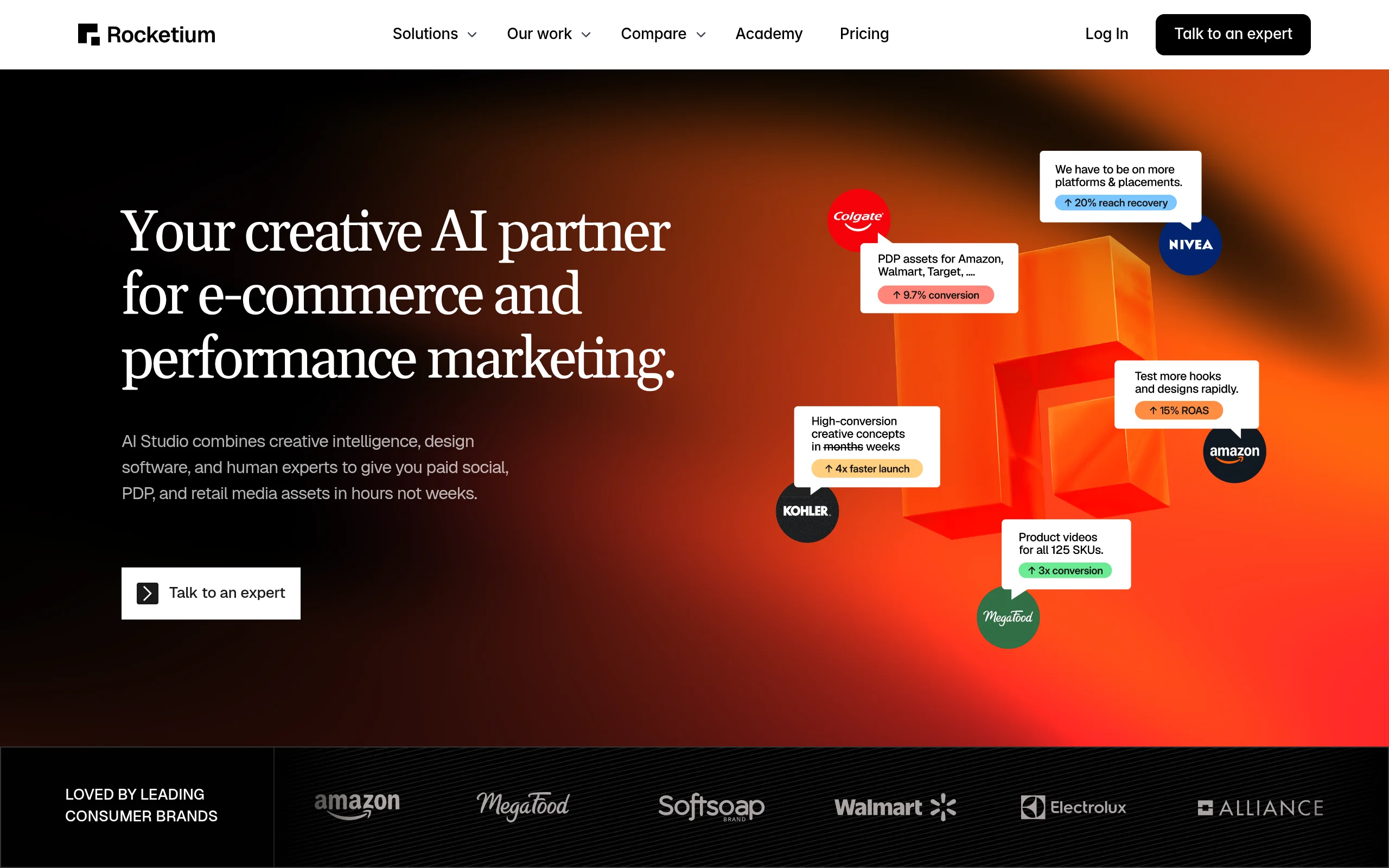
Its strongest use case is high-volume consumer-brand production where one approved campaign or product system has to become hundreds or thousands of assets across retailers, social platforms, display placements, products, markets, and languages.
The work is split into Concepting, Production, and Adaptation. Concepting can produce design directions, layouts, and storyboards from a brief. Production covers net-new creative work such as imagery, copy, translation, and motion. Adaptation takes approved creative and turns it into the channel-ready versions required for each destination.
The operational differentiation is in repeatable production. One master can be expanded into channel-specific formats, structured product data can flow into variants, and brand and platform compliance checks happen before the asset reaches final human review. The platform also supports approval workflows, self-serve editing, localization, naming, compression, and performance analysis.
G2 currently lists Rocketium at 4.2/5 in the Creative Management Platforms category.
Best for: Enterprise consumer brands with substantial recurring production across retailers and marketing channels, particularly where compliance, turnaround time, and internal production capacity are limiting campaign speed.
Where it is less suitable: Low-volume teams that mainly want a self-service canvas for occasional creative work are unlikely to get enough value from a managed, output-oriented model. Rocketium itself says the economics become harder to justify below roughly 5,000 creatives a year.
2. Superside is best when you want a broad external creative department
Superside operates much more like a managed creative partner than a software product your team has to run.
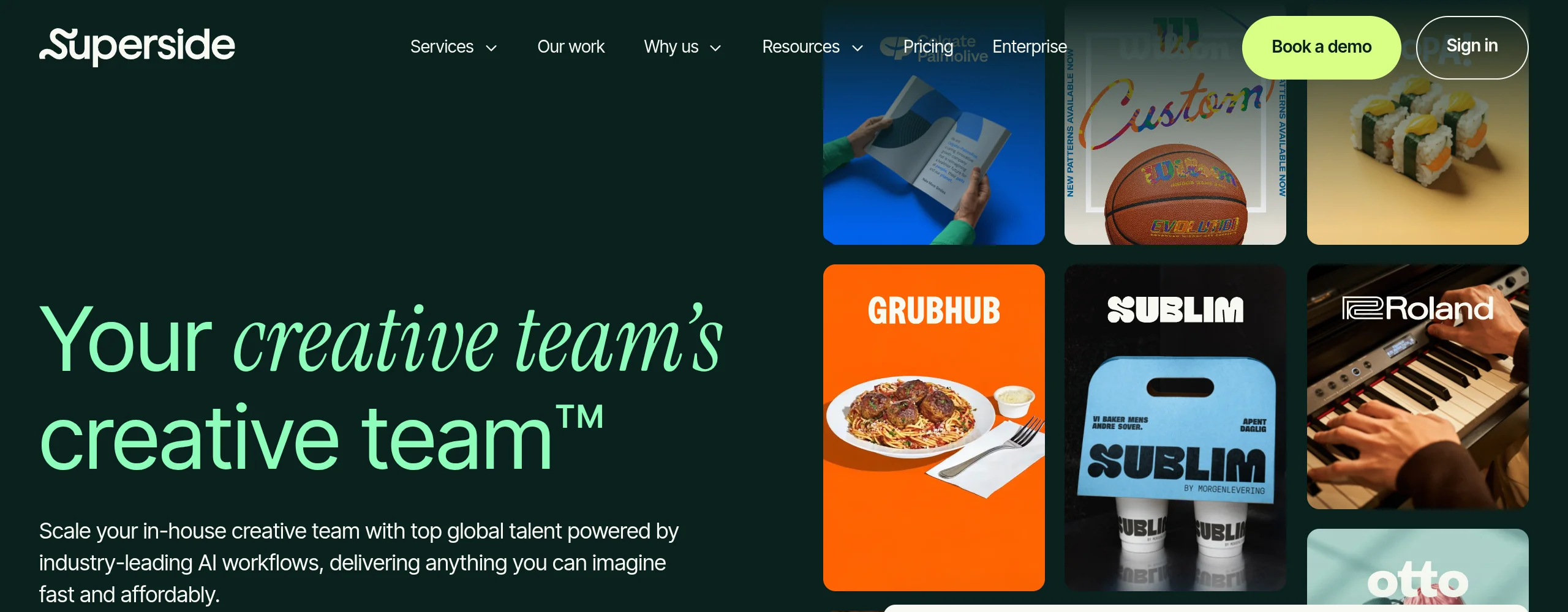
Its scope extends well beyond advertising production into brand design, presentations, illustration, web, UI, motion, and video, supported by account and project management.
That makes it attractive when a marketing organization wants access to many creative disciplines through one partner instead of building a specialist production stack.
The tradeoff is specialization. A broad creative-service model is useful when the workload itself is broad, but a buyer whose main constraint is retailer-specific production, feed-driven variants, or platform-compliance automation may need to compare how deep those workflows go before choosing it over a more production-focused system.
G2 currently lists Superside at 4.5/5, with reviewers frequently highlighting access to varied design expertise and account support.
Pricing is custom and subscription-based rather than publicly itemized.
Best for: Marketing teams that want ongoing access to a wide range of creative skills and would rather outsource both campaign production and adjacent design work than maintain multiple specialist partners.
Where it is less suitable: Teams primarily looking for deeply automated retailer or platform-specific derivative production may be paying for creative breadth they do not need.
3. DEPT is best when creative automation needs to sit inside a larger agency relationship
DEPT approaches creative automation as an agency practice rather than a standalone software purchase.
Its current Creative Automation Practice combines creative, growth, engineering, personalization, experimentation, and bespoke technology. DEPT says its systems can generate large volumes of multilingual, cross-channel assets and connect the resulting creative into delivery platforms through APIs.
That makes DEPT particularly relevant when the buyer does not want to separate campaign strategy from production infrastructure.
Its Project Sundae program for Just Eat Takeaway is a useful example. DEPT built a bespoke automation system around templates, feeds, approvals, and media-platform integrations. The system produces more than 25,000 assets per year across multiple markets and languages, according to DEPT.
The tradeoff is the commercial model. An agency relationship can give the buyer strategic thinking, engineering, creative, and execution through one partner, but that is a different cost structure from buying software or production capacity alone.
Best for: Large brands that want campaign strategy, creative thinking, automation infrastructure, and execution under one agency relationship.
Where it is less suitable: Teams that already have strong strategy and concepting internally and mainly need a lower-cost derivative production engine may be buying more agency scope than necessary.
4. Celtra is best for enterprise teams that want to run creative automation themselves
Celtra is an established enterprise creative automation platform built around producing, adapting, governing, and activating digital advertising at scale.
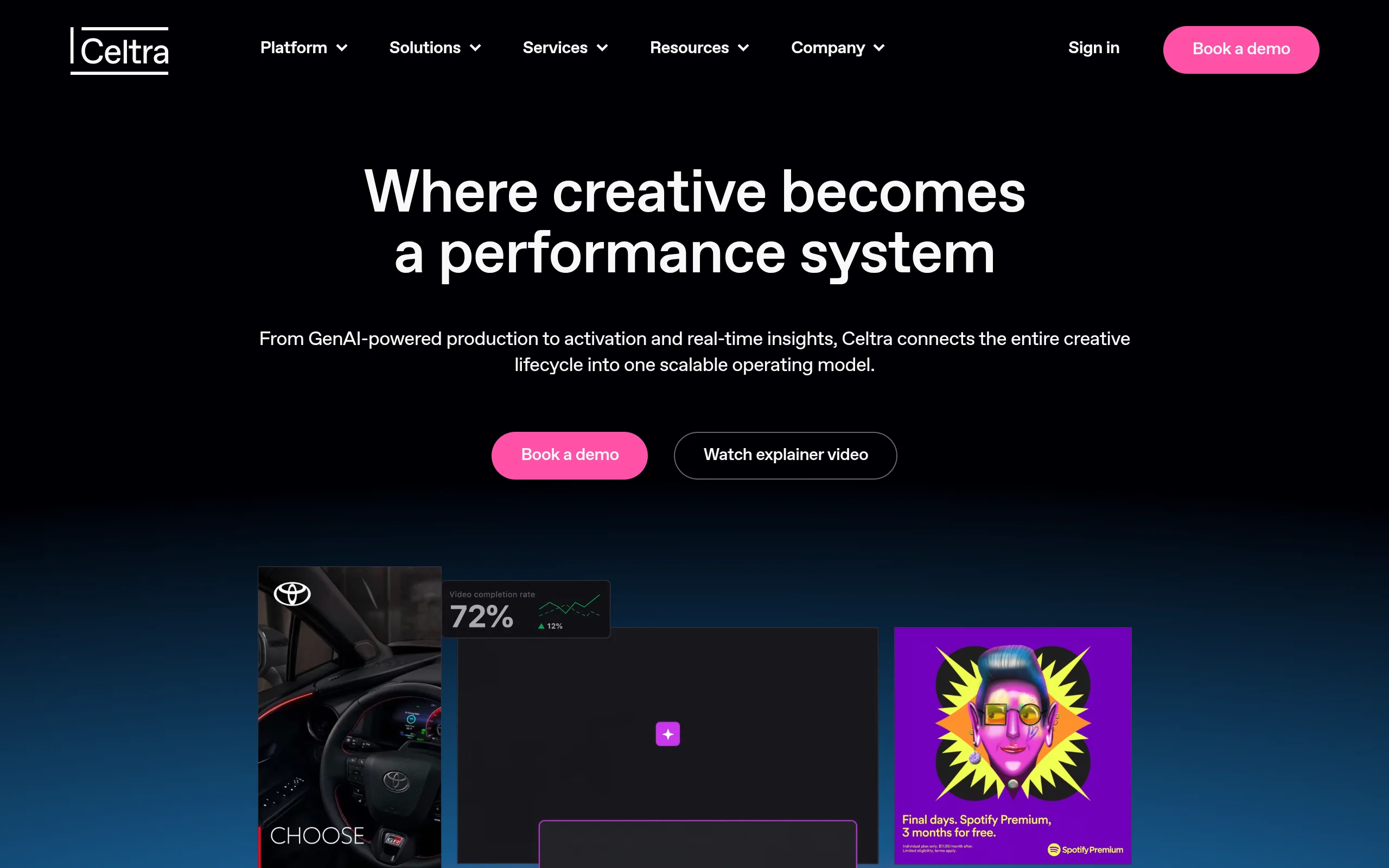
Its strongest fit is a mature Creative Ops organization that already has people who can own the platform. Creative Studio supports scaling master designs across formats, while Celtra also has mature capabilities around dynamic creative, personalization, brand controls, rich media, and creative analytics.
G2 currently lists Celtra at 4.4/5. Recent reviewers specifically highlight paid-media adaptation, sharing assets for review, and reducing rework when creative has to become many versions.
Pricing is not publicly listed.
Best for: Global enterprises with established Creative Ops teams that need high-volume display and paid-media production, strong governance, and dynamic creative capabilities.
Where it is less suitable: The platform still needs people to operate it. A brand whose fundamental bottleneck is lack of production capacity may automate workflows without actually removing enough work from the internal team.
5. Bannerflow is best for display-heavy teams that need HTML5 and campaign activation
Bannerflow remains particularly strong in display advertising.
The platform covers creative production, resizing, animation, dynamic creative optimization, publishing, campaign management, and analytics. Its focus on HTML5 display makes it a natural fit for teams whose production problem is less about PDP or retailer content and more about producing and activating digital campaigns across sizes, markets, and audiences.
Current G2 data lists Bannerflow at 4.5/5, with recent reviewers highlighting multi-format adaptation, publishing, collaboration, and support.
Pricing remains quote-based.
Best for: In-house display teams producing substantial volumes of HTML5, dynamic, personalized, and multi-market advertising.
Where it is less suitable: If most of your volume sits in Amazon A+ content, retailer PDP imagery, or ecommerce merchandising, display-specific depth may matter less than retailer-native production workflows.
6. Smartly is best when creative production and paid-media execution should live together
Smartly solves a different problem from most creative automation services because it connects creative production with campaign activation, optimization, and media spend.
The platform is particularly strong for performance teams running high paid-social volume. Feed-driven creative can be produced from product catalogs, launched through the same environment, measured against spend, and used to inform the next round of variations.
That shortens the loop between creative performance and media action.
G2 currently lists Smartly at 4.4/5. Recent users highlight ad automation, catalog customization, reporting, and campaign management.
Smartly does not publish a simple self-service price list, so enterprise buyers should model the commercial terms against their actual media spend and campaign scope rather than relying on third-party estimates.
Best for: Performance Marketing teams spending heavily across paid social and wanting creative generation, campaign execution, optimization, and reporting to operate as one system.
Where it is less suitable: A brand whose production volume primarily comes from ecommerce, retailer content, PDPs, or non-media assets may not benefit enough from paying for the media-management layer.
7. Storyteq is best when governed assets and multi-market localization come first
Storyteq combines creative automation with content operations and asset management, which gives it a different center of gravity.
Rather than starting only with an individual campaign, the platform is useful for teams managing large libraries of approved brand assets that need to be found, governed, adapted, localized, reviewed, and reused across markets.
Dynamic templates can turn governed source content into video, image, and banner variations, while workflow tools help teams control approval and multi-market production.
G2 currently lists Storyteq at 4.4/5, with Self Service + Support and Client Services both priced on request. G2 notes that license cost can depend on workspaces, templates, renders, users, and setup requirements.
Best for: Global FMCG, retail, entertainment, and other multi-market brands where the first challenge is governing and reusing a large approved asset library.
Where it is less suitable: Fast performance teams whose primary problem is getting dozens of new paid-ad tests live every week may prefer a system centered more directly on campaign production and activation.
8. Cape.io is best when creative automation must connect to omnichannel activation
Cape.io has moved beyond a narrow creative-resizing proposition and currently positions itself as an Intelligent Campaign Automation platform that connects planning, creative automation, validation, and activation.
Its channel coverage is a notable strength. Cape says teams can activate to Meta, YouTube, DV360, TikTok, Amazon, Snapchat, digital out-of-home, broadcasters, and other destinations from the same workflow. It also supports Advanced TV, preflight quality assurance, regulatory-compliance checks, approvals, and audit trails.
That makes it particularly relevant to enterprises whose campaign footprint extends across digital advertising and television rather than staying inside paid social or ecommerce alone.
Pricing is not publicly listed.
Best for: Large omnichannel organizations that need production, validation, delivery, CTV or linear TV, and digital activation to sit in a connected campaign workflow.
Where it is less suitable: A digital-only ecommerce team may not need the breadth and operational infrastructure that make Cape compelling to global omnichannel advertisers.
9. Adobe GenStudio for Performance Marketing is best when Adobe already runs the content supply chain
Adobe GenStudio for Performance Marketing is increasingly less about isolated generative creation and more about connecting creative assembly, brand governance, activation, and performance insight inside an enterprise marketing stack.
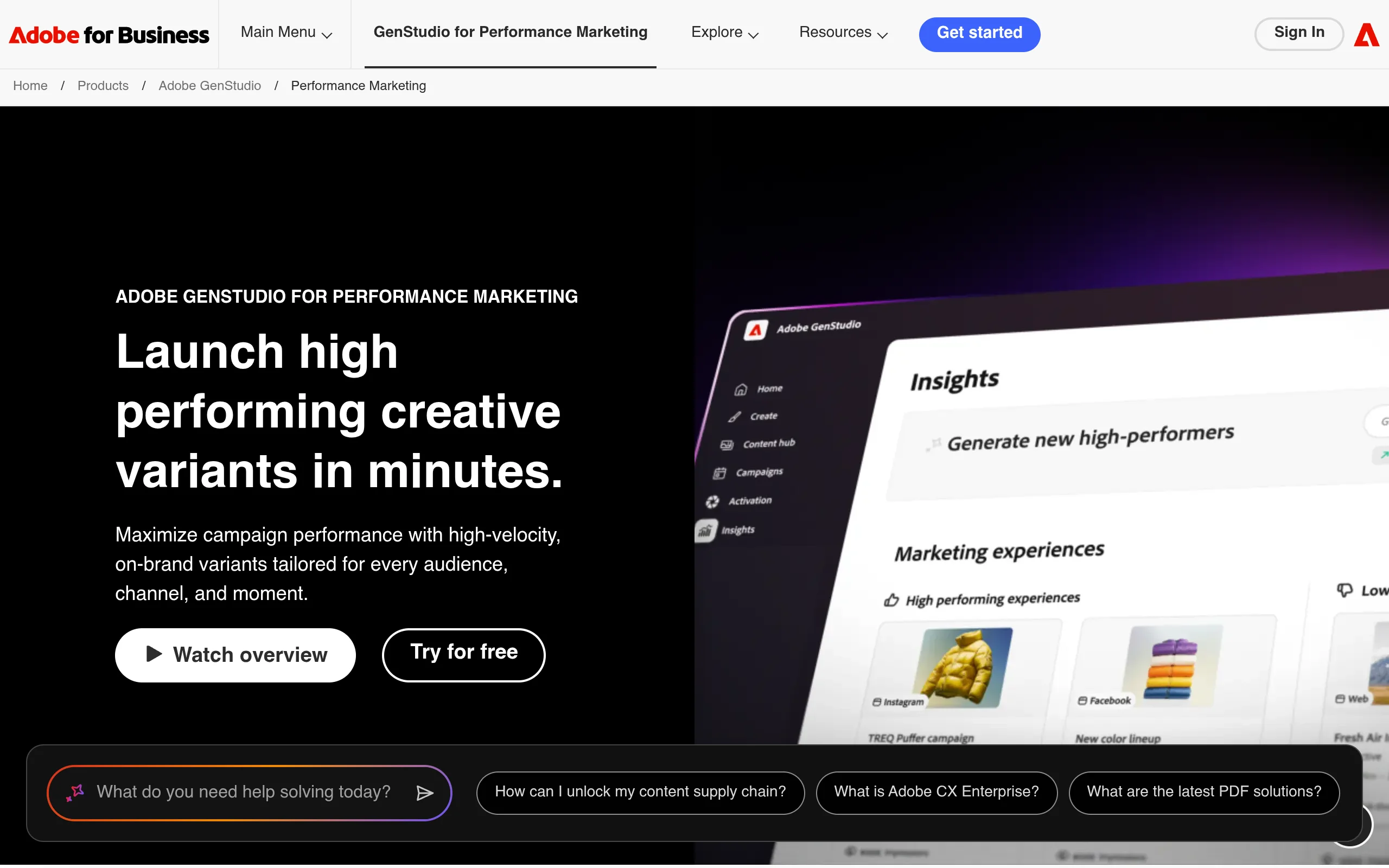
Adobe currently supports AI-generated and assembled copy, image, and video variants for social, display, CTV, and other performance channels. Brand templates can lock or control elements, while pre-approved disclaimers and citations can remain fixed inside generated versions.
Activation has also expanded. Adobe currently lists delivery integrations for platforms including Meta, LinkedIn, TikTok, CM360, Amazon, Innovid, and ChatGPT, with additional channels planned.
The biggest advantage appears when a business already uses Adobe Experience Manager, Workfront, Creative Cloud, or the wider Experience Cloud. In that situation, GenStudio can reduce handoffs across an existing stack instead of adding an isolated creative tool.
Enterprise pricing is not publicly listed, although Adobe currently offers a 28-day GenStudio for Performance Marketing trial with usage limits.
Best for: Large enterprises already invested heavily in Adobe and looking to connect governed asset reuse, generative variant production, approvals, activation, and performance analysis.
Where it is less suitable: A team that mainly needs a straightforward way to produce more ad versions may be taking on more enterprise architecture than the production problem requires.
10. The Brief is best for smaller teams that want accessible self-service automation
The Brief, formerly Creatopy, sits at the more accessible end of this comparison.
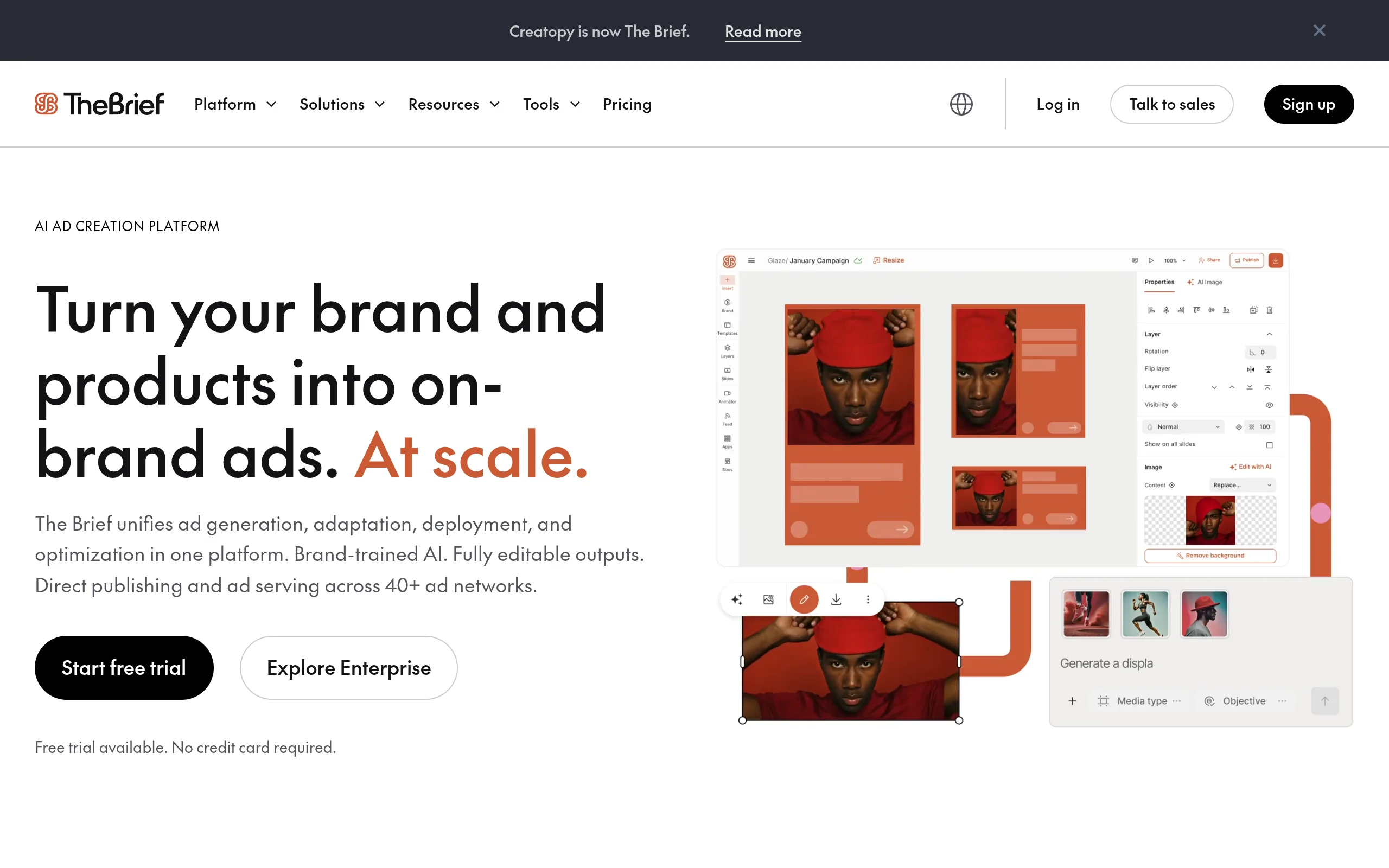
It combines ad design, resizing, feeds, AI generation, animation, HTML5 export, ad serving, publishing, and creative optimization in a self-service environment. The current product is organized around connected Discover, Create, Launch, and Optimize capabilities rather than only a standalone banner editor.
Its biggest differentiator in this group is pricing transparency.
As of September 2026, the official pricing page lists Pro at $29/month, Amplify at $79/month, and Collaborate at $49 per seat/month, all on annual billing. Enterprise pricing is custom. A seven-day trial is available without a credit card.
G2 currently lists The Brief at 4.6/5.
Best for: Smaller creative and marketing teams that want to produce, resize, animate, localize, and publish their own ads without committing to an enterprise implementation or managed production service.
Where it is less suitable: Teams with complex retailer compliance, very large approval structures, or a need to hand off production entirely will likely require more governance or managed execution than a self-service tool is designed to provide.
Which creative automation service fits your bottleneck?
By this point, feature-by-feature comparison is less useful than matching the vendor to the problem creating the queue.
Your main bottleneck | Options worth shortlisting |
|---|---|
We have the briefs but not enough production capacity | Rocketium, Superside |
We want strategy, campaign thinking, and production together | DEPT |
We have a strong internal Creative Ops team and want enterprise automation | Celtra |
HTML5 display and dynamic campaigns dominate the workload | Bannerflow |
Paid-social creative and media buying should be connected | Smartly |
Multi-market asset governance and localization are the priority | Storyteq |
We need digital, CTV, linear TV, validation, and activation together | Cape.io |
Adobe already runs our content and workflow infrastructure | Adobe GenStudio |
We need accessible self-service ad production | The Brief |
Retailer and ecommerce production create most of our volume | Rocketium |
This is also why asking for the "best creative automation platform" without describing the production bottleneck rarely produces a useful answer.
A buyer running 50,000 retailer assets has a different definition of automation from a team running weekly Meta tests or a global organization managing television, digital out-of-home, and paid social together.
What to ask before choosing a creative automation partner
Feature lists start to look similar quickly. The buying questions below expose how the workflow actually behaves.
Who will run the system every day? If the answer is already-overloaded designers or Creative Ops managers, calculate that operating cost alongside the software license.
What happens when volume triples? Seasonal campaigns, promotions, product launches, and market rollouts are where production systems usually get tested. Ask what changes in turnaround, staffing, and cost during a spike.
How are exceptions handled? Templates cover predictable work. Every real campaign eventually contains an awkward language, unusual product, new retailer specification, or layout that breaks the standard rule. Find out who owns those cases.
Where does quality assurance happen? Platform and brand rules checked before review remove rework. Rules checked only after the creative reaches a human reviewer simply move the bottleneck.
What channels are genuinely supported? Ask for actual retailer templates, platform rules, formats, and workflows rather than a list of category names. If Amazon, Walmart, Meta, TikTok, CTV, or HTML5 display matter to your business, ask to see those exact workflows.
How does pricing behave at your real volume? Per-seat subscriptions, credits, output pricing, agency retainers, and media-spend fees behave differently when campaign volume changes.
Your own asset history is more useful than an abstract pricing page. Take the highest-volume month from the last quarter and ask every shortlisted vendor what that exact workload would cost and who would have to do the work.
Integrations determine whether automation removes work or relocates it
Creative automation rarely exists on its own.
A campaign may begin with product data, pull approved visual assets from a digital asset management system, move through review, and eventually reach several ad platforms or retailer destinations. If those connections remain manual, the creative may be produced faster while the overall campaign still waits on copy-and-paste work.
Three connections deserve particular attention.
Product and customer data: Feed-driven automation is only as reliable as the source data. Incorrect prices, outdated product imagery, inconsistent naming, or missing translations will be reproduced quickly if nobody owns the feed.
Asset storage: Finished work should return to the digital asset management system or workspace the business already uses. Otherwise, the automation system becomes another disconnected asset library.
Media and performance data: Connecting platforms such as Meta, Google, and retailer-media accounts shortens the distance between what performed and what Creative needs to produce next.
Ask each vendor to name the exact systems it integrates with today. "We integrate with DAMs and ad platforms" tells you far less than a working connection to the specific systems your team already uses.
Creative automation speeds production, not weak strategy
Creative automation can produce more variations of an approved campaign. It cannot make a weak campaign idea stronger simply by multiplying it.
Brand positioning, the campaign proposition, the customer insight, and the decision about what deserves testing still require strategic judgment.
Concepting sits somewhere between pure strategy and derivative production. Some providers, including Rocketium, Superside, and DEPT, can support the creation of master directions or campaign concepts, but the quality of that work still depends on a clear brief, useful brand context, and somebody capable of judging the result.
The practical value of creative automation is narrower and more useful than the claim that AI can replace a creative department.
Skilled creative people should spend less time rebuilding approved work into another retailer dimension, language, product variant, or paid-social format. They should spend more time on the creative decisions that still require judgment.
If your current process still routes every predictable resize, product swap, retailer version, and localization through an agency or internal design queue, use one brief you have already completed as the comparison rather than beginning with a theoretical transformation project.
Frequently asked questions
What are creative automation services?
Creative automation services help brands produce the channel, retailer, size, language, product, and offer variations required from approved campaign creative. Depending on the vendor, the work may be delivered by a managed team, produced by your own team inside software, or handled through a hybrid model combining automation and experts.
What is the difference between a creative automation service and a platform?
A managed service takes the brief and returns finished creative. A platform gives your team software to produce the variations itself. A hybrid model combines automation with production experts while still giving the customer review or editing access.
What work can creative automation handle?
The strongest use cases are repetitive production tasks such as resizing, versioning, localization, product and offer swaps, feed-driven creative, retailer adaptations, platform formatting, naming, compression, and compliance checks. Some vendors also support concepting and generative asset creation.
How much do creative automation services cost?
Pricing models vary widely. Some self-service tools charge monthly subscriptions, enterprise platforms generally quote annual contracts, managed services may use retainers or output-based pricing, and Rocketium currently uses credits starting at $9 for a static adaptation. The most useful comparison is cost per approved, live asset at your actual production volume.
Which creative automation service is best for ecommerce and retailer content?
Look for specific support for the retailers and asset types your business actually produces. Amazon A+ content, Walmart product imagery, retailer media, social ads, and generic display banners require different production rules. A vendor that is strong in paid-social automation is not automatically strong in retailer-native production.
Can creative automation replace a creative agency?
It can replace or reduce agency time spent on predictable production work such as resizing, localization, product variants, and platform adaptation. Some providers also offer concepting, but senior brand strategy, positioning, and major campaign decisions still need human creative judgment.
Is a managed creative automation service better than software?
Neither model is universally better. A self-operated platform usually fits teams that already have design and Creative Ops capacity. Managed or hybrid models are more useful when the problem is that the team already has more production work than it can execute.
How should enterprise teams compare creative automation pricing?
Use a real campaign or month of production and calculate cost per approved, live asset. Include the subscription or service fee, implementation, template creation, internal operating time, review time, rework, and rejected assets. That produces a more useful comparison than looking at license price alone.
How long does creative automation implementation take?
It depends on the amount of template work, brand-rule configuration, retailer or platform requirements, product-feed setup, integrations, and approval workflows involved. Before purchasing, ask the vendor to scope implementation against a real campaign rather than provide only a generic onboarding timeline.