
What Is Creative as a Service? A complete guide for consumer brands
Our perspective
Claron Kinny
|
Growth Marketer
Reviewed by Satej Sirur, Co-founder & CEO
Media buying scaled and automated years ago. Creative production mostly didn't.
The gap is widening because the media side keeps adding inventory.
Retail media, the ad space sold directly by Amazon, Walmart, Instacart, and similar platforms, is on track for $69.33 billion in US ad spend in 2026, up from $58.79 billion in 2025.
Every one of those retail platforms comes with its own spec sheet, its own compliance rules, and its own creative formats. New inventory keeps showing up faster than most production models can fill it.
Creative-as-a-Service (CaaS) is the model built to close that gap: an always-on, subscription or usage-based operating model that gives brands ongoing access to a dedicated or semi-dedicated creative team, a shared platform, and a standardized production process, replacing one-off agency projects and headcount-heavy in-house teams.
For global consumer brands, e-commerce marketplaces, digital agencies, and enterprise marketing teams producing high volumes of assets, that means a more scalable way to launch on-brand campaigns across channels without turning creative workflows into a bottleneck. This piece looks at how CaaS connects creative automation, AI-powered creative operations, brand compliance at scale, video and image asset versioning, campaign production, creative analytics, and design operations to help teams produce more content faster and at lower cost.
What is Creative-as-a-Service (CaaS)?
Creative-as-a-Service (CaaS) is a subscription model for accessing creative talent through an operating model where a business gets ongoing access to a dedicated or semi-dedicated creative team, a shared platform, and a standardized production process, instead of hiring in-house or commissioning one-off projects.
According to us, three things usually make up a CaaS engagement:
A creative team with the skills the brand actually needs
A shared platform for intake, review, and collaboration
And a standardized process that keeps output on-brand and moving fast.
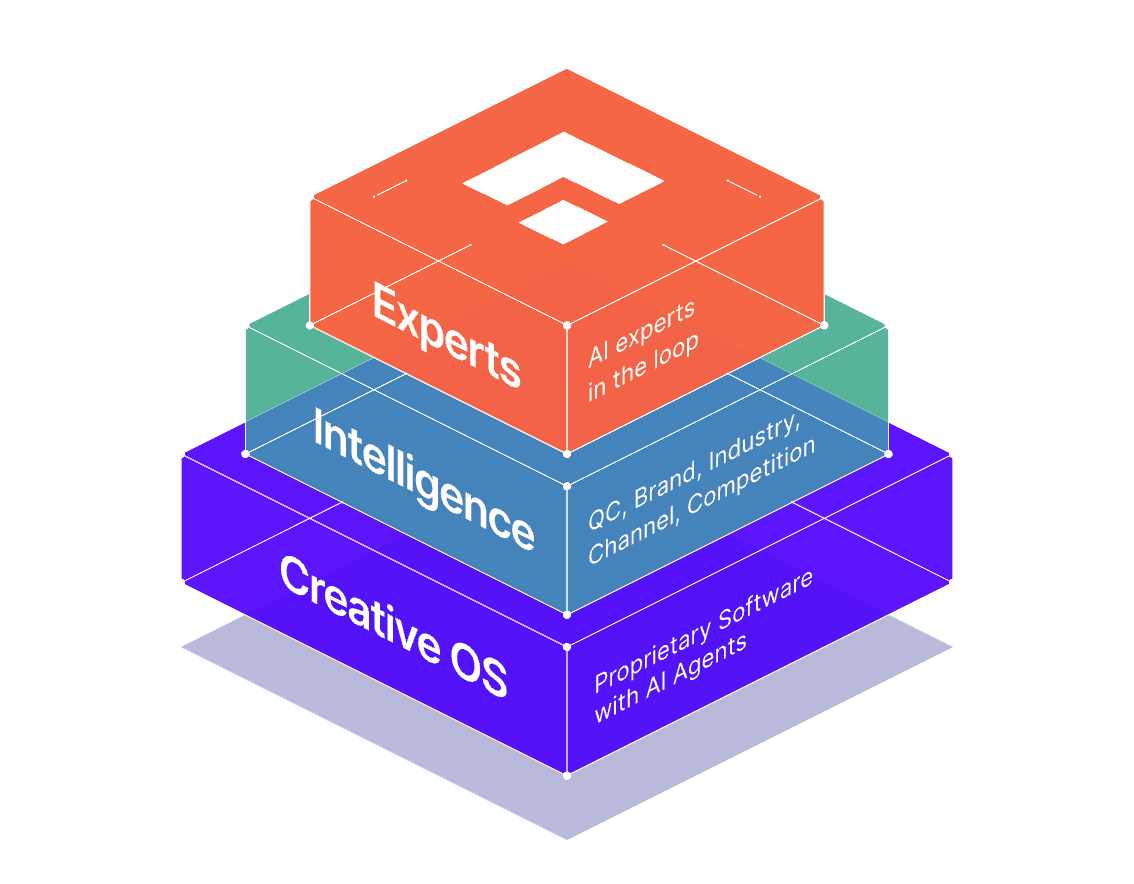
Drop any one of the three and the model breaks down into something else. A team without a shared platform is just a group of freelancers. A platform without a standardized process is just a ticketing system.
The model itself isn't new. Flat-fee "unlimited design" subscriptions have been around since the mid-2010s. What's changed by 2026 is what sits underneath them: AI now handles a growing share of the actual production work, with human experts directing and reviewing it, rather than a human team doing every step by hand.
CaaS isn't cheap outsourcing. It's a production engine built around the assets a brand actually ships: ad banners, product feed images, marketplace and PDP creative, short-form video, CRM visuals, and landing page graphics, all produced against the same brand rules every time.
Why traditional creative models create bottlenecks
In-house teams, agencies, and freelance marketplaces were built for a slower kind of marketing: a handful of campaigns a year, each with weeks to get from brief to launch. Hyper-personalized journeys weren't part of the design brief.
The mismatch shows up fastest at seasonal scale. A brand running a Black Friday push across Meta, Google Display, and Amazon DSP might need hundreds of on-brand banner variations, ready in days, not weeks.
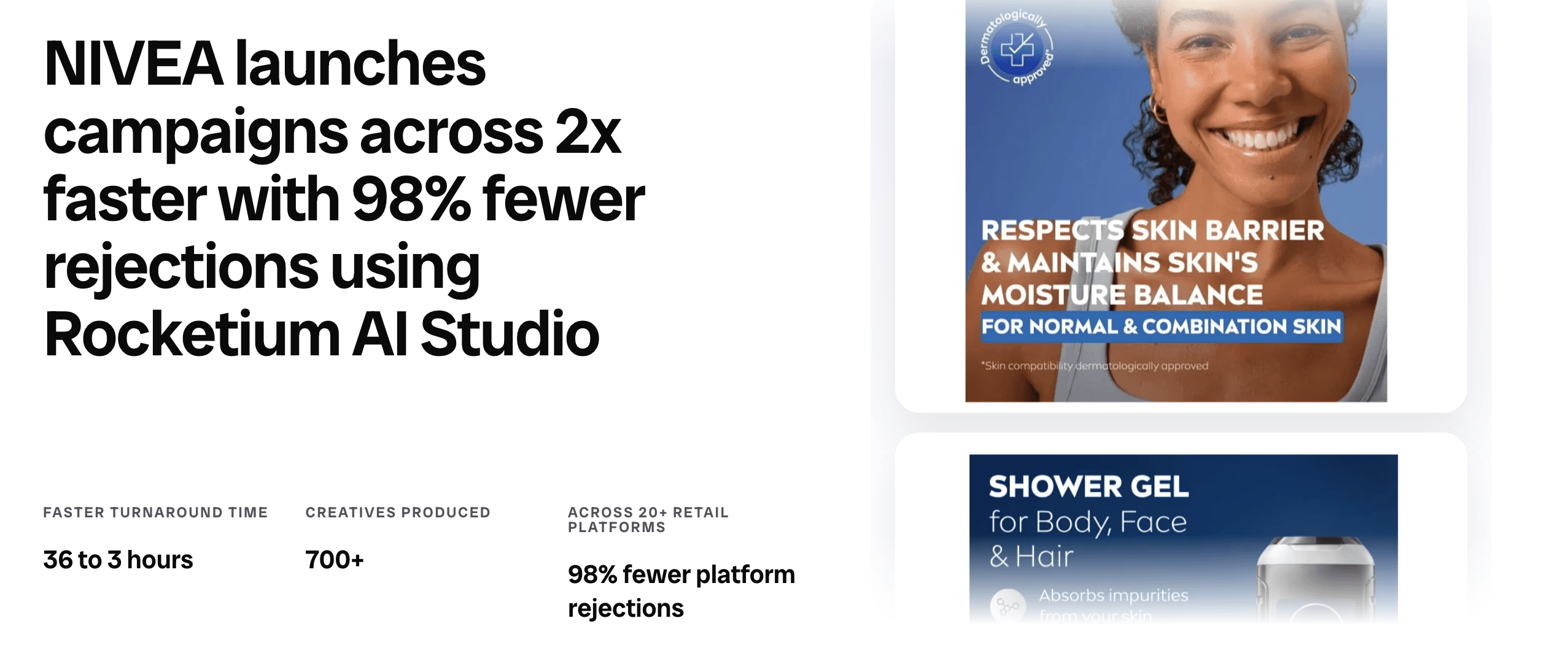
NIVEA hit exactly this wall launching campaigns across 14 platforms at once. Manually redoing designs for each platform's spec sheet was the bottleneck, not the creative idea itself. Once that process moved to AI Studio, NIVEA launched 2x faster with 98% fewer platform rejections.
The everyday friction is familiar: brief-to-first-draft cycles that stretch for days, approvals scattered across email threads, version chaos when three people edit the same file, and compliance that looks different in every market. Each one is a process gap, not a talent gap.
The cost shows up downstream. Launches slip. Creative hypotheses go untested because there's no time to build the variants that would test them. And the designers capable of real concepting spend their week on resizing and text swaps instead.
How the CaaS model works in practice
A CaaS engagement usually starts with onboarding: brand guideline intake, template and design system setup, workflow configuration, then ongoing production, and that onboarding is designed to integrate into existing workflows, not replace them. Done well, this moves fast.
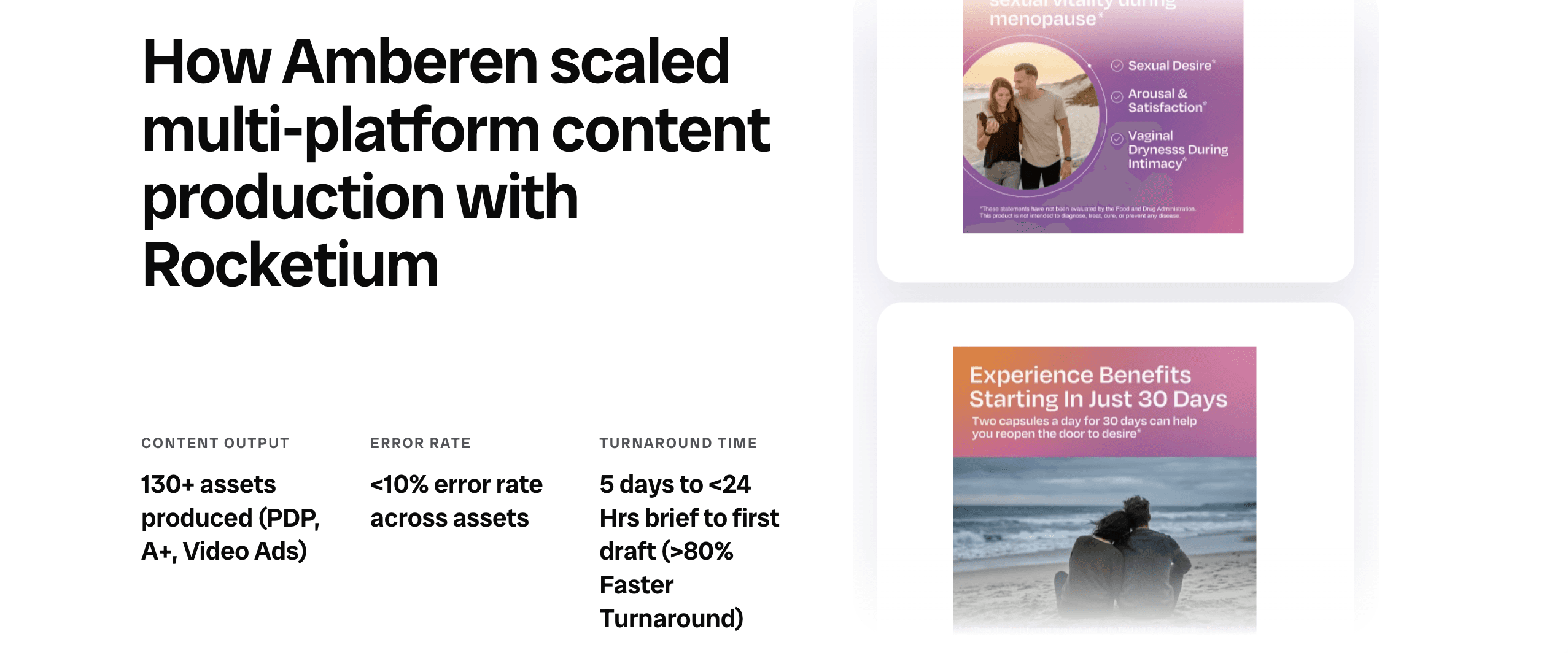
Amberen, a menopause supplement brand, completed kickoff, technical setup, and brand asset configuration within weeks of starting on AI Studio, and was running live campaigns before the first month closed.
Requests typically enter through a structured brief: the customer-provided instructions, attachments, channel specs, deadlines, and priority level, not an ad-hoc Slack message with a vague ask.
Scope usually spans three kinds of work.
Adaptation takes an approved design and resizes or versions it.
Production creates new assets from scratch, copy, imagery, video.
Concepting is the design thinking that comes before either, master layouts and storyboards.
Behind the brief sits a team built for exactly this: a creative or account lead plus creative professionals across design, motion, copy, and localization, so teams get access to multiple disciplines without hiring each role individually, with project management keeping design projects moving.
That model also gives on demand access to talent as needs change.
Turnaround depends on what's being asked.
Adaptation runs minutes to hours.
Production, since it involves new copy, imagery, or video, typically takes 1-2 days, and many providers deliver standard production work within 24–48 hours.
Concepting, the highest-judgment work, runs 2-4 days.
None of these are instant, and a CaaS partner that claims otherwise is usually skipping the human review step that makes the output usable.
Subscription, fixed pricing, and other CaaS commercial models
Most CaaS providers price one of three ways: a flat monthly subscription with defined throughput, a credits or "creative hours" system, or a hybrid retainer with on-demand overages. That fixed-fee structure is easier to compare than project based pricing or a traditional agency retainer, and it gives teams predictable monthly costs without surprise fees. Fixed pricing appeals to marketing ops for a simple reason: businesses pay a recurring fee to make creative spending easier to forecast, and there's no scope-change argument every time a request comes in, unlike hourly agency billing, which quietly punishes iteration.
Rocketium prices differently: Credits, where one static asset equals one credit and a video over 15 seconds equals two.
The gap against agency unit pricing is real. Static design versioning runs $75-$150 per asset with an agency versus 1 credit priced at $9 with AI Studio. End-to-end video runs $1,500-$3,000 per asset with an agency versus 20-60 credits.
The honest trade-off: credit pricing tracks usage, which suits volume that spikes around launches and sales, but it also means cost moves with output. A brand with genuinely flat, low volume may find a simple flat subscription easier to plan around. The best commercial models preserve the reliability of a caas provider while keeping the flexibility brands often seek outside traditional agencies.
Where AI-powered CaaS and CreativeOps change the game
The newest generation of CaaS is AI-assisted: human creative teams working alongside agentic AI, not AI replacing the team. This model improves creative operations by helping teams scale creative output up or down without expanding internal headcount or carrying the overhead of maintaining full-time creative teams. The AI handles the mechanical, repetitive production. The people handle brief interpretation, brand judgment, and final quality control.
Specific capabilities look like this in practice: automated resizing and layout adaptation across formats, dynamic text swaps at scale through feed-based generation, AI image generation and editing, AI-assisted video versioning, and automated brand compliance checks that flag violations before an asset ever reaches legal review. Together, these workflows support consistent quality and brand consistency across creative deliverables.
MegaFood is a real version of what this looks like at scale. The whole-food supplement brand needed to refresh Amazon PDP content for 50+ products. A comparable project the year before had taken freelancers 8 months at $150 an hour. Working in AI Studio instead, MegaFood created and got 1,100 assets approved in under 4 weeks, saving 40% against the freelancer cost. Faster production also improves marketing execution by reducing creative bottlenecks while maintaining high-quality work.
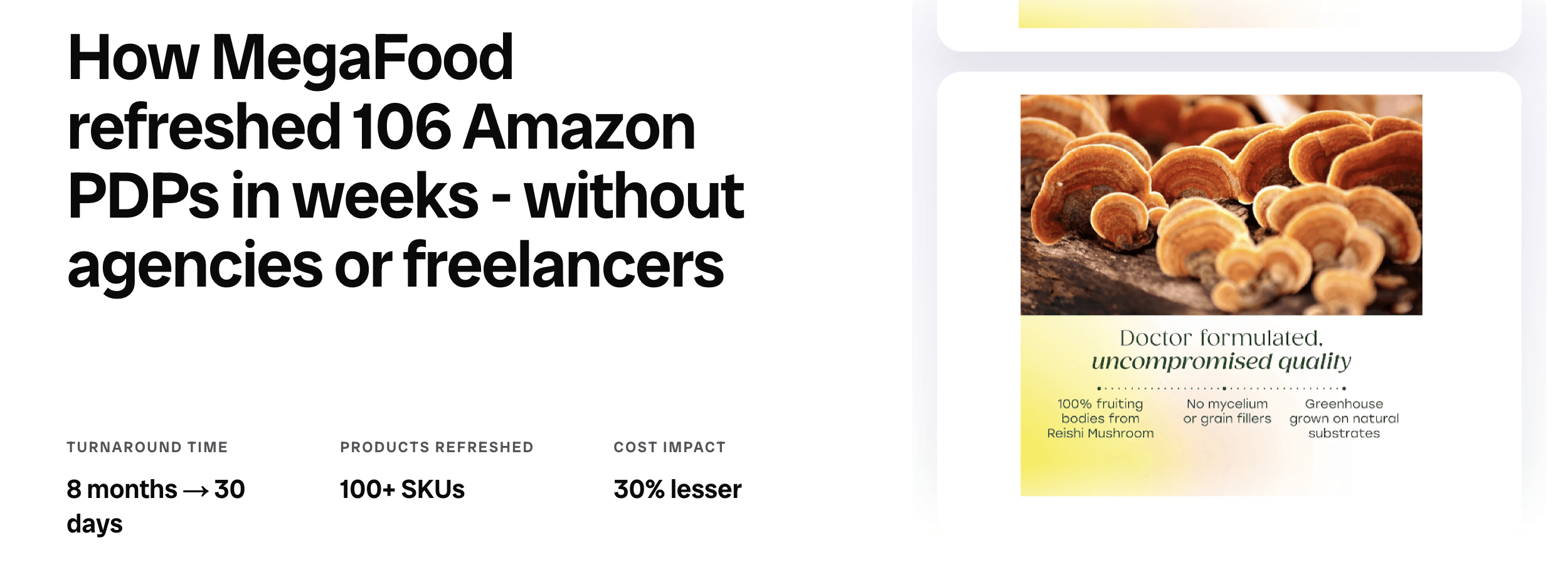
That's not a one-off result. Twelve Amazon-selling teams produce roughly 250,000 assets a year through AI Studio, at the same combination of AI-driven production and human review.
CaaS vs. traditional creative agencies, freelancers, and self-serve tools
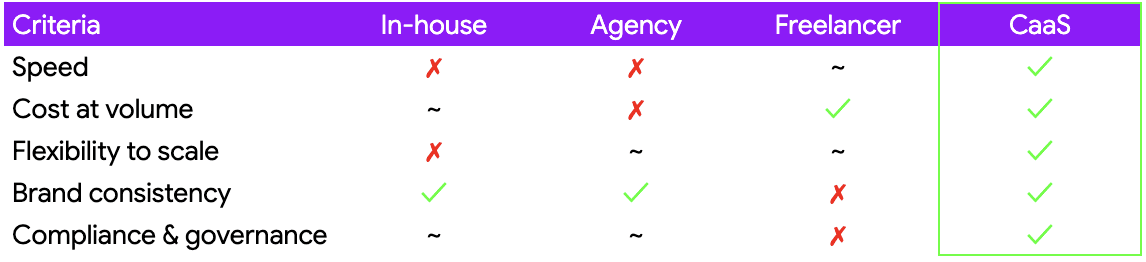
Agencies still earn their keep for the work that happens rarely: a full rebrand, a new brand platform every few years, the kind of high-stakes creative direction that benefits from an outside strategic partner. But CaaS is strongest when brands want the reliability of a managed service with more flexibility than traditional agencies, without waiting on agency timelines shaped by multiple clients. It's built for what comes after, the ongoing, iterative production that a brand needs every week, not every few years.
Freelancers solve for cost and speed on a single asset, but enterprise volume exposes their limits fast. Availability is inconsistent, quality varies person to person, and coordinating a dozen freelancers across time zones turns into its own management job, especially once retailer compliance enters the picture. Some providers can still introduce communication friction or uneven output if oversight is weak.
Self-serve tools like Canva or Midjourney work fine for one marketer making one asset. They fall apart the moment a brand needs to govern output across dozens of teams, markets, and sub-brands. Nobody's enforcing brand rules on a Midjourney prompt.
Modern AI-powered CaaS is the only model built to combine agency reliability with freelancer flexibility, delivered through a dedicated team and one governed platform instead of scattered across vendors. That's Rocketium's own framing of AI Studio: a creative operating system, not a marketplace of individual contributors, built for high quality creative work at scale even if it may not replace the deep strategic insight of an internal team on rare, high-stakes brand decisions.
What creative services and use cases fit CaaS best?
CaaS fits best when creative needs are frequent, channel-specific, or fluctuate with launches, promotions, and seasonal spikes: performance ads, marketplace and PDP imagery, CRM and email visuals, social posts, app-store assets, landing page graphics, and graphic design.
The useful split is net-new versus scaled production. Campaign platforms and brand redesigns are net-new, conceptual work. Localizations, format adaptations, and A/B variants are scaled production. CaaS is strongest at the latter.
By vertical, the fit varies. E-commerce brands lean on it for seasonal sales, allowing businesses to scale creative needs up or down across campaigns without adding in-house capacity. Beauty and personal care brands need claims-heavy PDPs kept consistent across retailers. CPG brands launching across multiple retailers at once hit format and spec differences constantly.
Multi-market brands benefit most, since CaaS can localize copy and adapt web design at volume while still enforcing one master-brand rule set.
How to integrate a CaaS partner into your creative workflow
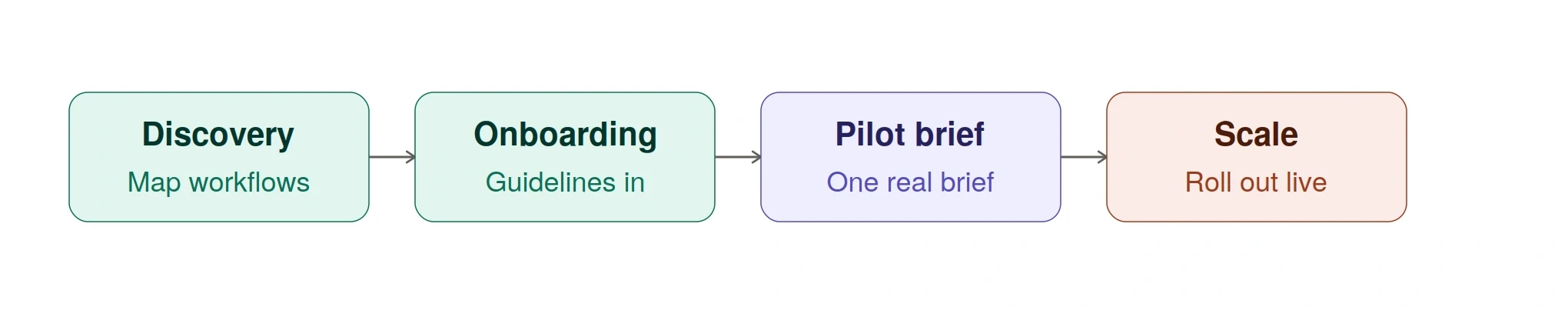
Rollout works best as a short sequence: a discovery workshop, mapping current workflows, then identifying where a CaaS partner slots in, usually right after the brief is written and before any asset actually goes live.
Treat the partner as an on demand creative team that functions as an extension of the internal team, with a dedicated Creative Director overseeing execution rather than an outside vendor. Shared Slack channels, regular standups, and joint planning around launches and campaign calendars work better than routing everything through a separate intake form.
Rocketium supports this directly: briefs and spreadsheets can trigger project creation through Slack, Teams or email integration, so a request doesn't have to leave the tools a team already uses. Its online platform centralizes requests, reviews, and feedback loops across multiple platforms.
Good onboarding covers brand guidelines, existing templates, Figma or PSD libraries, a handful of reference "gold standard" creatives, and performance benchmarks for priority channels. Rocketium imports PSD and Figma files with layer integrity preserved, so existing design work carries over instead of getting rebuilt from scratch.
Change management matters as much as the tooling. Internal creative teams reasonably worry that automation means less work for them. The honest answer is the opposite: automation removes the low-leverage tasks, resizing, last-minute edits, so the team's time goes toward strategy and brand work instead. Integration also works best when CaaS lets businesses hire design teams on demand to absorb overflow creative work and reduce pressure on the internal team.
Choosing the right CaaS partner: evaluation checklist
A few criteria are worth running through before signing anything, whether or not Rocketium ends up on the shortlist: brands should evaluate potential partners against operational fit, service breadth, and alignment with business goals.
Depth of services. Does the partner cover the full range you'll actually need, from professional creative services like content creation and graphic design services to social media management where relevant to the brand, or just one slice of it?
Industry experience. Have they handled your category's specific requirements: retailer specs, claims review, regulated content?
Volume capacity. Can they handle your expected output at peak, not just a steady-state trickle, and provide ongoing creative support with reliable ongoing support during launch periods?
Technology, not just a ticketing system. Look for real automation depth: brand governance rules, approval workflows, analytics. A shared inbox with a project tracker bolted on isn't the same thing.
AI capability and roadmap. In 2026, this matters specifically: does brand-rule enforcement happen at the point of generation, or only as a check afterward?
Creative team quality. Seniority mix, a dedicated lead, time zone overlap, and whether their creative capabilities can cover your actual creative gaps, including social graphics if those are a recurring need, while still talking to your product, growth, and brand teams, not just taking orders.
Whatever the pilot looks like, ask for real numbers on these: turnaround time, first-time approval rate, cost per asset, and, if the engagement runs long enough, any lift in CTR or ROAS from expanded testing.
Here's a usable checklist to consider while evaluating a CaaS |
Measuring the ROI of Creative-as-a-Service
ROI here splits into two questions:
Is production more efficient?
Is the output actually performing better?
Efficiency is the easier one to measure
Track the drop in average brief-to-launch time, the increase in assets produced per month, and cost per asset against whatever the prior model was.
Effectiveness is harder to isolate, and worth being honest about
CTR or conversion lift from expanded creative testing, and fewer brand or compliance violations across regions, are the right things to watch.
One thing that helps over time
Tagging creative attributes like layout, color, and messaging against performance data, so the next brief starts from what's already been shown to work rather than a blank page.
The future of CaaS and Rocketium's role
The direction is clear enough: basic design subscriptions are giving way to AI-native CreativeOps platforms, where CaaS is one piece of a larger system rather than the whole offering.
A few things are already visible. Agentic AI is taking on more of the repetitive production work on its own. Retail media keeps adding inventory, which means deeper integration with marketplace ad platforms matters more each year, not less. And real-time optimization, feeding live performance data back into the next round of creative, is moving from a nice-to-have to table stakes.
The likely shape for most enterprise brands is hybrid: an internal brand and UX team setting direction, paired with an AI-powered CaaS partner handling scalable creative assets and creative work that can scale needs up or down with demand at whatever level the retailer footprint requires.
If your creative queue is the thing slowing campaigns down, not the media plan, that's worth a closer look.

Frequently asked questions
Is CaaS only useful for brands without an in-house creative team?
No. The brands that get the most out of it usually have an in-house team that's already hitting capacity limits. CaaS absorbs the overflow and repetitive production, freeing that team for strategy and concepting instead of resizing and text swaps.
How is CaaS priced, and what's actually included?
It depends on the model. A flat subscription usually includes a defined throughput of requests, a shared platform, and a set team allocation. Rocketium's credit model works differently: one static asset equals one credit that costs $9, a video over 15 seconds equals two, and cost tracks actual output rather than a flat monthly number.
How does CaaS handle brand and retailer compliance at volume?
The stronger platforms run automated compliance checks, logo placement, color usage, claims language, before a human reviewer signs off, catching most issues before an asset ever reaches legal review. This matters most for regulated or retailer-heavy categories: beauty, pharma, CPG.
What's a realistic turnaround time?
It depends on the type of work. Adaptation, resizing or versioning an existing design, runs minutes to hours. Production, building new assets from scratch, typically takes 1-2 days. Concepting, the highest-judgment work, runs 2-4 days.
Can a CaaS partner work alongside an existing agency?
Yes. Many brands keep their agency for strategy and big-idea work, and route production and adaptation volume through a CaaS partner instead. The two aren't mutually exclusive.