
Top 5 attention heatmap tools for ad creatives (free and paid)
Article
Ankita Mathew
|
Product & Growth
Every creative review ends the same way. Someone says the logo feels lost, someone else says it's fine, and the version that ships is the one the loudest person preferred. Nobody in the room knows where a shopper's eye actually goes, because nobody has measured it.
Attention heatmap tools answer that with a model rather than an opinion: they predict, before spend, which parts of a creative get looked at first and which get skipped. This article compares five of them - Jarville, Neurons, Attention Insight, Expoze.io, and Dragonfly AI - across pricing model, what you get free, and the kind of team each one is built for.
Key takeaways
Jarville runs its own attention model and has the most accessible plans, giving the first few heatmaps away free, & then charging pay-per-use for subsequent runs ~5 credits ($0.50) per report
Neurons is the enterprise standard with the deepest feature set (video, cognitive demand, AOIs), but pricing is quote-only; third-party listings report roughly €15,000/year for a five-seat plan.
Attention Insight has 2 paid tiers, from $31/month for 40 credits with watermarked output, up to $324/month for unlimited analyses.
Expoze.io prices on credits per month rather than seats, from €19.99/month for 50 image credits to €399.99/month with unlimited users and video.
Dragonfly AI sells attention alongside emotion, memory, and comprehension scoring for enterprise creative teams; pricing is custom-quoted and not published.
What an attention heatmap tool actually needs to do
A heatmap on its own is a picture, and a picture is not a decision. Three things separate a tool you'll actually use in a creative review from one you open twice and forget.
It has to run on the asset you have, not the asset a research team would prepare. A working tool takes a PNG or JPG upload and returns a result in seconds, without a study setup, a task configuration, or a call with a customer success manager.
It has to say what's wrong, not just what's warm. A red blob over your model's face is not news. The useful output is the comparison: attention is landing on the lifestyle image and not the price flag, the eye order doesn't match the hierarchy you designed, the CTA sits in the coldest region of the frame. That means scores and ranked hotspots, not only an overlay.
The cost has to survive being used on a whole batch. Creative testing runs on variants — a Meta test with 12 concepts across three formats is 36 assets before retail media versions. A tool priced so that checking all 36 feels expensive is a tool that gets used on the hero asset only, which is the one that needed checking least.
Miss any of the three and the heatmap becomes a slide in a deck rather than a step in production.
Jarville
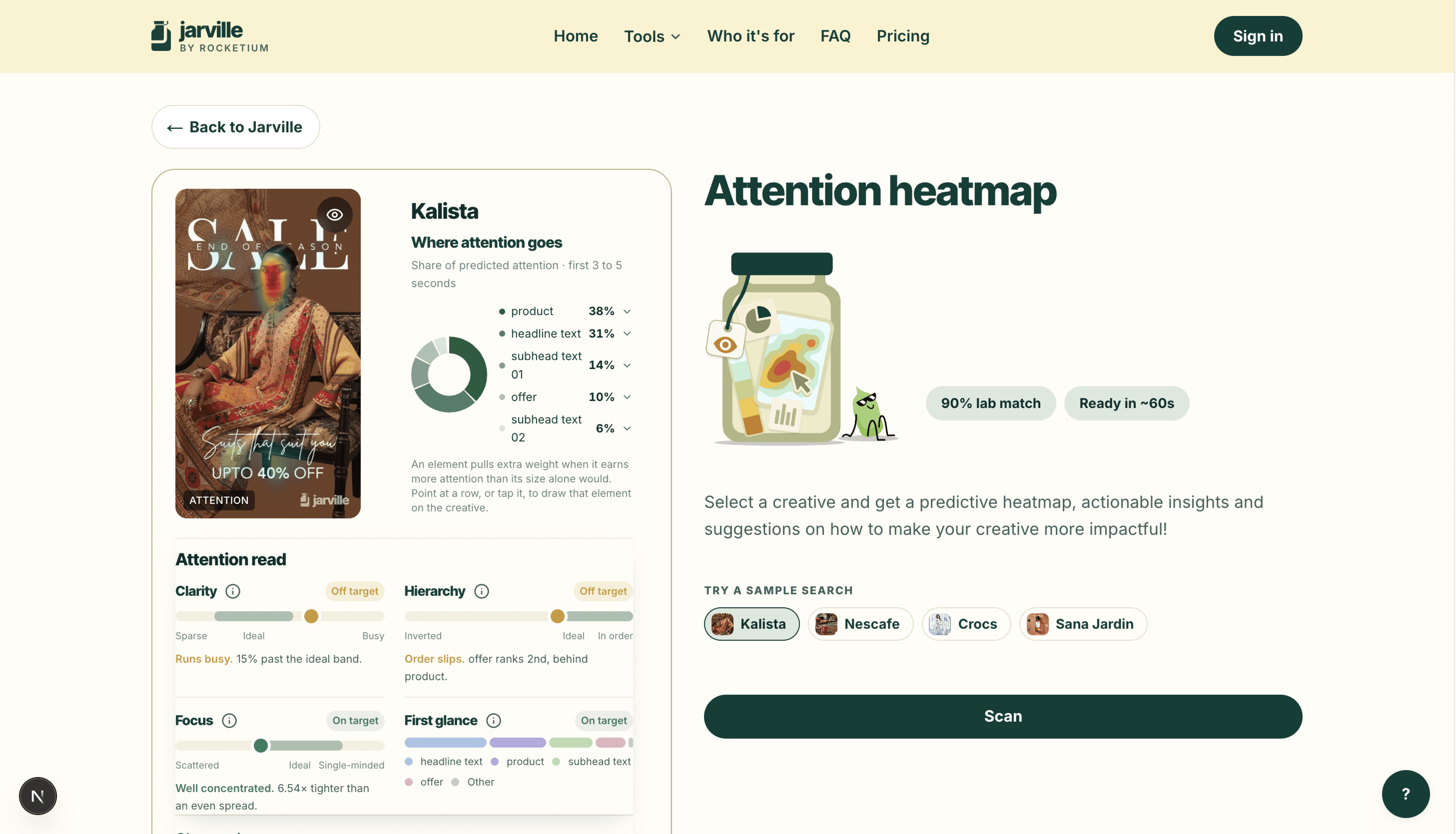
Jarville's attention heatmap is a predictive eye-tracking tool for ad creative, built by the team behind Rocketium AI Studio. Drop in a PNG, JPG, or WebP and it returns a heatmap from Jarville's own saliency model.
The split is by data, not by picture. Even without signing in you get the entire heatmap, no signup and no card. Signing in unlocks the numbers: a clarity score, a focus score, a hierarchy score measuring whether attention follows the ranking you designed, ranked hotspots, and real actionables ordered by severity, with each carrying the measurement it came from, because a suggestion a designer can't trace back to evidence is one they're right to ignore.
Users get 50 free credits on sign-up and add-on credits are pay-per-use: 5 credits ($0.50) per full report with no subscription or seat fees.
Key strengths: Full heatmap free with zero signup, lowest cost per report, hierarchy scoring against designer intent, fixes tied to their evidence, priced to run across a whole variant batch.
Considerations: Images only for now, video announced, but yet to be released.
Run a free attention heatmap on your creative → no card required
Neurons
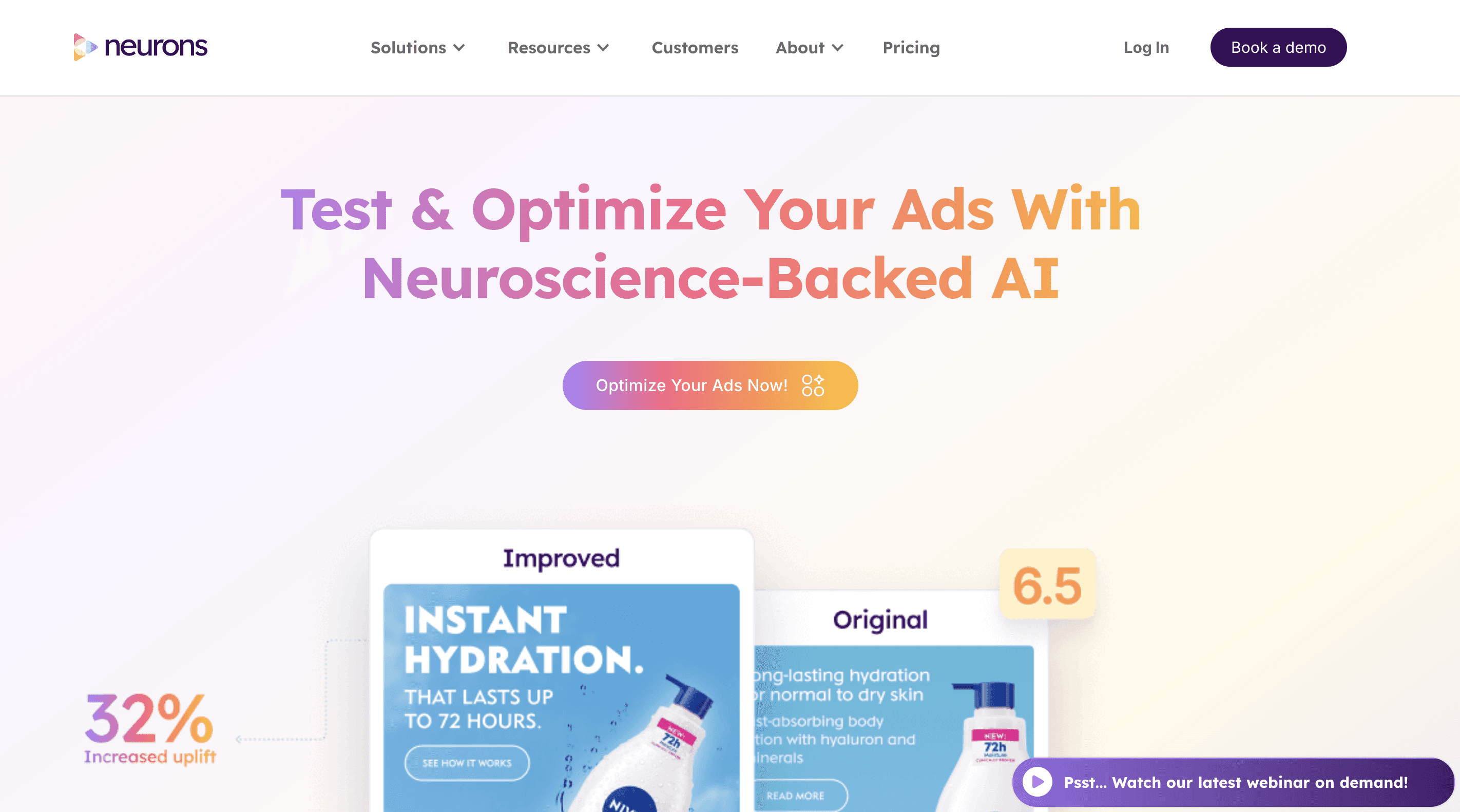
Neurons is the most established platform in predictive attention, and now the only home for VisualEyes and Loceye, both of which ceased operating as standalone products in January 2023 and were folded into the Neurons platform. Its Predict product covers attention and focus heatmaps, start-and-end attention maps, cognitive demand, clarity and engagement scores in beta, and arbitrary-shape Areas of Interest, across both images and video. It integrates with Figma, Adobe, and Chrome. Neurons reports over 95% accuracy against real eye-tracking studies. Pricing is not published: the company quotes per organization, and third-party listings report a Standard plan at roughly €15,000/year for five seats with unlimited analyses and API access. A free version and trial are referenced on software directories, but terms aren't stated publicly.
Attention Insight
Attention Insight is a predictive eye-tracking tool built on a claimed 70,000 eye-tracking studies, reporting 96% accuracy. It produces attention heatmaps, clarity scores, and percentage-of-attention Areas of Interest, and it's the most price-transparent option on this list. Basic runs $31/month for 40 credits, one seat, and watermarked output. Pro is $129/month for 200 credits, two seats, no watermark, video testing up to about three minutes, and API access. Hero is $324/month for unlimited credits plus up to two hours of expert design feedback and SSO. All tiers include a 14-day free trial, and a Figma-plugin-only plan is available at €23/month billed annually.
Expoze.io
Expoze.io by Alpha.one predicts visual attention for images and video with pricing structured around monthly credits rather than seats, which suits teams where many people need occasional access. Core is €19.99/month for a single user with up to 50 image credits. Core+ is €199.99/month for medium teams. Pro is €399.99/month and adds unlimited image credits, unlimited users, and roughly 11 minutes of video analysis per month. Plugin access and storage are included across tiers. The unlimited-users model on Pro is the differentiator: most competitors charge per seat, which makes wide internal rollout the expensive part.
Dragonfly AI
Dragonfly AI sells attention as one input among several. Its platform, built on a patented biological algorithm, scores creative for attention, emotion, memory, comprehension, and persuasion, and benchmarks assets against each other rather than scoring them in isolation. It's aimed at enterprise creative and insights teams testing at volume, with tiers named Light, Scaling, and Enterprise, differentiated by asset volume (from around 200 assets up to unlimited) and support level. Pricing is not publicly listed and is quoted based on team size, integrations, and requirements.
Quick overview
Tool | Pricing | Key features | Free tier |
|---|---|---|---|
Jarville | Pay-per-use, 5 credits (~$0.50) per full report | Own attention model, clarity + focus + hierarchy scores, ranked hotspots, evidence-linked fixes | 50 free credits on signup, no card |
Neurons | Custom quote (third-party listings report ~€15,000/yr, 5 seats) | Attention + focus heatmaps, cognitive demand, clarity/engagement scores, AOIs, video, Figma and Adobe plugins | Free version and trial available, terms not published |
Attention Insight | $31–$324/month | Predictive heatmaps, clarity score, AOIs, video on Pro+, API, Figma plugin | 14-day trial on all plans |
Expoze.io | €19.99–€399.99/month | Image and video attention prediction, plugin access, unlimited users on Pro | Trial via plan signup |
Dragonfly AI | Custom quote, tiered (Light/Scaling/Enterprise) | Attention plus emotion, memory, comprehension and persuasion scoring; benchmarking across assets | Demo only |
Decision framework: which tool fits your workflow?
The right tool depends less on model accuracy — the claimed numbers cluster in the 93–96% range across every vendor here — and more on how your team pays, how often you check, and whether video is in scope.
If you want to check attention on a whole batch of variants without a subscription: use Jarville. Pay-per-use pricing and a few free full heatmaps mean the marginal cost of checking one more variant is close to zero, which is the only condition under which anyone actually checks all of them.
If you need video, a documented accuracy record, and procurement will fund it: use Neurons. It's the deepest feature set in the category and the one most likely to survive a research team's scrutiny.
If you want published pricing and a mid-market monthly plan: use Attention Insight. It's the only vendor here with a full price list on its own site, and the $129/month Pro tier is the most common landing spot for a small in-house team.
If many people need occasional access and per-seat pricing is the blocker: use Expoze.io. Unlimited users on the Pro tier changes the rollout math.
If attention alone isn't the question and you need emotion, memory, and comprehension scored together: use Dragonfly AI, and budget for a sales cycle.
Try Jarville's attention heatmap free → full heatmap, no signup. Sign in for the scores and 50 free credits, no card required.
Frequently asked questions
Are attention heatmaps the same as real eye tracking?
No. Real eye tracking measures where actual people looked using a camera or lab hardware. Predictive attention tools use a model trained on eye-tracking data to estimate the same thing in seconds, without recruiting participants. Vendors here report 93–96% agreement with real studies. The tradeoff is speed and cost against ground truth: predictive tools are for screening every variant before spend, not for replacing a study you'd defend to a research board.
Is there a free attention heatmap tool?
Yes. Jarville returns a full attention heatmap free with no signup and no card, once per day. Attention Insight and Expoze.io offer trials rather than a permanent free tier, and Neurons references a free version without publishing its terms.
How much do attention heatmap tools cost?
Published pricing ranges from about $31/month (Attention Insight Basic) to €399.99/month (Expoze.io Pro), with enterprise platforms like Neurons and Dragonfly AI quoting custom — third-party listings put Neurons around €15,000/year for five seats. Jarville is the outlier on model rather than price: pay-per-use at roughly $0.50 per full report, with no subscription.
Does a higher attention score mean a better ad?
Not on its own, and any tool that implies it should be treated carefully. Attention concentrated on the wrong element is worse than attention spread evenly. Jarville scores clarity as a band for this reason, both a cluttered creative and an empty one score low, and grades hierarchy by whether attention follows the order you designed, not by how hot the map runs.