
Top 5 Celtra alternatives in 2026: a decision framework by bottleneck
Research
Satej Sirur
|
Co-founder and CEO
Reviewed By Satej Sirur
Why brands look for a Celtra alternative
Celtra has real strengths. It won the Digiday Technology Award for Best Content Creation Platform in 2025, and reviewers consistently praise its design flexibility and cross-team collaboration tools.
The complaints cluster around two things.
Setup complexity
Onboarding and project configuration take real time, particularly for teams running several concurrent projects. Second, functionality limits around project management, template management, and debugging show up repeatedly in reviews as friction that slows teams down rather than speeding them up.
Scope issue
Celtra is built for digital and display advertising: HTML5 banners, social ad formats, display units. It doesn't touch PDP images, retailer platform compliance, video built from a brief, or transcreation across markets, the parts of the job that consumer retail brands spend most of their time on.
Pricing compounds the frustration. Celtra doesn't publish rates. Market procurement data puts the median annual contract around $73,250, with entry pricing near $32,500 and enterprise deals running past $159,000, figures that only surface once you're deep into a sales conversation.
Top 6 Celtra alternatives: Detailed comparison
Design volume & speed alternatives
1. Rocketium
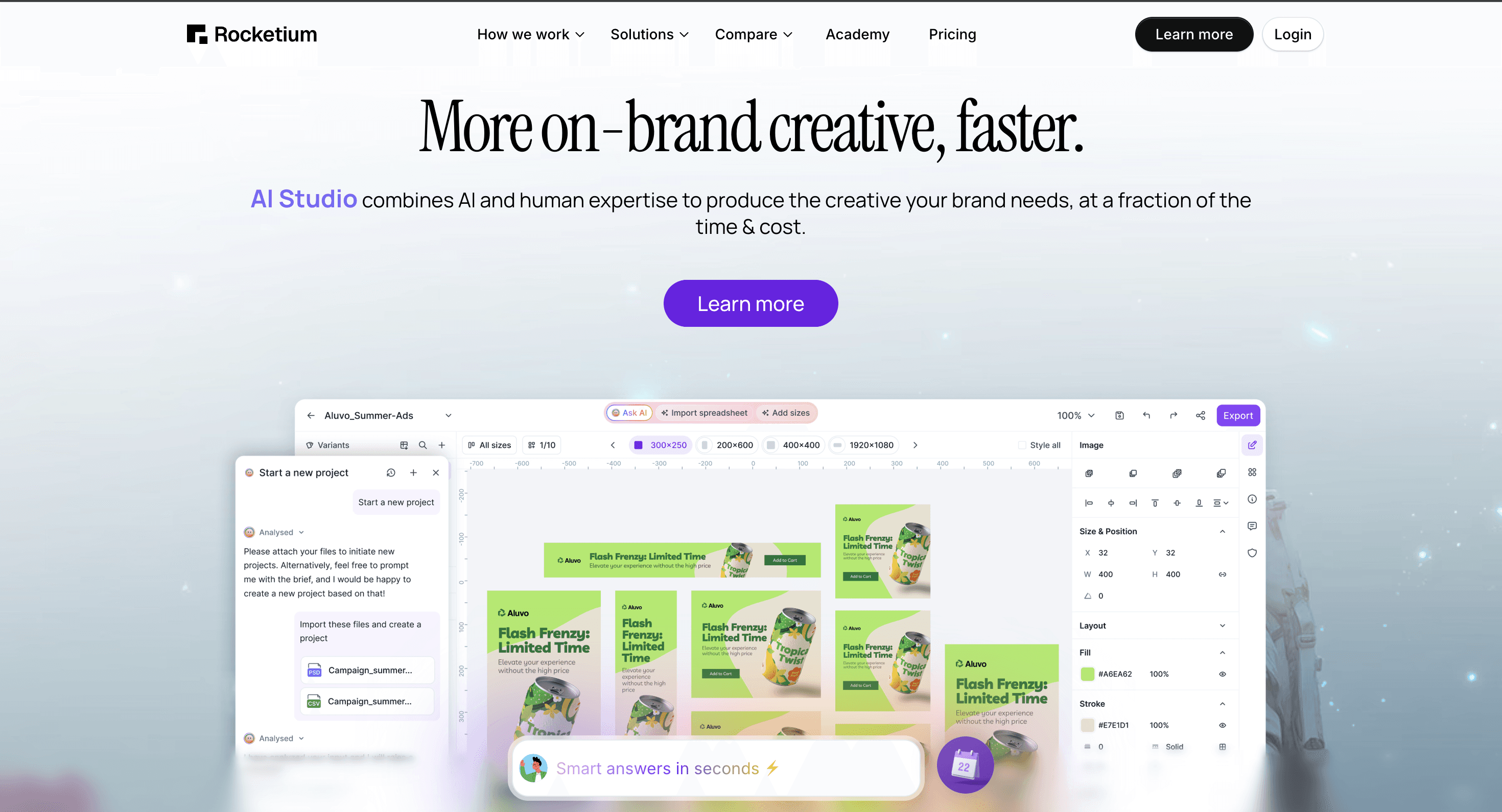
Rocketium AI Studio is a managed creative production infrastructure built for consumer brands that need assets at scale, on time, and on brand. It combines a Creative OS covering adaptation, production, and concepting with a team of AI agents, creative strategists, designers, and QA managers.
An Intelligence layer built from brand guidelines, retailer platform rules, and LLM integrations runs underneath every job.
For teams that want direct creative control, AI Studio also provides software access. Marketers can log in, make live edits, and iterate on assets without going back through a brief. The managed service and the platform access work together: the experts handle production at volume; the team uses the platform for quick edits and day-to-day changes.
Credits are the billing unit: 1 static asset = 1 credit which is $9-$18 per static asset. That compares to $75 to $150 per static asset through agencies, a 30 to 70% saving.
Retail platform compliance is built into the Intelligence layer.
NIVEA now launches campaigns across 14 platforms 2x faster with 98% fewer platform rejections. MegaFood refreshed 106 Amazon PDPs in weeks - without agencies or freelancers. |
Pilot setup takes 40 minutes of customer time. First results are delivered in 24 to 48 hours.
Honest trade-off AI Studio is optimised for high-volume, brief-driven production. Teams that primarily need one or two designers working directly in a design canvas on small runs of assets may find the brief-based workflow more structured than they need. Software access is available for brands that want both managed production and direct in-platform editing. |
Pricing: Starts at $9 per credit. 30-70% savings compared to hiring an agency
Pros | Cons |
|---|---|
✓ Human expert team (designers, strategists, QA) included in every job | ✗ Software access is available for direct edits, but the primary model is brief-driven; teams used to open-canvas self-serve tools will work differently |
✓ Retail platform compliance embedded in production workflow | ✗ Best suited to brands with consistent, high-volume creative needs; lower-volume teams may not fully use the managed production capacity |
✓ Covers production, adaptation, and concepting from one brief | |
✓ 30 to 70% savings versus agencies on static and video assets |
2. Storyteq
Storyteq combines digital asset management, creative automation, and workflow management in one platform.
Gartner named it a Leader in the Magic Quadrant for Content Marketing Platforms for the third consecutive year in 2025, and it holds a 3.9 out of 5 rating on Gartner Peer Insights.
Clients include Heineken, Haleon, and ASOS.
Its three modules cover the full lifecycle: a Content Portal for brand-approved assets, an Adaptation Studio for versioning and localization, and a Collaboration Hub for briefs, reviews, and approvals. That breadth suits brands managing content across ten or more markets with layered approval requirements.
Honest trade-off Storyteq is a content marketing platform first, creative automation tool second. Brands that need managed production support or retailer-specific compliance built into every asset will need to pair it with additional services. |
Pricing: €30,000 to €180,000 per year depending on features and usage. No self-serve free tier.
Pros | Cons |
|---|---|
✓ Gartner Leader recognition three consecutive years (2023, 2024, 2025) | ✗ No test environment to preview templates before publishing (G2 reviewer) |
✓ Strong multi-market video localization and adaptation capabilities | ✗ Some features still evolving; limited tutorials for newer capabilities |
✓ End-to-end workflow: briefing through analytics in one platform | ✗ High minimum spend makes it inaccessible for smaller teams |
✓ AI-powered brand governance and content discoverability |
Omnichannel distribution alternatives
3. Bannerflow
Bannerflow is a display advertising CMP built around HTML5 production, dynamic creative optimization, and campaign management. G2 rates it 4.6 out of 5, and it holds Gartner's CMP Leader badge. More than 2,000 enterprise brands use it across gaming, eCommerce, travel, and automotive.
Its Creative Studio handles design, animation, and scaling from a single master creative to every required format. Campaigns publish directly to more than 100 ad networks and DSPs, and live ad updates run without republishing, a real time-saver during active promotions.
Honest trade-off Bannerflow is a display-ad-first platform. Brands needing retail-specific asset formats, PDP production, or managed creative support will need to supplement it with other tools. |
Pricing: Quote-only. Annual subscription; not publicly disclosed.
Pros | Cons |
|---|---|
✓ G2 rating 4.6; strong user experience and support reputation | ✗ Occasional bugs and UI stability issues (G2 reviewers) |
✓ HTML5, rich media, and DCO built into one platform | ✗ Limited creative depth for complex builds; external design tools often still needed |
✓ 100+ ad network and DSP integrations | ✗ Not fully optimized for all social platforms |
✓ Live ad updates without campaign republishing |
4. Smartly.io
Smartly.io combines creative automation with paid social campaign management and AI-driven bid and targeting optimization across Meta, Pinterest, Snapchat, and TikTok. G2 scores it 8.5 out of 10 on meeting requirements and 9.3 out of 10 on support quality.
The architecture is different from Celtra's at a fundamental level. Celtra separates creative production from media execution.
Smartly connects them, so creative performance data directly informs which variants scale, which audiences get targeted, and how budget shifts in real time. For teams that manage both creative and media buying in-house, that removes the manual handoff between creative ops and media.
Honest trade-off Smartly is a social-media-first platform. Brands that also produce retail platform assets, display ads, or non-social formats will need a separate solution for those channels. |
Pricing: $4,000/month (third-party data; Smartly.io does not publish pricing). Annual commitment required.
Pros | Cons |
|---|---|
✓ Creative and paid social management in one platform | ✗ Steep learning curve; best operated by experienced performance marketers |
✓ AI adjusts bids, targeting, and creative combinations in real time | ✗ High cost threshold; difficult to justify below significant ad spend |
✓ Strong support quality (G2: 9.3 out of 10) | ✗ Creative flexibility shaped by channel constraints; limited for non-social formats |
✓ Effective for social-first brands running complex cross-platform campaigns |
Dynamic performance & execution alternatives
5. Hunch
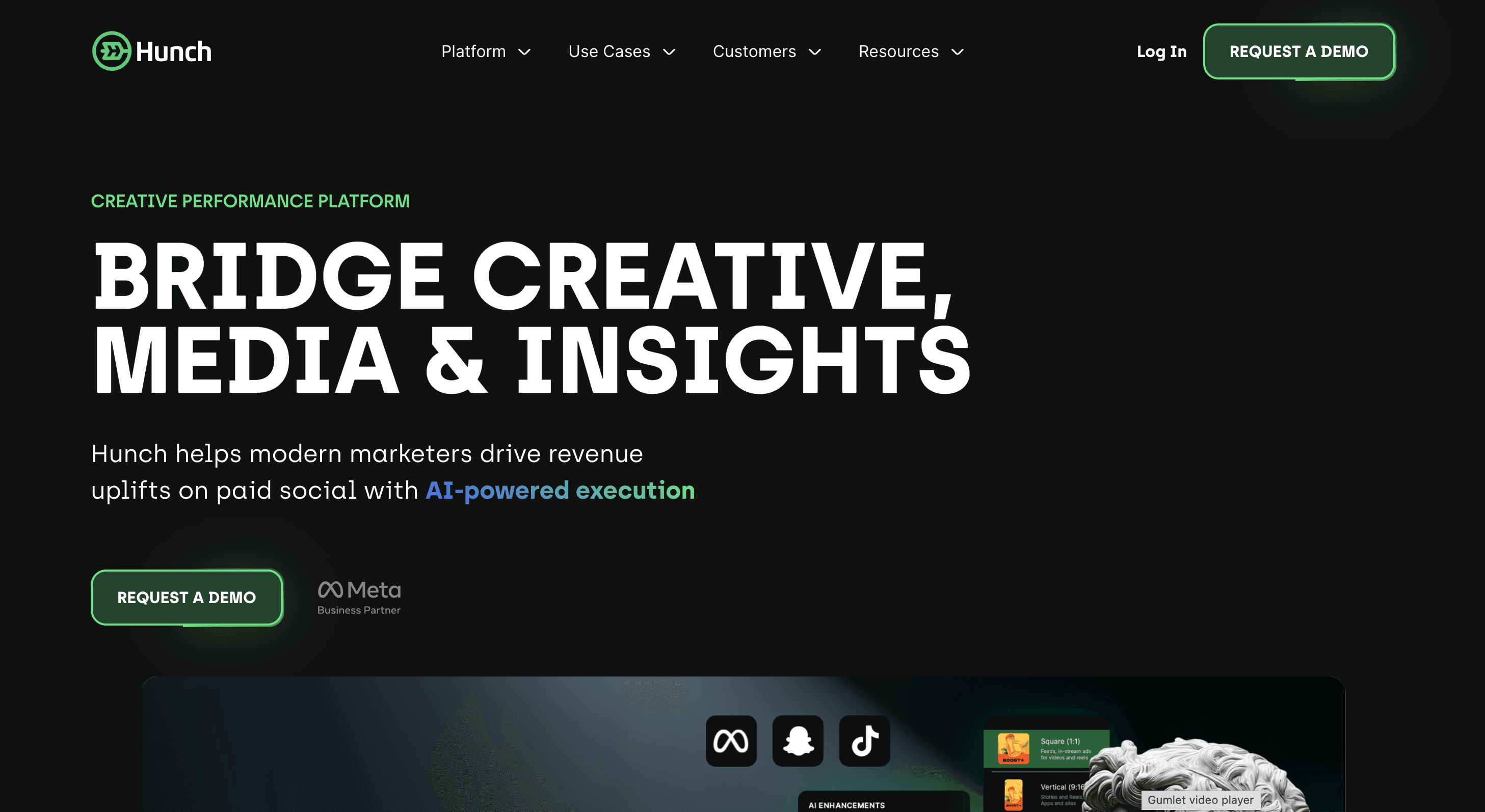
Hunch is a creative automation and paid social platform built for growth-stage and mid-market brands running product-feed-driven campaigns on Meta, Snapchat, and TikTok. Pricing starts at €2,500 per month, based on ad spend volume, with no limits on ad accounts and core AI features included in the base fee.
Its primary differentiator from Celtra is product feed integration. Where Celtra works with creative templates independently of product catalog data, Hunch connects live product feeds directly to dynamic creative templates. This enables automatic generation of personalized video and static ad variants at catalog scale, with up to 20 creative variations per template. AI creative enhancements adjust assets based on live performance signals.
The workflow also covers media buying: audience management, ad delivery, and campaign automation run from the same platform as creative production. For brands that spend their media budget primarily on paid social and need creative and spend to react to the same signals, Hunch is a focused, practical system.
Its pricing model is designed to stay predictable as ad spend scales, which contrasts with percentage-of-spend models used by some competitors. There are no per-account limits at any spend level.
Honest trade-off Hunch doesn't serve display advertising, retail platform assets, or non-social channels. Brands with omnichannel creative needs will find significant gaps outside of paid social. |
Pricing: From €2,500/month based on ad spend volume. Annual commitment. No per-account limits.
Pros | Cons |
|---|---|
✓ AI-powered product feed integration for dynamic ad variants at catalog scale | ✗ Missing key campaign analytics metrics (G2 reviewer) |
✓ Up to 20 creative variations per template | ✗ Occasional response delays when syncing product catalogs (G2 reviewer) |
✓ Creative and media buying workflows in one platform | ✗ Limited training resources and support documentation |
✓ Predictable fee-based pricing as ad spend scales |
Which Celtra alternative is right for your brand?
Start with the bottleneck. If the problem is production volume, retailer compliance, and brand consistency at scale, Rocketium AI Studio is the only option here that combines a managed human expert team with AI across production, adaptation, and concepting.
If the bottleneck is distribution across channels or optimizing live media spend, Bannerflow, Smartly.io, or Hunch solve a different, real problem.
Many brands end up running two: one for production, one for distribution or optimization.

See AI Studio in action for your brand
Frequently asked questions
What is Celtra used for?
Celtra is a cloud-based creative management platform used mainly for digital and display advertising production. It helps enterprise teams build, adapt, and activate creative across social, display, video, and rich media formats. It doesn't publish pricing and targets large enterprise brands. It won the Digiday Technology Award for Best Content Creation Platform in 2025.
What's the difference between Celtra and AI Studio by Rocketium?
Celtra is a self-serve design platform: your team builds and manages everything inside it. AI Studio combines a managed production service with software access. You submit a brief and get production-ready assets in 24-48 hours, or log in and edit directly. AI Studio also builds retailer platform compliance into every job; Celtra's focus stays on digital ad formats.
How much does Celtra cost compared to its alternatives?
Celtra uses custom enterprise pricing with no public rate card, with market data suggesting a median annual contract around $73,250. Storyteq runs €30,000-€180,000 a year. Bannerflow is quote-only. Smartly.io runs around $4,000 a month per third-party data. AI Studio uses a credits model, one static asset per credit, each credit costs $9.
Which Celtra alternative is best for retail brands selling on Amazon or Walmart?
Rocketium. Its Intelligence layer builds in retailer platform rules for Amazon, Walmart, and 100+ retail ad platforms, which cuts asset rejection rates at submission. 12 Amazon teams already produce 250,000 assets a year through AI Studio.
Can I migrate from Celtra to another platform without losing existing templates?
Celtra restricts creative export outside its platform, a limitation documented in G2 reviews. Migration usually means rebuilding templates in the new system rather than transferring files directly. Most alternatives, including AI Studio, build a setup and migration phase into onboarding.
Do I need one Celtra alternative, or more than one?
Usually more than one, if you're active in both production and media buying. Production and compliance needs point to Rocketium's category. Trafficking or real-time optimization needs point to a different tool entirely, since no platform on this list does both well.