Creative operations hasn't had its Toyota moment. Yet.

Creative operations hasn't had its Toyota moment. Yet.

Article

In the 1970s, Toyota did something that changed manufacturing forever. They did not hire better workers or build a bigger factory. They built a measurement system - one that made every inefficiency visible, every bottleneck nameable, every improvement trackable. Your supply chain team has dashboards that would make Toyota proud. Your finance team knows the cost of every input to three decimal places.

Creative operations remains the last unmeasured function in most marketing organizations.

Not because the people running it are unsophisticated, but because the measurement conversation has never been forced. Until now.

The human question first.

Let's address what you're actually worried about.

When the words "AI" and "creative operations" appear in the same sentence, the question most people in the room are actually asking is: what does this mean for my team? It is a legitimate question. It deserves a direct answer, not a reassuring platitude.


On technology, work & the human advantage

The anxiety around AI in creative work is understandable, but the research consistently points elsewhere. Erik Brynjolfsson and Andrew McAfee at MIT have documented that technology augments human capability when organizations redesign work around what humans do uniquely well - judgment, strategy, taste, persuasion. The threat has never been the technology. It has been organizations that automate without redesigning the roles around it.


"The key question is not whether AI will replace workers, but whether organizations will invest in helping workers move up the value chain - toward higher-judgment, higher-meaning work that machines cannot replicate."

-Erik Brynjolfsson · Stanford Digital Economy Lab


Lynda Gratton's research at London Business School reaches the same conclusion. The professionals who thrive through technological transitions are those who proactively craft their roles toward complexity, creativity, and human connection. The designers most valuable in five years are not the fastest at resizing. They are the ones with creative direction, brand intuition, and strategic judgment that no system can generate.


"The most resilient professionals are those who continuously shift their work toward tasks that require uniquely human capabilities, and away from those that can be systematized."

-Lynda Gratton · London Business School


Here is the reframe: the real threat to your team's jobs is not AI Studio. It is spending the next five years doing work that AI can already do. The Creative Director managing production becomes a brand architect when that production is handled. The designer resizing assets becomes a creative strategist when the resizing is automated. The capacity was always there. The system was consuming it.

Where it hurts

Not a people problem.al.

Most marketing organizations are caught between two bad options. Agencies are expensive and slow - campaigns miss windows, assets sit in review, seven revision cycles pass before legal clears it. Raw generative AI is fast and cheap but brand-unsafe, and nobody actually trusts it to go live. Both options produce the same outcome: a creative operation that cannot keep pace with the business it serves.


"The dirty secret of creative operations is that most cycle time is not production time, it is wait time. A 10-day cycle might contain only 6 hours of actual creative work."

Rocketium · Creative Operations Metrics Playbook, 2026


McKinsey's Global Institute estimates that generative AI can automate up to 70% of repetitive creative production tasks - resizing, versioning, transcreation, format compliance. That number is not a threat. Read correctly, it is a roadmap for where human creative talent should not be spending its time.


"Companies that combine AI execution with human oversight consistently outperform those that pursue either pure automation or pure human production — on quality, speed, and cost simultaneously."

BCG Henderson Institute · AI & the Future of Work, 2024


The waste is not in the creative work. It is in the system around it. And systems that are not measured cannot be improved.

Clearing up the misconception

is not AI Studio 

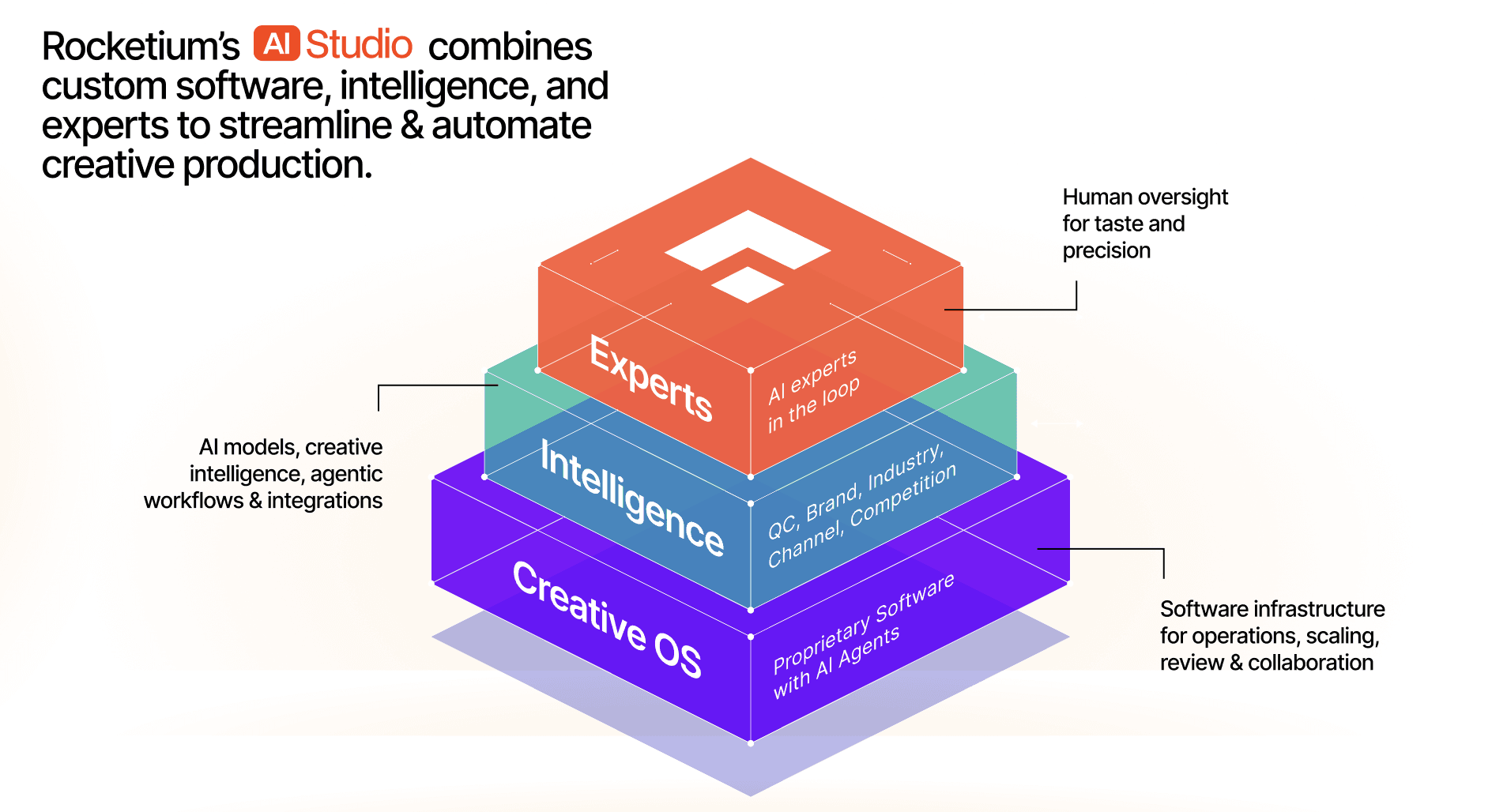
If your team already uses Canva, Adobe Express, or Celtra, the instinct is to ask: why would we add another system? It is a reasonable question with a flawed premise. Those are authoring tools - they answer how an asset gets made, by someone who already knows what to make. AI Studio is not a tool your team logs into. It is not an agency you brief and wait on. It is a production system: AI agents do the mechanical work, human experts review every output, and your team receives finished, compliant assets. At the scale most retail brands operate, that distinction matters more than any feature comparison.


AI STUDIO IS NOT

✗  A replacement for Canva, Adobe, or Celtra

✗  A Gen AI image generator

✗  A tool your designers log into

✗  Another software subscription to manage

✗  A replacement for your creative team

✗  Unpredictable AI output with no oversight

AI STUDIO IS

✓  An end-to-end production system

✓  AI execution + human expert review on every asset

✓  A dedicated team your team briefs directly

✓  Brief to platform-ready asset, in hours

✓  The production layer that frees your team

✓  Every output compliance-checked before delivery


The question is not Canva versus AI Studio. It is: what happens after someone opens Canva? Who briefs the work, manages the variants, handles transcreation across seven markets, checks compliance, and gets the asset to the right spec for fourteen placements - on time, every time? That gap compounds into a competitive disadvantage every quarter it goes unaddressed.

The measurement framework

Toyota did not improve manufacturing by working harder. They improved it by making performance visible - giving everyone a common currency for what good looked like. Creative operations needs the same thing. Not more effort. More signal.

Rocketium's 2026 research across leading retail brands identifies ten metrics across four categories. These four tell you most, fastest.


Quality

First-time approval rate

Assets approved without revision. Low rates are almost never a talent problem — they are an alignment problem. The brief said one thing; the reviewer expected another. Every revision cycle is a process failure, not a creative one.

Benchmark: Above 80%

Speed

End-to-end cycle time

Total time from brief to approved delivery. Most of this time is not production — it is wait time. Assets sitting in inboxes, queues, approval chains. The biggest gains come from eliminating wait, not asking designers to move faster.

Benchmark: Under 3 business days

Cost

Cost per asset

Fully loaded cost to produce one approved asset. Most brands measure this poorly or not at all. The biggest hidden cost is not agency fees - it is opportunity cost. Every hour on resizing is an hour not spent on creative that moves performance.

Benchmark: Below $50

Intelligence

Insight-to-production loop

How quickly a performance signal becomes a live asset. The loop breaks at every handoff. By the time the updated asset is live, the window has closed. This is the metric that separates brands that react to the market from brands that move with it.

Benchmark: Under 1 week


The pattern across lagging operations is consistent: cycle times above ten days, first-time approval rates below 50%, cost per asset unknown, and no connection between performance data and what gets briefed next. These are not creative problems. They are operational ones- and operational problems respond to operational solutions.


Quality

First-time approval rate

Assets approved without revision. Low rates are almost never a talent problem — they are an alignment problem. The brief said one thing; the reviewer expected another. Every revision cycle is a process failure, not a creative one.

Benchmark: Above 80%

Speed

End-to-end cycle time

Total time from brief to approved delivery. Most of this time is not production — it is wait time. Assets sitting in inboxes, queues, approval chains. The biggest gains come from eliminating wait, not asking designers to move faster.

Benchmark: Under 3 business days

Cost

Cost per asset

Fully loaded cost to produce one approved asset. Most brands measure this poorly or not at all. The biggest hidden cost is not agency fees - it is opportunity cost. Every hour on resizing is an hour not spent on creative that moves performance.

Benchmark: Below $50

Intelligence

Insight-to-production loop

How quickly a performance signal becomes a live asset. The loop breaks at every handoff. By the time the updated asset is live, the window has closed. This is the metric that separates brands that react to the market from brands that move with it.

Benchmark: Under 1 week


The pattern across lagging operations is consistent: cycle times above ten days, first-time approval rates below 50%, cost per asset unknown, and no connection between performance data and what gets briefed next. These are not creative problems. They are operational ones- and operational problems respond to operational solutions.


40%

AVG. COST SAVINGS VS. AGENCY OR FREELANCE

<2 days

TRANSCREATION ACROSS 7 MARKETS · COLGATE

98%

FEWER REJECTIONS ACROSS 14 PLATFORMS · NIVEA

The leadership imperative

The brands winning on Amazon, Meta, Walmart, and TikTok are not the ones with the biggest creative teams. They are the ones who treated creative production as a measurable, optimizable system. The cost of moving is a change management conversation and a pilot brief. The cost of not moving is measurable too: slower campaigns, higher cost per asset, a creative team occupied with work that does not build their capability - every quarter.

Toyota did not wait until the competition caught up to start measuring. The question is not whether creative operations will have its measurement moment. It is whether you lead it or inherit the gap someone else closed first.


The question to take into your next leadership meeting

If your creative operation had the same measurement discipline as your supply chain - what would it tell you about where you're losing?

That is not a hypothetical. Start with one metric and one brief. AI Studio executes it - AI agents, human experts, compliance-checked. You have a platform-ready asset in hours and a baseline to improve from.

See AI Studio in action

for a real custom brief of your brand

See AI Studio in action

for a real custom brief of your brand

See AI Studio in action

for a real custom brief of your brand

See AI Studio in action

for a real custom brief of your brand


a blurry image of a purple and blue background

Want to level up your
creative game with AI Studio?

a blurry image of a purple and blue background

Want to level up
your creative game with AI Studio?

a blurry image of a purple and blue background

Want to level up your
creative game with AI Studio?