
Design and agentic AI: Craft winning creatives in the age of AI
Our perspective
Satej Sirur
|
Co-founder and CEO
The problem isn't a missing model. It's an unchanged process.
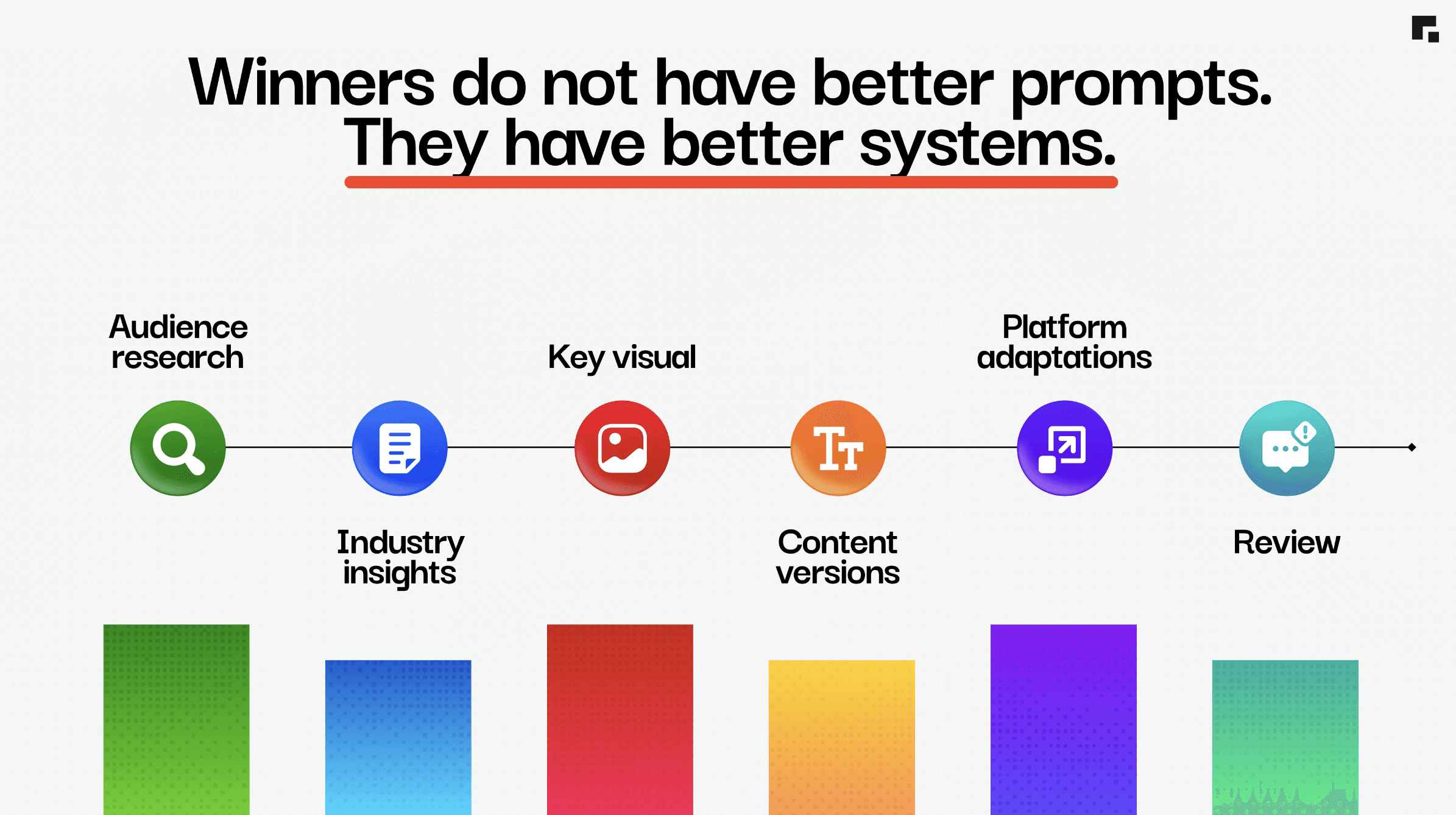
Here's what I mean by that. The bottleneck is usually a design process problem, not just a tooling problem. Instead of adding agentic ai as another prompt layer, teams need to design autonomous systems for goal-directed behavior, so the image gets made faster while everything around it stays the same.
That's not a criticism of the team. It's just where most AI adoption in creative starts, because generating something is the most visible, most demoable part of the job. But visible isn't the same as valuable. A traditional ai system may accelerate one step, while an agentic ai system makes dynamic decisions across the workflow; if you map out where the actual time and judgment go in a creative cycle, research, concepting, testing, production, review, you'll usually find production is one stage out of five. AI applied only there caps your upside at a fifth of the process.
The teams getting real leverage from AI apply it at every stage, not just the one that's easiest to point a demo at. That is an agentic ai architecture question shaped by the design patterns behind the workflow, not just a model-quality question.
Your audience research is already available
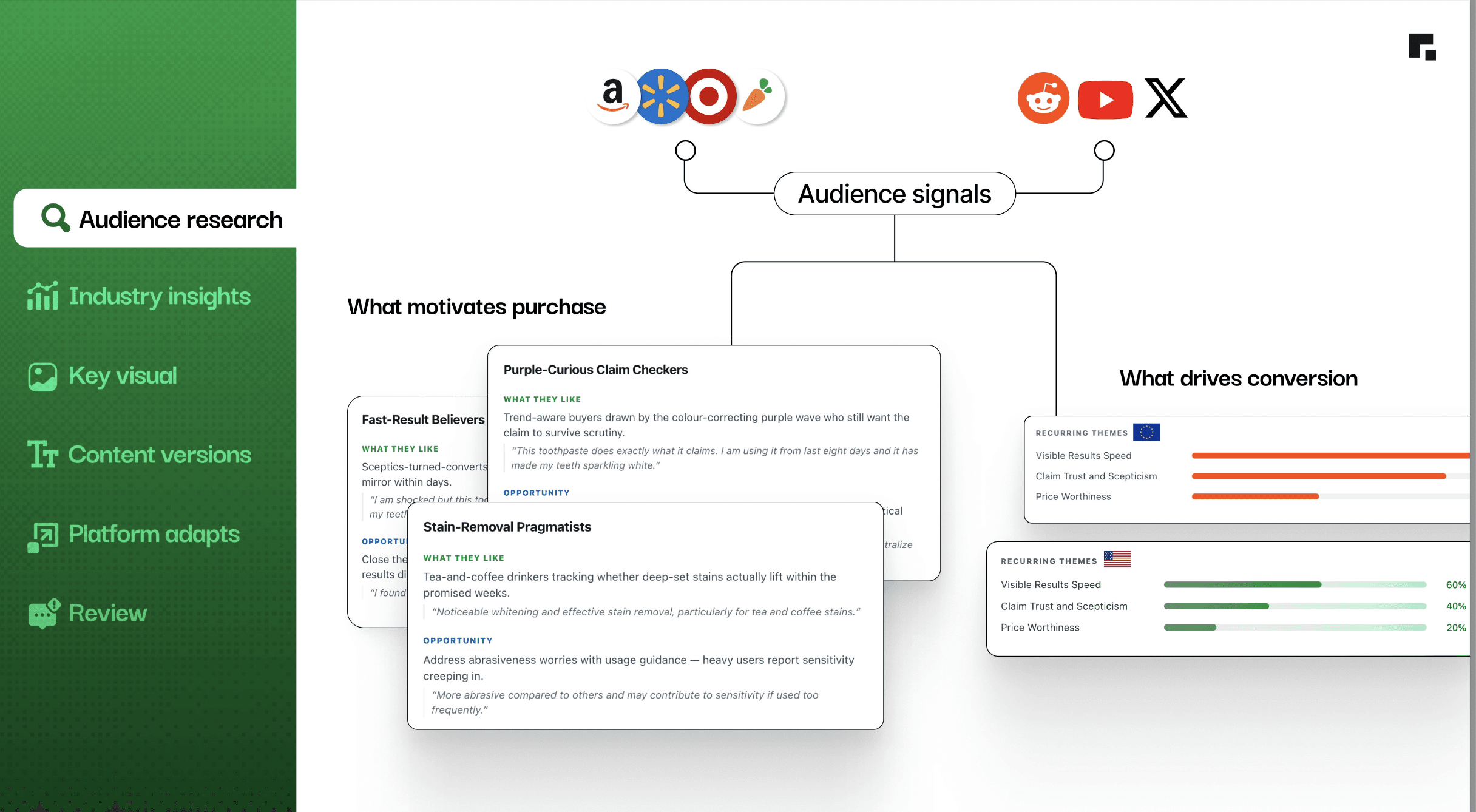
Before you write a single line of creative copy, you probably already have more audience insight than you're using. Product reviews on Amazon, Trustpilot, and Trust Radius. Reddit threads where your category gets discussed unprompted. Your own historical A/B test results, sitting in a dashboard nobody revisits once a test ends.
This is exactly the kind of unstructured, high-volume information an LLM is good at working through. Feed it into a model and ask it to infer user intent from reviews, tests, and audience signals, not just what your team assumes motivates people, and you get something closer to what your customers actually said, at a scale a person reading one review at a time never gets to. As it builds out what actually motivates each audience segment, an agent can track patterns over time and adapt to preferences as more feedback comes in. It can also handle multi step tasks across multiple steps to turn messy research into actionable audience understanding.
Competitor research, and research outside your category, at a scale a person can't do alone
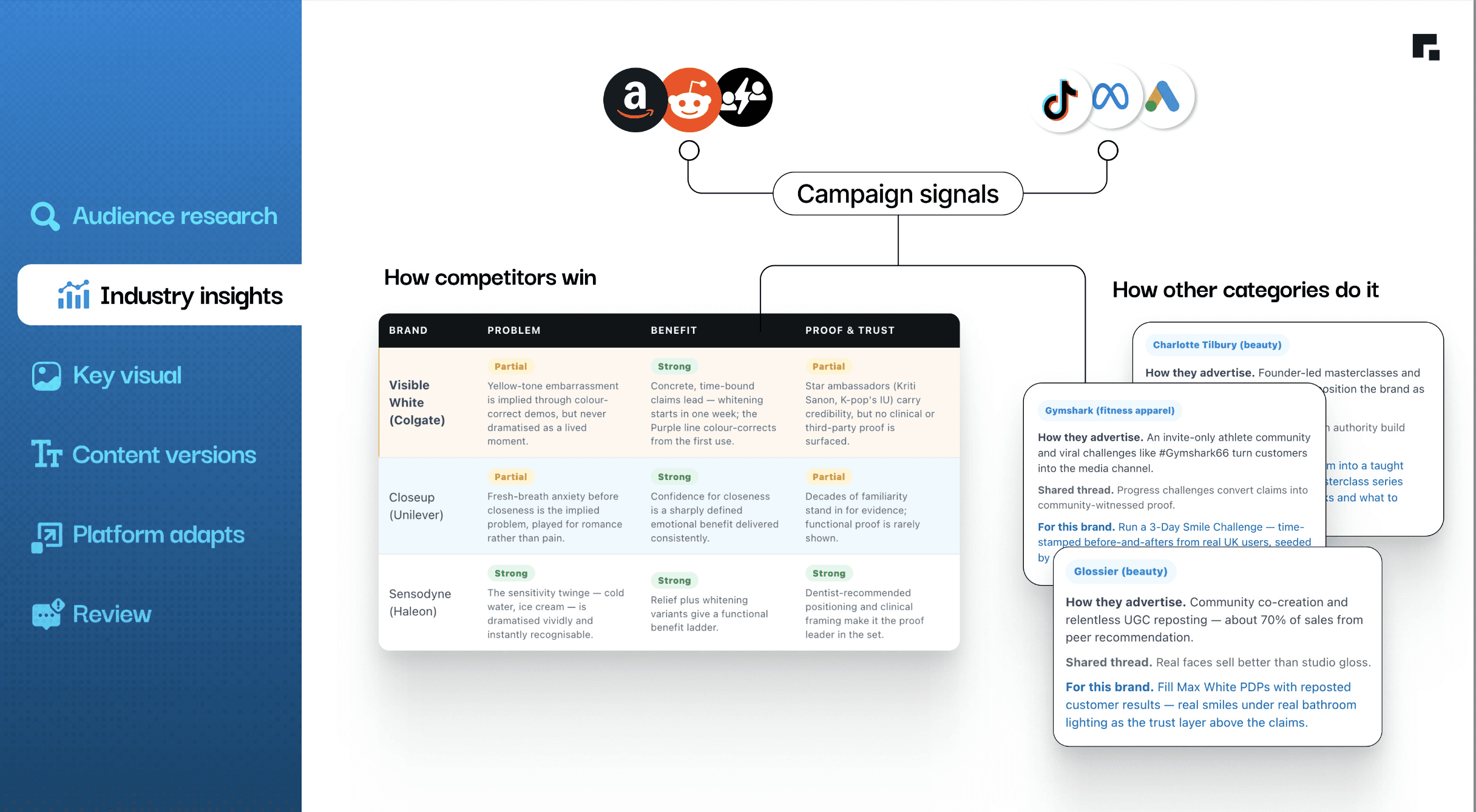
The same logic applies to competitor research. Facebook, Google, and TikTok's ad libraries are public. Every brand's creative, including yours, is sitting there for anyone to study. AI agents can pull that data and analyze it: how each competitor tells their story, which formats they lean on, which of their assets appears to be running longest (a decent proxy for performance).
Here's the part that's easy to miss. Looking only at your own category tends to produce the same handful of ideas everyone in that category already has. Studying a completely different industry, one with a different customer, different constraints, different creative conventions, tends to surface angles your own category's blind spots hide. A person can do this manually for a handful of brands. Across hundreds or thousands of data points, that's not a research task anymore. It's a data problem, and that's exactly where AI has the advantage over a person doing it by hand.
Pre-testing a concept before it costs you media dollars
New creative direction can be judged by instinct, or it can be judged against real audience data before you spend a cent putting it in front of anyone. Take the audience segments you've already built from public and performance data, and ask an LLM: given everything we know about this segment, how is this creative concept, this copy, this angle, likely to land?
That's not a replacement for a real A/B test. It's a filter before the test. It won't tell you exactly how a concept performs, but it will tell you when a direction is clearly off before you've spent money finding that out the hard way. Skip this step and you're still testing blind, just faster.
Production is the most automated step. Review is sometimes skipped.
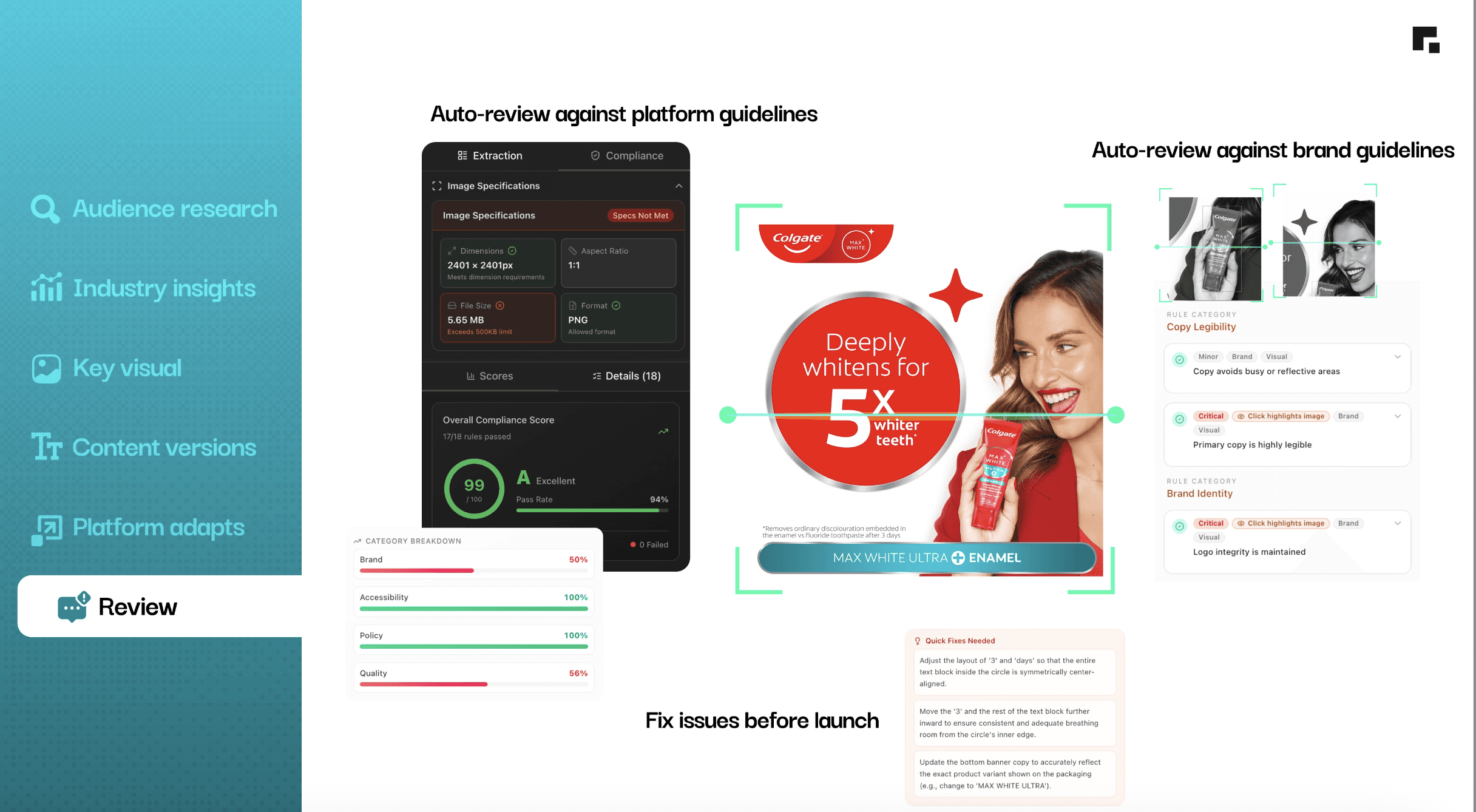
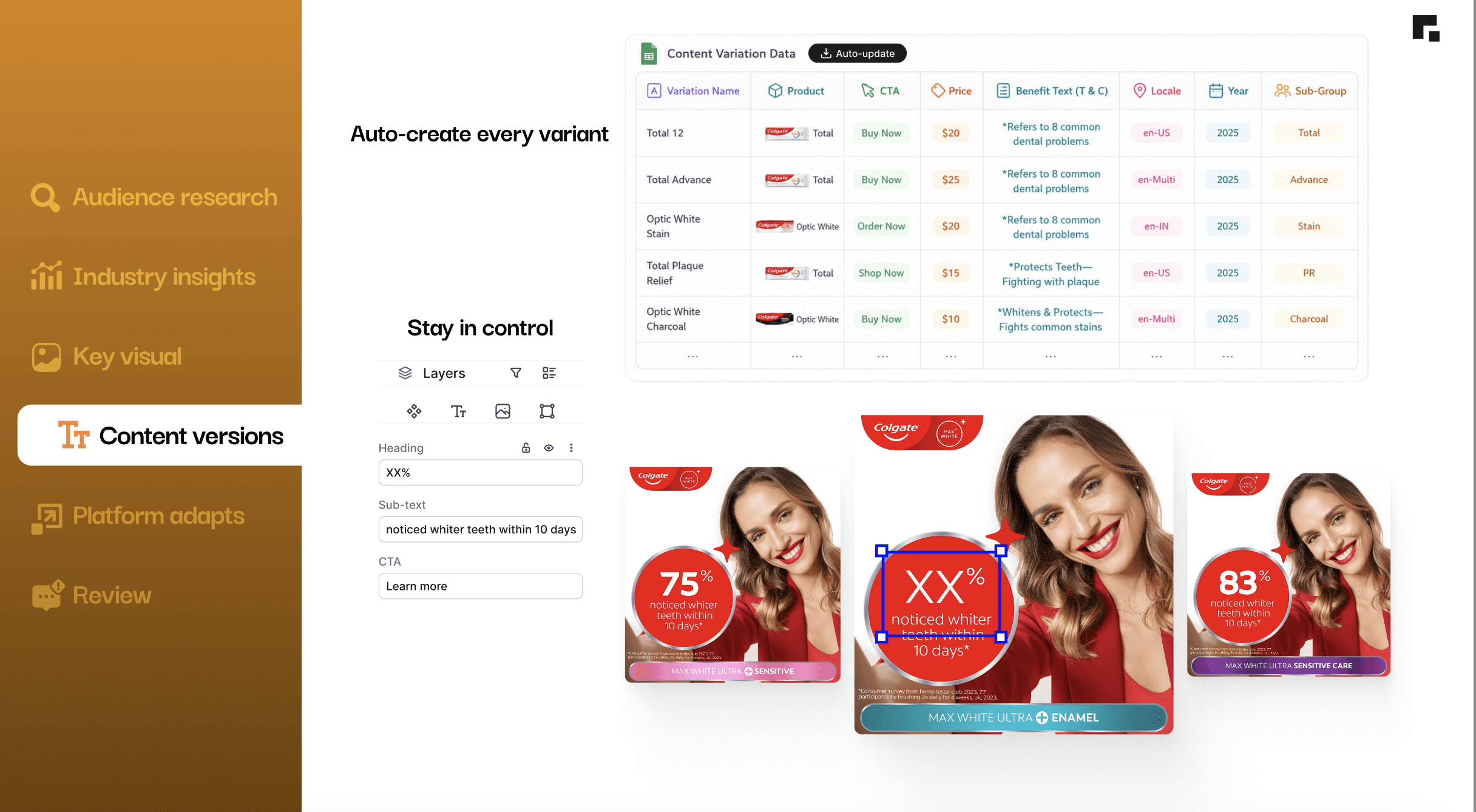
Production, the part where the design actually gets built, adapted into every size, and versioned for every test, is genuinely where specialized AI tools do more than a general-purpose LLM. This is the tedious, mechanical layer: resizing, platform compliance, file naming, and the dozens of small variations testing requires. We built AI Studio because we hit this exact wall ourselves. Colgate uses it to get transcreation and adaptation for seven country teams done in under two days, work that used to run through multiple agencies at roughly $75 per asset for two dozen product variants. Alliance Pharma gets launch-ready product video in under four days, saving around 20% against other GenAI tools and 90% against agency rates.
But the step most teams quietly skip is review. When brands are listing on a dozen retail platforms and advertising on half a dozen more, checking every asset against every platform's rules by hand doesn't scale. Most of it either gets done manually at real cost, or it doesn't get done at all, and inconsistency slips through.
That work can be offloaded to AI agents that are given explicit rules to check against. What can't be offloaded is the sign-off. If there's one thing I'd want every team to take from this: don't let AI publish anything as the final, unreviewed step. Put guardrails on the AI and put a person on the output. That's not caution for its own sake. It's the difference between AI that scales your judgment and AI that quietly removes it.
The tool was never the constraint in ai design
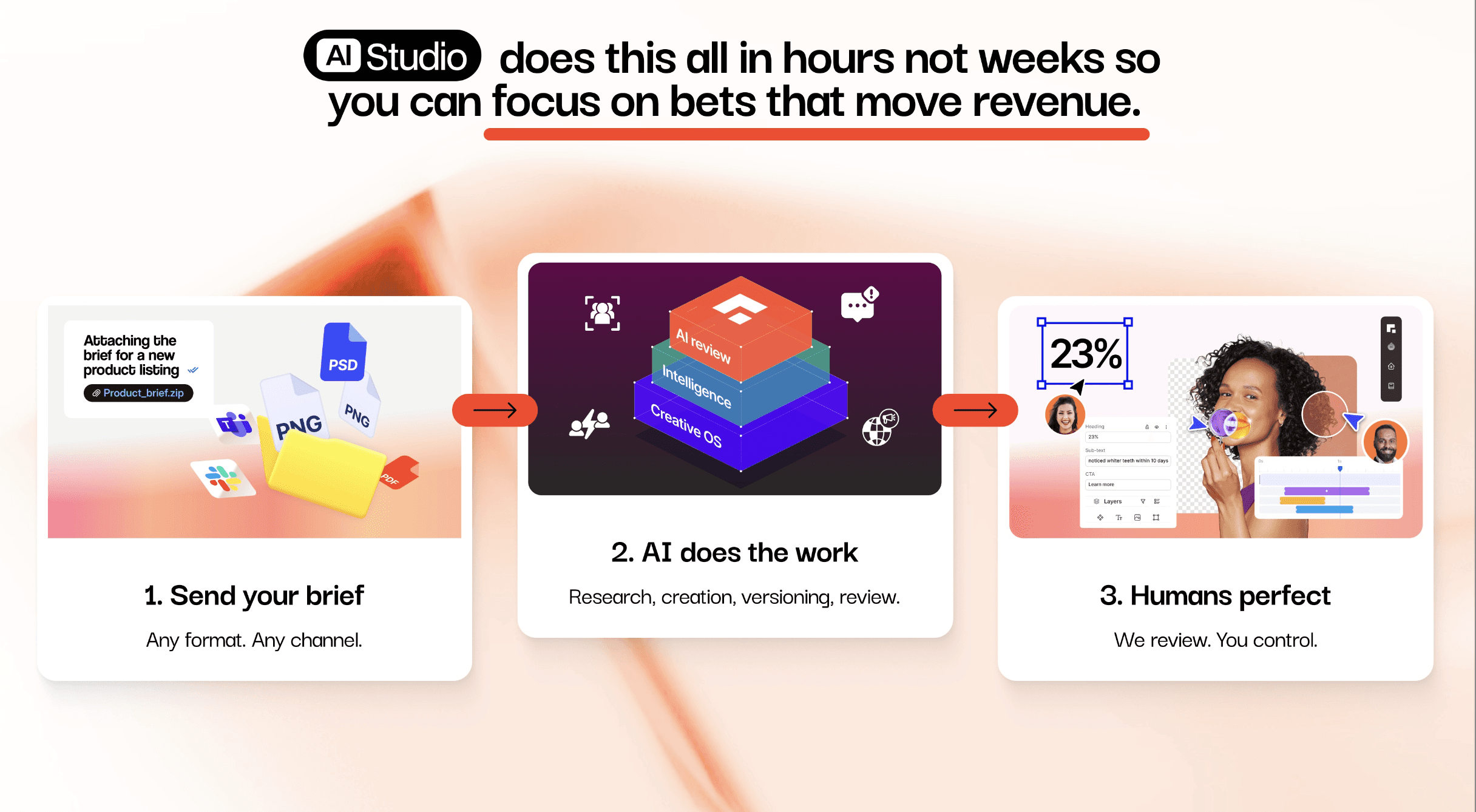
None of this requires switching platforms or waiting for a better model. It requires looking at your process end to end and asking where AI is actually being applied versus where it's just sitting on top of the same old sequence. Most teams will find they've automated the one stage that was easiest to demo, and left the four stages that actually determine whether the creative works untouched.