
Why creative scale has become a revenue problem
Article
Cameron Nelson
|
Sr. Marketing Manager
Reviewed By Satej Sirur
For years, creative production was treated as a brand function, a design challenge, or a campaign execution task. Today, that framing no longer reflects reality.
Your creative scale has quietly become one of the most important revenue constraints inside modern marketing organizations. This shift is not driven by aesthetics. It is driven by economics, performance, and operational limits.
Most teams have not adjusted to this reality yet.
Creative Volume Has Exploded. Most Creative Systems Have Not
Marketing environment have fundamentally changed:
🔹More channels
🔹More audiences
🔹More formats
🔹More SKUs
🔹More testing cycles
🔹More personalization demands
For many retail and eCommerce brands, creative demand is no longer measured in dozens of assets per campaign. It is measured in hundreds or thousands.
Yet workflows often still resemble an earlier era.
❌Manual versioning
❌Fragmented approvals
❌Endless resizing
❌File management overhead
❌Reactive production cycles
The result is predictable: creative becomes the bottleneck that slows growth initiatives, delays campaigns, and restricts experimentation.
What feels like a production problem is actually a revenue problem.

Your Media Efficiency Now Depends on Creative Efficiency
Paid media strategies have matured.
🔹Bid optimization is sophisticated
🔹Audience targeting is precise
🔹Attribution is increasingly refined
But performance outcomes still depend heavily on creative quality and creative variation.
When your creative velocity slows, testing slows → When testing slows, performance stagnates → When performance stagnates, media efficiency declines.
This creates a structural tension inside your organization.
Your media spend can scale instantly. Your creative production rarely can. When creative systems fail to keep pace with media investment, revenue efficiency suffers.
Creative production is no longer just about execution, it is either your performance multiplier or your performance constraint.
More Creative Alone Does Not Improve Performance
Many teams attempt to solve scaling pressure by increasing output.
✅More assets
✅More variations
✅More iterations
However, volume without systemization introduces new problems.
❌Inconsistent messaging
❌Brand drift
❌Approval friction
❌Measurement complexity
❌Operational chaos
Creative scale without governance does not produce leverage. It produces noise.
High performing organizations recognize a critical distinction. Creative production is not about generating more assets, it is about generating the right variations with speed, consistency, and measurable impact. This shift is exactly where Agentic AI becomes transformative.
Instead of relying on manual effort, your systems can now:
🔹Adapt assets intelligently
🔹Generate variations dynamically
🔹Operate workflows autonomously
🔹Continuously optimize outcomes
Agentic AI does not simply accelerate production. It changes how creative systems operate entirely.
Creative Systems Have to Become Your Growth Infrastructure
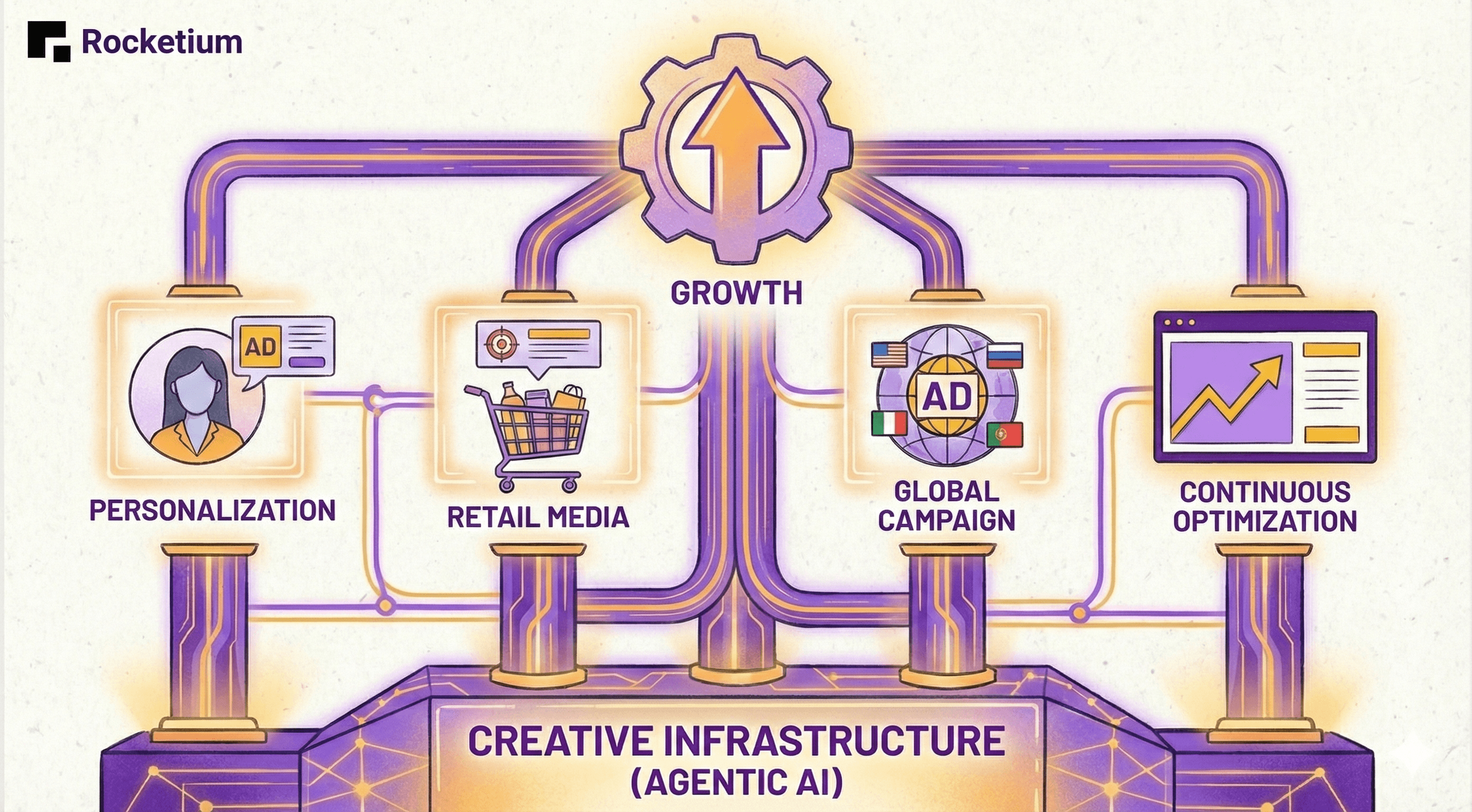
Forward looking organizations are reframing creative operations. Creative can no longer just be content creation. It needs to be your autonomously automated infrastructure.
Your infrastructure should automate:
🔹Personalization strategies
🔹Retail media expansion
🔹Performance marketing velocity
🔹Global campaign adaptation
🔹Brand governance at scale
🔹Continuous optimization
This mirrors transformations already seen across marketing:
🔹Data became infrastructure
🔹Attribution became infrastructure
🔹Automation became infrastructure
🔹Agentic AI is now becoming infrastructure
Creative systems are now following the same trajectory. Organizations that treat creative scale as a strategically automated capability unlock structural advantages.
✅Faster experimentation
✅Higher media efficiency
✅Greater brand consistency
✅Lower production overhead
✅Improved performance predictability
Organizations that do not adapt inherit growing constraints.
The New Reality
Your creative scale is no longer just a design challenge. It is an economic challenge. It is an operational challenge. Most importantly, it is a revenue challenge.
Your growth strategies increasingly depend on your ability to:
🔹Produce variations rapidly
🔹Adapt assets intelligently
🔹Enforce governance automatically
🔹Optimize continuously
The limiting factor is rarely creative talent. It is your underlying creative systems.
The organizations that recognize this shift early will outperform those that continue to treat creative production as a tactical function.
Because in modern marketing environments, when more budget, more channels, and more personalization demands are at play than ever before, your creative scale is directly tied to your revenue scale.