
Manual workflows to AI-driven creative ops
Podcast & webinar
Cameron Nelson
|
Sr. Marketing Manager
Reviewed By Satej Sirur
In this recent Rocketium webinar, Cameron Nelson, Head of Marketing for US & EU, sat down with Co-founder & CEO, Satej Sirur, to talk about something every creative leader is now being asked about: agentic AI.
Not just “type a prompt, get an image”, but AI that can plan, act, coordinate tools, and collaborate with humans to actually ship campaign-ready work.
Why creative teams care now (and why software alone is not enough)
The pressure on creative and marketing teams is clear: more campaigns, more formats, same or smaller teams. As Satej puts it:
“you always have more ideas than you have time to work on them, right? So especially these days with teams either staying the same or in many cases shrinking, all of that workload has to be managed with the same team.”
Yet most teams are still operating inside a messy stack of design tools, storage, workflow apps, exports, naming conventions and manual checks. Every tiny step needs UI, training, and muscle memory. That old world, Satej argues, “is no longer okay.”
The interesting shift is that AI conversations are now more about growth than cuts:
“A lot of folks today aren't really coming to us with cost saving or any defensive measures. It's all about offense. They want to grow faster. They want to deal with competition.”
Takeaways:
You cannot keep cutting cost every year, but you can keep improving how fast you ship.
Traditional software gives you buttons, not outcomes, and still relies on humans to stitch everything together.
AI is now a competitive weapon for speed and scale, not just a cost-saving side project.
GenAI changed everything but it cannot run your campaigns
When most teams hear “AI,” they still think generative AI, which is great at ideas and exploration, less great at deterministic production.

Cam nails one of the biggest issues for marketers:
“I think part of what's cool, but also some of the drawback about GenAI is that it almost creates an archetype of whatever you're looking for. So if you tell it to generate a cup, for example, it'll skim through thousands, millions, billions of images of cups, and it tries to create the perfect cup - which it is a perfect cup, but it's also not personalized. And it's hard to make it unique or personalized to an individual’s preference.”
That “archetypal” vibe is a problem when you need:
strict brand governance
localized nuance
consistent, repeatable output across thousands of assets
As Satej says, generative AI is “magical technology,” but:
“when it comes to real production work, there are some challenges.”
Takeaways:
GenAI is ideal for ideation and exploration.
It struggles with brand consistency, repeatability, and precise edits.
Relying on prompts alone makes enterprise creative ops too unpredictable.
What agentic AI actually is (and how Rocketium uses it)
Agentic AI is about workflows of specialized agents, not one all-purpose model. These agents plan, act, and evaluate, while using actual software and your real context.
Satej explains why this matters in day to day operations:
“Once you realize that in your day to day operations, there are steps to your tasks, which are very clearly something that you can define. You are able to build a workflow that can keep executing so that you as a person who's creative, who's got a family, who has to take care of so many different things, you don't want to sit and do repetitive work. This is where AI comes in.”
Inside Rocketium’s AI Studio, a typical creative workflow looks like this:
You drop in your master design, copy, and brief.
A planner agent reads it all and decides which workflow to trigger (translations, resizes, variants, etc.).
A set of specialist agents take over, each calling a specific part of Rocketium’s design and workflow stack: delayering PSDs, resizing, versioning, naming, running brand checks.
An evaluation agent validates that the assets match the brief and brand rules and decides what needs human review.
For you, the experience is closer to a self-driving production line. You come back from coffee to campaign-ready assets, and still have full creative control if you want to tweak something.
Takeaways:
Agentic AI is GenAI plus software plus process, wired together.
Agents are narrow and specialized, which makes them more predictable.
The value is not “AI ideas,” it is automated execution of 10–20 steps you used to do manually.
Humans in the loop: from doing the work to supervising it
Agentic AI is not about removing people, it is about changing what they do.
Rocketium uses a bench of AI experts to supervise and tune workflows, especially early in a customer’s journey. Over time, this expert oversight becomes training data and configuration, not manual production.
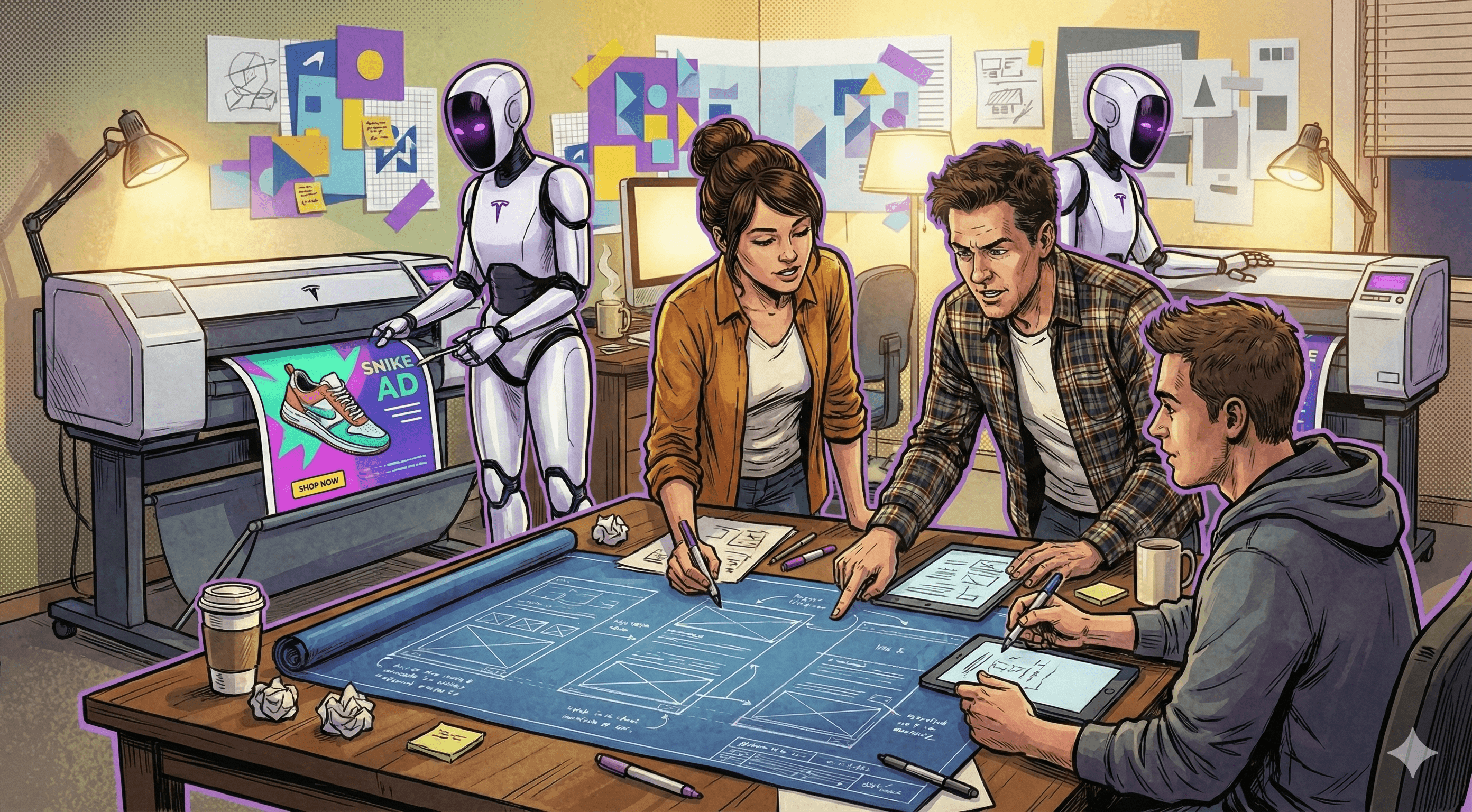
“Exactly, that's exactly the point because you do want human oversight and creativity and innovation involved, both from the customer side as well as Rocketium’s side. But if the whole process is so manual that every request of yours, somebody has to behind the scenes sit and execute that, you're not really getting leverage for the human potential that we have.”
The analogy Satej uses is cars: you should be able to drive when you want, but you should not have to manage carburetors every day just to get to work.
“you should have the control when you need it, but you shouldn't have to take control every single time. Right. The software should do your bidding rather than it being the other way around.”
Cam frames the mindset shift this way:
“Let AI handle all the production and repetitive tasks, and let humans focus on ideation, storytelling, strategy, and the creativity. I think when teams see AI as an accelerator and not a replacement, that adoption will really stick and people will be much more willing to embrace AI as an assistant to their day-to-day lives.”
Making the shift: how to actually start
The biggest risk is not the tech, it is trying to “AI everything” at once. Status quo is strong.
Satej’s advice is to start small and prove value:
“Pick a simple use case. Don't go too crazy. Don't try to do the most extreme, most elegant automated way of operations.”
A practical way to begin:
Pick one high-volume, low-risk workflow your team does every week.
Measure current time, cost, and rework.
Automate that single flow with agentic AI and humans in the loop.
If it works, move to the next slightly higher impact use case.
And be very clear on why you are doing this:
“There is always going to be good reasons for not changing something, right? But if you know why you're doing it, that's always a good starting point.”
Takeaways:
Start with one workflow, not a full reinvention of creative ops.
Measure before and after so you can defend the change internally.
Keep repeating the pattern: prove value, then expand.
Moving at the speed of AI
Models and capabilities are evolving at a pace that is hard even for software builders to track, let alone creative teams who also have to ship campaigns. Agentic platforms like Rocketium exist to absorb that complexity and give you something simple and useful back:
faster production cycles
more consistent brand output
less time on repetitive work
As Satej sums it up:
“So hopefully, whoever is listening to this and motivated enough to change their process can move at the speed of AI.”
If your team is staring at a wall of briefs, a tangle of tools, and a mandate to “do more with less,” agentic AI is not just a buzzword. It might be your next creative operations upgrade.
Watch the full webinar below: