Most brands producing at scale in 2026 are not short on creative ideas. They are short on the infrastructure to execute those ideas across 10+ ad platforms, 30+ formats, and dozens of markets - without the creative team breaking under the weight of it. That is the problem creative automation is supposed to solve. The question is which tool actually solves it.
This list covers seven platforms evaluated against four criteria that matter to creative ops and performance marketing teams at consumer retail brands: brand compliance, channel compliance, ad production at scale, and creative workflow automation. We evaluated each tool on what it does well, where it falls short, and who it is actually built for.
What you will get: A direct comparison of seven tools, grounded in verified customer reviews and real outcome data. One of those tools is ours. We have tried to be honest about all of them.
What you will not get: vendor taglines passed off as analysis, unattributed statistics, or a sales pitch disguised as a buyer's guide.
Key takeawaysBefore the detail, here is the landscape at a glance. Four criteria drive the comparison:
|
|---|
Creative automation tools: A quick glance
Solution | Best for | Brand | Channel | Ad production | Workflow | Self- | Pricing model | Adoption Complexity |
|---|---|---|---|---|---|---|---|---|
Rocketium AI Studio Managed service | Retail brands $100M+ | ✓ | ✓ | ✓ | ✓ | ~ | Per credit | Low |
Celtra Enterprise CMP | Enterprise / agencies | ✓ | ✓ | ✓ | ✓ | ✓ | On request | High |
Smartly Paid social platform | High-spend Meta/TikTok | ~ | ✓ | ~ | ✓ | ✓ | % of ad spend | Very high |
Storyteq Campaign versioning | Mid-market / global campaigns | ✓ | ✓ | ✓ | ✓ | ✓ | €30K–180K/yr | Medium |
Bannerflow Display advertising | Global display campaigns | ~ | ~ | ✓ | ~ | ✓ | On request | Medium |
Bynder Studio DAM + production | Existing Bynder users | ✓ | ~ | ~ | ~ | ✓ | On request | Low–medium |
AdCreative.ai AI generation | SMB / rapid testing | ~ | ~ | ~ | ✕ | ✓ | From $21/mo | Low |
✓ Strong capability | ~ Partial/limited | ✕ Not designed for this
A few things stand out immediately. Rocketium AI Studio is the only tool in this list purpose-built for retail brands managing high-volume PDP and retail media production, with a managed service model that handles brand compliance, channel compliance, and production in a single brief-to-delivery workflow. Every other tool requires your team to operate the platform. That trade-off, control versus outcomes, is the most important decision you will make when evaluating this category.
The three tools with the steepest learning curves (Celtra, Smartly, Storyteq) are also the three that require the most implementation investment before they deliver value. That is not a reason to avoid them. It is a reason to budget for it honestly.
Top 7 creative automation tools in 2026
1. Rocketium AI Studio

Best for
Consumer retail brands at $100M+ revenue managing PDP production, retail media assets, and multi-market campaigns across Amazon, Walmart, Target, and other platforms.
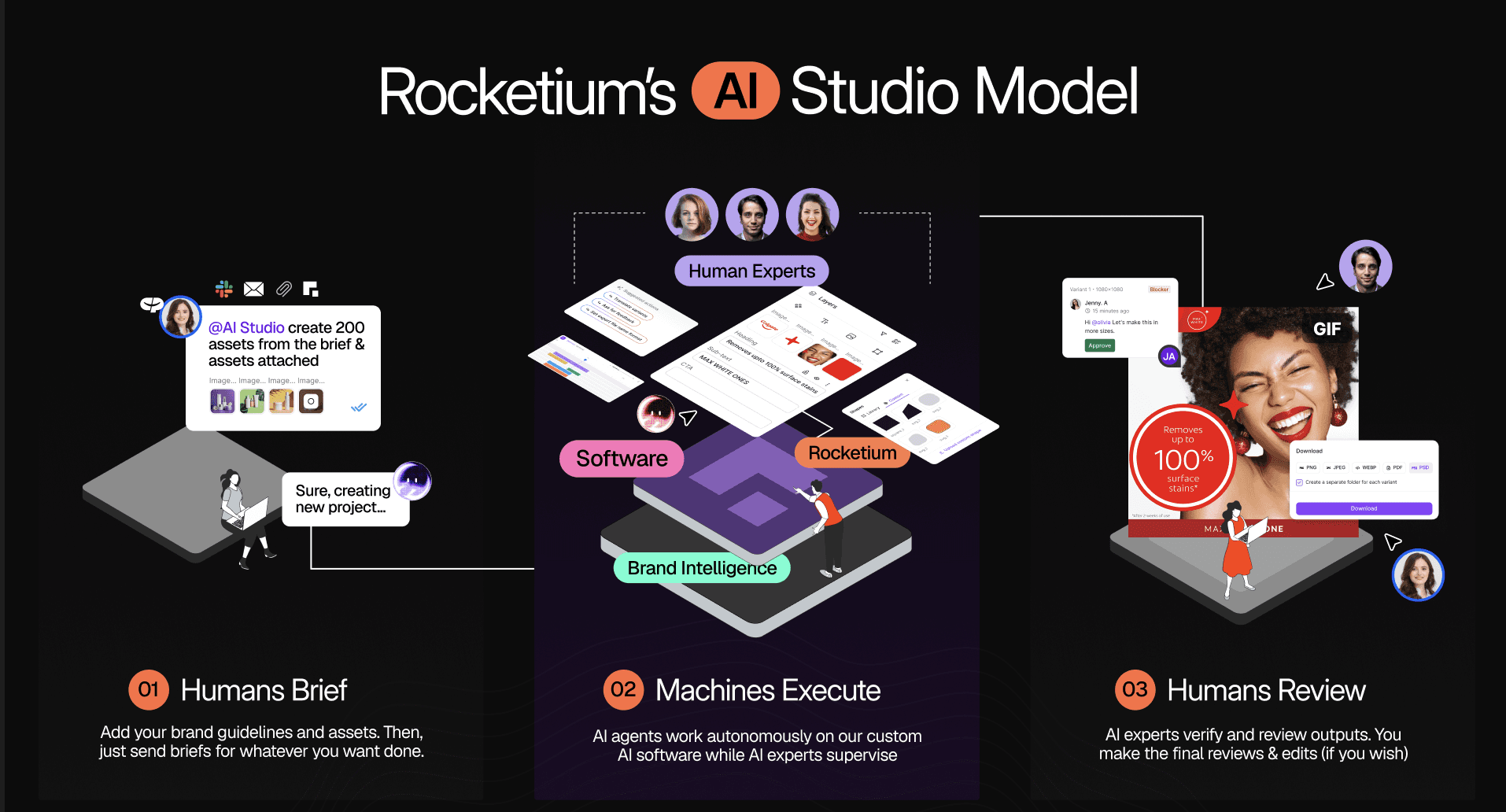
Rocketium AI Studio is a managed creative production service, not a self-serve platform. You submit a brief; a team of AI engineers, creative strategists, designers, and QA managers delivers production-ready assets using Rocketium's propitiatory AI software. That distinction matters. The bottleneck for most retail marketing teams is not access to a creative tool. It is the time and expertise required to run one.
AI Studio covers three types of work: Versioning (adapting a master design across sizes, formats, and markets), Production (creating net-new assets from a brief, including copy, imagery, and video), and Concepting (master designs, storyboards, and end-to-end video from scratch). Most tools in this category handle Versioning. Fewer handle Production well. Almost none handle Concepting.
Brand compliance
Brand compliance is built into the brief intake, not bolted on at the end. Every asset is scored against brand and platform guidelines before it reaches the customer. Ferrero received 22 studio-quality assets in under one day with zero back-and-forth. That outcome reflects a compliance-first production model, not a post-production review layer.
Channel compliance
Platform specs for Amazon, Walmart, Target, and 14+ other retail media networks are pre-configured into the production workflow. Nivea went from manual rework across 14 platforms to a single briefing process, cutting delivery time in half and reducing platform rejections by 98%. The comparison is direct: their media agency had been manually redoing designs for each platform's requirements.
Ad production at scale
12 Amazon teams produce 250,000 assets per year through AI Studio. Samsung went from brief to 500 approved assets in one hour. MegaFood created and approved 1,100 PDP assets in under four weeks - a job that had taken a freelancer eight months at $150 per hour. At $15-25 per credit (one static asset = one credit, one video over 15 seconds = two credits), 20 adaptations cost $300-500. A typical agency charges $1,000-4,000 for the same output.
Creative workflow automation
The workflow is a brief upload. That is the entire interface for the customer. The pilot process takes roughly 40 minutes of customer time and returns first results in 24-48 hours. AI Studio then handles the production pipeline: AI context creation, multi-LLM generation, brand and platform scoring, human QA, and delivery. Colgate's seven country teams replaced multiple transcreation agencies and received transcreated and adapted assets in under two days per market.
The honest trade-off
AI Studio is a managed service, not a self-serve platform. While Rocketium operates a robust design editor at its core, giving users the ability to jump in and make last minute creative changes at scale, Rocketium’s Agentic AI model was built to eliminate the friction typically associated with onboarding and learning yet another new tool. The trade-off is intentional: the managed model is what produces 98% platform compliance rates and studio-quality output at scale. However, if internal control over the design tool itself matters more to your team than outcomes, factor that in.
Pricing
$50K annual platform fee. Credits included. $15-25 per additional credit. End-to-end video runs 20-60 credits versus $1,500-3,000 at an agency. Savings over agencies typically run 30-70%.
2. Celtra

Best for
Enterprise brands with large in-house creative teams running high-volume ad campaigns across display, social, and video who need strong brand governance and predictive performance scoring.
Celtra is the most established creative automation platform in this category. Spotify, Adidas, Unilever, and Hearst are among its 400+ enterprise customers. It produces over 5 million creative assets annually and serves over 120 billion ad impressions. McDonald's Nordics achieved 12.8x greater production efficiency using Celtra's centralized creative supply system, averaging 36 seconds per ad creative produced.
Brand compliance
Brand compliance capabilities are a real strength for Celtra. Modular templates with locked brand elements, centralized asset libraries, and role-based workspaces mean market teams can localize within guardrails without going off-brand. Enterprise GenAI with brand governance generates scalable, media-ready variations within structured design systems. Users on G2 consistently cite brand compliance at scale as the platform's standout feature.
Channel compliance
Celtra supports 100+ demand-side and supply-side platforms. Automation ensures assets are built to exact placement specifications without manual resizing. The platform also includes predictive performance scoring before launch, which helps surface assets that are not just brand-compliant but likely to perform.
Ad production at scale
Celtra's production scale is genuine. Thousands of assets across multiple markets, languages, and formats from a single template set. The constraint is setup: teams without strong creative operations infrastructure in place typically face a steep initial onboarding curve before production velocity picks up.
Creative workflow automation
Agentic workflows link creative generation, approvals, media activation, and performance tracking in one governed system. Collaboration tools, approval routing, and version control are reliable. Where workflow automation breaks down: when content feeds grow large, some users report page crashes and content displacement issues during high-volume production sessions.
The honest trade-off
The learning curve is consistently cited across G2, Capterra, and SoftwareReviews. Non-designers report a slow ramp before independent production is possible. Pricing is enterprise-only and available on request, which signals contracts typically starting in the tens of thousands annually. Celtra also has no API available, which limits integration depth for teams wanting to connect it to broader martech infrastructure.
Pricing
On request. Enterprise contracts. Best fit for teams spending significantly on creative operations already.
3. Smartly

Best for
Enterprise brands spending $50,000+ per month on Meta and TikTok who want creative automation tightly integrated with campaign management and media buying in a single platform.
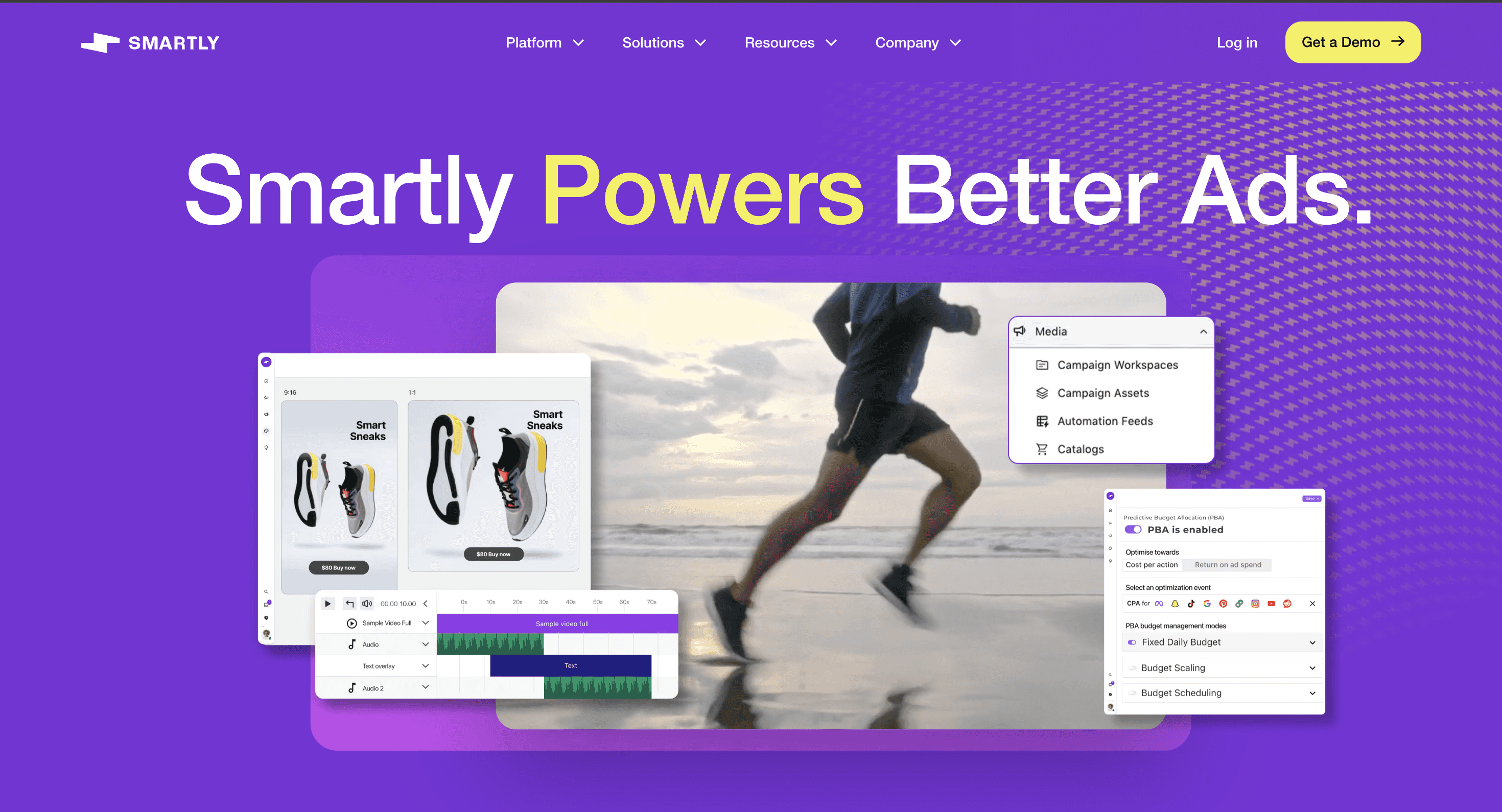
Smartly manages nearly $5 billion in ad spend for 700+ brands including Walmart, L'Oreal, Nestle, and Disney/ESPN. It is, first and foremost, a paid social campaign management platform. Creative automation is one module within a broader media execution system. That framing matters: Smartly solves a different core problem than the other tools in this list.
Brand compliance
Smartly's brand governance lives at the template level. Templates enforce brand assets across platform-specific ad formats. The limitation, noted by third-party analysis, is that fine-grained brand guideline governance across all content types is not its primary role. It is built for ads, not brand content broadly, and the controls reflect that scope.
Channel compliance
This is a genuine strength. Native integrations with Meta, TikTok, Pinterest, Snapchat, Google, and Reddit mean assets are built for platform-specific requirements from the start. AI Studio within Smartly has generated 1.9 million creative assets across 260+ customers with a reported 30x faster creative process. A multi-location franchise with nearly 100 locations uses Smartly to localize and launch national campaigns in minutes rather than weeks.
Ad production at scale
Dynamic creative automation generates thousands of ad variations from product catalog data automatically. For retail brands running DPA campaigns on Meta, the production pipeline is well-suited. The constraint is that production is optimized for performance ad templates, not studio-quality brand content. Assets produced at speed in Smartly look like performance ads because they are engineered to be.
Creative workflow automation
Smartly's workflow automation covers campaign setup, bidding, budget management, and creative rotation - all connected. Users report a 30% reduction in campaign management time. The workflow integration between creative and media buying is the platform's clearest differentiator. The cost of that integration is complexity: G2 reviewers consistently describe months of onboarding before advanced features become accessible.
The honest trade-off
Pricing is percentage-of-ad-spend based, starting in the thousands per month. Below $50K/month in social spend, the platform fee typically does not produce positive ROI relative to manual management. The learning curve is one of the steepest in this category. Support is sometimes cited as a weak point. And automation features across channels beyond Meta and TikTok are, per G2 reviewers, "not quite 100% yet."
Pricing
Percentage of managed ad spend. Enterprise-only. Not viable for brands below significant Meta/TikTok spend thresholds.
4. Storyteq

Best for
Mid-to-large brands in retail, automotive, and entertainment that need to version and localize campaigns across markets, with strong video template capabilities and structured approval workflows.
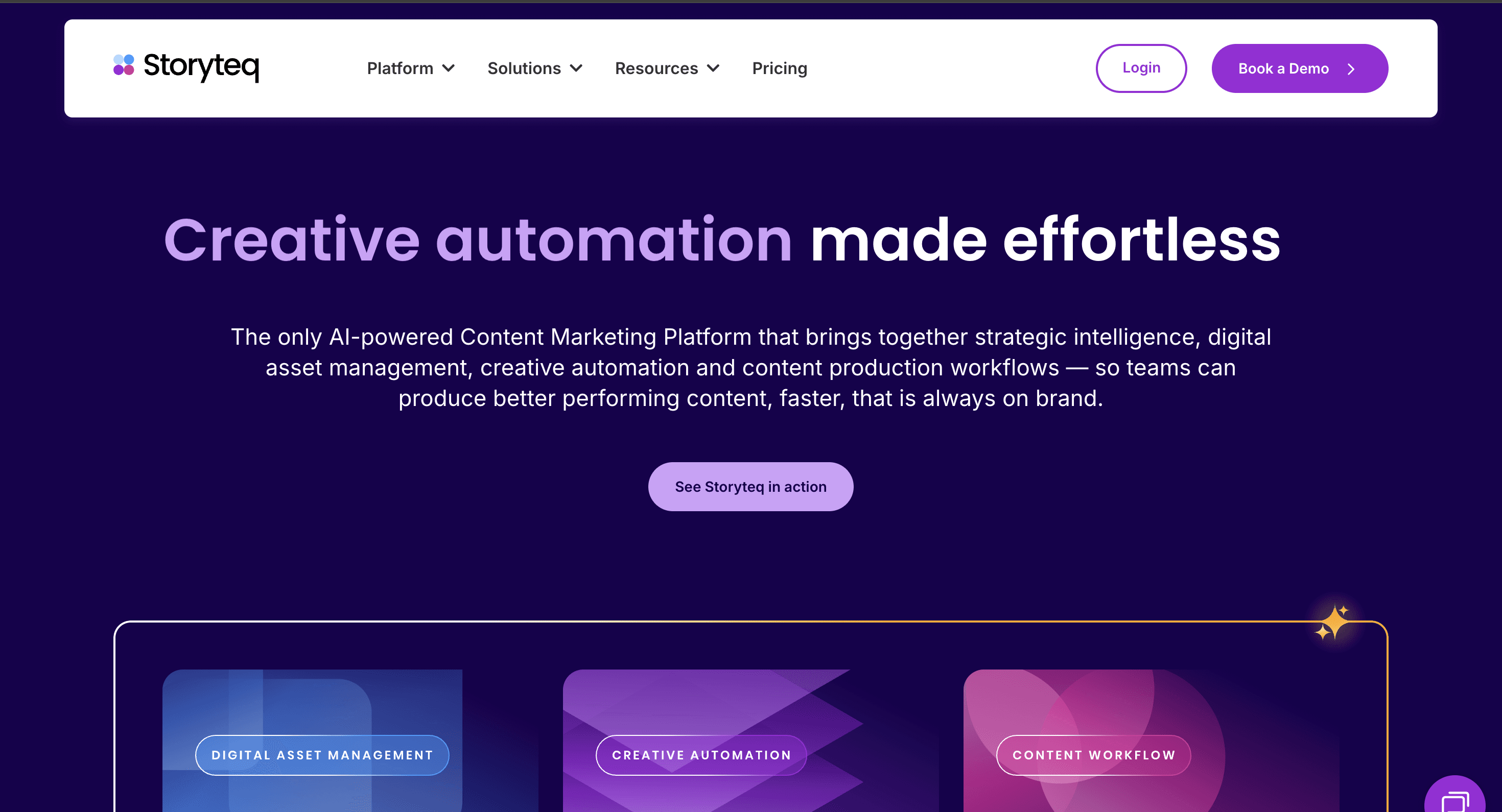
Storyteq has three connected modules: Content Portal (find, organize, track), Adaptation Studio (version content for every channel and format), and Collaboration Hub (briefs, reviews, and approvals in one place). The pricing model is published: €30,000-180,000 per year depending on scale, which makes budget planning more straightforward than most enterprise platforms in this list.
Brand compliance
Storyteq embeds brand rules directly into templates. Locked elements (logo placement, brand colors, typography) cannot be altered during customization by market teams. Approval workflows route content to designated reviewers before finalization, catching brand violations before assets go live. Gartner Peer Insights reviewers describe the templating feature as "highly flexible allowing us to adhere to brand guidelines while producing variations for different markets."
Channel compliance
Assets are automatically adapted for correct formats across channels and markets. The platform supports video (MP4, MOV), digital banners (HTML5), statics (JPG, PNG), and print assets (PDF). Direct connections to social platforms allow fast deployment once assets are approved. Real-time preview across all formats and channels saves manual resizing time.
Ad production at scale
Storyteq is built for campaign rollout across global markets. Large campaigns for international accounts across 30+ markets are a documented use case. The constraint: initial template setup requires significant effort and close collaboration with Storyteq's onboarding team. Once live, production throughput is high. Getting there takes longer than buyers often expect.
Creative workflow automation
The Collaboration Hub and approval workflows are among Storyteq's most praised features. G2 reviewers describe approval workflows and version control as "very reliable." The integration with DAMs (Bynder, Adobe, Google Drive) and After Effects reduces friction for creative teams already using those tools.
The honest trade-off
Template library depth is a documented gap. Users report the available templates feel limiting, and managing a growing library creates performance issues - the editor becomes sluggish with large asset libraries, per multiple G2 reviewers. Poor customer support and integration issues are the most frequently cited negative themes on G2. Storyteq is a growing company; product maturity still lags behind Celtra and Rocketium for the most complex enterprise retail production use cases.
Pricing
€30,000-180,000 per year. Transparent published pricing is a genuine differentiator in this category.
5. Bannerflow

Best for
In-house marketing teams at multi-national brands running global display advertising campaigns who want to produce, publish, and manage HTML5 banners across 100+ ad networks from a single platform.
Bannerflow is purpose-built for display. Its production studio is strong enough that many designers prefer it to Adobe for banner creation. Publishing to 100+ networks from one interface reduces meaningful manual work for teams running localized display campaigns across European or global markets.
Brand compliance
Brand compliance in Bannerflow operates at the template level. Brand elements can be locked within templates, and team members work from a shared asset library. The constraint: template depth is a consistent user complaint on G2. Available templates feel limiting, and advanced customization requires design skills that not every marketing team member has. This means self-serve brand compliance depends on design resources being available.
Channel compliance
For display specifically, Bannerflow's multi-network publishing infrastructure handles channel-specific specs efficiently. The platform does not cover retail media networks (Amazon, Walmart) - it is built for display and programmatic, not PDP or retail platform content.
Ad production at scale
Bannerflow's production model is self-serve template-based production at scale. The production speed increase is genuine for display-focused teams. The ceiling is the template library: limited template variety means heavy-volume production can feel repetitive for teams needing highly differentiated creative across SKUs.
Creative workflow automation
Built-in approval workflows, version control, and live-feed integration for dynamic content updates are among Bannerflow's genuine strengths. Multiple users cite the support team as a standout positive. Where workflow automation breaks down: missing API connectivity is a flagged gap for larger teams moving toward automation-first operations. Enterprise teams needing to connect Bannerflow to broader martech infrastructure will find the absence of a native API limiting.
The honest trade-off
No API is available, which is a barrier for automation-first workflows at enterprise scale. Template availability is limited compared to the breadth users need for high-volume varied production. Occasional browser compatibility differences between Chrome and Safari create inconsistencies in how assets render during production.
Pricing
On request. Estimated $500/month for SMB, scaling significantly for enterprise.
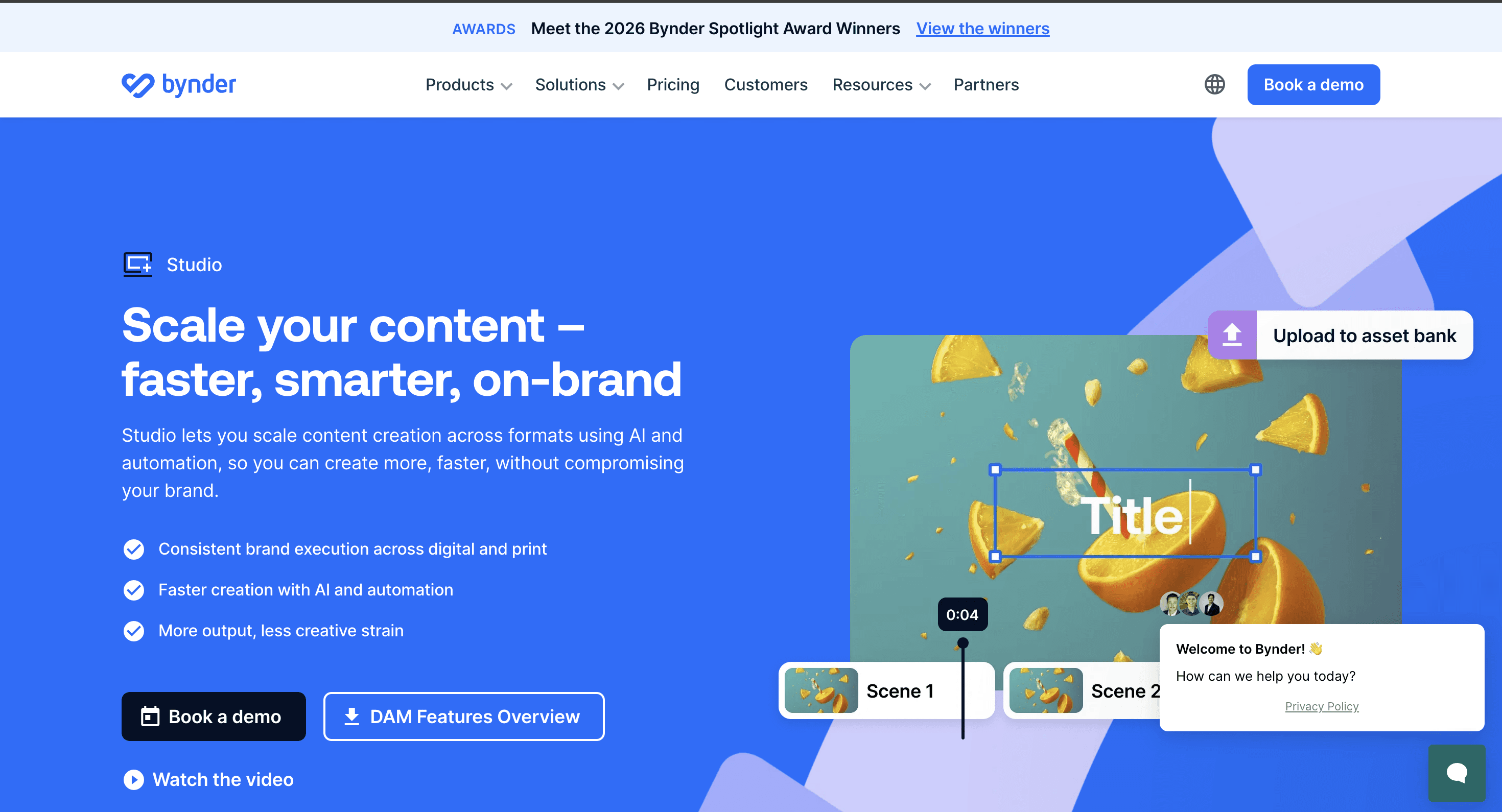
6. Bynder Studio

Best for
Teams already using Bynder as their digital asset management platform who want to add creative production without switching systems.
Bynder was named a Customer Favorite in the Forrester Wave DAM Systems Q1 2026 report. Studio is its creative automation layer: built to turn the DAM into a production hub. If your team already lives in Bynder, Studio is a natural extension. If you do not already use Bynder as your DAM, adopting it primarily for creative production means paying for infrastructure you may not need.
Brand compliance
The DAM-plus-production model creates a natural compliance environment. Brand guidelines, approved assets, and templates live in the same system. Designers create templates; marketing teams execute within them. Brand drift is reduced because the source of truth for assets and guidelines is the same platform used for production.
Channel compliance
Studio handles AI-assisted resizing and preset-based adaptation for digital formats. It imports existing designs and applies automation to reduce repetitive resizing tasks. Channel compliance depth for retail media platforms is limited - Studio is designed for social and digital content, not the spec-heavy requirements of Amazon or Walmart PDP production.
Ad production at scale
For teams already managing large asset libraries in Bynder, Studio enables faster campaign refreshes and localization without exporting to external tools. The production ceiling is lower than purpose-built creative automation platforms. Studio is a production accelerator for existing Bynder users, not a high-volume production engine.
Creative workflow automation
The integration with existing DAM workflows is Studio's clearest advantage. Teams that have already built approval and versioning processes in Bynder can extend those processes into production without rebuilding. For teams without Bynder infrastructure, this advantage disappears.
The honest trade-off
Video production capability is limited compared to purpose-built platforms. Creative automation depth for concepting and net-new production lags behind Celtra, Storyteq, and Rocketium. Studio is a DAM add-on, not a production-first platform. Teams evaluating it primarily as a creative automation tool should benchmark its output against tools built specifically for that use case.
Pricing
On request, as part of Bynder DAM licensing.
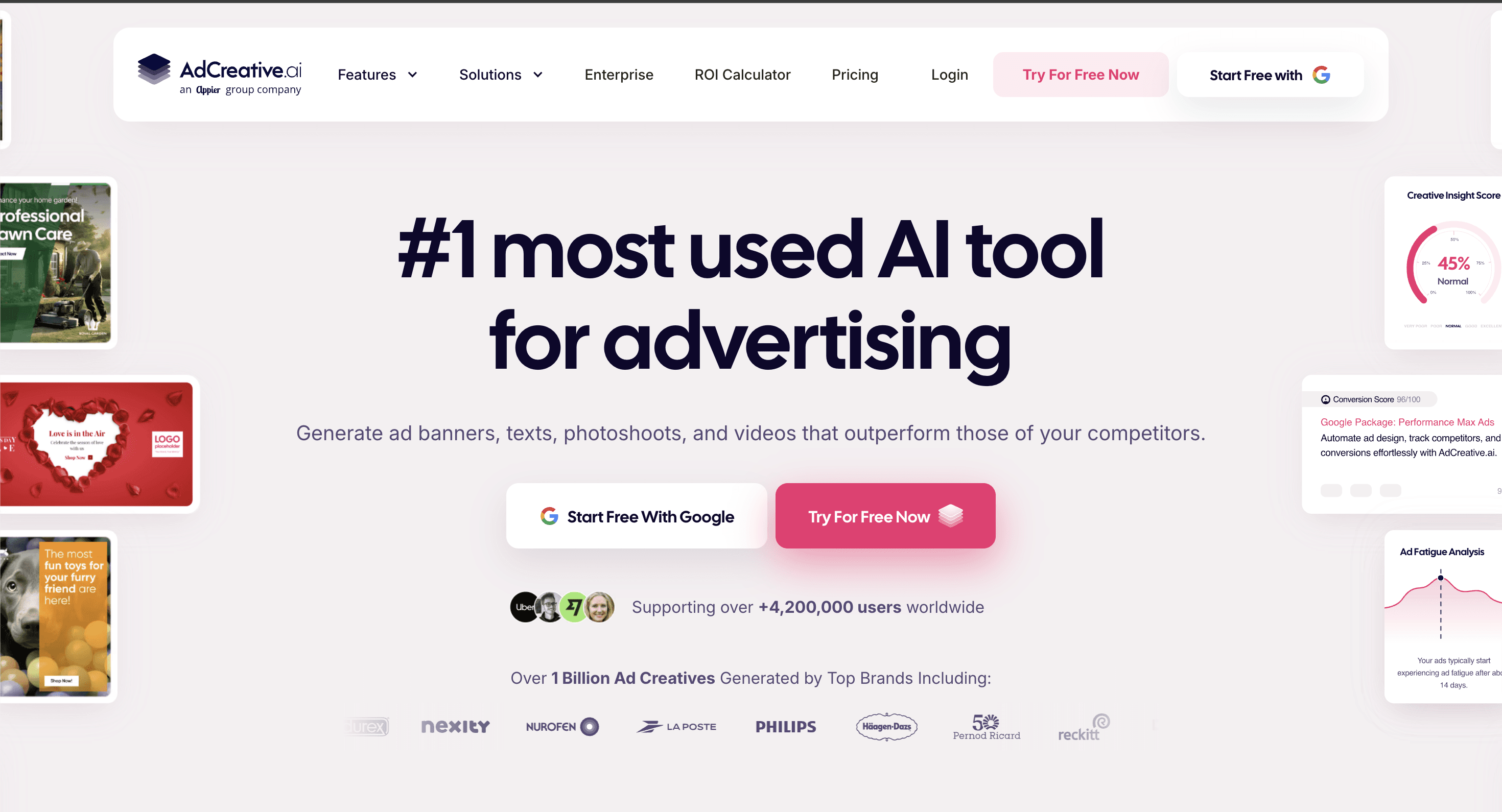
7. AdCreative.ai

Best for: Small teams and individual performance marketers who need to generate ad creative quickly for conversion testing on Meta and Google, without enterprise brand governance requirements.
AdCreative.ai (acquired by Appier Technologies in early 2025 for $38.7 million) serves over 4.2 million businesses. It is the fastest way to generate ad variants at volume. G2 recognized it as one of the three fastest-growing software products globally in 2024. That growth reflects genuine value for its core audience: growth-stage brands running direct-response campaigns on paid social.
Brand compliance
AdCreative.ai generates on-brand assets when given quality inputs: clean logos, clear color palettes, and well-structured brand briefs. The compliance mechanism is input-dependent, not governance-enforced. Multiple reviewers and independent testing note that AI-generated designs "may need some tweaking to align with your brand's aesthetics." Pixel-perfect brand compliance still requires a fair bit of human review and manual intervention before publishing.
Channel compliance
Ads are automatically sized and formatted for Meta, Instagram, Google, TikTok, and LinkedIn. Auto-scaling to platform specs is a documented strength. The platform added a compliance checker that flags creative against platform policies and brand guidelines. The constraint: TikTok workflow is limited compared to Meta and Google, which creates friction for teams where TikTok is a primary channel.
Ad production at scale
Generation speed is genuine. 20+ ad variants in under five minutes. 60+ creatives in the first 24 hours. For conversion-focused testing at modest budgets, this is the platform's core value. The ceiling for scale is quality consistency: production at high volume surfaces template repetition patterns. For enterprise retail brands needing differentiated creative across hundreds of SKUs, this limitation compounds quickly.
Creative workflow automation
AdCreative.ai automates generation and scoring. It does not automate the broader creative production workflow: briefing, approvals, localization, and channel distribution all require separate tooling. Multiple reviewers describe needing to combine AdCreative.ai with Canva (for finishing) and a separate distribution tool to cover the full workflow.
The honest trade-off
Post-generation editing is limited. Once assets are produced, meaningful structural adjustments require design tools outside the platform. Billing complaints are the most common negative theme across G2 and Trustpilot: unauthorized charges, complicated refund processes, and charges post-cancellation appear repeatedly in verified reviews. For enterprise retail brands with strict brand compliance requirements, AdCreative.ai is not the right tool. It is built for volume and speed, not governance.
Pricing
From $21/month (Starter) to custom enterprise plans. Credits do not roll over month to month.
How to choose a creative automation tool
The right tool depends on where your bottleneck sits.
Is it brand compliance across global markets?
Rocketium AI Studio (managed, retail-specific) or Celtra (self-serve enterprise, strong governance) are the strongest fits.
Is it channel compliance across retail platforms like Amazon and Walmart?
Rocketium is the only tool in this list built specifically for that requirement. Nivea's 98% reduction in platform rejections is the clearest benchmark available.
Is it ad production at scale across a large SKU catalog?
Rocketium (managed, 250,000 assets/year with 12 Amazon teams), Celtra (self-serve, 5M+ assets annually), or Smartly (for paid social DPA specifically).
Is it creative workflow automation for paid social campaign management?
Smartly, if your spend justifies the pricing model.
Is it localization and versioning across multiple markets?
Storyteq or Celtra for self-serve. Rocketium for managed services (Colgate: seven country teams, transcreated assets in under two days).
Is it fast creative testing at low cost?
AdCreative.ai for direct-response testing at modest budgets.
FAQ
What is creative automation?
Creative automation is a platform-driven or managed-service approach to asset production that uses templates, AI, and workflow tools to generate multiple creative variants from a master design or brief. For retail brands, this typically means one brief producing hundreds of SKU-specific assets across multiple platforms, in multiple formats, without manual production of each individual asset.
What is the difference between brand compliance and channel compliance in creative automation?
Brand compliance means assets meet your internal brand standards: correct logo placement, brand colors, typography, and messaging tone. Channel compliance means assets meet the external technical specifications of the platform they are destined for: correct dimensions, file sizes, safe zones, and creative policies for Amazon, Walmart, Meta, or any other distribution platform. Most tools handle one better than the other. Rocketium AI Studio handles both in the same production workflow, which is why Nivea's platform rejection rate dropped by 98%.
How much do creative automation tools cost?
Costs vary significantly. Rocketium AI Studio starts at $50K annually with credits at $15-25 each, saving 30-70% over agency rates. Storyteq publishes pricing at €30,000-180,000 per year. Celtra, Smartly, and Bannerflow are enterprise-only with pricing on request. AdCreative.ai starts at $21/month for small teams. The important comparison is not tool price in isolation but cost per approved asset at your required volume.
How long does it take to get started?
Rocketium AI Studio's pilot process takes roughly 40 minutes of customer time and returns first results in 24-48 hours. Enterprise self-serve platforms like Celtra, Smartly, and Storyteq typically require weeks to months of onboarding before teams are producing independently at full throughput.
Which creative automation tools are best for Amazon PDP content?
Rocketium AI Studio is the only platform in this list purpose-built for this use case. MegaFood used it to produce and approve 1,100 Amazon PDP assets in under four weeks at 40% lower cost than freelancers. Most tools in this category are built for display advertising or paid social, not the compliance-heavy, SKU-specific requirements of retail platform content.
Do creative automation tools work for video?
Yes, with significant variation in capability and cost. Rocketium AI Studio delivered high-conversion product videos for Alliance Pharma in under four days, saving 20% over other generative AI tools and 90% over agency rates. Storyteq has strong video versioning for campaign content. Celtra supports video at scale. Smartly generates video variants for paid social. AdCreative.ai handles basic video formats, but independent reviewers note quality consistency issues with AI video compared to its static image output.
What is the difference between a managed creative production service and a creative automation tool?
A creative automation tool gives your team software to operate. You set up templates, run production, manage approvals, and publish assets. A managed creative production service like Rocketium AI Studio handles the production pipeline for you. You submit a brief; production-ready assets come back. The managed model typically produces higher compliance rates and studio-quality output because it includes human QA and expert creative strategy. All while still leaving final control in the user’s hands to make any last minute adjustments.
If your team is evaluating Rocketium AI Studio, book a 15-minute call with a specialist. No deck. No pitch. A conversation about your production volume, platform requirements, and what good looks like for your brand. |
|---|