Creative production is where media budgets go to wait. Most performance teams at consumer brands have the spend, the strategy, and the brief. What they don't have is an asset pipeline that keeps up. Across 10+ ad platforms, 30+ formats, and dozens of retailer-specific specs, the creative queue is always the bottleneck.
This list covers seven creative automation tools evaluated against four criteria that matter to performance marketing and creative ops teams: brand compliance, retail platform channel compliance, ad production volume, and workflow automation. Each tool is assessed on what it does well, where it falls short, and who it is actually built for.
Key takeaways
|
|---|
Creative automation tools: A quick glance
Solution | Type | Best for | Brand compliance | Retail platform compliance | Pricing |
|---|---|---|---|---|---|
Rocketium AI Studio | Managed service | Consumer brands $100M+ | Strong | Strong (100+ platforms) | From $50K/year |
Celtra | Self-serve | Enterprise / agencies | Strong | None | On request |
Smartly | Self-serve + managed | High-spend paid social | Partial | None | % of ad spend |
Storyteq | Self-serve + managed | Mid-market global campaigns | Strong | None | From €30K/year |
Bannerflow | Self-serve | Global display campaigns | Partial | None | On request |
Bynder Studio | Self-serve | Existing Bynder users | Strong | Partial | Bundled with DAM |
AdCreative.ai | Self-serve | SMB / rapid testing | Partial | None | From $21/month |
Strong = purpose-built | Partial = limited or inconsistent | None = not designed for this
Top 7 creative automation tools in 2026
1. Rocketium AI Studio

Best for: Consumer brands at $100M+ revenue that need production-ready assets across PDP images, retail media, paid social, display, video, and multi-market campaigns, without building or managing the production infrastructure themselves.
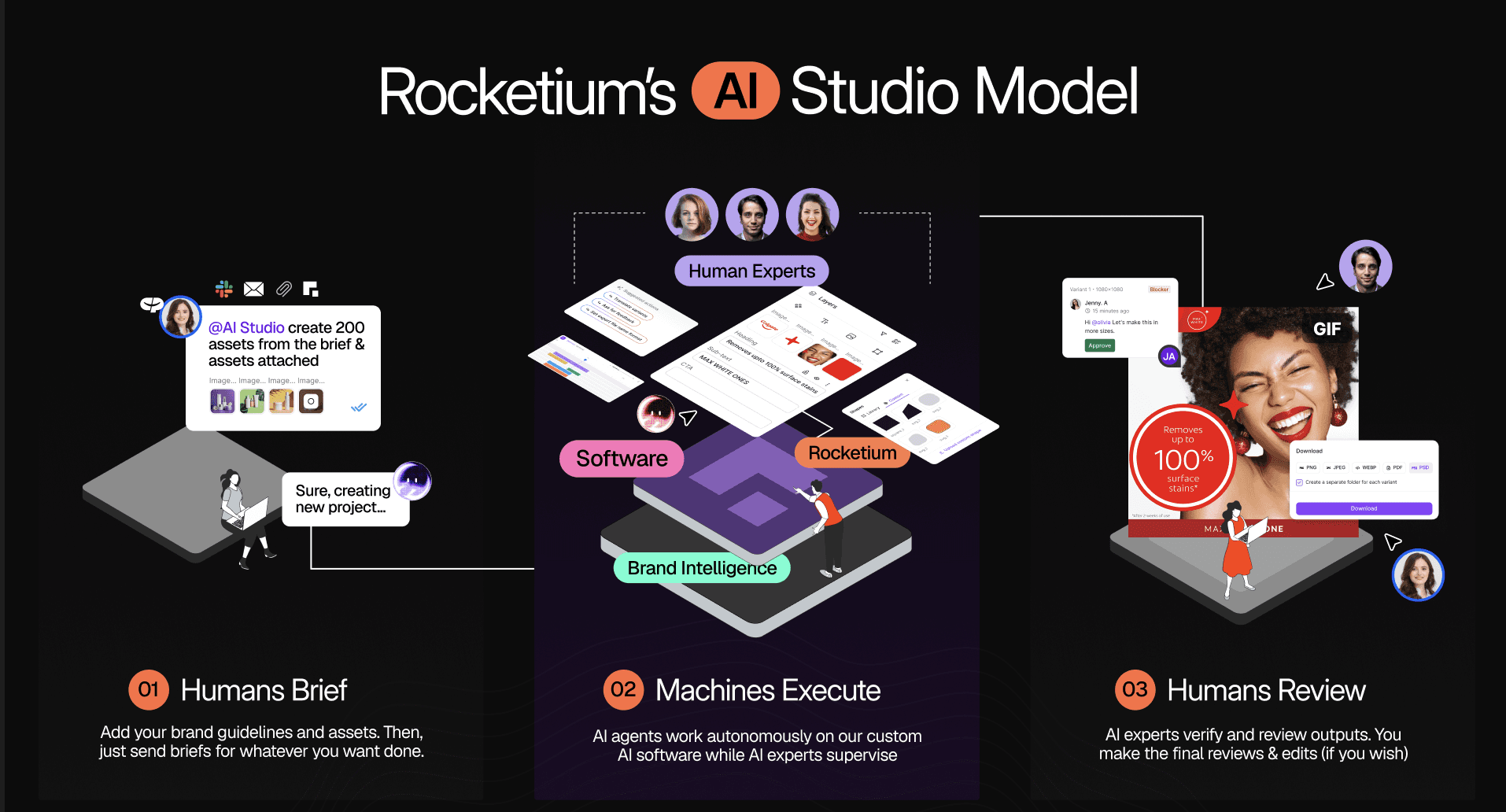
AI Studio is a managed creative production service. You submit a brief; a team of AI engineers, creative strategists, designers, and QA managers delivers finished assets using Rocketium's proprietary software and AI agents. The bottleneck for most marketing teams is not access to a creative tool. It is the time and expertise required to run one at volume across a dozen retailer specs and ad formats simultaneously.
AI Studio covers three types of work. Adaptation takes an approved master design and produces it across sizes, formats, and markets. Production creates net-new assets from a brief, including copy, translation, imagery, and video. Concepting handles master layouts, storyboards, and end-to-end video from scratch. Most tools in this category handle Adaptation. Fewer handle Production. Almost none handle Concepting.
Brand compliance is enforced at every production step, not reviewed at the end. Assets are scored against ingested brand guidelines and platform specs before they reach the customer. Ferrero received 22 studio-quality assets in under one day with zero back-and-forth. NIVEA launched campaigns across 14 platforms 2x faster with 98% fewer platform rejections. MegaFood created and approved 1,100 PDP assets in under four weeks. Freelancers had taken eight months at $150/hour for the same project.
The workflow for the customer is a brief. The pilot takes roughly 40 minutes of customer time and returns first results within 24-48 hours.
The honest trade-off: Teams that want to operate the design tool themselves, rather than submit a brief and receive production-ready assets, will find the model a different way of working. That said, customers retain full creative control throughout: every asset goes through your team's review and approval before export, and the platform is accessible for direct edits at any stage.
Pricing: $50K annual platform fee, 500 credits included. One static asset = one credit; one video over 15 seconds = two credits. Additional credits at $15-25 each. Savings over agencies typically run 30-70%.
2. Celtra

Best for: Enterprise creative teams at large consumer brands and agencies running high-volume digital ad campaigns across display, social, and video who need strong brand governance and want to operate the platform themselves.
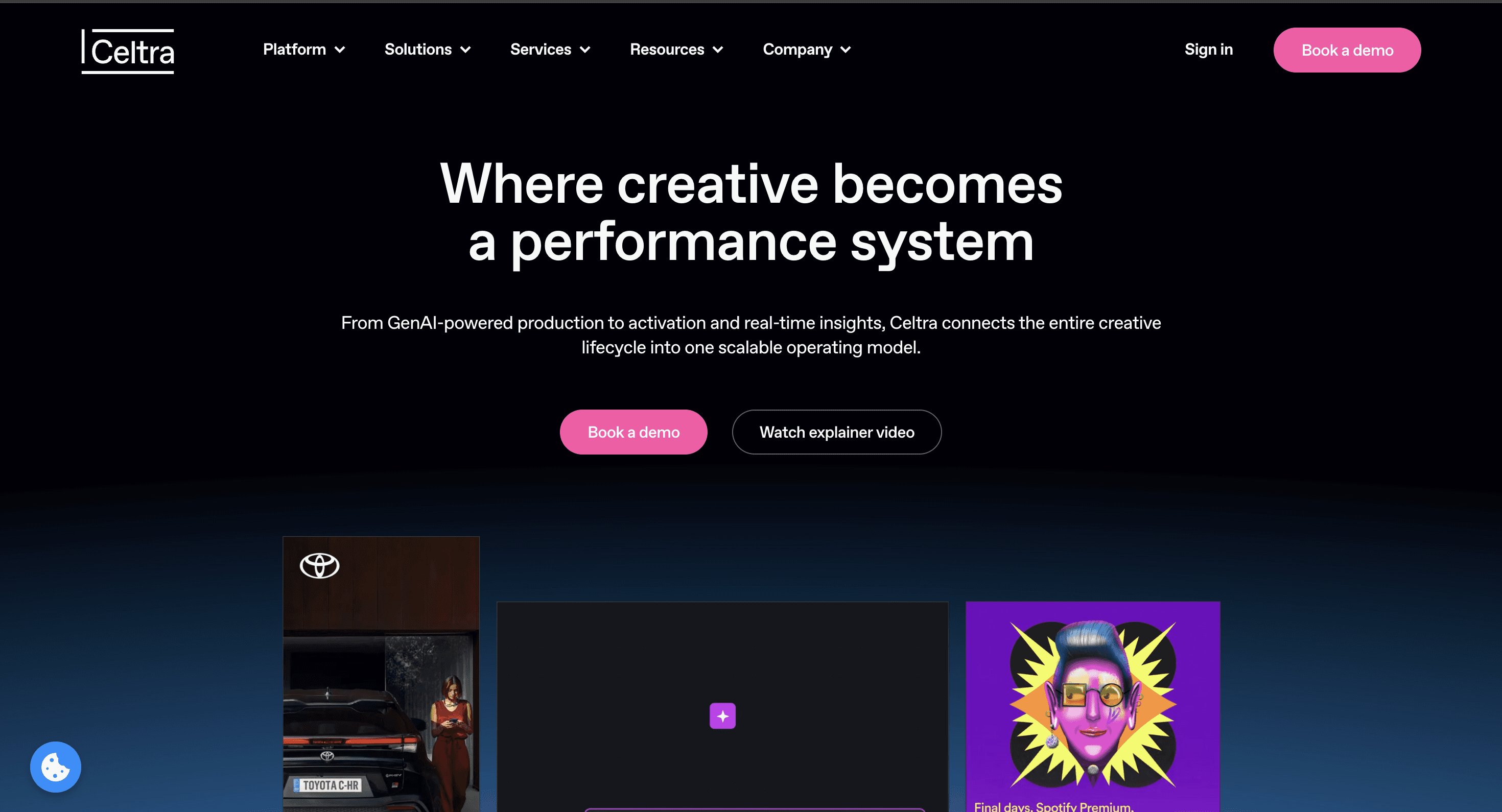
Celtra is the most established creative management platform in this category. It's rated 4.4/5 on G2 across 397 reviews and used by more than 400 enterprise customers including Spotify, Adidas, Unilever, Hearst, and Bloomberg. The platform produces over 5 million creative assets annually and serves more than 120 billion ad impressions each year. It won the Digiday Technology Award for Best Content Creation Platform in 2025.
Brand governance is a genuine strength. Modular templates with locked brand elements mean market teams can localize and adapt creative within guardrails without going off-brand. Celtra integrates with over 100 demand-side and supply-side platforms, and includes predictive performance scoring before launch. Siemens used Celtra Toolkits to produce over 13,000 creatives across global B2B campaigns, reaching 8.2x greater productivity.
The constraints are consistent across review platforms. Celtra is self-serve only. There is no managed production layer, no human QA on delivery. Setup and onboarding are flagged as time-consuming across G2, Capterra, and Gartner Peer Insights, particularly for teams without strong creative operations infrastructure already in place. Designer experience is still required for pixel-perfect output. No API is available, which limits integration depth with broader martech stacks. Pricing is chargeable per download, which affects cost predictability at high production volumes.
The honest trade-off: Celtra is built for digital ad formats, display, social, and video. It does not address the broader production pipeline that consumer retail brands manage, covering PDP images, retailer platform compliance, and transcreation across markets.
Pricing: Custom enterprise, on request. No published rate card. Consistently described as expensive for smaller teams across Capterra and G2.
3. Smartly

Best for: Enterprise brands managing $50,000+ in monthly paid social and streaming ad spend who want creative automation, media buying, and performance measurement inside a single platform.
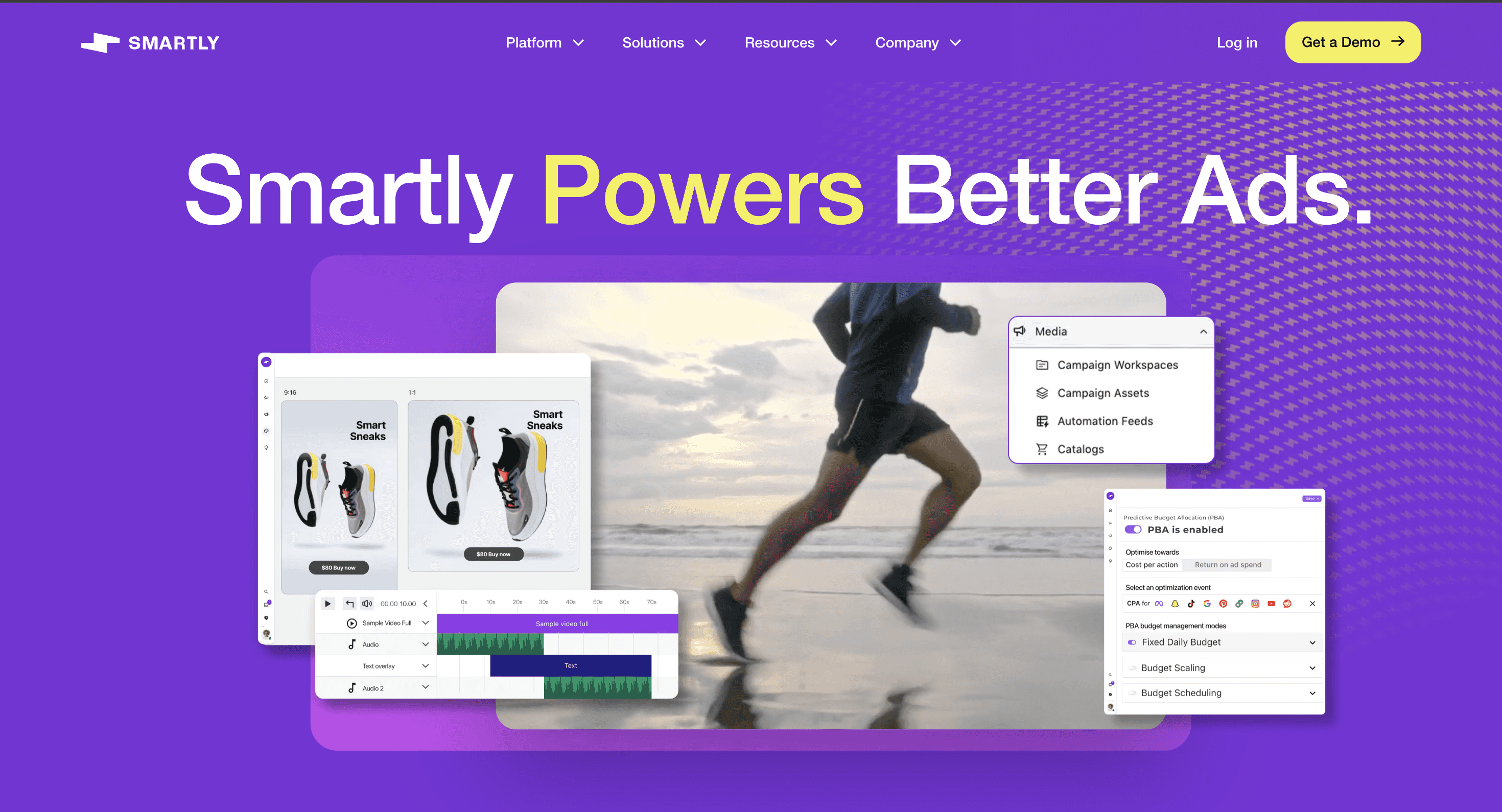
Smartly is rated 4.4/5 on G2 and manages over $6 billion in ad spend for 800+ brands including Walmart, L'Oreal, Gymshark, and Foot Locker. The platform structures itself around three integrated suites: Creative for production and scaling, Media for campaign management and optimization, and Intelligence for performance measurement. That integration is its clearest differentiator. Creative performance data flows directly into media decisions without manual transfers between tools.
The Creative Suite handles template-based production, product catalog integration, and format adaptation across Meta, TikTok, Pinterest, Snapchat, Google, and, since March 2026, Amazon DSP for CTV. Foot Locker refreshed over 10,000 product images in one click using AI. The Times tripled creative output without increasing team size. A PwC-validated study found campaign workflows ran 3.3x faster than native platform workflows.
The constraint is scope. Smartly is built for paid social and programmatic. PDP images, A+ content, and retailer-specific production for Amazon and Walmart are outside its design brief. Creative automation is also template-based at its core, which limits element-level performance intelligence and custom creative workflows. Chat support is consistently flagged as slow or unhelpful across G2 and Gartner Peer Insights, even as enterprise accounts with dedicated account managers tend to rate support highly.
The honest trade-off: pricing is percentage-of-ad-spend based, with reported minimums of $4,000-5,000 per month. For teams below significant spend thresholds, the cost structure does not produce positive ROI relative to simpler tools.
Pricing: Percentage of managed ad spend. Enterprise-only. No published rate card. Median annual spend cited in reviews is approximately $90,000.
4. Storyteq

Best for: Mid-to-large brands in retail, automotive, consumer goods, and entertainment managing campaign versioning and localization across multiple markets, with strong video template capabilities and structured approval workflows.
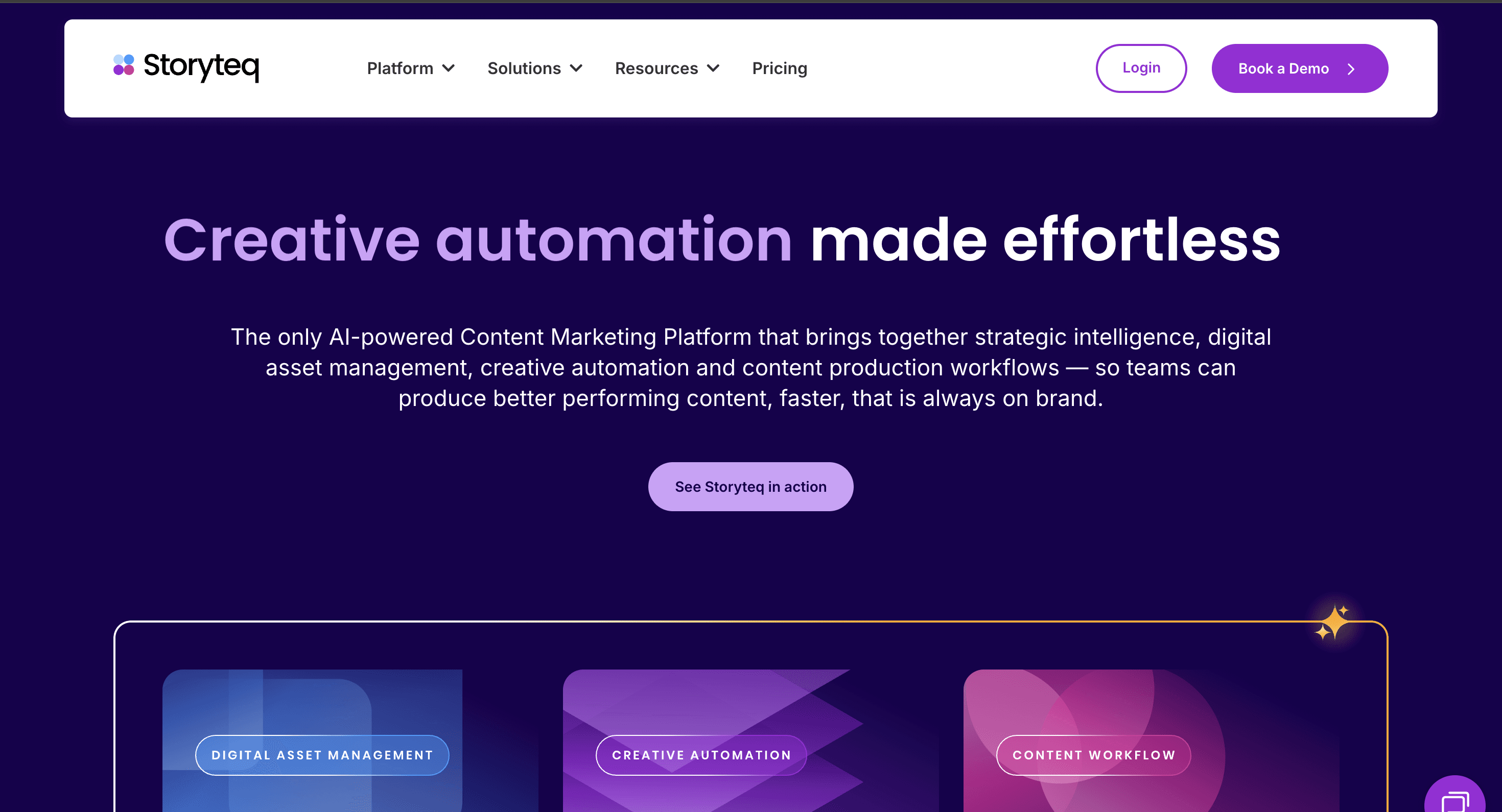
Storyteq is rated 4.6/5 on G2 across 281 reviews and has been named a Gartner Magic Quadrant Leader for Content Marketing Platforms for the fourth consecutive year in 2026. Customers include Heineken, Renault, Haleon, ASOS, and Mentos. The platform brings together three connected modules: a Content Portal for organizing and sharing brand-approved assets, an Adaptation Studio for versioning content across channels and formats, and a Collaboration Hub for briefs, reviews, and approvals. Renault used Storyteq to localize five core brands across 128 countries, resulting in a 36.7% increase in sales. Mentos localized assets across 150 markets without manual production work.
Brand compliance is enforced through locked template elements. Market teams can adapt copy, imagery, and layout within guardrails without altering core brand decisions. Approval workflows route content to designated reviewers before finalization. The platform supports MP4, ProRes, HTML5, JPEG, PNG, GIF, and PDF, giving it genuine versatility across digital and print formats.
The constraints are consistent across G2 and Gartner Peer Insights. Initial template setup requires significant effort and close collaboration with Storyteq's onboarding team before production throughput picks up. Editor performance degrades with large asset libraries. Poor customer support and integration issues are the most frequently cited negatives, appearing together across multiple G2 reviewers. Retailer compliance for Amazon and Walmart is not a built-in capability.
The honest trade-off: Storyteq is a strong fit for global campaign localization where the problem is versioning and market adaptation. If your production focus is retailer-specific compliance or net-new asset creation from a brief, it is not designed for that.
Pricing: Custom enterprise. One-time setup fee plus annual license. Starting around €30,000 per year, scaling to €180,000 depending on functionality and usage.
5. Bannerflow

Best for: In-house marketing teams at multi-national brands running omnichannel digital advertising campaigns who want to produce, publish, and manage ads across display, social, video, mobile, and digital out-of-home (DOOH) from a single platform.
Bannerflow holds a Gartner CMP Leader badge and is recognised by the Deloitte Tech 50. Customers include Virgin Voyages, SEGA, Meliá Hotels, Telia, and CMC Markets. The platform covers the full campaign lifecycle from creative production through to publishing and performance optimization. Dynamic creative optimization (DCO) connects live product data to ad variants automatically, and campaigns can be updated across live placements without rebuilding or republishing. CMC Markets cut production time and increased conversions by 23% using Bannerflow's real-time campaign management. Virgin Voyages credited it with their highest-performing Black Friday campaign.
Brand compliance operates at the template level. Locked brand elements and AI-powered localization let market teams adapt copy and imagery within guardrails. Customer support is consistently praised across G2 and Capterra, with reviewers describing the team as responsive, helpful, and proactive, which stands out in a category where support quality is frequently cited as a weakness.
Two constraints appear consistently across reviews. No API is available, which multiple reviewers flag as a barrier for automation-first operations at enterprise scale. Template variety is limited compared to what high-volume teams need, and this ceiling becomes apparent when producing differentiated creative across large SKU catalogs. Retailer-specific compliance for Amazon and Walmart PDP production is not a design goal for the platform.
The honest trade-off: Bannerflow is strong for omnichannel display and digital advertising at scale. Teams that need retailer platform compliance or net-new asset production from a brief will find it outside scope.
Pricing: Custom enterprise, on request. Estimated from $500 per month for smaller teams, scaling significantly for enterprise accounts.
6. Bynder Studio

Best for: Teams already using Bynder as their digital asset management (DAM) platform who want to add template-based creative production without switching systems or rebuilding approval workflows.
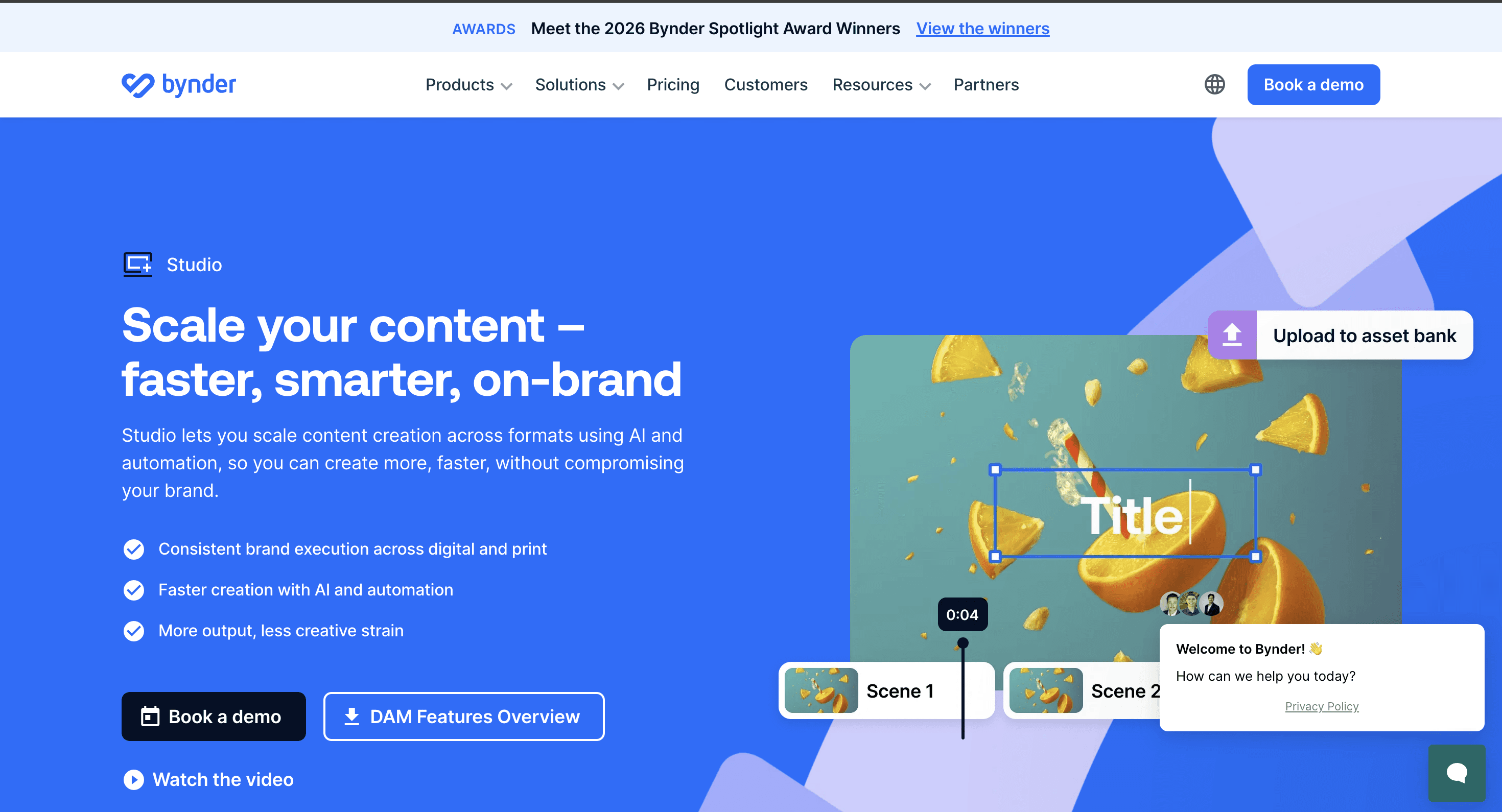
Bynder is rated 4.4/5 on G2 and is trusted by 4,000+ brands including Puma, Spotify, TED, and Five Guys. It was named a Customer Favorite in the Forrester Wave DAM Systems Q1 2026 report and a Leader in the Gartner Magic Quadrant for Digital Asset Management. Studio is Bynder's creative automation add-on, built to extend the DAM into a production environment. It supports AI-powered content scaling, designer-approved templates, automated resizing, localization via AI translation, and Figma imports. The integration advantage is genuine: brand guidelines, approved assets, and templates all live in the same system teams already use for storage and distribution. Schroders used Bynder to win the Best Use of Social Media award at the Investment and Marketing Innovation Awards, citing the platform's improvement to their creative production process.
Studio comes in two tiers. Basic covers core creative automation. Advanced adds AI-generated variations, batch creation, and advanced user permissioning. The full platform connects to 145+ integrations including Adobe Creative Cloud, Salesforce, CMS platforms, and PIM systems.
The constraints matter for the right buyer evaluation. Studio is a DAM add-on, not a standalone production platform. If your team does not already run Bynder, adopting it for creative automation alone means a first-year investment of $55,000-$165,000 including implementation, which needs to be weighed against tools purpose-built for production. Channel compliance for Amazon and Walmart PDP production is not in scope. Performance also slows with very large asset libraries, flagged consistently across G2 and Gartner Peer Insights.
The honest trade-off: for existing Bynder customers, Studio is a logical and low-friction extension. For everyone else, the case for adopting the full DAM ecosystem to access the creative automation layer needs careful cost justification.
Pricing: Custom enterprise, on request. Verified transaction data shows $12,160-$78,893 annually, with implementation costs of $25,000-$70,000 additional in year one.
7. AdCreative.ai

Best for: Small teams, agencies, and e-commerce brands that need to generate high volumes of static ad variants quickly for conversion testing on Meta and Google, without enterprise brand governance requirements.
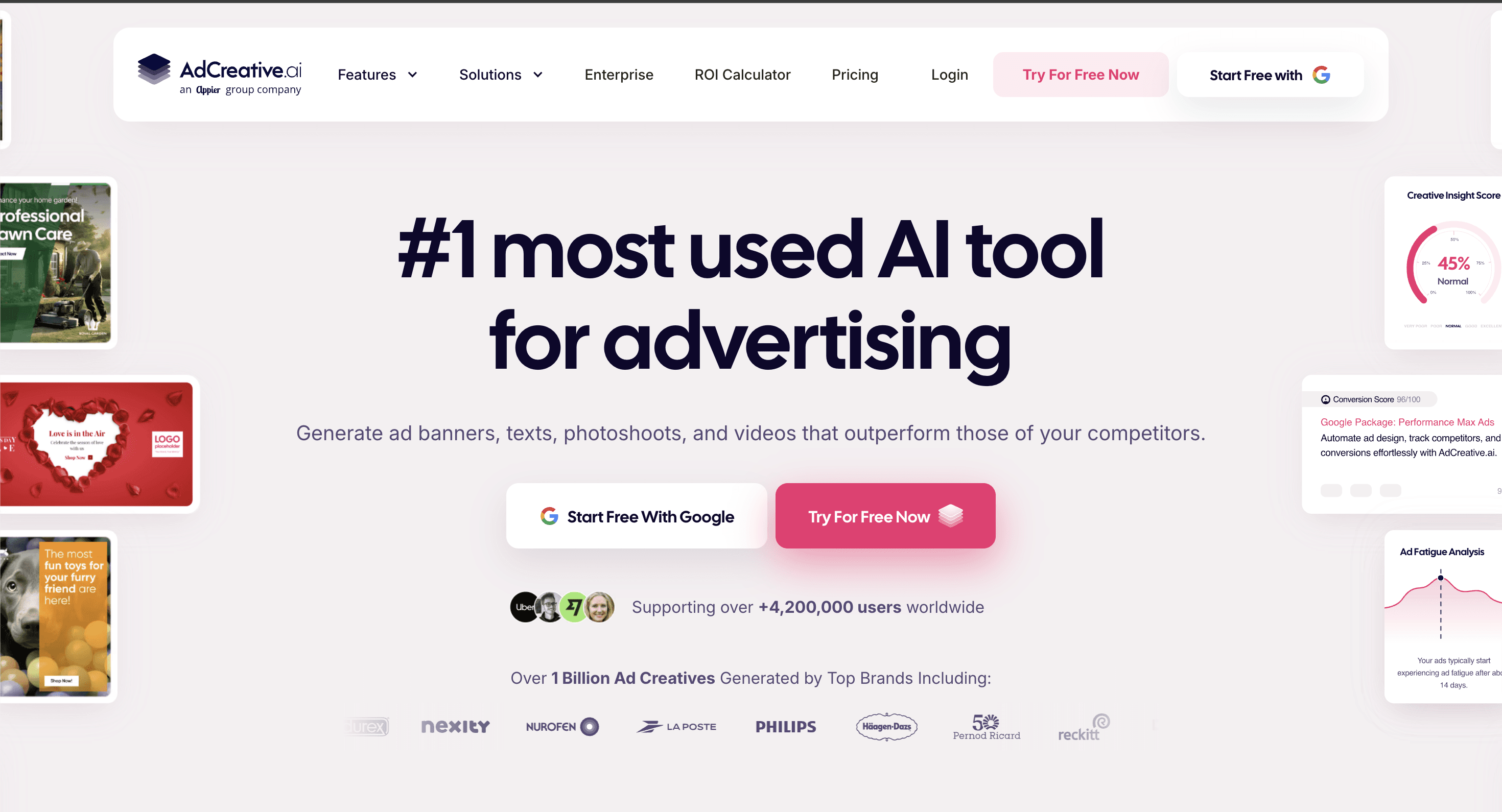
AdCreative.ai serves over 2 million users and is positioned as one of the fastest routes to high-volume ad variant generation in this category. The platform generates 20+ ad variants in under five minutes, connects directly to Facebook Ads Manager and Google Ads for one-click deployment, and stores brand guidelines including colors, fonts, and logos so new ads are produced in consistent brand style automatically. A Creative Scoring feature claims 90%+ accuracy in predicting which variants will perform best before launch. Access to 100M+ stock images from iStock, Pexels, and Unsplash is built in. For growth-stage brands running direct-response campaigns at modest budgets, the speed and price point are genuinely competitive.
The constraints are consistent and specific across G2 and Capterra. Output quality is variable: some reviewers describe only around 30% of generated ads as usable without further editing, and post-generation customization requires external design tools. Mobile ad sizes are not supported on lower-tier plans. Direct TikTok API integration is not available. Template variety is limited, and quality consistency degrades when producing differentiated creative across large SKU catalogs.
Billing complaints are the most documented negative theme across G2, Capterra, and Trustpilot. Unexpected charges after free trials, difficulty cancelling subscriptions, and refusal of refunds appear repeatedly in verified reviews. These are worth understanding before committing.
The honest trade-off: AdCreative.ai is a strong fit for fast, low-cost ad variant testing on Meta and Google. It is not built for enterprise brand governance, retailer platform compliance, or high-volume production across complex catalogs.
Pricing: From $39/month (Starter, 10 credits). Professional at $249/month, Ultimate at $599/month. Credits do not roll over month to month.
How to choose the right creative automation tool
The right tool depends on where your actual bottleneck sits. Most teams evaluate creative automation tools on features. The more useful question is: what does your team need to stop doing manually, and who handles the production work once you sign?
If your problem is retailer platform compliance across Amazon, Walmart, and Target, AI Studio is the only tool in this list built specifically for that. NIVEA cut platform rejections by 98% after switching from a manual multi-platform workflow. No other tool here pre-configures retailer-specific specs into production.
If your problem is brand governance at scale with self-serve control, Celtra (4.4/5 on G2) or Storyteq (4.6/5 on G2, four-time Gartner Magic Quadrant Leader) are the strongest options. Celtra suits teams focused on digital advertising formats. Storyteq suits teams managing multi-market campaign localization.
If your problem is paid social at high media spend, Smartly, provided your monthly Meta and TikTok spend justifies a percentage-of-spend pricing model. The platform is designed for advertisers spending $50,000+ per month across paid social and is expanding into CTV via Amazon DSP.
If your problem is omnichannel display advertising, Bannerflow for teams running global campaigns across display, social, video, and DOOH from one platform. Strong on channel reach and support quality. No retailer platform coverage.
If you already run Bynder as your DAM, Bynder Studio is a logical extension. If not, the first-year investment of $55,000-$165,000 including implementation needs to be weighed against purpose-built production tools.
If your problem is fast direct-response creative testing at low cost, AdCreative.ai for Meta and Google testing at SMB budgets. Understand the billing terms before committing.
Conclusion
Most tools in this list solve a real problem. Just not necessarily yours.
Paid social automation, display banner production, and DAM-integrated production all have their place in a well-run marketing operation. They are not the same as retailer-compliant, brand-governed creative production at the volume consumer brands actually need across Amazon, Walmart, and retail media networks.
The teams that produce more, faster are not the ones with the biggest creative departments. They are the ones that stopped treating production as a manual, agency-dependent process. MegaFood refreshed 1,100 PDP assets in under four weeks at 40% lower cost than freelancers who had taken eight months. NIVEA cut platform rejections by 98%. Samsung went from brief to 500 approved assets in one hour.
Those results come from a workflow built specifically for retail creative production. No agency cycle. No manual resizing. No waiting.
If you want to see what that looks like for your own catalog, book a 30-minute demo. Bring a brief you've already executed. We'll show you the output side by side with what your current process produces. No slides. No pitch deck. |
|---|
Frequently asked questions
What is creative automation?
Creative automation uses templates, AI, and workflow tools to produce multiple asset variants from a master design or brief without manually producing each individual asset. For consumer brands, this means one brief producing hundreds of SKU-specific assets across multiple platforms and formats. The category includes self-serve platforms your team operates and managed services that handle production for you, with the key difference being whether your team runs the tool or receives finished assets.
What is the difference between brand compliance and channel compliance in creative automation?
Brand compliance means assets meet your internal standards: correct logo placement, colors, typography, and required disclaimers. Channel compliance means assets meet the external technical specifications of the platform they are destined for, covering dimensions, file sizes, safe zones, and content policies for Amazon, Walmart, Meta, or any other platform. Most tools handle one well. AI Studio handles both in the same production workflow, which is why NIVEA's platform rejection rate dropped by 98%.
How much do creative automation tools cost?
Costs vary significantly across the category. AI Studio starts at $50K annually with credits at $15-25 each, delivering 30-70% savings over agency rates. Storyteq starts around €30,000 per year. Celtra and Smartly are enterprise-only with pricing on request. Bannerflow and Bynder Studio are also on request. AdCreative.ai starts at $39/month. The right comparison is not platform fee in isolation. It is cost per approved asset at your required volume and compliance standard.
How long does it take to get started?
AI Studio's pilot takes roughly 40 minutes of customer time and returns first results within 24-48 hours. Enterprise self-serve platforms including Celtra, Smartly, and Storyteq typically require weeks to months of onboarding before teams reach full production throughput. That gap matters when you're working against an active retailer deadline or a campaign launch window that won't move.
Which creative automation tools work for Amazon PDP content?
AI Studio is the only platform in this list purpose-built for this use case. MegaFood produced and approved 1,100 Amazon PDP assets in under four weeks at 40% lower cost than freelancers who had taken eight months at $150/hour for the same project. Most tools here are built for display advertising or paid social, not the compliance-heavy, SKU-specific requirements of retail platform content.
What is the difference between a managed creative production service and a self-serve creative automation platform?
A self-serve platform gives your team software to operate. You set up templates, run production, and manage approvals. A managed service like AI Studio handles the production pipeline for you. You submit a brief; production-ready assets come back. Your team retains full creative control throughout, reviewing and approving every asset before export. The managed model produces higher compliance rates and consistent quality because human QA is built into every delivery, not added as an optional step.